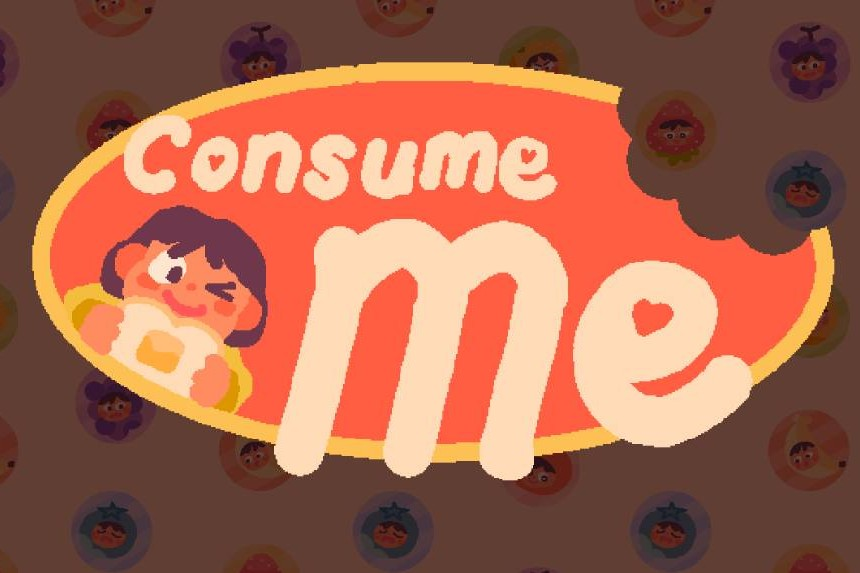

Developed/Published by: Jenny Jiao Hsia, AP Thomson, Jie En Lee, Violet W-P, Ken “coda” Snyder / Hexecutable
Released: 07/08/2025
Completed: 19/02/2026
Completion: Finished it, A++.
Hmm. You know, often with these essays I can tie myself in knots with structure, trying to introduce things gradually, poetically [“what are you talking about.”–Ed.] but sometimes I think it makes sense to just say things really plainly up front and then pick it apart from there. So.
Consume Me is a solid, engaging life sim with immaculate vibes, held back by repetitive minigames, frustrating UI, ambiguous themes and an ending that is, I think, a cop out.
Phew.
Let’s try and work through that, eh?
Consume Me is an autobiographical game from Jenny Jiao Hsia and AP Thomson (who actually worked together on Fortune-499, which I didn’t even realise when I played that) and it absolutely cleared house at the IGF in 2025, picking up the Nuovo Award, Wings Award and the Seamus McNally Grand Prize. It’s self described as a game about feeling “stupid, fat, lazy, and ugly in high school” which I think basically everyone reading this probably recognises (you’re reading about a video game on the internet, don’t lie to me) and explores that via classic life sim mechanics and mini-games: days progress, and on each day there will be some set things you have to do (such as eating your lunch) and then you have a set amount of free time during which you can choose some other things to do, which affect your character’s growth, generally with the idea that you’re building your character to some ideal that either you or the game has decided. So, for example, in Consume Me you can choose to read a book to improve your academic skill; or work out to increase your athletic skill (and lose some “bites”, the game’s obfuscation of calories.)
Like in other life sims, these actions have a cost more than just using up a time unit; they can cost you happiness, energy, or even increase your hunger, which require that you perform actions that can restore them: so, for example, you can eat a protein bar to feel fuller, or read a comic book for pleasure rather than something educational.
Of course, your choices can be constrained. Each week you’ve got a series of goals that have (generally) been set by Jenny’s own expectations (represented by herself in the mirror making demands.) So Jenny requires that she keep to a strict diet–meaning you can’t eat too much at lunch or need to waste precious time on working out. Jenny might demand that she score particularly well on a test at school that week, requiring you read books or do practice tests–which might be difficult to fit in if she also needs to do chores. You need to walk the dog, clean the bathroom and keep up on laundry or you’ll be stuck wearing dirty clothes–though those actions at least earn allowance.

Split up into 5 chapters of a week each, this design really works. I really appreciate that the game is very open about what it is: a strict time/resource management puzzle where you’re trying to absolutely min-max everything to reach obvious goals. If you’re familiar with life sims, you probably know that even with the ones that promise a more fuzzy “play it out and see what you get” experience can quickly devolve into min-maxing and save scumming, because it’s almost impossible to stop yourself. Better just be honest and say “this is a puzzle.”
At first, too, it’s going to seem great. The art–by Hsia and Jie En Lee–is perfect. It’s simple and incredibly evocative; cute without being cloying. Along with the music and sound design (from Ken “coda” Snyder and Violet W-P) you feel absolutely wrapped up in Consume Me’s world. And the mini-games are pretty fun to learn. Lunches start with a balancing mechanic but that (unusually) gets completely discarded for a Blokus-like game where you’re trying to fit a small range of lunch options onto your plate without eating too many bites. When doing makeup or cleaning you control Jenny’s hand and swish it around to try and get as much done before the timer runs out. When exercising you try to position Jenny’s body to match hand and head markers, trying to move slowly because otherwise she flails around wildly. Laundry involves folding clothes; reading involves trying to keep Jenny’s eye on the book and away from distractions; walking the dog is a slightly odd game that reminds me of something or other where you’re tethered to the dog, and either you or the dog rotate around the other and you have to time actions to actually move forward (while also picking up money and letting the dog relieve themselves.)

The problem is that as a min-max focused life sim, you are going to want to nail these minigames, and if you don’t… you’re going to want to save scum. I think there’s some important stuff to say about this in terms of the game’s themes, but if we take it purely mechanically… you are going to get sick of these minigames. They don’t change in any way across the game, and some–notably the makeup mini game–you will do every single day, possibly more than once, and that they’re quick is not really an excuse, because it gets really boring once you fully grasp how to play them.
What’s arguably worse is that I never got comfortable with the UI. The game has that traditional life-sim look–you’ve got to have a big piece of art of the main character at all times, I genuinely agree with that–but it means that everything you need to do is in this infinite scroll menu at the bottom and other information is in the large sidebar. I don’t know what it is–maybe the way the game returns you to the main screen from mini games, maybe the lack of tiny icons for categories–but I spent significantly more time than I’d like scrolling through this menu back and forth even when I knew exactly what I wanted to do; it was easily as annoying as the interface in Zombi, and that’s from 1986 and by a group of French teenagers. I eventually worked out that by pushing the right stick(!) I could quickly switch categories, but that never solved the falderal of trying to use the sidebar, where your goals often have to be scrolled in order for you to see them all. Generally meaning that there’d be this long sequence where I had to flick back and forth between the sidebar and menu repeatedly to decide what I was going to do next, but actually doing way more scrolling and pausing the game than I intended. Not fun!!!
To be honest, I think I could have accepted these issues if as Consume Me went on I didn’t lose sight of what it’s about. When the game begins, it’s implying itself to be a life sim satire of the pressures on a teen girl, with meaningful growth replaced with an unhealthy drive to lose weight. Indeed the game opens with a sensitive warning that the game’s focus disordered eating might be stressful or upsetting, and I think most players will cede to the game’s unhealthy demands thinking they’re playing along until the other shoe drops; the one that recasts the behaviour the game forces on you. But it doesn’t really happen! After the first chapter, the diet aspect of the game recedes into the background as just one of your tasks, and the expectations of the rest of the game’s system don’t just force but reward even more extreme, unhealthy behaviour.

Now, that Consume Me has a nice, crunchy set of systems is perhaps the main pleasure of the game, I think it even makes sense that they’re open enough to be exploitable, but it’s interesting that the game actively encourages you to give Jenny an absolutely warped existence. At one point in-game you’re given an extra goal to do 16 activities in one day (you normally get 2) and there’s an achievement to write two essays in one day, which requires something absolutely absurd like 28 actions. This means that you have to abuse energy drinks, coffee and staying up late to hit your goals, and the issue is the game’s punishments are limited (headaches) and the things you lose–energy, happiness, fullness–are restored easily by abusing other actions like changing into clothes that increase them again or spamming zero time-cost actions.
As I said, I kept expecting this to all come down on Jenny’s head but it just doesn’t. Now, you could argue it would be too obvious, too moralistic, but I think it would have been interesting to use the player’s urge to min-max against them. To do something like show them that they kept Jenny up till 4am after drinking 12 energy drinks and then made her do eight yoga sessions in a row, and then show how genuinely unhealthy that would be. Maybe twist it so that it turns out that the puzzle you were supposed to be solving was giving Jenny a balanced life.
The game instead has a mechanical implication that you can do all of these things and get away with them, because Jenny’s big “I can’t do this any more” moment has nothing to do with any of that: instead it’s that her long distance boyfriend breaks up with her (like you obviously know is going to happen.)
Now, in some respects, I shouldn’t criticise this; it appears to be one of the most autobiographical things in the game. But at the same time, it draws into focus that Consume Me’s issue is that the decision to be autobiographical works in complete cross purpose to the game’s largely mechanically-focused play. It turns out that nothing you’re doing matters. The mechanics are not actually thematically important; indeed, after the break-up the wheels come off entirely and you experience an extensive (if interactive) endgame cutscene where Jenny imagines the future that she believed she was working towards and then the real future that Hsia has.
This segment reminded of Despelote, another game that pulls the curtain back at the end of the game in a way that I think could feel like a cop out, but which rings true because it more cleanly lampshades the game’s fictions to help push the player towards the underlying truth. Here instead the turn to full autobiography feels purely solipsistic. The Jenny you created–or thought you were creating–is secondary to the “real” one, and it ends up with (I think) a far more cliché ending: the “well, it seemed really important when I was a teenager, but I ended up who I was going to be and that’s alright. Good actually.”
Consume Me might be a pretty decent life sim–minigames and UI issues aside–but it’s complicated by how much it implies it’s about something important but it really isn’t about it at all. I’m not sure it’s ultimately about anything, really, which makes game rewarding you for min-maxing dieting feel… well, I don’t have enough knowledge to say if it’s actively harmful (I do think the game is pretty obvious and consistent that what Jenny is doing is ridiculous) but it does feel like there’s something ill-conceived about the entire thing.
Oh well. It is really cute though.
Will I ever play it again? I absolutely rinsed this, because of my min-max brain problems, so I have no reason to.
Final Thought: Something I didn’t mention–couldn’t quite find a place for it–is that more than for its potentially problematic mechanics, Consume Me has led to some controversy for featuring a religious aspect (a bit like and Roger…). I think the game’s store description is a bit disingenuous: it says of Jesus “don’t worry! He doesn’t do anything” but he actually does: he gives you a new mechanic, praying, that solves a tremendously frustrating issue you have in the game’s chapter 5 difficulty spike.
Probably the weirdest thing about the introduction of religion is it’s introduced with an unbelievably long section where a song that I can only describe as having “Mountain Goats energy” plays (Is it supposed to be funny? I honestly couldn’t tell.) I wouldn’t have minded religion appearing (I didn’t have a big issue with it in and Roger… and it is a part of a lot of people’s lives) other than it happens at the point in the game where you think Jenny’s demands on herself are catching up to her and the game is intentionally taking you to a point where you can’t keep up, and then it just straight up fixes the problem. It’s another example of the uneasy mix of mechanics and autobiography–I can’t believe I’m saying this, but it really does feel like Consume Me might have worked better leaning more on the and Roger…/Florence design, taking the player through the minigames to tell Hsia’s story without all the potentially problematic life sim cruft. It’s even got the same teeth brushing!