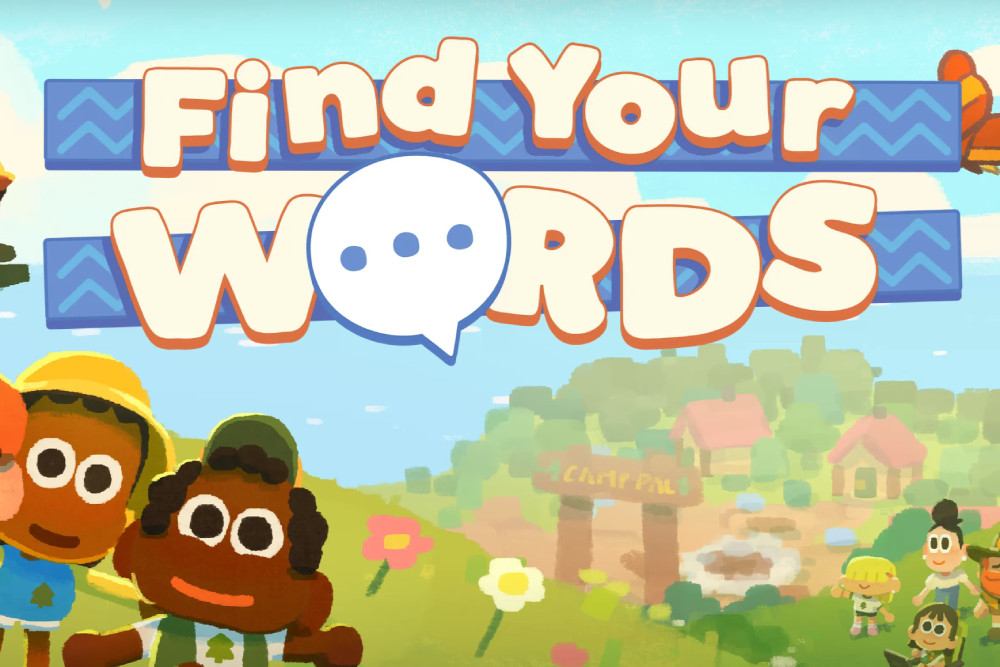

Developed/Published by: Capy
Released: 08/04/2026
Completed: 10/07/2026
Completion: Made all the friends!
Feel like I’ve been going pretty hard on articles recently so let’s have a nice easy one this week, eh? I’m a fan and acquaintance of Capy–I think I’ve played everything they’ve released, I worked in their offices while working on Sound Shapes–so I’m not going to argue from any position of objectivity (though if you’re new here, I never do) but I think Find Your Words is adorable, worthy, and worth anyone’s time considering it’s free.
To be honest, it being free is almost an… issue? While it doesn’t quite grind my gears like Evil Egg–the freeness of which still seems completely wrong–that it’s free makes it feel a bit churlish to complain about Find Your Words. But the problem is that I think there’s just so much more they could do!
Inspired by designers Jon Maur and Vic Ngyuen’s experience as the parents of non-verbal children, Find Your Words casts you as a non-verbal child going to summer camp for the first time, and takes you through the experience of making friends via AAC, or “augmentative and alternative communication.”
The fun thing here–and it must have at least partially been the genesis of the project–is that communication books, a form of AAC, are perfect as a communication tool in a video game. With a communication book, you have a limited number of symbols and can combine them to make simple sentences: you could select “where” and “beach” let’s say, show it to someone, and they’d know quite simply that you’re asking where the beach is.
When trying to create a “natural” form of communication for a video game, this so… elegant. There’s none of the problems of having the full freedom of text input, and there’s similarly none of the strict, “that isn’t quite what I wish I could say” of pre-selected statements.
Yes, the more options you have, the more difficult it is to ensure that you hit a sensible answer for each possibility–meaning you have to keep your context small. I do think that’s why Find Your Words is limited to a single day at a summer camp (and there are still situations where combinations that you think would work lead to unsatisfyingly generic answers.)
However… I think it’s ripe for further exploration. I know systems like this have existed before–even something like Ultima’s original “Name, job, bye” system has similarities–but I think I like it particularly here because I feel like we’ve gotten so stuck in the mindset of strict dialogue trees. Playing Find Your Words I could see, like, a detective game starring a non-verbal hero (a silent protagonist, as it were…) using this quite easily.
Honestly, it’s my main criticism of Find Your Words. It’s delightful, and I think meaningful. But I wish they’d got a little bit more… designery with the actual game. The communication tool isn’t particularly important to the game’s puzzles: you mostly make friends by finding them and saying the same simple things in different locations. I suppose for that reason it’d be a great game for a kid, or to play with a kid–though I did struggle to find all the birds, I guess because it doesn’t really use the game’s main mechanic.
That said, it doesn’t take that long and you can be done with this game in an hour and change; possibly why they chose to make it free (better to sell a supporter pack to fewer people than face many a steam refund from jerks?) and I certainly didn’t feel like I wasted my time. I just… do more with this! Please!!!
Will I ever play it again? There really isn’t any reason to, sadly–there’s no branching or anything as far as I can tell. It’s sweet, but it is simple.
Final Thought: At the very least, if they’re not going to do any more with this concept they should make some plushies of the bird designs. I love them!!! (Even if they were annoying to actually find in the game.)