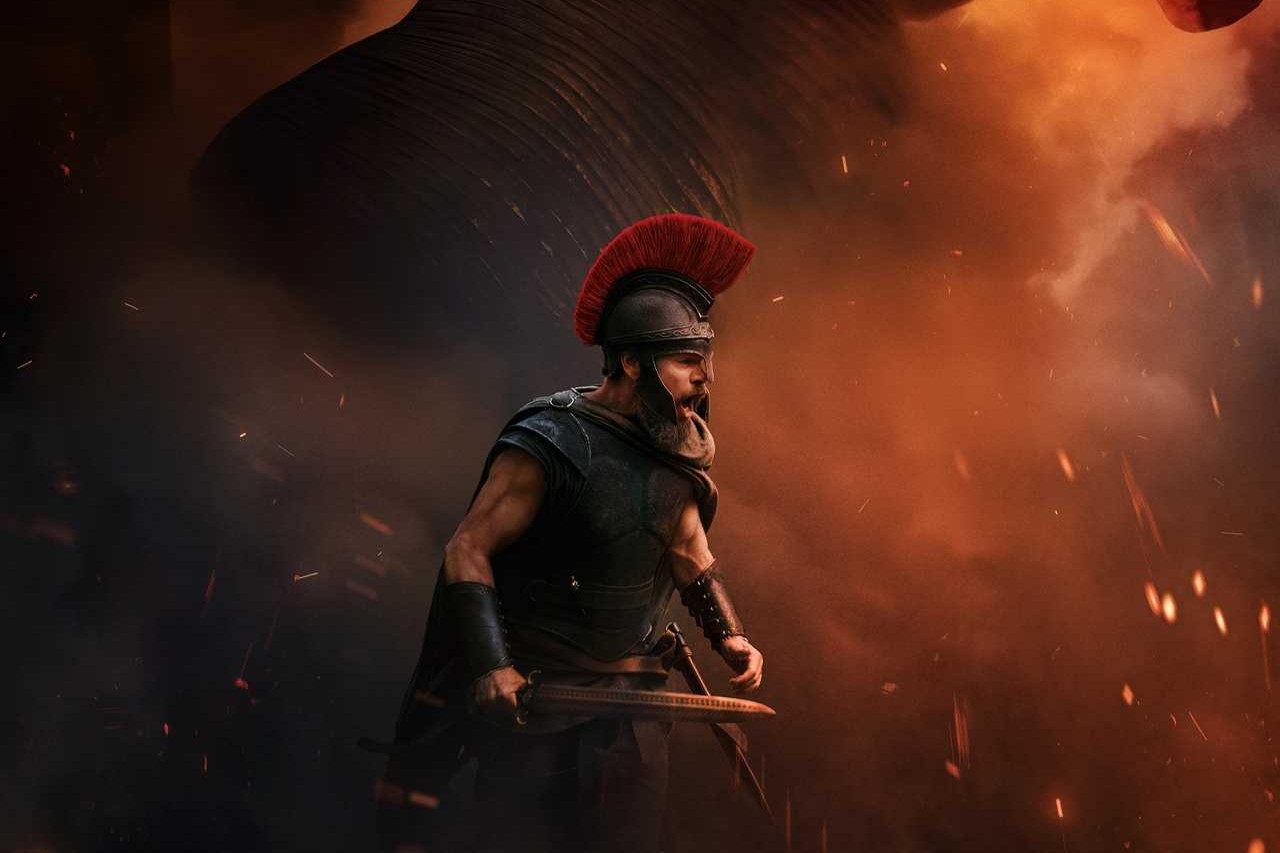
No one needs another lengthy essay on The Odyssey… is something I’m sure students have been saying since around the 3rd century BC, but, well, here I am. To be honest, the discourse around Nolan’s attempt to grapple with one of the oldest surviving works of literature has done nothing but depress me. We started with a chud revolt over the perceived “realism” of people of colour in a work that features cyclopes and witches, and as soon as the film was released–and was tremendously successful–the war of consensus began, where fandom (as it tends to) rushed to defend a work from any and all criticism, aggrieved over the idea that an interpretation might be interpreted itself and seen wanting.
Both wars, of course, are a disturbing continuation of the rejection of critical thinking and experts1. It is ironic, I think, that it should be considered unacceptable for an adaptation of a work that has been debated since at least the time of Plato to be criticised by a classicist (Emily Wilson) who has translated The Odyssey once (and in the process of doing so again) because she wasn’t sufficiently courteous. That she dared to write with a little zing and took a little pleasure in a takedown. The edges of everything must be sanded off, every bite must be palatable, give us nothing to chew on, let our teeth become vestigial.
Perhaps the most has been made of Wilson saying that she’d be “ashamed to have written any part” of The Odyssey, which I (personally) can’t completely sign off on. But I would have been ashamed to have written the many, many times characters in The Odyssey drop thudding clumps of exposition, or just straight up say the themes of the movie out loud. “Our civilisation is collapsing” characters say with the kind of tone you might have if you were blandly noting a restaurant you never saw anyone in was closing down.
Consider: Christopher Nolan finally gives a woman close to a decent role with Penelope, a woman trapped behind a veil, fighting for stalemate. Anne Hathaway does what she can, but we never get to sense Penelope’s frustration with sitting next to an empty throne as little more than a prize; she instead screams almost directly into the camera that her abilities are worth less than the hair on a man’s chin, obliterating what was hardly very subtle to begin with. Of course, this is all conveniently forgotten as soon as Odysseus returns, heavily bearded, to take said throne, Penelope reduced to a weeping damsel.2
Indeed, what stands out about Nolan’s Odyssey–outside of his own preoccupations, which really colour every part of the film–is how much the original text’s ambiguities have been flattened into the Hollywood paste. Honestly, I’m surprised. Every addition is intended to make the work go down smoother yet diminishes it. Robert Pattinson’s isn’t just a dick who is abusing xenia (described as “Zeus’s Law” in the film, a patronising simplification3) but actually a shameful draft dodger. Agamemnon becomes Darth Vader (albeit one where George Lucas let David Prowse voice him) willing to kill his child in order to secure… trade routes. Fucking trade routes!!! I’m sorry, George!!!
These elaborate back stories, added to show why characters are baddies or goodies, so we can boo them or cheer them on at the appropriate moments are just thematically confusing if you think about them too long (war is bad… but draft dodging is also bad…) The Odyssey is practically a direct sequel (well, prequel) to Oppenheimer and Nolan, obsessed with the idea of what great men must do, what it costs them, and what these fated actions mean for the future, ties himself in knots.
In many ways, The Odyssey’s sins begin with Sinon. We’re getting several layers of irony deep (here based on the pronunciation of Sinon) but as much as the decision to include a thread from the Aeneid, Roman poet Virgil’s epic that sees Odysseus as a duplicitous baddie could be seen as an attempt to offer balance, it really just sets up Nolan’s Odyssey as another paean to the feelings of the oppressor.
It is important, I think, that although in Nolan’s Odyssey we do get a single Trojan character, they are a symbol, not an embodied actor in the story, and that every enemy soldier is faceless. Because it speaks to that focus.
If Nolan was interested in a wider view of the Trojan War, it seems strange that he used the Aeneid rather than The Iliad. Let’s put aside the question of authorship (which gets especially thorny with the section of The Iliad I’m going to discuss) but why not use the Doloneia as an example of Odysseus’s sins? Odysseus commits an act of espionage, captures a (terrified) scout, extracts information at the promise of their survival, and then lets his companion execute them.
It possible that Nolan is just such a dork that he doesn’t believe that section belongs in the Iliad, but this one-sided concentration on Odysseus’ feelings above all–we see the sack of Troy reflected in his sad eyes almost exclusively–has an awkward fit that lives (as Nolan’s far more conservative Batman movies did) in the aftermath of a war on terror built on lies big and small, and now during the continued genocide of the Palestinian people and the morass of a war with Iran. In these wars it is not honest regret that is shared, but consent manufactured. Think of the sadness in the eyes of Israeli soldiers, depressed about shooting children’s legs off because it took them away from rifling through women’s underwear drawers.
It’s sad, they say, because you made us do it to you.4
But alright. Odysseus’ sin has to be lying for the “right” reasons; he is the hero after all. But isn’t it just so neat for a man, broken by his realisation that his abuse of xenia via the Trojan Horse apparently the original sin of the bronze age5 can come home and… kill everyone in his house for abusing xenia? While I understand the ending of the original Odyssey is hardly going to satisfy a modern audience (the families of the slaughtered show up to kill Odysseus and Athena appears and goes “listen guys, they were dicks. Let it go”) the themes collapse into anticlimax.
Ultimately, Nolan has latched onto xenia as a theme and made what I can only describe as a “Liberal boomer doomer” movie. A film that says “Modern civilisation is ending because we stopped having the neighbours over for dinner.”
“We’ll die soon enough, though, so hopefully the next generation (Tom Holland in a headband) can sort it out. Bye!”
This is, frankly, the kind of message I would be ashamed to put my name behind, so maybe I do fully agree with Wilson. It reminds me of the similarly feeble “maybe the kids will sort it out” denouement of One Battle After Another (though at least without that film’s smug detachment.) I just don’t think it’s that meaningful to be telling stories where the takeaway is “oh shit… damn… yeah… I guess that sucks. Oh well, what are you going to do?” in the face of climate and societal collapse.
In each of our homes, we live with suitors we seem powerless to evict. No longer embodied in our space, but making a banquet of our wealth remotely. They lay us off and take huge bonuses. They raise prices on our groceries and pocket the difference. They rip the wire from the walls of the stores on our high streets and then, once they’ve taken everything they can, leave them boarded up and empty. They hollow out everything we used to have, our third spaces, our communities, our environment, our homes, because they think it is their right to take what we have.
The rage we should feel is legitimate. The decades we have been at sea while this has happened should not have dulled it, no lotus flowers, no siren songs should be enough. If we’re on the beach, I want us to start building the raft, and it’s not to sail off into the sunset.
I’m not asking The Odyssey to be a polemic, but it’s depressing to see Nolan attempt to grapple with big themes using an icon of the Western canon and devolve into the easy non-answer of the Hollywood ending.
Look. If you really ask me to take it as it is, to put up with it being thematically muddled and full of blatant exposition it’s… fine. The design of the palace–with a physical screen used as a “veil” I thought was clever. The body horror section was intriguingly unusual for Nolan (and goes on so much longer than you expect). Leguizamo better be picking up some statues (to make up for all the ones he didn’t get for his role as The Pest). The redrafting of Odysseus revealing his identity to Telemachus until he saw his dog worked for me (I’m not made of stone.) Pattinson enjoys himself, and I enjoy that he’s enjoying himself. But that fight at the end is absolutely garbage and probably more embarrassing than anything else. Come on Nolan, you don’t want to hire anyone who can choreograph and shoot action? No?
In the end, The Odyssey is more interesting in what it says about Nolan than what it says about The Odyssey, though the discourse on that is, hopefully, not going to last another three thousand years. I apologise for adding to it, but you know what Athena’s like, always inspiring us to battle. Well… actually, if you’ve only seen The Odyssey you don’t know what she’s like.
- Of which I am not one. I’m just some prick waffling online, so if this article annoys you, consider it a learning experience where you can go “well, I didn’t agree with that” and move on with your life. ↩︎
- I say “close” to a decent role, because Nolan removes two things that enrich Penelope’s character. Her dream, which expresses complicated, ambiguous feelings about Odysseus’s return, and her later test of Odysseus. I think Nolan plays the idea that Penelope clocks Odysseus early well, but it’s sad that she doesn’t get a grace note showing that maybe she’s the clever one. ↩︎
- As an aside–it’s frustrating that the main (only?) explanation of xenia given is that it’s done in case a guest is a god in disguise (especially as the gods are not, exactly, seen here.) While that’s true, it’s much more interesting as a symptom of the currency-free palace economies that The Odyssey represents, where visitors would often have little to barter with; without it, travel and diplomacy would be near impossible, it was reciprocal, and it was not just given in fear of divine punishment. ↩︎
- Consider Helen, given a miserable fate here yet still explicitly taking the blame. ↩︎
- I mean technically in the source Paris abducted Helen while he was a guest of Menelaus, itself breaking xenia. Sorry if I’m getting too into the weeds here but “yeah but I did it via the form of a big wooden horse” doesn’t seem like that big a step up unless, like Nolan, you’re attracted to the idea that “wooden horse” equals “nuclear weapons”. [“Who’s making the gross simplifications now?”–Ed.] ↩︎