Developed/Published by: Namco Released: 06/08/1985 Completed: 18/08/2022 Completion: Played a few levels in both the original dungeon and the secret “Another Dungeon” but life is too short. Version Played: Namco Museum Archives Trophies / Achievements: n/a
You know, I’ve had fun playing the old games I’ve got access to; I’ve discovered some hidden gems, rediscovered old favourites… but there’s definitely points where I’ve honestly wondered how video games as a medium didn’t merely survive but thrive post 1983 crash. Because to be honest, the last chunk of games–action games, anyway–have been pretty miserable. The Famicom’s output has been totally uninspired, and every arcade game is so brutal and relentless that there’s no time to get hooked–you just die.
So, no matter my own attempt to understand these games within their actual context, it’s been really hard to get into them. I’m still playing them in the 2020s, and I’m still me.
And this Famicom port of The Tower of Druaga is a perfect example of that friction. I don’t like the The Tower of Druaga. You can read all about that here. But it’s also insanely seminal and was a genuine phenomenon in Japan. I’m sure Namco’s Famicom port was hotly anticipated and as far as I understand it was a massive hit. And academically? I understand it completely.
Because this is a great port! Sure, it’s got the muted colours of a Famicom/NES release and like Mappy chops down the level sizes (7 tiles vertically rather than 9) but most importantly not only does it feel similar but all of the hidden bollocks (I mean treasure) are unlocked as in the arcade (bar some very minor differences) allowing you to actually throw yourself into finishing the game without having to spend a small fortune in 100 yen coins–you can even continue! I can understand totally why you’d be running out to get this for your Famicom in 1985.
But it’s 2022 and this is still just unbearable to play. I just can’t put myself in the shoes of a wee guy in 1985 playing this and (apparently) enjoying it. Booting this up and being faced with just how slow Gil moves on the first level? It’s revolting. How boring were things in 1985 that I would sit there, playing this with the tips page of Famitsu (or whatever) open?
What makes my total inability to get this worse is that this version even includes an entire extra dungeon, with a whole new range of inscrutable things to do required to complete it. It’s actually hard to argue with the insane value here and how thrilled you’d be to discover this! But to me, in 2022, it’s like finishing a plate of rocks and being served a plate of glass.
That said, it’s a matter of months in 1985 before dessert shows up, and it’s literally ice cream. I know why the video game industry survived a crash and then whatever this is: Super Mario Bros.
(Oh, but I’ve got Namco’s Battle City to play first. Dang it!)
Will I ever play it again? Thankfully, these are the only two versions of The Tower of Druaga I have access to. I know the Game Boy version has bosses and things (sort of interesting) and I believe the PC Engine version is significantly different (more of an action RPG thing) but I’ll stick to ice cream from here on out.
Final Thought: Struck by the fact that as I’m back into collecting Game Boy games and I hope one day to go back to Japan to pick up an bunch of cheap fodder, I’ll already be seeking Namco’s Game Boy compilation cartridges meaning I may end up with a copy of the Game Boy version after all via Namco Gallery Vol. 2. I’ve never been one for toppings on ice cream really, but guess I might as well sprinkle some broken glass on it…
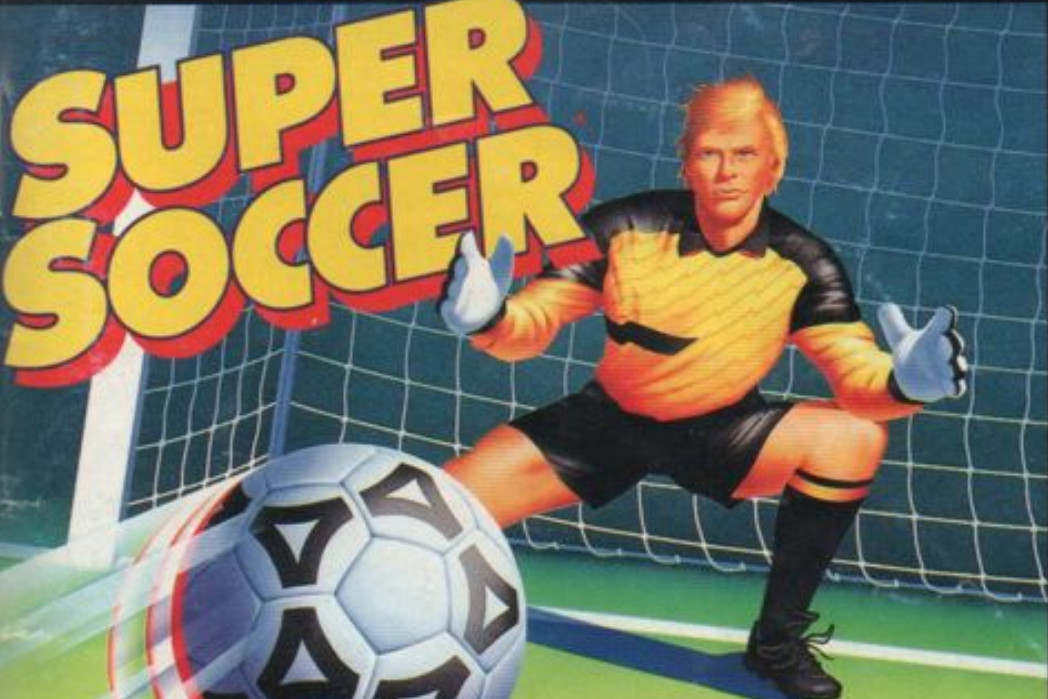
Developed/Published by: Intelligent Systems / Nintendo Released: 2/2/1985 Completed: 12/07/2022 Completion: Beat four levels of difficulty while fighting off boredom as “GBR” which because they’re the team in blue I decided were actually Scotland. Take that, “Federal Republic of Germany”! Version Played: Switch Online Trophies / Achievements: n/a
Well, I’ve suffered through Tennis, and Baseball, and all these other frankly pretty rancid early NES games from Nintendo, so how bad can Soccer be? I mean, I like football, so at least I can accurately judg–[starts projectile vomiting]
It’s… it’s bad, guys. It’s bad. Something that has struck me about Nintendo’s NES sports games is how perfunctory they are. There’s no charm, no spark, and no sense that anyone involved is trying to make a fun video game as much as tick off the box that says “the Famicom has a [name of sport] game”. And apart from some slightly nicer graphics, you’re really not feeling a massive jump from pre-crash video gaming here.
Soccer, for example, is as bare-bones as you get, offering the ability to play friendlies against a variety of (identical) six-a-side teams with a five point difficulty setting. Six-a-side is disappointing (but not particularly unusual in this era) but what’s really the problem here is that the game is so slowww. Actually… not just slow, horribly disjointed? You see, Soccer has the (I guess) noble aims to simulate the experience of actually dribbling a ball, with players kicking the ball each time they move, but rather than fluid movement it’s more like the way toddlers play football–they run to the ball, stop moving, kick the ball, and so on. This makes everything not just slow, but feel unresponsive, as you really can’t do anything unless you’re at the right point in an animation, making it all feel a bit random.
Of course, as with all of the other sports games for NES, my mistake ultimately is to be playing this against the AI, which here might be more horrible than anything we’ve seen before. The opposing team and your teammates seem to have no intelligence on any level of difficulty (the small pitch doesn’t give them much to do, to be fair) and raising difficulty just means that if you put it on the highest level instead of scoring every time the opposing goalie will make a beeline for you when you get close to the goal and take the ball off you (there’s really no lateral movement when you’re dribbling in this game it’s so slow and unresponsive.)
I sort of can’t imagine this was especially enjoyed by people playing it in multiplayer though.
Will I ever play it again? No.
Final Thought: I was mildly interested if I’ve been unnecessarily unfair with judging this with modern eyes considering this is from 1985, and in my head I was like “this is bloody worse than a Spectrum game.” Well, if I’m going to be completely fair… the Spectrum did honestly had better (and deeper) footy games! with Jon Ritman’s first Match Day (released in 1984) is at least as good as this, never mind Match Day II or the likes of Microprose Soccer (Sensible Soccer’s predecessor) showing up a few years later in ‘88.
My suspicion, actually, is that Nintendo’s Soccer is essentially a clone of International Soccer, released for the Commodore 64 in 1983, but as usual I have no way to verify that because… how would I. I have no idea if Nintendo designers had even seen a Commodore 64 at the time. But there’s more than enough similarity between these… and somehow Nintendo’s version still comes off worse!
Developed/Published by: Naughty Dog / Sony Interactive Entertainment Released: 19/6/2020 Completed: 24/05/2022 Completion: Finished it. Trophies / Achievements: 78%
This write-up contains massive spoilers for The Last of Us and The Last of Us Part II, unavoidably.
Abby died. Ellie killed her, in the theatre.
Again.
And again.
And again.
It was what was right. It was what I wanted, it was what Abby deserved.
So why wouldn’t the game finish?
Why did the the game make me keep playing Abby, doing things I didn’t want to do–attacking Ellie? In fact, why was the game making Ellie a boss? I thought… were the designers of this serious? Were they expecting me to feel… conflicted? To possibly feel like I was on Abby’s side, after what she did, and then after spending all that time on what was, ultimately, a totally irrelevant ten hours???
They couldn’t be that foolish, could they? Did they have that much hubris that they thought this story work?
So maybe I switched the game all the way down to “very light” and thought, hell, I could be wrong. Maybe they’re actually going to pay off this story.
They didn’t.
So yeah, Abby died. Ellie killed her, in the theatre.
Will I ever play it again? I will never play this again. I intend never think about this game again after writing about it here.
Final Thought: …Damn. Neil Druckmann. Man. Turning out to be a Ken Levine… it’s almost sad! It’s really depressing, actually, that the reaction to The Last of Us Part II–like basically everything these days–got tied up in tired culture war bullshit, because it only serves to undermine any extremely legitimate criticism of a badly conceived story poorly told. To be honest, I’d love to leave my write-up here, but there’s this worry that you’ll read this and be like “oh, this guy hates Abby because she’s got muscular arms!” or something.
It’s genuinely quite hard to know where to begin, but if you need my problem in precis, it is simply that The Last of Us Part II manages to tie itself into knots in how it feels about interactive storytelling. On one hand, it decides that despite the fact if you’re playing “The Last of Us Part II” you’ve already spent 10+ hours being Joel and that the previous game used that to (very effectively) make you feel like you’ve personally led Ellie across the United States, growing ever closer to her, that the player will have enough distance that, sure, they’ll be shocked, but they’ll be more “interested in how the story plays out” than “hating Abby with a fire that could burn out a thousand suns”. But then they assume that if you spend 10+ hours being Abby, you’ll get close enough to her that you’ll start to see things her way… even though you’ve just spent 10+ hours playing Ellie, with your hatred only growing.
And through this, they seem to… forget(?) That Abby’s revenge is not merely for something the player did, but something they goosed the player up to do. There’s a horrible smugness to the game standing in judgement of the player, especially when they don’t know how the player actually felt about what the previous game literally forced them to do (if they wanted to see the end of the game) and I know others didn’t approach it with quite as much of a righteous fury as I did.
It’s even worse than that, really, because they actually have to do one of the weakest-ass retcons to make standing in judgement work! At the end of the game the Fireflies are real dicks, who unjustifiably are about to kill essentially a child without giving them any say in the matter… but Part II makes it clear that it was very hard for them! They felt sad about it! Also it was the only thing they could do, and they needed to do it immediately! Also… Abby would have let it happen to her, so really, what a monster you are! We mean, uh, what a monster Joel was!
It is, I can not put too fine a point on it, just the most embarrassingly desperate writing. It’s forced and it simply does not ring true, not to the player’s experience and not to, well, anything. Sucks for Naughty Dog, but we’re all currently living through a global pandemic where it turns out vaccines are not a panacea, and even if Covid turned your head into a fucking mushroom half the US wouldn’t want to take it and you’d never reach the required immunity, meaning the Fireflies were as likely to kill a lassie and get fuck all out if it as anything else. So fuck off.
I don’t even really understand some of the storytelling decisions from really any angle. Even structurally; when playing the only way I could basically justify spending the second half of the game playing Abby was going to be that her side of the game–playing, as it does, out across the three days of Ellie’s half–would feature her following Ellie’s trail of destruction and seeing the cost of that, or somehow presenting a meaningful mirror. But… actually her side of the game is almost entirely completely irrelevant story about TWO OTHER CHARACTERS!!!
Sorry, I’m actually yelling now, but it’s not actually just idiotic it’s actually sort of offensive? I’m no expert (and on this point I’m happy to accept if people feel I’m in the wrong here) but The Last of Us has previously handled a queer story naturally, but The Last of Us II goes big on using a trans character that basically only exists to make us like Abby more and I found it, well, I found it fucked up?
I mean, this is where the culture war bullshit gets iffy, actually–because it’s completely fair to say that the narrative in “Abby’s side” isn’t what a player wants to be spending their time on in this game, and definitely not at the point where they get to it. Not because queer and trans stories and representation aren’t valuable! But this feels very clearly like a queer/trans story being used not shared; and it only gets even dodgier in my opinion when you read up and realise that the entire WLF vs. Seraphites angle is meant to be some kind of allegory for Israel and Palestine; the technically superior WLF versus backwards religious zealots with bad opinions but guess what: they just might be as bad as each other!
(If I’d read that a lot of Druckmann’s inspiration for this came from his sympathy for the IDF I would never ever have fucking played this. I mean what the fuck.)
I’ll be honest… I’m tired of thinking about this stupid fucking game; I meant what I said above in my “Will I ever play it again?” It has made me more depressed than I’ve probably ever been about triple-A video games as a form for storytelling and it has literally taken me weeks to sit down and write this because it just bummed me out so hard. I keep thinking… did they actually think this was profound? Then I remember how the game has an entire EXTRA THIRD at the end that adds nothing except to make the entire experience only more miserable and make Ellie seem like an idiot, culminating in her making a decision that she literally would not make because she DOESN’T KNOW WHAT THE PLAYER KNOWS!
FUCK!
(It’s actually quite funny to read Druckmann dither noncommittally about why she makes that decision in interview in a way that makes it clear it was a necessary story decision, not a character decision.)
Anyway, please don’t ever waste your time with this. The game has less intelligent things to say than the deleted scenes from Austin Powers (that got left in the UK release, making it a better movie, honestly.) I mean, watch this. Now that’s some powerful storytelling!!!
Developed/Published by: Namco Released: 06/1986 Completed: 23/11/2021 Completion: Got all the required chests and beat it. Trophies / Achievements: n/a
Wizardry: Proving Grounds of the Mad Overlord is one of the most important games in Japanese RPG history (despite not being Japanese itself), and here’s the other side of the coin: arguably the most important game to the action RPG genre: The Tower of Druaga.
The Tower of Druaga is known for a couple of things. One, that it’s built around the player performing obtuse, un-explained behaviors to make chests appear that without which the player cannot complete the game; and two, that although it was a smash-hit in Japan (second top grossing machine of 1984) it never received a wide release in US or European arcades and so goes almost completely unknown in the west.
(I’d actually be fascinated to find any articles or information about The Tower of Druaga being released in the west—there’s very little to google for in English about it, so it would require proper digging. That’s how unsuccessful it was here.)
That said, Namco has a dedication to making “fetch” (The Tower of Druaga fandom) happen, because it keeps sticking it on every collection it does and you get weird things like how in Pac-Man 99 there’s The Tower of Druaga DLC and that. This probably seems weird, but it’s a side-effect of the fact that “fetch” happened in Japan and it would be a waste of time to remove The Tower of Druaga ROMs or references from western releases plus people would obviously complain even if they’ll never play it.
Anyway. Should you play it? I didn’t come away recommending Wizardry, though I found it very educational to play. And Tower of Druaga has an obvious influence on The Legend of Zelda, Ys, and so on, so you can feel its DNA in some respects coursing through practically everything we play nowadays. It’s similarly educational, then, but holy lord do not touch this with a fucking bargepole.
I’ll give props to the team who put Namco Museum together, though. On the Switch version, you’re a mere push of the X button away from seeing what idiotic thing you have to do to find the next chest, and it even informs you if you need it or not (well, that said, it accidentally claims one of the Balance items is a trap. It isn’t, you 100% need it.) This turns the game from “a completely impossible treasure hunt” into “a nigh impossible puzzle.”
I think I imagined this would play… better? I know it’s from 1984 and that, but I just assumed it would have a Pac-Manny sort of responsiveness. No such luck, as the game locks improvements behind treasure chests and at the start of the game you control a pitifully slow hero who swings his weapon lethargically and is killed by touching anything. At the end of the game you control a slow hero who swings his weapon… still pretty slowly, to be honest? who dies after touching nearly everything.
This might be fine, except within a few levels you are navigating a maze where wizards near-randomly teleport and can fire spells at you through walls that kill you immediately unless you make sure you’re facing the spell with your shield. They’re supposed to not spawn any closer than two squares from you, but if you’re moving it doesn’t update that so you can easily walk into them as they spawn in, too, which is amazing. And if two guys shoot a spell at you from different directions? Sucks to be you I guess. Oh and when you stab them you’ll not get any feedback that they’re dead. Again, sucks to be you.
I’m fascinated by the idea that in 1984 Japanese arcades were awash with people who were pumping in 100 yen coins into this and enjoying it. That’s a lot of money for 1984! Famously, the game encouraged a communal aspect, where players worked out how to make the (brutally necessary) treasure chests appear, and I imagine that in arcades across the land there had to be notepads lying out where players jotted down their discoveries. However, this blows me away because the game is just so unrelentingly brutal, with several “gotcha” levels where it feels like wizards are upon you immediately, requiring you move instantly and specifically or die, and requirements that I genuinely can’t imagine working out or performing with any success in arcade conditions.
I mean this game, near the end, requires you defeat six enemies on one level in a specific order… and then do it again on the next? Enemies that move faster and massively outpower you? It’s not so much that I can’t imagine anyone working these kind of things out–it’s that I can’t imagine players reaching the level of virtuosity where they could, for example, get to level 30 enough times that walking around the level and surviving they’d eventually work out that you needed to walk on a specific square three times. Players must have maddened themselves touching every wall, standing in place, spinning in circles—all things you need to do to progress, while just surviving.
I beat this by saving every level—I couldn’t save during any levels, because I was worried I’d fuck up somehow and Namco Museum only allows a single save–and this took me literal hours. The final level is an exercise in brutality as you cannot defeat Druaga if you’ve taken a spell hit before he appears, and yet the game gives you such poor feedback you can easily take a spell hit you don’t notice while fighting a wizard who attacks you from four directions at once.
I’d love to see a master of Tower of Druaga play this. While playing it, the hardest levels quickly devolved to become Pac-Man like memorisation strategies—I knew that if at the start of the level I moved in a particular way, I’d spawn enemies here and there and could therefore survive, but if I ever died I’d have to reload because on my next life I’d not be able to make the same thing happen. Did people’s guides, or do official guides, show you how to navigate the maps a bit like How To Win At Pac-Man? It’s the only way I can imagine seeing this through to level 60 on a single credit.
I am, to be honest, baffled by Tower of Druaga. The mania that surrounded it you’d expect to have dissipated when people realised how insane the requirements were, but the game had multiple successful home conversions in Japan (I believe the Famicom version was a massive hit) and people love it so much that many of the conversions include even harder, more obtuse dungeons to play though! I had hoped that playing with solution in hand this would be a fun arcade title that felt good to play and I just had to puzzle out how to complete a level, not what to do but no such luck. This is a miserable exercise in dying and reloading and I wouldn’t wish it on anyone.
Will I ever play it again? I’ll be taking a quick look at the Famicom version as part of Namco Museum Archives on the Switch, but I find it massively unlikely I’ll play it more than a couple of times.
Final Thought: Something else wild about the Tower of Druaga: the hero (Gil) actually has a health bar, but it’s hidden from the player. And the bad version of important pick-ups look exactly the same as the good versions! The game goes out of its way to make you not know what’s going on. How. Did. Japanese. Players. Like. This.
Developed/Published by: Al Iapicca, Bob Johnston / Energy Games Released: 1981 Completed: 05/12/2021 Completion: I played it. We’ll go as far as that. Trophies / Achievements: n/a
It’s the holiday season, and I was struck recently that I never make a point of playing any Christmassy games during the period. I mean I don’t even get Christmas Nights out! Shocking really. Considering I’m going through my backlog chronologically, I thought I’d see what the earliest Christmas games were, and I’m surprised to find that this, a little-known Apple II game that, like, came in a ziploc bag in 1981 is the first Christmas game ever–unless you particularly want to count a type-in memory game from Softside Magazine that just happened to use Christmas words. Well, unless Mobygames is wrong, which I guess it could be.
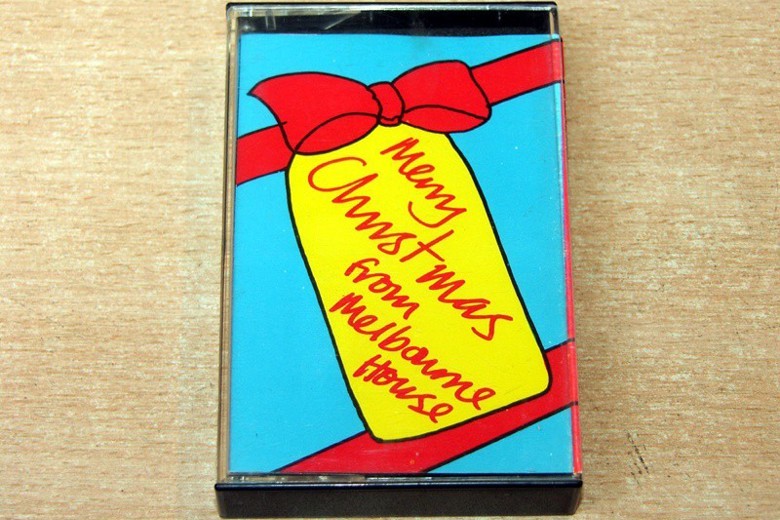
Update (05/12/2025): It seems a copy of this showed up on eBay this year, a rare opportunity to see the game as it looked, ziploc and all.
Anyway, this is a very strange little shooter where you control an absolutely massive Santa flying behind a huge blue Rudolph (I assume all the other reindeer are to his right depth-wise in a row). You move right to left (odd) must shoot… Pac-men? And… stars? While trying to drop presents into the chimneys below that you can (surprisingly) control the direction of a bit. All of which you do at about one frame a second, if that.
It’s, obviously, not very good, and it doesn’t particularly make you feel Christmassy outside of a beepy version of Jingle Bells right at the start (it’s silent the rest of the time.) It seems like the programmers (Al Iapicca and/or Bob Johnston of Marin Data Systems, according to the title screen) couldn’t work out how to make Santa only move up and down when you held the direction, so as soon as you hit A or Z he just… goes in that direction until you push the opposite one1. It’s also clear–unless the game has the slowest ramp-up of difficulty ever–that they couldn’t manage to get more than one enemy on screen at a time with all the chimneys moving too, so there’s points where you’re just like… should I go off and make a cup of tea and come back?
Not that having more enemies on screen would be a good idea–Santa is so bloody massive and slow [“oi!”–Santa] that it’s hard to really do anything. It’s not exactly, hard–if you’re dedicated you can slowly line up your shots and avoid the birds that you can’t kill, all while dropping presents–but it’s really, really hard to want to.
That all said… I have this weird suspicion that this was inspired by Defender (which came out in early 1981) of all things. Sure, you can’t turn around, but there’s a Defendery-ness to the stars, Rudolph shoots a similar laser and dropping presents feels inspired by the rescues in Defender, so maybe they thought “you know what would make Defender better? A MASSIVE SANTA.”
It doesn’t, but you know what? It was 1981. They weren’t to know where games would go. Here’s to the dreamers.
Festive vibes ranking: You’re constantly staring at a huge Santa. HIGH
Will I ever play it again? I barely played it the first time.
Final Thought: Thinking about this in the context of 1981, the Apple II had had an extremely impressive year, with seminal RPGs Ultima and Wizardry coming out, and system defining titles including Swashbuckler and Castle Wolfenstein also being released. With inflation considered, it’s wild to imagine how anyone afforded the “affordable” Apple II (the price translates to about five grand now!) but let’s assume you lived in one of those mansions from a John Hughes movies in the 80s and you excitedly ran downstairs on Christmas morning–you could just about accept that your granny bought you Santa’s Sleigh Ride by asking a clerk in a “mom-and-pop” computer store (if this managed any form of actual distribution at all) but you’d be hoping your parents picked up one or two of the other titles I’ve mentioned so you weren’t bored ten minutes later and have to *shudder* go and play outside.
This is apparently an issue with input on the Apple II, though it’s hardly ideal. ↩︎
Developed/Published by: Size Five Games Released: 20/07/2017 Completed: 6/08/2021 Completion: Finished the story mode! Trophies / Achievements: n/a
If you’re familiar with me, this blog, or even any of my appearances on the Insert Credit Show you’ll be well aware that I consider Sensible World of Soccer one of the greatest games of all time and I wish it came out every year on modern consoles with updated rosters and everyone was playing it online against each other like what it was FIFA.
Unfortunately, it does not. So, even though I boot it up every once in a while, I generally chase the dragon by playing other footy games, of which Dan Marshall’s Behold The Kickmen has been on my radar for a while and once I noticed it was on Switch [“Not a very good radar, then”–Ed.] I picked it up, what with the Switch being the indie handheld of choice (until the Steam Deck shows up, I suppose).
Now. I’m pretty sure I remember reading a review of this where the reviewer got really annoyed at it for sneering at football. And I can see it, in that saying things like “foot-to-ball” or whatever is tedious and just about as boring to people who like football as football is to football non-likers, but Behold the Kickmen has a genuinely funny, absurd little story that you’d have to have quite the chip on your shoulder to take offence to, and the “wrong” football, even it actually came from an sneery, anti-football stance… creates a really interesting video game???
Being annoyed at this because it offends the beautiful game is a big old waste of time. Behold the Kickmen is mostly played like football with a “bullet-time” like mechanic for aiming, shooting, and tackling, but what makes it interesting is that each action you perform while holding possession (or not losing possession for too long, anyway) adds to a multiplier that increases the amount of money you’re going to make when you score a goal. If the opposing team scores a goal or the half ends, you lose it all.
It leads to a really remarkable game where it’s not really about goals–until it is. You’re much better pissing about in mid-field, passing and dodging, until you need to score or lose it all. I played on the default settings and to be honest the AI was nothing to write home about and I beat them handily, but maxing my multiplier (and scoring in time…) became the game, and I loved it.
There’s issues with it–it’s technically “funnier” to have a round pitch but it’s a lot of wasted space and the slow-down is a bit stop-start and means there’s no multiplayer (which I think would work!)–but it does what any good “football” game should do in making every goal feel incredible. The daft story that you follow as you win games had me lollin’–although there’s several set-ups that don’t actually have any pay-off and I wished that there was more of it (I’d be tempted to play again to see if anything different happens if I make different choices, but I suspect not.)
Anyway if you like sports games or games with interesting design twists this is worth every penny of the couple of bucks it’s going to cost you on Switch or PC. Pick it up!
Will I ever play it again? If it had multiplayer I would. Just turn off the slowdown, see how that works.
Final Thought: It includes a theming that parodies Speedball 2: Brutal Deluxe, the second greatest game of all time behind Sensible World of Soccer [“Steady on”–Ed.] but sadly doesn’t do anything with the theming like adding score pads on the side or slide attacks or something because, I guess, that would be a completely different game. But now I want to play Speedball 2…
Developed/Published by: Dani Bunten Berry / EA Released: 11/1983 Completed: 24/06/2021 Completion: Beat Tournament mode against 3 AI with a colony score of 110,000+ Trophies / Achievements: n/a
MULE is an interesting one. I was trying to think what the cinema equivalent is, as a sort of easy metaphor: a classic that was lauded (if never particularly imitated) by a generation of filmmakers that goes almost completely unwatched these days. It’s not one of the obvious ones (you know, Super Mario Bros. as Birth of a Nation, or something); it’s too sophisticated to be something super early (Space Invaders as Journey to the Moon) and so I just can’t place it. The Red Shoes, perhaps?
The thing is though–and I suppose it’s the reason I’m trying to draw the metaphor–is that if you want to watch The Red Shoes and see what the likes of Scorcese have raved about, you can do so easily–it’s streamable on about nine different services, free with subscription or even ad-supported; you can buy it on a Criterion blu-ray and get a boat load of special features to give you context. Nothing is holding you back.
Here’s how you can play MULE: you can pay $8 to Good Old Games to play the trash PC port that is totally unrepresentative (it’s maybe also available on Origin, but I haven’t looked.)
Ok, so you don’t want to do that (and it’s not Good Old Games’ fault: they near-exclusively sell PC games). So here’s how you play MULE “as intended”: You have to download an Atari 800 emulator or understand how to make something like Retroarch make that happen. Then you have to find a ROM (watch out! You might download a pirate one that crashes if you catch the wumpus!). Then you have to find the BIOS files that will let the emulator run the Atari 800. Oh and don’t forget that the Atari 800 emulator requires a bit of fiddling to make that work. And because you want to see the game as intended, you’ve either now got to make this run on that CRT you’ve got lying around for this sort of thing or run it through a shader, preferably with a nice border so it looks like you’re running it on an old TV.
Oh, and for context, you’re going to want to look up the (beautiful) box and manual online.
The alternative, is, of course, to buy an Atari 800, monitor, a copy of the game (good luck finding it for less than $200) and four joysticks.
This is, clearly, absurd. Now don’t get me wrong; there are lost films and inaccessible films. But MULE is out there, and in the history of games it’s at least as important as The Red Shoes is to cinema. But you have to be extremely dedicated to play it–and worse, if you don’t need to be (for example, you pass an Atari 800 in a “VIDEOGAMES!!!” exhibition at a museum) it will be completely impossible to grasp.
So anyway, that sucks, because if you’re a student of games and their history you should play MULE, and not just because it’s honestly still pretty fun. Because it’s passed into this position that people only talk of it from the second or third hand–often to pay tribute to the pioneering Dani Bunten Berry–and I actually feel a bit sad about that. We pay tribute to those who came before us by playing their work, not just talking about it.
[“OK, now start the criticising”–Ed.]
How dare you… ahhh you got me. I think MULE is super cool but here’s the thing that happens after you put in all that work: you go “mannnn this is olddddd” because MULE is old, and “80s personal computer” harsh. It’s at its heart almost a board game, but it’s slathered in early “we haven’t quite worked all this out” design decisions that sorta made sense at the time but also extremely don’t now.
It’s played like this: you and up to three other players (though it’s always played with four) are settling a planet; each round you have to select a plot of land (from plains, mountains or river) and then select a mule, equip it to either mine ore, collect energy or farm food, which it can do on any plot (well, you can’t mine on river tiles) but gain the most benefit from doing so on the equivalent tile. After everyone has done so, a random event happens (a solar storm makes more energy production, for example) each commodity is consumed by your community and the surplus is traded: either to or from other players or to or from the town store. And then the next round happens (oh, and sometimes you can buy plots of land at auction, not just take them when given.)
It’s actually pretty graspable, but the quirk is the law of supply and demand. With particular lands (and land placement) you can create massive surpluses of certain goods, and you can also choose to ignore some goods even though your community needs them. “I’ll make so much money selling this ore” you think, “that I’ll be able to buy as much food as I need.”
Trading happens in a format that must have inspired the negotiations in Theme Park (“Ah yes, I know exactly the mini-game”–every reader, who is as decrepit as me) where you walk your characters down or up the screen to meet at a value, with the quirk that if the store doesn’t have any of a good to sell you the sellers can walk back infinitely (well, within the set time limit) to bleed you dry. (And the computers will do this…) BUT–if they do this, they’re in danger of the colony getting a bad score at the end of the game! So it’s all about the balance of winning (individually) without losing (as a collective). Man sounds like those clowns in congress should play some MULE, am I right???
So far so good, right? The problem is it’s the early 80s, so all of this is done with a one-button stick where you have to control your character and make them walk into the mule pen and then walk out with the mule and then walk into the outfitter and then walk to your plot and then the timer runs out because you didn’t make enough food, or because moving your character is janky as hell. And selecting your plot of land? Oh that’s a reaction test as a cursor moves along the screen (faster on the higher difficulties) meaning the PC is gonna screw you out of half your lands (and mis-timing is going to screw you out of the other half.) And because there’s not that much space on the screen, actually fully understanding supply and demand in context… isn’t going to totally happen. You need to remember how much of a good you need to buy to not be in shortage. How the shop price affects things and changes is… obscure.
Which is not even to raise the nadir of MULE: random “punishment” events. Yep, this was designed well before balancing was really a thing, and they had the best intentions at heart, but “lift up the low boats” wasn’t a thing– “smash the high ones with a tsunami” was. It’s a bummer because it doesn’t really work. It’s super clever to make the winning players play first (so it’s easier for the worse off to strategise) but some players can get into such a commanding position that losing some money here or there isn’t that bad. And instead, things tend to happen like you scrimping and saving, finally getting your engine up and running, lots of ore coming in… and a pirate ship shows up, takes all your ore on a turn when the players ahead of you all switched to energy and food, and now you’re stuck with nothing to sell and no way to afford the energy or food you need to keep your plots going. It is the dogshit worst.
That said, while MULE has the capability to cause (and must have caused) Monopoly-esque meltdowns, the game is still dang fun if you can get into the mindset. The AI is hilariously vindictive–I love that it will screw you on land auctions if you try and force the price up to screw them (it’s all about timing when to walk backwards…) and that they’ll be extremely selective as to when to buy from you, even if it hurts them (I’d swear it knows it doesn’t need food towards the end of the game…) and if you save-scum away only the bullshit punishments or mis-clicks (be generous; it’s 2021) the core here is so dang solid–and it only really makes sense as a video game, because I’ll be fucked if I’m calculating the new cost of mules based on the previous trading period using a table in a board game manual or something.
Is it a classic I’ll return to again and again? No, not really. Is it something that any student of video games should play once, twice, three times at least? Of course, and if there’s anything you take from this it’s criminal that they probably won’t.
Will I ever play it again? I am desperate to play this on tournament mode with three other experienced (but not too experienced) players IRL. No joke desperate. I think there some of my issues (the misclicks; the punishments) stop becoming as massive an issue when you’re playing with more than two people…
Final Thought: Shout out to TreyM for their classic CRT overlays! This kind of thing really doesn’t feel right without them–and they’ll continue to help me experience things “in context” as much as I can when I get to the likes of Rescue on Fractalus…
Developed/Published by: Team Cherry Released: 24/02/2017 Completed: 09/12/2020 Completion: Finished the main story with a percentage north of 100%. Trophies / Achievements: 48%
Kinda funny, but not that funny to be writing at this today [”months earlier”-Ed.] after listening to the Greatest Games Ever Insert Credit Show where Tim Rogers enthused that this was the best Metroidvania ever and Brandon Sheffield hated it very, very much.
Might as well cut to the chase and say I like it far, far less than Tim Rogers but don’t hate it quite as much as Brandon Sheffield (but then, I played it more than an hour, and if I’d stopped at an hour I might have.) However, this is me falling headlong into “no, it’s the children who are wrong” territory because I’m going to say that is pretty much everything I hate in Metroidvania design (level design in general, even) and I’m truly, truly baffled by why this is so lauded. I mean, this is a game that opens with a short tutorial segment (fine, good) but then throws you into a level with multiple long pathways, no map unless you pick the right path quickly, and extremely samey graphics across the area meaning you just stumble around second guessing every move. I mean the whole “you don’t get a map in a section until you find the guy who has the map”… people like that? And don’t get me started on how the game doesn’t let you see yourself on the map unless you waste one of your equip slots. That’s honestly unpleasant.
I mean the level design is bad enough on the macro level, but each area is also chock-a-block with blind drops, punishment drops, and enemies that take forever to kill because you have to engage with a punitive weapon levelling system that, frankly, you’ll won’t be able to engage with unless you literally look up where to get the materials.
This kind of complaint, however, is the exact type of thing that breeds what has to be one of my most hated “extremely online gamer” takes, which to respond to a complaint something is just tediously hard or obtuse by telling folk to “Git gud”. Here’s my response: the game should get good.
Anyway, what I did with Hollow Knight was ignore everyone who says you shouldn’t look anything up because I ain’t got time for that and just start to actually roll through it using a map to find the traversal skills etc. While I never ever actually liked the level design basically ever, the game only really starts to become anything worth your time once you’ve unlocked dashing and even then it wasn’t until I unlocked the ability to dash through enemies and damage them that I gelled with it at all (especially because you can’t cancel the dash or backdash, meaning until the point dashing was safer I didn’t like it).
Even at that, a bit like with Celeste, I didn’t ever really care for how the main character controlled, nor how battles felt or having to go and get your “shade” any time you died so you could get your money back (guess what! It was never hard to do that, my stomach only ever sank at the waste of time.)
The problem is of course is that metroidvania design is so… more-ish? I played this wayyyy longer than I needed to because it’s actually fairly trivial to beat this if you “git gud” and just do the exact main quest, but instead I unlocked all the abilities, fully upgraded my sword, got all the equips… I mean, I basically dredged this because even if I wasn’t really having fun in the moment I was always so close to doing the next thing and so I did.
Anyway I beat it and the spell was broken.
Will I ever play it again? No, and no fucking way will I play a sequel or anything like that.
Final Thought: Hollow Knight is… not good. There’s no excuse for lengthy, tedious mapping and no excuse for punishing, tedious level design. Or the terrible introduction to the game or pacing/planning of the unlocks (I mean come on, the first unlock being a spell instead of dash, which is so core to the experience; lol). That said, you’ll probably stockholm syndrome yourself into thinking it’s the bee’s knees because there’s just so much content. Plus, to be honest, there’s some charming animation and even if I didn’t like the setting or any of the world design (so bland! So samey!!!) I actually thought the soundtrack was nice. In conclusion: the children are wrong!!!
Developed/Published by: EA Vancouver, EA Romania / EA Released: 27/09/2016 Completed: 29/08/2020 Completion: Finished a season with Partick Thistle winning everything, Scotland won the World Cup, and completed Alex Hunter’s Journey. Trophies / Achievements:
Yes, I was still playing FIFA 17 in 2020. There’s a reason, though!
It’s a bit melancholy, really. I was moving out of my lovely wee apartment and leaving the city I’d called my home for a couple of years in a time of tremendous upheaval, and FIFA 17 was the first game I played when I moved in. I was deep in world cup fever and I fancied playing a FIFA, and at the time I was like “oh yeah, there’s that story mode they just started with FIFA 17, I’ll try that. Plus it’s like $8 now.”
Of course, at the time I didn’t even try the Journey mode. I just played all the other modes and I have such nice memories of sitting in my wee home, sweaty in the height of a heatwave, banging in goal after goal because it was too easy on Semi-Pro and too hard on Pro (lol).
Anyway, I knocked through the story mode, “The Journey” in my last couple of weeks in the flat to sort of say goodbye the way I said hello, and what a strange experience. To play a mixed-race Black kid from London while protests continued and in fact the NBA itself went on a wildcat strike right in the middle of it. I kept thinking about how Alex Hunter would have experienced race, of all the awful ways that Black football players and other players of colour have been treated on and off the pitch and I thought–ridiculously, I guess, for a yearly franchise and an instalment from three years prior [”Michael Brown was killed in 2014″–Ed.]–”I wish they could deal with this.”
Instead what you get, obviously, is cut-scenes here and there (far fewer than I expected!) a terrible meaningless Mass Effect-me-do conversation system and endless training sessions which you can’t skip because for some fucking reason Alex Hunter will pretty much always get Ds and Fs (but I still should have skipped them.) It feels like you maybe have a lot of opportunity to make the story go different directions but apparently you get game overs if you fuck anything up too badly, so you probably can’t. In fact you definitely can’t because even though I was able to keep Alex Hunter in the first team consistently Hunter’s social media is like “Alex Hunter should be in the starting eleven” so it definitely barely pays attention to what you’re doing. It’s your basic “struggle to the top” story where you suffer a setback and your pal turns out to be a prick that you have to defeat anyway.
FIFA is pretty fun though. I mean it’s no Sensible Soccer (too many fucking buttons) but it was a laugh for a while.
Will I ever play it again? Good question would be “Would you play FIFA 18 to continue Alex Hunter’s story?” Well, probably no for two reasons: 1) if you have to succeed when you’re playing in the England squad fuck that, because I’ll just turn around and pump in as many own goals as possible. 2) Apparently it’s still full of training mode shite. Maybe it’s easier to skip though.
Final Thought: As you might be able to tell I couldn’t give a fuck about English football, which made picking a team for Alex Hunter challenging. I went with Sunderland for two reasons: it was the most northern squad I could get and it said right on the selection screen they’re called the black cats and of course I bloody love black cats (even if they’ve only got three legs, like mine.) This definitely led to a hilarious sequence where Sunderland were somehow facing Middlesborough for the FA Cup.
It would be a couple of days later when I’d discover just how bloody hilarious that was by watching Sunderland Till I Die on Netflix, the weirdly entertaining docuseries following the club’s absolute implosion in the 2017-2018 season from mismanagement and having a disinterested arsehole billionaire as an owner. The lesson is that capitalism must be destroyed. The lesson is always that capitalism must be destroyed.
Developed/Published by: Intelligent Systems / Nintendo Released: March 13th, 2015 Completed: 25th April, 2017 Completion: Finished all the levels, collecting all but eight of the gears. Trophies / Achievements: n/a
Here’s another Nintendo failure, then! You know, I do like to complain that Nintendo only seem to pump out games in just a few franchises (Mario, Zelda, recently Fire Emblem) but here’s what happens whenever they put anything else out: it tanks. So no wonder they’re getting the idea that people just want the same thing over and over until they run it into the ground. And honestly, sometimes it’s fair that the things they release fail, because they’re insanely misguided (Metroid: Federation Force) but then it’s also sad because Nintendo then learns the wrong lesson from them (“people hate Metroid”).
I mean, the lesson they might have learned here—Intelligent System’s attempt at a Valkyria Chronicles-esque third-person strategy title—is probably “don’t let Intelligent Systems do anything except Fire Emblem” because bloody hell I can’t keep up with the number of Fire Emblems that have come out. (Remember Advance Wars? It’s been almost ten years, guys.)
And, frankly: it’s a shame. Because I liked Code Name: STEAM. I know, that’s insane. I hate everything. And let me state as caveat that I immediately installed the patch that allows you to speed up the enemy turns. But Code Name: STEAM is a completely serviceable strategy title that—outside of a few frustrations—I found completely pleasant.
Now, I can agree: it’s a bit weird looking. It doesn’t manage to nail the comic book look it wants, and the enemies are somewhat… dull. However, it’s got a weirdly interesting and diverse cast drawn from literature. It gets some points, for example, for gender-swapping Zorro (was this secretly why it failed? Neckbeard boycott?) but loses some for having Dorothy bare her midriff (why?) but maybe it gains those back by including Queen Califa. I’m not a perfect arbiter of points, ok?
It does have some other flaws. Many (most?) people complain about the lack of a true tactical view, but that didn’t bother me because it’s obviously not what they’re trying to do. With free movement before you commit (hindered by enemy overwatch attacks), it’s a game about careful scouting and much more about the feel of being in a small attack squad. I do think the game is much too stingy with its steam-based action points, meaning you travel through levels very slowly, and the game doesn’t have any good sense of a progression of power—all of the unlocks are similar in power levels, just different, when it could have done with more steam being offered as you unlock new boilers (for some reason, most boilers don’t refill fully each turn, and the ones that refill slowly that you unlock I found unusable. Rather a big misstep, I feel.)
I’d say the main mistakes they’ve made are in working against the slow, methodical play style that the limited action points engender. To mix things up they add a lot of “pressure”—first with baddies that spawn in (behind you, usually) which is a mild irritant, and then just the worst: “spotter” baddies in levels featuring mortar attacks. They spawn and you have to get out of their line of sight or take a severe hit. Of course, so you can’t stall, you can’t kill them (just move them, hopefully out of sight, but it’s generally awkward to do) and this is insanely frustrating with the limited amount of action points on offer. There are certain levels where you will be harried to the point scouting is impossible, and you get situations where you stumble forward, get shot by a baddie with knock-back, and then land directly in the path of the spotter you thought you were escaping, and die by mortar. Oh, and there’s a couple of difficulty-spike levels outside of that: one with mounted guns that don’t have a clear range (frustrating) and another with a bunch of exploding enemies dropping in that I found… ragey.
Honestly, at least one of these levels had me considering stopping playing, and that’s really awful, because the game is so close to being an all-round nice time like Valkyria Chronicles. The final boss is a pain in the arse too, admittedly—but at least it’s nothing like the final boss of Fire Emblem: Shadow Dragon, my last dalliance with an Intelligent Systems game.
However, the levels in which it works—it really works. In general the map design is clever, with a good mix of complex indoor and outdoor spaces, and while generally it’s a bad idea to split up your team of four, the level where you’re forced to do was a particularly fun one, I thought. There are far more fun levels than frustrating ones, it’s just the annoying ones are going to stick in your craw (I mean, they’re ultimately why I didn’t collect all the gears you can find in levels, and I wanted to.)
I’m gonna say that it’s weird to me that Code Name: STEAM didn’t get a fairer shake when it was released. It was slated by almost all reviewers with them almost all concentrating on the (pre-patch) lengthy wait between turns, and I guess that one mistake wrecked any chance of it managing critical acclaim at least.
Well: It’s got the only critical acclaim it truly needs: that I liked it. I mean, I didn’t love it or anything but I had a nice time. That should be more than enough!
Will I ever play it again? I won’t, but the sequel they tease at the end I would have played, except it shall never exist.
Final Thought: I recommend this, actually. I’m gonna… recommend it. Really! Because when I picked it up it was $5, and pretty much any store is gonna have it for pennies. You can do so much worse.