
Developed/Published by: Dani Bunten Berry / EA
Released: 11/1983
Completed: 24/06/2021
Completion: Beat Tournament mode against 3 AI with a colony score of 110,000+
Trophies / Achievements: n/a
MULE is an interesting one. I was trying to think what the cinema equivalent is, as a sort of easy metaphor: a classic that was lauded (if never particularly imitated) by a generation of filmmakers that goes almost completely unwatched these days. It’s not one of the obvious ones (you know, Super Mario Bros. as Birth of a Nation, or something); it’s too sophisticated to be something super early (Space Invaders as Journey to the Moon) and so I just can’t place it. The Red Shoes, perhaps?
The thing is though–and I suppose it’s the reason I’m trying to draw the metaphor–is that if you want to watch The Red Shoes and see what the likes of Scorcese have raved about, you can do so easily–it’s streamable on about nine different services, free with subscription or even ad-supported; you can buy it on a Criterion blu-ray and get a boat load of special features to give you context. Nothing is holding you back.
Here’s how you can play MULE: you can pay $8 to Good Old Games to play the trash PC port that is totally unrepresentative (it’s maybe also available on Origin, but I haven’t looked.)
Ok, so you don’t want to do that (and it’s not Good Old Games’ fault: they near-exclusively sell PC games). So here’s how you play MULE “as intended”: You have to download an Atari 800 emulator or understand how to make something like Retroarch make that happen. Then you have to find a ROM (watch out! You might download a pirate one that crashes if you catch the wumpus!). Then you have to find the BIOS files that will let the emulator run the Atari 800. Oh and don’t forget that the Atari 800 emulator requires a bit of fiddling to make that work. And because you want to see the game as intended, you’ve either now got to make this run on that CRT you’ve got lying around for this sort of thing or run it through a shader, preferably with a nice border so it looks like you’re running it on an old TV.
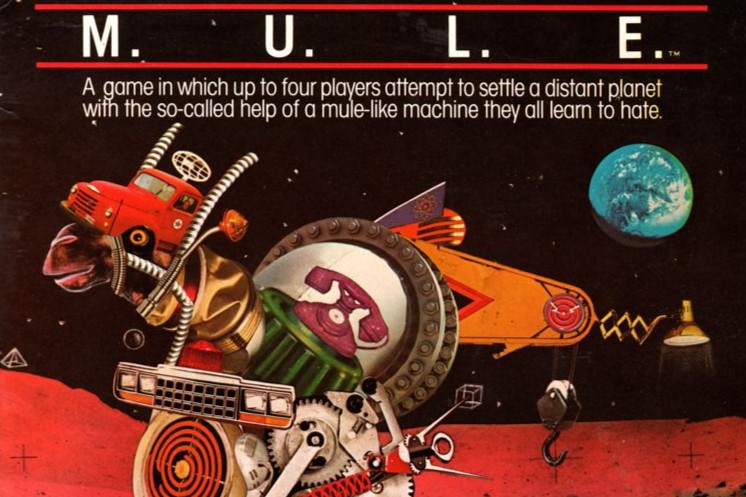
Oh, and for context, you’re going to want to look up the (beautiful) box and manual online.
The alternative, is, of course, to buy an Atari 800, monitor, a copy of the game (good luck finding it for less than $200) and four joysticks.
This is, clearly, absurd. Now don’t get me wrong; there are lost films and inaccessible films. But MULE is out there, and in the history of games it’s at least as important as The Red Shoes is to cinema. But you have to be extremely dedicated to play it–and worse, if you don’t need to be (for example, you pass an Atari 800 in a “VIDEOGAMES!!!” exhibition at a museum) it will be completely impossible to grasp.
So anyway, that sucks, because if you’re a student of games and their history you should play MULE, and not just because it’s honestly still pretty fun. Because it’s passed into this position that people only talk of it from the second or third hand–often to pay tribute to the pioneering Dani Bunten Berry–and I actually feel a bit sad about that. We pay tribute to those who came before us by playing their work, not just talking about it.
[“OK, now start the criticising”–Ed.]
How dare you… ahhh you got me. I think MULE is super cool but here’s the thing that happens after you put in all that work: you go “mannnn this is olddddd” because MULE is old, and “80s personal computer” harsh. It’s at its heart almost a board game, but it’s slathered in early “we haven’t quite worked all this out” design decisions that sorta made sense at the time but also extremely don’t now.

It’s played like this: you and up to three other players (though it’s always played with four) are settling a planet; each round you have to select a plot of land (from plains, mountains or river) and then select a mule, equip it to either mine ore, collect energy or farm food, which it can do on any plot (well, you can’t mine on river tiles) but gain the most benefit from doing so on the equivalent tile. After everyone has done so, a random event happens (a solar storm makes more energy production, for example) each commodity is consumed by your community and the surplus is traded: either to or from other players or to or from the town store. And then the next round happens (oh, and sometimes you can buy plots of land at auction, not just take them when given.)
It’s actually pretty graspable, but the quirk is the law of supply and demand. With particular lands (and land placement) you can create massive surpluses of certain goods, and you can also choose to ignore some goods even though your community needs them. “I’ll make so much money selling this ore” you think, “that I’ll be able to buy as much food as I need.”

Trading happens in a format that must have inspired the negotiations in Theme Park (“Ah yes, I know exactly the mini-game”–every reader, who is as decrepit as me) where you walk your characters down or up the screen to meet at a value, with the quirk that if the store doesn’t have any of a good to sell you the sellers can walk back infinitely (well, within the set time limit) to bleed you dry. (And the computers will do this…) BUT–if they do this, they’re in danger of the colony getting a bad score at the end of the game! So it’s all about the balance of winning (individually) without losing (as a collective). Man sounds like those clowns in congress should play some MULE, am I right???
So far so good, right? The problem is it’s the early 80s, so all of this is done with a one-button stick where you have to control your character and make them walk into the mule pen and then walk out with the mule and then walk into the outfitter and then walk to your plot and then the timer runs out because you didn’t make enough food, or because moving your character is janky as hell. And selecting your plot of land? Oh that’s a reaction test as a cursor moves along the screen (faster on the higher difficulties) meaning the PC is gonna screw you out of half your lands (and mis-timing is going to screw you out of the other half.) And because there’s not that much space on the screen, actually fully understanding supply and demand in context… isn’t going to totally happen. You need to remember how much of a good you need to buy to not be in shortage. How the shop price affects things and changes is… obscure.
Which is not even to raise the nadir of MULE: random “punishment” events. Yep, this was designed well before balancing was really a thing, and they had the best intentions at heart, but “lift up the low boats” wasn’t a thing– “smash the high ones with a tsunami” was. It’s a bummer because it doesn’t really work. It’s super clever to make the winning players play first (so it’s easier for the worse off to strategise) but some players can get into such a commanding position that losing some money here or there isn’t that bad. And instead, things tend to happen like you scrimping and saving, finally getting your engine up and running, lots of ore coming in… and a pirate ship shows up, takes all your ore on a turn when the players ahead of you all switched to energy and food, and now you’re stuck with nothing to sell and no way to afford the energy or food you need to keep your plots going. It is the dogshit worst.
That said, while MULE has the capability to cause (and must have caused) Monopoly-esque meltdowns, the game is still dang fun if you can get into the mindset. The AI is hilariously vindictive–I love that it will screw you on land auctions if you try and force the price up to screw them (it’s all about timing when to walk backwards…) and that they’ll be extremely selective as to when to buy from you, even if it hurts them (I’d swear it knows it doesn’t need food towards the end of the game…) and if you save-scum away only the bullshit punishments or mis-clicks (be generous; it’s 2021) the core here is so dang solid–and it only really makes sense as a video game, because I’ll be fucked if I’m calculating the new cost of mules based on the previous trading period using a table in a board game manual or something.
Is it a classic I’ll return to again and again? No, not really. Is it something that any student of video games should play once, twice, three times at least? Of course, and if there’s anything you take from this it’s criminal that they probably won’t.
Will I ever play it again? I am desperate to play this on tournament mode with three other experienced (but not too experienced) players IRL. No joke desperate. I think there some of my issues (the misclicks; the punishments) stop becoming as massive an issue when you’re playing with more than two people…
Final Thought: Shout out to TreyM for their classic CRT overlays! This kind of thing really doesn’t feel right without them–and they’ll continue to help me experience things “in context” as much as I can when I get to the likes of Rescue on Fractalus…