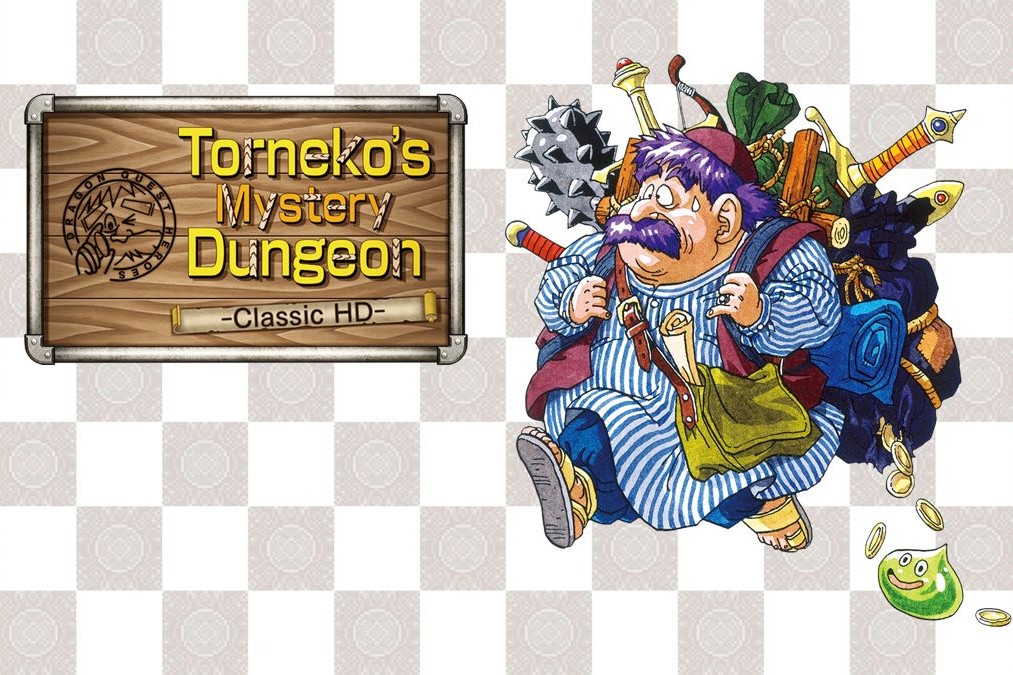

Developed/Published by: Square Enix
Released: 09/09/2026
Completed: 15/09/2026
Completion: Returned to the surface with the Chest of Cheer!
On the 9th September I stuck on the Nintendo Direct, which isn’t something I always do (if I remember I’ll put it on in the background) and one thing caught my eye: a re-release of Torneko’s Mystery Dungeon, the first game in Chunsoft’s beloved Mystery Dungeon franchise. Chunsoft has their own original IP for the franchise, Shiren The Wanderer, and the series has also seen instalments in the Final Fantasy and Pokemon franchises… in fact even the Etrian Odyssey and The Tower of Druaga franchises! It’s a game design that’s got legs, obviously, having been directly inspired by Rogue (so a true Roguelike) but it all started here.
I’m not sure why I got so particularly excited by this that I picked it up on the same day. I mean I’ve got Shiren the Wanderer for DS and I’ve never finished it, along with countless other Roguelike and Roguelike-likes either abandoned or on the docket. Maybe I was just looking for the excuse to be excited about something, and, honestly, as you know by now, I love starting franchises at the beginning, and with no official release of Torneko’s Mystery Dungeon until now…
And yet, I’ve really struggled with if I should write about this one. Shortly after its release–and after I’d played it for at least six hours–John Harris posted a new instalment of his @play Roguelike article where he provided a lot of tips that will be particularly helpful to people playing any version of Torneko’s Mystery Dungeon for the first time, but also noted:
“I note that the credits to this game have a section for AI content. I don’t think that necessarily means it was used to make this game.”
This, obviously, made me pause. It was hardly conclusive (though I did post about it on Bluesky to let people know) so I had to decide: do I keep playing this version, which I was already finding a bit flawed? Or was that just a sunk cost fallacy?
I looked for the game credits to see if I could confirm the information. But.
You can’t see the credits unless you finish the game–which in this case, means trekking down to the 27th floor, getting the “Chest of Cheer” and trekking back up. And this is a Roguelike. And I’ve never beaten Shiren the Wanderer, so…
Well, you know I had to do it to ‘em. There weren’t any long play videos online to look up to try and see the credits, so I just thought–let’s do it.

I’ll say this. Torneko’s Mystery Dungeon is a good “first” proper Roguelike, because while it’s not easy–in fact, it absolutely doesn’t help the player in any way, when it says randomly generated, it means it–the game has less stuff in it than a lot of later games, meaning that there’s only so much you need to know. And it’s a true Roguelike, in that if you get lucky, you can finish it on your first go–there’s absolutely no requirement here that you grind up unlocks to get to the point where you can actually finish it. It’s random, but it’s “fair.”
So I got a bit lucky and was able to finish Torneko’s Mystery Dungeon, an extremely satisfying thing to do. And then there it was. The entire segment of the credits that credited the people that worked on “AI and Engine Development.”
I have to say… it’s not looking good. The obvious rationalisation you might want to make is “well, when they say AI, they might mean enemy AI.” But Torneko’s Mystery Dungeon is a Roguelike, and it’s a very simple one, where every enemy apart from a few (that move randomly) just move directly towards Torneko by the quickest route they can manage. Even characters that, say, steal from Torneko and then flee seem to just be moving randomly unless they are a square or two away from Torneko, at which point they flee again.
I could program this, and I’m not even a coder. No team is required. And that it says “AI and Engine Development” implies–or at least, I am inferring–that AI was involved in creating the engine for this HD remake.
Now, does that mean that this is a complete vibe coded botch job? Well, not absolutely. But as many people including Harris have pointed out, the version launched had some frustrating issues, with laggy inputs and frustratingly slow, unskippable dialogue boxes in battles, which smell a bit… vibey.1
I approached Square Enix for comment and (unsurprisingly) got nothing, so I can’t say for sure. However, the thing about Torneko’s Mystery Dungeon is that it’s a great, great game, and even if the HD remake wasn’t vibe coded, it’s really not the best way to play it.
To review this version: It’s fine. The new 2.5D style is hardly HD2D (although I know everyone is getting sick of that style by now) really just replicating the original simple graphics but a bit 3D, and that’s… about it for actual differences. Otherwise it’s just the same, so really all you’re getting is the graphics tilted slightly and a bit of a lighting effect. The game’s major addition is the “Streaming Up a Storm: My Dungeon, Your Rules (β)” DLC which adds audience participation if you’re streaming the game–I love the idea, but haven’t tried it and wouldn’t call it a major selling point.
If you don’t want to stream the game, the best way to play the game is almost certainly going to be the original version. If you’re willing to put up with Japanese, you can pick up a cart only copy of the game for less than this new HD version goes for, and there’s a fan translation available. The only thing you might miss from the remake is the cute papercraft intro, but you can look that up online so you’re fine.

To be honest, Torneko’s Mystery Dungeon -Classic HD- is a bit of a sad situation. This is a truly fucking great game, and you should want to support it, considering there are two more Torneko sequels out there that it’d be cool to see out there in English. But, frankly, not like this. It’s a no-win situation. You buy this version and support it and Square Enix think: well, slopping out a crappy port is all we need to do! And you don’t support it and they think: making old games available isn’t worth our time.
When all they really need to do was to show a tiny bit of care.
So we’re back at square [“Enix?”–Ed.] one, really: no one is going to care for game history but us. Keep circulating the tapes.
Will I ever play it again? Unless Square Enix get back to me and unequivocally state they didn’t touch AI while developing this, no, never. As much as when this was released I got stars in my eyes imagining my new career streaming this.
Final Thought: And for everything that I’ve said, I really do want to state: Torneko’s Mystery Dungeon is a great introduction to true Roguelikes. It’s very manageable and you can learn the game’s techniques as you go and understand why it’s so captivating. I was reminded how great these games are at creating diegetic stories. My very first game where I was 19 floors deep(!) found myself in a monster den, read the scroll of sanctuary that would have saved me (because I didn’t grasp I needed to just drop it) and immediately died. The following game where I didn’t find a weapon for 13 levels, arrived in a monster den, cast bang twice, killed everyone, excitedly moved towards a weapon and… fell through the floor. Or my winning run, where I had to resort to throwing herbs at dragons just to get past them, and then the terrifying climb back up through the dangerous levels I’d just experienced with almost no items to hand. Thank god for the sustaining ring. If you know, you know.

- There has since been a patch, but this came in just after I finished the game, annoyingly. I can’t speak to how much the game has been improved or not. ↩︎