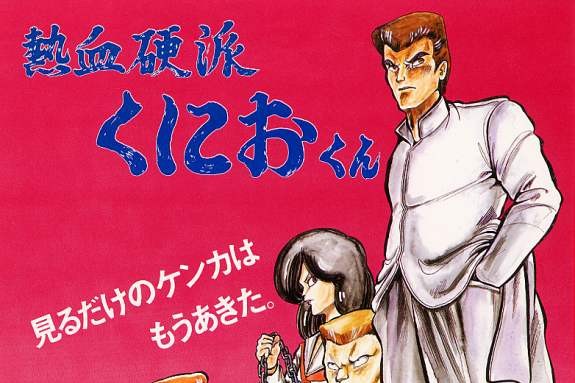

Developed/Published by: Technōs Japan/Taito
Released: 05/1986
Completed: 08/03/2026
Completion: Finished it (Saving after each level.)
It was announced on April 5th that the designer of Nekketsu Kōha Kunio-Kun, Double Dragon and more, Yoshihisa Kishimoto, had passed away. There’s a sad coincidence here, as I’d just played both Nekketsu Kōha Kunio-Kun and Double Dragon for an unrelated reason. These weren’t Kishimoto’s first games–he started at Data East and created some well-regarded laserdisc games, Thunder Storm and Road Blaster (also known as Cobra Command and Road Avenger) but they are his best known works, so as tribute I’ll be posting my articles on them this week and next.

I hadn’t originally planned to play this–in fact, in my write-up of the Famicom’s Nekketsu Kōha Kunio-Kun I said I wouldn’t–but I had a research-related reason and the Egret Mini II’s most recent release, Arcade Collection Part I meant I suddenly had easy access to it, so it would have been an absolute dereliction of duty to not play it.
Best known as Renegade, Nekketsu Kōha Kunio-Kun is a cornerstone video game the likes of The Tower of Druaga or Xevious, in that it would spawn an entire genre that would end up in an almost entirely different–arguably simpler–place. It’s the original “brawler” style beat ‘em up (or, as it’s known in Japan, “belt scrolling action”) though as it exists pre-genre convention, it will surprise any modern player with its stages, which are arena battles (rather than continuous levels) and combat that requires savvy positioning and careful timing, as there’s no way to credit feed (although your health is restored after each stage, there are no continues.)
Renegade was created by Techōs Japan for Taito to appeal to a western audience and was directly inspired by Walter Hill’s New York-set The Warriors (despite that hardly being a contemporary reference; the film was over seven years old by that point) but Nekketsu Kōha Kunio-Kun is remarkable for being an early example of an–at least mildly–autobiographical game. Designer Yoshihisa Kishimoto based Kunio on himself, who as a teen found himself getting into fights on a daily basis.1 The game is strongly inspired by the unique culture of delinquency in Japan: the hero, Kunio, is a high school student driven into action to defend his bullied friend: first against “banchō” (male high school delinquents) then against “bōsōzoku” (custom motorcycle biker gangs) then “sukeban” (female high school delinquents) before finally the deadly yakuza.

Nekketsu Kōha Kunio-kun is deceptive. It can be beaten in as quickly as six minutes, but only the very best players could even attempt such a feat. The game is crushingly hard even on its easiest difficulty, with enemies that intelligently swarm you and a boss in each arena who can seem invincible. The trick is that there are three buttons: a left attack, jump, and right attack. You hit the attack in the direction you are facing, and if there is an enemy behind you, you can hit the opposite attack to do a powerful back kick to make space. This is, honestly, pretty confusing if you’re more used to later games that quickly discarded such a system, but it’s a large factor in the game’s richness. You don’t try to overwhelm enemies in Nekketsu Kōha Kunio-kun; you have to carefully position yourself to avoid getting stunlocked by attacks from multiple directions, and when you face bosses, you have to consider your tactics. The bōsōzoku boss can be taken down easily with jump kicks, but the sukeban boss will always duck; meaning you’ll have to take advanced tactics like keeping a lower-level enemy on screen so that you can face them and instead use your powerful back kick on the boss.
It can be frustrating–and it certainly doesn’t feel fair–but the game is so quick that there’s a draw to trying again with a new tactic in mind. The game does push it a little too far with the yakuza level featuring enemies who all one hit kill. With the boss able to fire a gun and kill you from afar, you have to take extremely conservative hit-and-run tactics that can make a loss absolutely gutting (with a lot of luck you can just wail on the boss as soon as he appears; if the other enemies don’t surround you, they might similarly get stunlocked and you’ll survive; it’s far from a consistent tactic, however.)
I’m a bit surprised by how much I enjoyed this. Maybe it was the novelty of my Egret Mini II, maybe it was that I let myself save after every level, but I had fun trying to “solve” each level after getting over the initial hump of difficulty. There’s depth to the mechanics–you can throw enemies into other enemies, or off the edge of the train platform–and as your health gets restored after each level there’s a real value in trying to survive each brawl at any cost.

Normally I wouldn’t be so in favour of a game this hard, but my memory of the Famicom version is that– though the game was far more expansive, with multi-stage levels, a motorbike mini-game, even a maze–it was just too easy to cheese your way through. It’s better, but not as thrilling. I felt like I really had to work for my win here, and for whatever reason, that just worked for me.
Will I ever play it again? No, but maybe this will lead to a reappraisal of Double Dragon, also on the Egret II Mini’s Arcade Collection Part 1, which I remember being straight cheeks when I played it on (of all things) Xbox 360.
Final Thought: As much as I like the Egret II Mini (despite some issues previously mentioned) they really dropped the ball on dip switches. Nekketsu Kōha Kunio-kun has four difficulties, but they’re listed in the menu as A, B, C, D, and it’s set to B difficulty. Feels like that would make it easy to assume that’s “normal” difficulty, but the default on the machine was normal, which would maybe make that actually A position. I beat the game on A, which I thought was easier than B, but honestly, having switched difficulties around, I can’t really tell. The game is balls hard no matter what, I guess. I’ve played it longer than I would admit and when I start a fresh run I still can’t beat the first level consistently.
- This is sourced from a Polygon article in 2012, though as that article notes, there’s an entire book on Kishimoto’s career by Florent Gorges, Enter the Double Dragon, if you’re interested in learning more. ↩︎