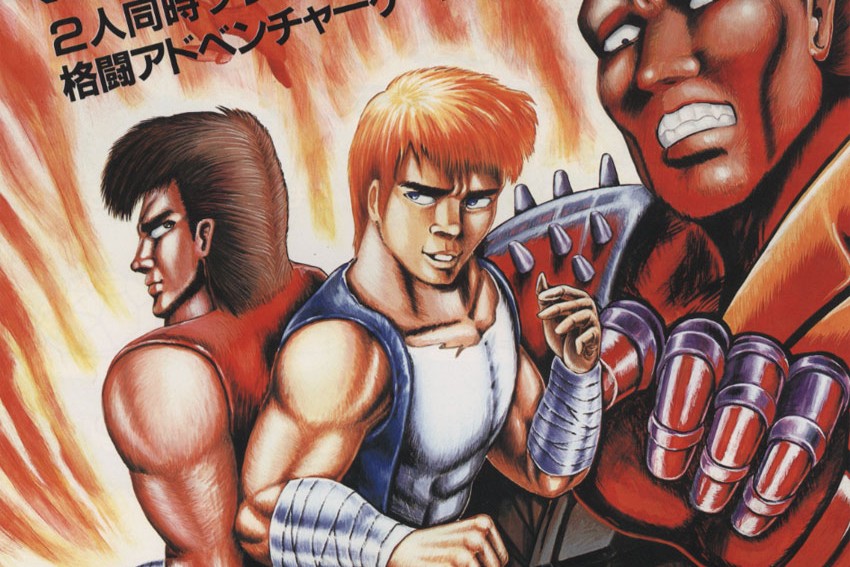
Tag: technōs japan

  • Double Dragon (Technōs Japan, 1987)

    Double Dragon (Technōs Japan, 1987)

    Developed/Published by: Technōs Japan (Published by Taito in North America.)
    Released: 22/04/1987
    Completed: 12/03/2026
    Completion: Finished it (no need for saving until that ridiculous final level.)

    This essay on Double Dragon follows last week’s on Nekketsu Kōha Kunio-Kun as a tribute to the recently departed Yoshihisa Kishimoto, even though, to be honest, I’m pretty hard on it.

    Well, in for a penny, in for a pound, and if I’ve got an Egret Mini II and I’ve paid to own Double Dragon again, then I might as well play it. 

    In my write up of the NES version, I mentioned that I’d played and completed the arcade original in the form of a now long-delisted Xbox 360 release (written up for Eurogamer.) I absolutely put the boot in, but re-reading that now, I notice how it’s definitely a review of the Xbox 360 release rather than an examination of the arcade original. But there’s something I mention in the review I had completely forgotten about: Double Dragon’s astonishingly poor performance.

    I initially thought the Egret II Mini was at fault–I’d remembered someone saying that if the power supply is too low there are issues–but I’d plugged it in with a decent charger. It’s simply that the game’s original hardware wasn’t up to the game design, and the Egret II Mini stays authentic to that (it seems that people can, and do, overclock the game when emulating it through other means; it might have been nice if Taito had offered something like this, but I understand why they didn’t.)

    Ultimately, the game suffers so much slowdown it is agonising to play. The game slows down as soon as there are as few as two enemies on screen, but speeds up if (for example) you’ve knocked one of them down. The speed of the game undulates in a way that’s completely discombobulating. It makes playing the game unpleasant in a way that’s unusually unique; like trying to build a card tower in front of a rotating fan. And you’ve got jam all over your hands.

    Now… just because I feel that way doesn’t mean that the arcade audience of the late 80s felt that way, with Double Dragon “America’s highest-grossing dedicated arcade game in 1988 and 1989.” I find that baffling, because it’s nigh unplayable! 

    (The only assumption I can make–and it very much is an assumption–is that because the game was using older 8-bit chips, maybe the board was cheaper and so a lot of machines were sold, so it won by sheer numbers. But I certainly don’t have any sales numbers.)

    The thing that makes this all a bit of a shame is that, well, even if it’s stupidly hard, I sort of like Nekketsu Kōha Kunio-Kun, and Double Dragon, as the next game from Yoshihisa Kishimoto–and the one that truly defined the side-scrolling beat-em-up by featuring proper levels that you have to progress through to complete–should be better than it is.  Kishimoto is really trying to make another leap here, and you can feel the game straining within the limitations of the obvious technical problems.

    For example: the game is clearly intended to improve on Nekketsu Kōha Kunio-Kun’s enemy AI, one of that game’s most interesting aspects. And while the enemies here do try and position themselves to take you on, the thing you’re most going to notice is that they’ll just refuse to get close to you if you’re holding a weapon (making holding weapons a complete waste of time) and then otherwise they’re really as dumb as rocks, happily walking into dynamite they’ve just thrown or off cliffs.

    And the player’s abilities are supposed to be deeper, more interesting, more situational, with new moves like a headbutt and a spinning jump kick. But it’s ruined by the fact that–I’m sure inspired by Kunio-Kun’s powerful back kick–heroes Billy and Jimmy Lee have a “elbow smash” that attacks enemies behind them. Possibly aware that the back kick was frustrating–because you couldn’t use it unless you had an enemy behind you–you can now do the elbow smash whenever you like, and because it guarantees an immediate knockdown… the entire game becomes about turning your back on enemies, performing the elbow smash, and then performing it again as soon as they get up.

    I want to be clear: I don’t think you can play this game “properly.” It’s simply too frustrating, with no sense that anything that happens is related to your own abilities because of the slowdown. So instead, the actual and I suspect only way to get through this game is to elbow smash every enemy you face–the ones you can’t make drop off edges, anyway. 

    The only reason this game isn’t an easy single credit win is because the final level is, frankly, nonsense. The first section features some blocks that spring out from the background and some spears that statues attack you with that knock off half of your health. They don’t have any tell (the blocks in particular are infuriating) and it means that you will almost certainly lose a life (and the default settings only start you with two.)

    (There’s also a jump across a bridge in the previous level that will probably take a few lives from you, but at least you can see that.)

    Once you get past all that nonsense, the main problem is just that every enemy has a ludicrous amount of health and (yet again calling back to Nekketsu Kōha Kunio-Kun) the final boss can kill you in one hit by shooting you. He goes down easily to the elbow smash like everyone else, however.

    I really, really wish I liked Double Dragon. It’s a hugely important game, but when you play it, you almost can’t understand why. The design is coming from the right place. I can see that Kishimoto is trying to move the genre forward. But it’s still a bit half-baked, and the performance is too poor for you to appreciate it anyway.1 I wasn’t that hot on the NES version–with its awkward platforming, and still including those annoying stupid blocks–but it’s a much better way to spend your time than this.

    Will I ever play it again? Right, that’s twice. That’s absolutely enough times.

    Final Thought: You know what? There’s one thing they nailed straight off with Double Dragon. The theme music. Absolutely gets the blood pumping.

    1. I’d love to read Florent Gorges’ Enter The Double Dragon to see if it has anything on Kishimoto’s experience making this, but it’s 1) in French and 2) not easily accessible. ↩︎
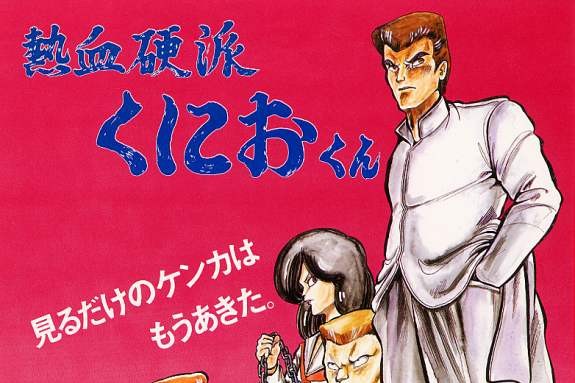
  • Nekketsu Kōha Kunio-Kun (Technōs Japan, 1986)

    Nekketsu Kōha Kunio-Kun (Technōs Japan, 1986)

    Developed/Published by: Technōs Japan/Taito
    Released: 05/1986
    Completed: 08/03/2026
    Completion: Finished it (Saving after each level.)

    It was announced on April 5th that the designer of Nekketsu Kōha Kunio-Kun, Double Dragon and more, Yoshihisa Kishimoto, had passed away. There’s a sad coincidence here, as I’d just played both Nekketsu Kōha Kunio-Kun and Double Dragon for an unrelated reason. These weren’t Kishimoto’s first games–he started at Data East and created some well-regarded laserdisc games, Thunder Storm and Road Blaster (also known as Cobra Command and Road Avenger) but they are his best known works, so as tribute I’ll be posting my articles on them this week and next.

    image via https://x.com/FlorentGorgesFR/status/2041105532522561653
    Yoshihisa Kishimoto (1961-2026)

    I hadn’t originally planned to play this–in fact, in my write-up of the Famicom’s Nekketsu Kōha Kunio-Kun I said I wouldn’t–but I had a research-related reason and the Egret Mini II’s most recent release, Arcade Collection Part I meant I suddenly had easy access to it, so it would have been an absolute dereliction of duty to not play it.

    Best known as Renegade, Nekketsu Kōha Kunio-Kun is a cornerstone video game the likes of The Tower of Druaga or Xevious, in that it would spawn an entire genre that would end up in an almost entirely different–arguably simpler–place. It’s the original “brawler” style beat ‘em up (or, as it’s known in Japan, “belt scrolling action”) though as it exists pre-genre convention, it will surprise any modern player with its stages, which are arena battles (rather than continuous levels) and combat that requires savvy positioning and careful timing, as there’s no way to credit feed (although your health is restored after each stage, there are no continues.)

    Renegade was created by Techōs Japan for Taito to appeal to a western audience and was directly inspired by Walter Hill’s New York-set The Warriors (despite that hardly being a contemporary reference; the film was over seven years old by that point) but Nekketsu Kōha Kunio-Kun is remarkable for being an early example of an–at least mildly–autobiographical game. Designer Yoshihisa Kishimoto based Kunio on himself, who as a teen found himself getting into fights on a daily basis.1 The game is strongly inspired by the unique culture of delinquency in Japan: the hero, Kunio, is a high school student driven into action to defend his bullied friend: first against “banchō” (male high school delinquents) then against “bōsōzoku” (custom motorcycle biker gangs) then “sukeban” (female high school delinquents) before finally the deadly yakuza.

    The level intros, where your pal gets his beaten up and even shot(!) aren’t replaced with anything in Renegade, to its detriment, I think.

    Nekketsu Kōha Kunio-kun is deceptive. It can be beaten in as quickly as six minutes, but only the very best players could even attempt such a feat. The game is crushingly hard even on its easiest difficulty, with enemies that intelligently swarm you and a boss in each arena who can seem invincible. The trick is that there are three buttons: a left attack, jump, and right attack. You hit the attack in the direction you are facing, and if there is an enemy behind you, you can hit the opposite attack to do a powerful back kick to make space. This is, honestly, pretty confusing if you’re more used to later games that quickly discarded such a system, but it’s a large factor in the game’s richness. You don’t try to overwhelm enemies in Nekketsu Kōha Kunio-kun; you have to carefully position yourself to avoid getting stunlocked by attacks from multiple directions, and when you face bosses, you have to consider your tactics. The bōsōzoku boss can be taken down easily with jump kicks, but the sukeban boss will always duck; meaning you’ll have to take advanced tactics like keeping a lower-level enemy on screen so that you can face them and instead use your powerful back kick on the boss.

    It can be frustrating–and it certainly doesn’t feel fair–but the game is so quick that there’s a draw to trying again with a new tactic in mind. The game does push it a little too far with the yakuza level featuring enemies who all one hit kill. With the boss able to fire a gun and kill you from afar, you have to take extremely conservative hit-and-run tactics that can make a loss absolutely gutting (with a lot of luck you can just wail on the boss as soon as he appears; if the other enemies don’t surround you, they might similarly get stunlocked and you’ll survive; it’s far from a consistent tactic, however.)

    I’m a bit surprised by how much I enjoyed this. Maybe it was the novelty of my Egret Mini II, maybe it was that I let myself save after every level, but I had fun trying to “solve” each level after getting over the initial hump of difficulty. There’s depth to the mechanics–you can throw enemies into other enemies, or off the edge of the train platform–and as your health gets restored after each level there’s a real value in trying to survive each brawl at any cost. 

    This motorbike section must have felt like such a slap in the face to those who finished the first level in arcades. You have to time your jump kicks perfectly.

    Normally I wouldn’t be so in favour of a game this hard, but my memory of the Famicom version is that– though the game was far more expansive, with multi-stage levels, a motorbike mini-game, even a maze–it was just too easy to cheese your way through. It’s better, but not as thrilling. I felt like I really had to work for my win here, and for whatever reason, that just worked for me.

    Will I ever play it again? No, but maybe this will lead to a reappraisal of Double Dragon, also on the Egret II Mini’s Arcade Collection Part 1, which I remember being straight cheeks when I played it on (of all things) Xbox 360.

    Final Thought: As much as I like the Egret II Mini (despite some issues previously mentioned) they really dropped the ball on dip switches. Nekketsu Kōha Kunio-kun has four difficulties, but they’re listed in the menu as A, B, C, D, and it’s set to B difficulty. Feels like that would make it easy to assume that’s “normal” difficulty, but the default on the machine was normal, which would maybe make that actually A position. I beat the game on A, which I thought was easier than B, but honestly, having switched difficulties around, I can’t really tell. The game is balls hard no matter what, I guess. I’ve played it longer than I would admit and when I start a fresh run I still can’t beat the first level consistently.

    1. This is sourced from a Polygon article in 2012, though as that article notes, there’s an entire book on Kishimoto’s career by Florent Gorges, Enter the Double Dragon, if you’re interested in learning more. ↩︎