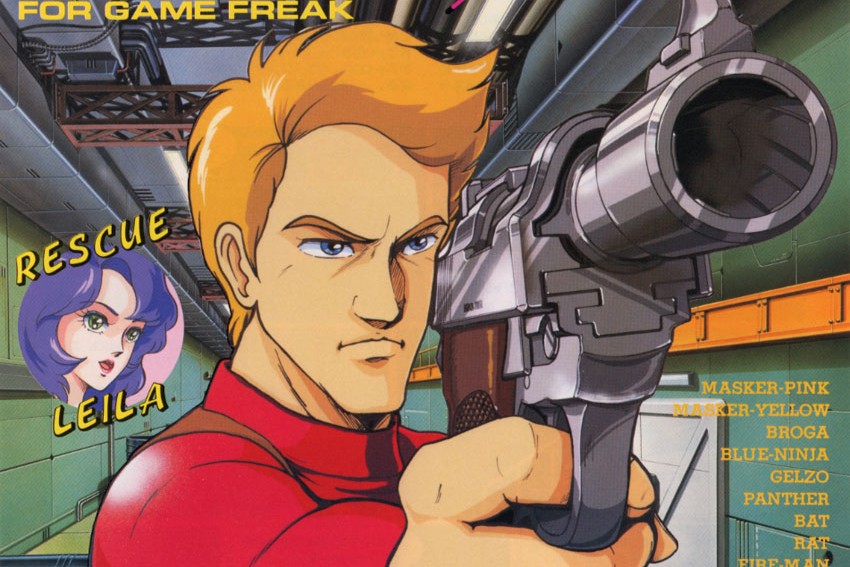

Developed/Published by: Namco
Released: 09/11/1986
Completed: 18/09/2025
Completion: Finished it. Save states at each checkpoint… though I also had to use a few more in lulls just for my sanity on levels 8 and 10 for very obvious reasons.
It’s strange, the games you remember, and the games that you don’t. I suppose it’s about the games that make an impression. Something interesting, I suppose, in my trip through these early(-ish) days of arcade games is not even how few I have any connection to, but how few I even remember seeing in arcades. They’re all from an era “before my time” but only a rarefied few managed to make a consistent enough profit to hang around until it reached my time, and even then, they were probably in some dusty old corner or a banged up cabinet in a chippy, something I probably never played but just stared at the attract mode while I waited for my mum to pick up… hmm, probably a fish supper and a sausage supper? Maybe a special fish if my nana’s over? A couple of pickled onions and a red cola?
Personally, I rather like this separation from nostalgia. That I can really experience these games with fresh eyes. And I can’t say that Rolling Thunder represents that we’re reaching an era that we’ll start to see more things that I remember, or might have played (looking at my to-play list, it absolutely does not.) But Rolling Thunder definitely had something to it that I remember it really well. This isn’t a vague, childish memory of maybe a Gradius or a Salamander machine in the Magnum–god knows, it could have been an R-Type–this is a “I played this. I played this more than once. I will have been annoyed because I’ll have lost my credit so quickly. But I definitely put good money after bad.”
Because Rolling Thunder looks. so. cool.
I don’t know if I can explain it. There’s just a very clean, clear style to the graphics. Although you’re actually playing a member of the “World Crime Police Organization” on a mission to save another agent, there’s a real 60s spy flick feeling from the very first screen–like you’re James Bond, attacking the base at the end of You Only Live Twice. And the action is fast and more importantly stylish. The hero, Albatross, ducks behind cover to shoot enemies, and leaps over rails to switch between low and high ground. It looks cool as hell. It looks like it’s going to be a lot of fun to play.
Historical Aside
There was a meme going around on Bluesky a while ago that looked like this:

I’m absolutely not going to disagree with it, not having sucked it up and tried to play the Portopia Serial Murder Case (yet). But history is a many faceted thing, and I think if I was going to make the meme from what I’ve learned over my time spent digging into the history via what I’ve played, it would look like this:
The Tower of Druaga on top of Xevious, and the stalk is Spartan X.
Now, I haven’t written about Spartan X (better known as Kung-Fu Master) because, well, I’m trying to not keep loading more games onto my to-play list (uh, more than I already do) but it’s an unbelievably important keystone. It takes the rhythm of the designer Takashi Nishiyama’s previous game, Moon Patrol, and translate it into a side-scrolling action game (one that, weirdly, starts with you scrolling right-to-left). The main thing you need to know about it is that pretty much any game you’ve ever played where dudes relentlessly stream in from a side of the screen? That’s from Spartan X. Something like My Hero is an obvious, but the DNA is over Ghosts n’ Goblins, even Super Mario Bros., and, absolutely, Rolling Thunder.
Rolling Thunder is, actually, very fun! But it absolutely suffers for the nature of arcade games of the era (or any era, I suppose): the requirement that it remove the quarters from your pocket like you’re being held upside down and shaken by a bully. From the very beginning of the game, you have to play it in an exacting fashion, and be prepared to learn the game’s layout, because you can’t survive via reaction–you have to know what’s coming and act before it happens (literally, in many cases.)
It’s a shame, because the core design is unbelievably solid. You can move and shoot. You can leap between the two levels (as long as there’s a railing–Albatross will only jump if it looks cool) and there are doors enemies come out of and which you can enter, which is a bit like Elevator Action but actually the only doors you want to go in are the ones that have more bullets or the machine gun upgrade, because coming in and out of a door is dangerous and confers no advantage (you can’t duck into a door to avoid taking a hit, it’s too slow, and enemies often just hang out in front of them. In fact, you quickly learn to not even stand above or below doors, because enemies might pop out and leap on you before you can do much of anything.)
The design is a game of forward momentum, enemy and area control. You want to keep yourself positioned so you don’t get overwhelmed or surprised, take on enemies and move forward. When it works, it’s amazing. You shoot an enemy when they pop out from cover from behind cover yourself. You leap over the cover, spin around, shoot another enemy. You leap up to the higher level, pop a few more enemies, move forward so an enemy on the lower level leaps up too, you shoot them–and so on.
The problem is that it only rarely feels like play. The game plays a genuinely ridiculous trick on the player from the off–it claims you have eight bars of health, but actually, you generally die in two hits, and often what is one or feels like one (I think headshots kill you in one, and some enemies hit you twice in quick succession.) There are no ways to regain health, and you get a maximum of one checkpoint on the often long levels (and the 5th and 10th levels have no checkpoint!) so you just can’t style it out ever. The game doesn’t have strictly deterministic enemies or enemy layout, but you can plan around the doors and spawns.
If you do this, the game is… mostly fair for the first five levels, which the game calls “Story 1” (this is a confusing bit of framing. Story 2 feels like a second loop, but it’s actually different. There is a narrative, of sorts, to the game and levels, so is Albatross failing the first time? I’m overthinking it). A player with a patience could probably single credit the first story with some effort as long as some particular gotchas are memorised (the section where you have to jump an obstacle to get to an enemy throwing bombs at you stood out to me, but there’s also the timing of invisible, flying and fire enemies to worry about). Story 2, however, is absolutely fucking bananas.
Something I’ve failed to mention about the design–once you’re three levels in, the game, almost quietly, introduces the ability to switch between the foreground and background planes on the lower level via doors, and that seems to allow the designer(s) to increase the chaos on screen tremendously. So no longer are you just dealing with enemies in front of you, behind you and above or below, but also in all those locations on a second plane. If you’re on the upper level and there are enemies on the background, well, they can jump up and kill you the same way the enemies in the foreground are.
This gets pretty bad, but the true depths of Rolling Thunder are in any of the sections where it tries out being an actual platformer. Albatross is stiff in the way Arthur in Ghosts n’ Goblins is, but he’s also about twice the size and only has a short hop laterally compared to his leaps over railings. The 4th level is bad enough, but the 8th introduces a final section where you’re hopping across tiny columns after an enemy gauntlet where you literally have to position yourself correctly to avoid being killed immediately by enemies below you–I have no idea how anyone did this when they had to start from a checkpoint minutes earlier.
As I played this via Namco Museum I had no rewind to abuse like I did in Ghost n’ Goblins, so finishing this–particularly the ridiculous final level–was an absolute test of my nerve. Rolling Thunder is so determined to strip you of your money that even the level timer is stupidly tight–I finished many levels with less than ten seconds to spare, and that was booking it as much as I could–which made me save state only when absolutely necessary. That I still finished this makes me think that the game is easier than Ghost n’ Goblins, though not by much.
I think also that I liked it a bit more (even if it was, at times, deeply annoying and frustrating.) As the enemies are more predictable and the layouts simpler, the game is easier to learn, though for many the more reactive play in Ghosts n’ Goblins might be preferable (but at this level of difficulty, I don’t think I agree.)
Because Rolling Thunder gates its “true” ending behind the last five, brutal levels of Story 2 I’m not certain I can give it an unequivocal thumbs up. I wish that they’d been able to ease off the gas a little bit, maybe let the levels live a little more (like a lot of these arcade games, it introduces ideas briefly, forgets them, moves on.) But I don’t know… it’s still as cool as it ever was.
Will I ever play it again? I don’t say this for every arcade game, but if I saw this in an arcade, I’d see how much I could show off by how far I could get into this. I suspect only the second or third level, but still, most people don’t make it to the first checkpoint, so I’ll take it.
Final Thought: Rolling Thunder received a couple of sequels, but the true legacy of the game is almost certainly that it inspired Shinobi quite directly, a series that would go on to far outlive it. Also the game’s Blogas absolutely 100% had to at least slightly inspire Blanka. I mean look at their colours! That’s basically Blanka’s alternative palette!!!