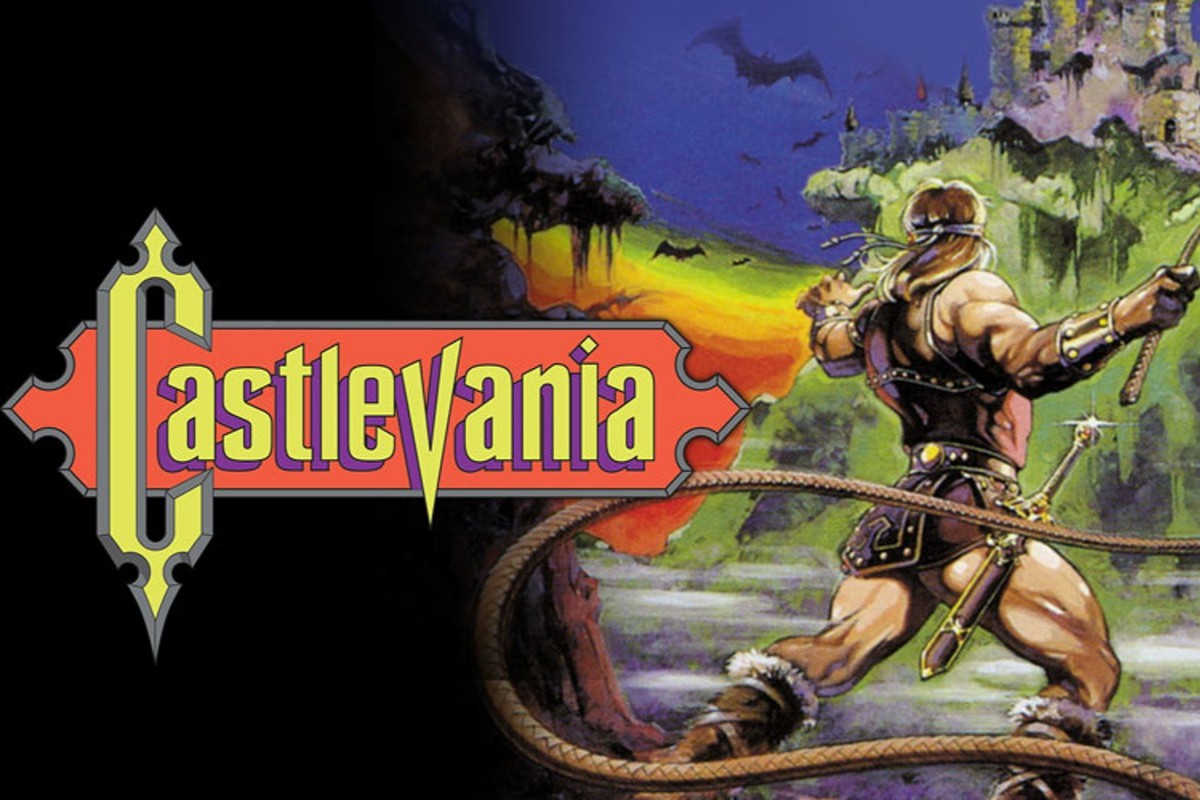

Developed/Published by: Konami
Released: 26/09/1986
Completed: 09/09/2025
Completion: Finished it. I did do a save state before Dracula though, to avoid repeating an exploit.

Before we get into the article: you can pre-order a copy of exp. 2602, my brand new zine, right now. If you haven’t picked up any issues yet, there’s a discounted bundle of all three zines! Patreon members get an even bigger discount: subscriptions start at just $1!
I’ve been in the trenches of 1986 for such a long time by this point that I feel like, sometimes, I lose a bit of perspective, so as I reach Castlevania, released within two months of Metroid (and also on the Famicom Disk System) it’s good to take a minute to reflect again on the strength of the release calendar for the Famicom. It’s not just Nintendo’s groundbreaking output, for example, it’s also incredible arcade hits such as Gradius and Ghosts n’ Goblins coming home in solid ports.
And with the influence of The Legend of Zelda and especially Metroid going to take more time to disseminate, I think it’s important to consider Castlevania within the post-Super Mario Bros. milieu where the arcade still reigns supreme as the state of the art. You went to the arcade and wanted to play games that good at home, and developers wanted to sell people on their “arcade quality” experiences, even if there was no arcade title attached.
I’m assuming you can see where I’m going with this, but the interesting thing about Castlevania is as much as it is tied to the Metroidvania genre–and would begin dipping its toes into that within a month–the first game is no more attempting to create an expansive, “home” experience than Konami’s earlier port of Gradius is. If you’re being generous, you could claim that Castlevania is Konami’s attempt to make the style that’s already worked so well for them in the scrolling shooter for the arcade–short, hard games with impactful, unique levels and standout bosses–translate to the side-scrolling action game/platformer for the home. If you’re not being so generous, you could say this is Konami’s rip-off of Ghosts n’ Goblins.
That one probably works better.
I don’t think it’s unfair, really! Ghosts n’ Goblins is a good port, but it looks weedy. It’s hard not to imagine Konami, given the extra power of the Famicom Disk System, thinking that they could simply do something better, and the hallmarks are all there. A spooky setting. A stiff, inflexible hero who struggles with platforming. Limited power increases and different weapons to collect, which all have important situational uses. When you look at the original Japanese titles it looks even more sus. Ghosts n’ Goblins is “Demon World Village” Castlevania is “Demon Castle Dracula” (to not get too into the weeds on this, Demon isn’t spelled exactly the same, but they do both use the kanji 魔.) And if you don’t consider that case closed? Well, there’s also the difficulty.
The bloody difficulty.
Unlike Ghosts n’ Goblins, Castlevania absolutely lulled me into a false sense of security at the start. There’s no Red Arremer here as a harsh wakeup call, and the first boss, a bat (which does have a bit of the Red Arremer about them) is easily dealt with if you have the axe subweapon, which is literally in a candle right before them.
Once you’re in the second level, however, all bets are off, as you’re suddenly facing the dreaded medusa heads paired with the fact that you lose a life if you fall into a pit (easy to do as you get stunned and knocked back on getting hit) and it only gets worse from there. There are some absolutely hair pulling moments.
Really, Castlevania feels like a game that shouldn’t work, because hero Simon Belmont is so slow and it’s such a challenge to react to anything. But the game has a weird sort of pleasure in its heavy, exacting feel. Simon slowly moves forward and really feels like he’s absolutely thumping the enemies in front of him, and a bit like a shooter it’s all about finding your racing line through the game, collecting the right subweapon at the right time and learning where the meat Dracula has stuffed in his walls are for safety (good poll if they ever add polls to Bluesky: would you eat Dracula’s wall meat? Yes / No / If I was really hungry, I guess).
There’s also an intriguingly vestigial sort of hidden, sort of experience system–if you use subweapons a lot enemies eventually drop upgrades that let you have up to three on screen–but it’s foiled by the fact you want to switch subweapons a lot and you lose the upgrades when you do (why!!!) but if you can master it you can absolutely cheese some of the bosses–I mean, it’s how I saw the end of this…
I even like that Dracula’s Castle sort of makes sense as a layout. I mean, it doesn’t really, but I like that they made the drop that happens after you fight the mummies sort of the correct length, and then you might be surprised that the “clock tower” section of this game is so short, but it’s tall and thin… like a clock tower!
The brutal difficulty of Castlevania makes some sense on the Famicom Disk System because you could save at any stage(!) and when the game was re-released on cartridge in Japan it got an easy mode–although it removes knockback on hit, which just seems weird (if you’re interested, it’s included in the Rumbleminz SNES port, the method by which I played this.)
Ultimately, if Konami set out to best Ghosts n’ Goblins… well… they did!
Will I ever play it again? I will play its many, many remakes and… side-makes?
Final Thought: Yeah, so, the weird thing about Castlevania is that it came out on Famicom Disk System just a month before it came out on MSX2 (a version generally known as Vampire Killer, as it was titled that in Europe.) Although Vampire Killer shares graphics, enemies, and is still a trudge through Dracula’s castle, individual level design differs completely, as levels are non-linear and you’re expected to search them for a wider range of items, upgrades and keys to unlock doors to the next level!
Annoyingly, I can’t find good information on why the games are so different, outside of pretty generic speculation (“now, PC games drive like this [mimes driving like a huge nerd] and Famicom games drive like this…”) so it’s really hard to say what concept “came first.” if the MSX version was the original idea, then my Ghosts n’ Goblins hypothesis–my Ghosts n’ Goblothesis–is incorrect.
I do feel like it would be a bit unusual if both games weren’t directed by the same man, elusive series creator Hitoshi Akamatsu, and Castlevania II would go on to be much more of an adventure, which would be a mark against my goblothesis, but weirdly according to an amazing shmuplations translation, Akamatsu was inspired by The Maze of Galious, which is itself a post-Vampire Killer design, so who knows. I guess I can get closer to finding out if I play it, so let’s see how long I can avoid that for.
Update 2025/10/01: Actual game historian Kate Willaert got in touch over on Bluesky with some critical context:
“My understanding, from delving into this era of Konami, is that the two versions of Castlevania were developed in parallel, with the teams possibly sharing ideas with each other, and so neither game is “first” nor the “real” one. See also MSX vs. FC Goonies, which laid the groundwork for this game … While it’s possible that Ghosts N Goblins inspired some surface elements, my personal theory is that the foundation of Castlevania can be found in the computer game Aztec, which was fairly popular among a particular generation of Japanese game devs.”