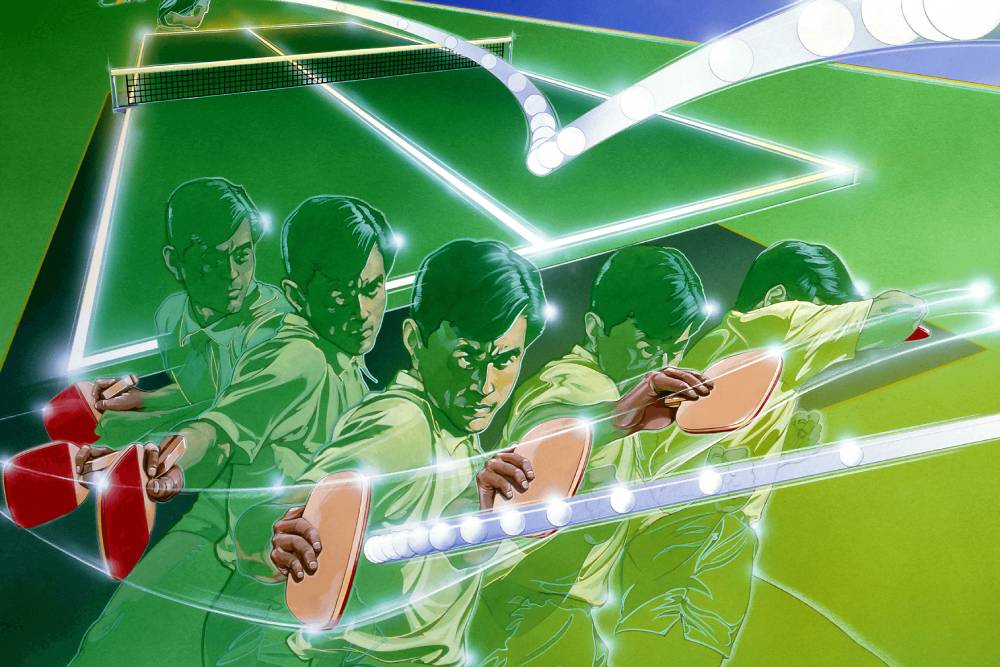

Developed/Published by: Konami / Nintendo
Released: 30/05/1987
Completed: 09/04/2025
Completion: Beat a computer opponent!
Smash Ping Pong is a bit of a mystery in the Famicom Disk System line-up, and Nintendo’s history in general. Created, and originally released, by Konami in arcades (and on other home systems such as MSX) as Konami’s Ping Pong, for some reason Nintendo put it out on the FDS themselves. This is especially odd when Konami were one of the few third-party developers to go all-in on the FDS–like Nintendo: their new releases were on disk, not cartridge.
There’s a few possibilities as to how Nintendo ended up publishing this, but it does seem to stem from its very likely background as a port that Konami had kicking around in the back of a cupboard unreleased. In fact, The Cutting Room Floor says as much: that there is “ample evidence” that it’s a salvaged cartridge release, most damning that the game code includes a serial number that aligns with “missing” serial numbers from Konami’s early Famicom lineup.
The question really is: why put a game that’s already a couple of years old by this point out on the FDS? Well, Nintendo will have almost certainly been looking for more games to help quickly fill out the add-on’s catalogue, and sports games are a perennial filler.
Or, perhaps Konami considered it more profitable to fob Smash Ping Pong off on Nintendo to handle all the publishing duties for, considering the Famicom Disk System’s licensing terms anyway, which requested partial copyright ownership and royalties compared to the complete wild west of Famicom cartridges.
But having said all that, it might just be that someone at Nintendo really liked Konami Ping Pong! Because… it’s really good?
I’ll admit to not having much experience with ping pong games before this–I’ve never played the much loved Rockstar Table Tennis, for example–so I don’t know if what Smash Ping Pong does is unusual or influential, but I am extremely impressed with a design that cleverly side-steps any questions like “well, why not just play a tennis video game, aren’t they the same?”
You see, in Smash Ping Pong, you don’t control the movement of your paddle. Your disembodied hand and paddle already track the position of the ball. The game is instead entirely about which strikes you use, and the timing of your strikes.
While this takes a bit of getting used to–and the speed of the game doesn’t help, but then it is ping pong–savvily the game only features three kinds of strikes: drive (a fast strike) cut (a slower strike) and smash (self explanatory?), chosen with a tap of the d-pad, plus the ability to change if you’re holding the paddle fore or backhand by holding A, which can change the direction of the strike.
It is shockingly elegant, and I think is one of the best examples of a game trying to replicate the experience of playing a sport at least at this early stage I’ve seen. You don’t have to think about positioning–in ping pong, it’s about hitting the ball, not about getting into position to hit the ball, right? And so it’s all about watching the ball and getting into a rally, trying to force your opponent into a mistake. You don’t need to think too much, but you do need to practice and learn how to guide the ball in an advantageous way, when to change strikes, when to change to fore or back hand.

There is some “give” to the design though. When a strike goes awry, either from your or your opponent, a tone is played to make it clear this is a slow, easy ball that you can smash–usually an easy point unless you’re at the far end of the table and don’t change hand position.
It just… works, and while it does suffer from the classic “one player is at the back of the screen” issue of this kind of game (though it switches positions to keep it fair) Famicom owners who played it probably found this one of the most balanced and engaging sports games for two players on the system. Not as flashy as Pro Wrestling, but a good companion.
It does fall down a bit on single player though. You can select difficulties and play either first to 11 or first to 21 matches, but there’s no tournament or campaign mode; you just play a single match and you’re done, at best a practice mode to get you up to speed to play another human. They do try for some character–the Famicom Disk System mascot Diskun shows up, and Donkey Kong is in the crowd (he probably didn’t want to go see the tennis, what with Mario being there) but it’s not quite enough to keep the attention.

I’ve talked previously about the kind of “curated” collection you would want to end up with if you were a Famicom collector–a selection of games you might actually play on occasion rather than just have on shelves–and this would 100% be in mine along with Pro Wrestling. Didn’t expect that at all.
Will I ever play it again? I would love to. It’s funny, while playing this I was struck by the question of how often “retro” gamers actually play these old games with other people, or if they do just sit in collections. Because this is ripe to be rediscovered–it doesn’t feel like a design where you’re better off playing a newer ping pong game instead, because it’s so focused and complete as it is.
Final Thought: I liked this so much I wanted to see if it was fondly remembered by Japanese players so looked it up Nintendo’s handy Famicom 40th Anniversary site, only to learn, tragically, that it didn’t even get a sniff at the “What do you think of when you hear ‘sports game’?” poll, which had rank rubbish like Volleyball in ninth.