Developed/Published by: Acquire, Japan Studio / Sony Computer Entertainment Released: March 18th, 2010 Completed: 29th March, 2014 Completion: Finished the main campaign without letting a single person die/go unsaved. Hurrah! Trophies / Achievements: n/a
Oh, hello! Patchwork Heroes is a game I actually wrote about already—for exp. issue infinity—and so I don’t think I should write about it again. And, yeah, I wrote about it without having finished it. Deal with it. I kind of forgot about the game for a while but returned to it last weekend and polished it off. I’m not going to discuss it any more than that—look, if you wanted to hear what I had to say, you should have bought a copy of the zine three years ago, ok—well, other than to say you should buy it, you can download it for the PS Vita and it’s lovely. Just buy it.
Will I ever play it again? A tougher question than usual. I can see myself playing it again, yeah, but I’d (as usual) rather see a sequel.
Final Thought: It’s funny how if you really like a game, failing a lot and having to replay it just isn’t a problem, eh? Towards the end of Patchwork Heroes there’s actually a few unfair twists (hell, it’s a Japanese video game, that’s the way they make things harder) but I always had this sense I could deal with it, that I could do better. So I would spend hours not really getting further but still enjoying it. And yet in so many games when I hit a high challenge it’s such an unpleasant stumbling block. Was I ever really enjoying them at all?
Developed/Published by: Richard Hofmeier Released: July 29, 2010 Completed: 27th March, 2014 Completion: I didn’t. This is the first time on this site I have a game I can officially state I gave up on. Trophies / Achievements: n/a
Before we get into the article: you can pre-order a copy of exp. 2602, my brand new zine, right now. If you haven’t picked up any issues yet, there’s a discounted bundle of all three zines! Patreon members get an even bigger discount: subscriptions start at just $1!
I wasn’t going to write about Cart Life! As I played it for a while and gave up on it, I was prepared to let it slink off into the dark. However, I was asked by a few people (not least Incredibly Strange Games’ Chris Charla) why I didn’t like Cart Life, so I kind of feel honour bound to outline why I couldn’t bring myself to even finish one of the stories in Cart Life.
Full disclosure: I played every one for at least two-three days of in-game time, and in every case multiple times.
So, Cart Life then. After this year’s IGF and GDC Awards, where Papers Please cleaned up, I decided to go back and find out what it was that made the last two award-show defining titles the titles you—at a glance—can deduce are obviously depressing, intentionally boring, and glibly worthy. I’ll talk about Papers Please in future! But I wanted to trust that these games were being chosen for what they actually are, not what they represent vis-a-vis a “trend.” (I’m not convinced.)
But what is Cart Life?
Cart Life is a weird sort of mash-up of adventure game and Lemonade Tycoon-esque simulator. There’s sort of a dash of The Sims, too. Basically, you have a hero—one of three street vendors—and they have a goal, something simple like “get enough money together for a deposit on a flat within a week.” They’ve also got to eat, sleep, and feed their addiction (smoking, or coffee, for example.)
So, what you do is you get them up in the morning, you get them over to their cart, and you spend their day doing monotonous tasks. Then you either do something vaguely social/story-related if there’s time, or go to sleep and have pointedly bad dreams. And there’s never, ever enough time in the day.
That there’s never enough time in the day is an obvious point for a game to make, but it’s a point that Cart Life is making, and it’s what kind of leads to what I consider my main criticism of it:
Without already being extremely video game literate, Cart Life is impossibly off-putting. Yet with an extreme level of game literacy, Cart Life presents a challenge that obscures anything it’s trying to say.
This is possibly a little hard to explain, but to put it roughly: Cart Life uses its video gamey aspects: world navigation, maps, menus, “mini-games” to represent the challenge the characters face. But if you’re not already very familiar with this kind of thing, the idiosyncrasies of the system and general lack of useful tutorials are insurmountable. And this isn’t something I could call useful to the meaning to the game, as it’s definitely a struggle with the “top layer” of the content.
Of course, if you can become familiar with how to play the game, as I did… it’s too easy to get drawn into a system where you are determined to absolutely murder the challenge; to “min-max” your play. Didn’t spend the day just right or make enough money? Reload the last save.
This is probably controversial! In fact, I can imagine that many (most?) players of Cart Life doggedly played a “failing” hero right to the end (where it turns out it’s the taking part that counts, anyway.) However, having played many, many first days where I made mistakes because I didn’t understand how to play, once I did I was in the mindset that I could always do better. It was after beginning Melanie’s story for the fifth time or so where I managed to run a “perfect” first day (set up the cart, get the permit and a bus pass, even walk her daughter home from school) that I was like “gah, fuck this.” (Admittedly because I’d min-maxed so hard that I went to bed at 6pm, woke up at 3am the next day and broke the game completely.)
In an earlier article I talked briefly about how when and why you stopped playing a game is also educational, just in a different way from doggedly getting to the end to suck the marrow from the bones of its design. With Cart Life, I stopped because I found the tension of “being a game” and “being meaningful” impossible to relate when presented the design of Cart Life.
There are several interviews with Richard Hofmeier where he talks about how the game is supposed to not so much be depressing, but to instil in the player that kind of pride a wage slave worker gets from doing a boring, repetitive task well. I’m going to set aside how arguably patronising that is—there’s a rougher, more polemic article I could write about how Cart Life’s success is related to a safe, private othering of the working poor by the kind of middle-classes who would write and talk about and vote for an “art” game—and say that having been a wage slave, Cart Life is weak at this. I know how it feels to cut the plastic ties on a bundle of newspapers or a cardboard box, and it doesn’t feel like switching my hands to the keyboard to type “cut the ties,” an experience which in every case I thought “urgh, how irritating.”
You don’t think “how irritating” when doing a job like that. You think “just a few more then it’s break time” or “fuck, these bindings are cutting into my hand” or you escape into your own mind entirely because it’s all you’ve really got to do.
I just don’t see the challenge of the game as accurately representing the challenge of these lives, something that I think Hofmeier admits (he’s stated in interviews that actual vendor cart owners respond least positively to his game, and I do understand his artistic urge to make dealing with newspapers involve text.)
But If you want a key example: Andrus is an immigrant. As an immigrant myself, one who was pretty sure he was speaking English, I discovered that when I moved to Canada I spoke Scots and no one understood me. Just talking to people became a difficult navigation of the right words to use. A challenge.
Andrus? He speaks awkwardly, yeah. But if I want to talk to anyone in the game, I just hit “up” and he does all the work for me.
Will I ever play it again? Hofmeier has made the game open source and I’m definitely interested to see if anyone is interested in picking the game up and murdering the bugs which plague it. I actually doubt we’ll see a complete, non-glitchy version of the game, but if we did, I’d consider taking another run at it, tempering my urge to min-max or “be a gamer.”
Final Thought: I wouldn’t let Andrus smoke. No matter how bad his cough got, how poorly treated by the cough drops from the store, I wouldn’t let him smoke. I never said the game didn’t succeed in some ways.
Developed/Published by: Project Soul / Namco Bandai Released: September 1st, 2009 Completed: 25th March, 2014 Completion: Uh… there’s no actual story mode or anything in this. Not even an Arcade mode. I just… stopped. Trophies / Achievements: n/a
Apparently Soulcalibur is how you write the name of this series? Huh. Well… you know, Soulcalibur on Dreamcast is the first time I remember being “wowed” by graphics. It’s rare, but it happens. I remember standing in G-Force Games on Union St.—never a game store I’ve been fond of, I’ll spill—and seeing the attract mode run; Kilik all swingin’ his staff about. I was genuinely impressed.
So, later I bought a Dreamcast and Soulcalibur and basically devoured every single piece of content. It was enjoyable! Anyway, a while ago Soulcalibur: Broken Destiny was put on PlayStation Plus and it works on a PlayStation Vita, so I thought I’d give it a wee go and see how I felt about it, having not played a single Soulcalibur game since the Dreamcast one.
The PlayStation Vita screen is nice, isn’t it? Because weirdly, there’s something about the PSP-level graphics on such a nice, crisp screen that I found… impressive. Like these graphics are just good enough that I’m drawn back to that “wow” feeling, without being so good I don’t notice them or feel weird about them. Just before the uncanny valley, or something.
However, I’ve since discovered: I don’t remember or never knew how to play Soulcalibur, and I don’t really care to either.
Will I ever play it again? No.
Final Thought: So, there is a bit of the game that you could expect me to want to complete, the “Gauntlet” mode which is sort of a silly story mode/tutorial. Despite being cute, even borderline amusing, it’s hundreds of incredibly short “react instantly to your opponent’s move” tutorials that are boring and teach you nothing really about the systems of the game. So I didn’t.
Developed/Published by: Zen Studios / LucasArts Released: February 19th, 2013 Completed: 25th March, 2014 Completion: It’s pinball. You can’t actually complete it, so yet again more truthfully: I just stopped playing. Trophies / Achievements: 27%
Pinball is in a wee bit of a renaissance, recently. Not the physical machines (god no) but in video game-o-form, with FarSight Studios more or less kicking the whole thing off with their excellent digital re-creations of classic pinball tables in things like Pinball Hall of Fame and now their ongoing project The Pinball Arcade, which has enough of a following that they’ve managed to run fairly pricey Kickstarters for new tables and otherwise keep up a pretty regular run of new tables.
So people who like this—admittedly fairly niche—line of game design are well served. What I think has been so important to the whole thing is a little odd, though, considering that it’s something I pretty much hate in every other kind of game. It’s achievements.
You see, I don’t actually think it was until I went to the Pinball Hall of Fame in Las Vegas that I ever really understood how to play Pinball. For pretty much my entire life up to that point, every table was an inscrutable jumble of flashing lights. You put in your 50p, and the entire aim of the game was “don’t let it go down the hole in the middle… or those holes down the side, but you can’t really do anything about that.”
Not to say I didn’t like some tables! I always loved the Data East Star Wars pinball machine (which we’ll probably never see remade, thanks to this) Twilight Zone and so on. But understand them? No. It was only by spending almost an entire day at the Pinball Hall of Fame, working my way up from the most basic tables to the most modern, that I got this gradual understanding. Tables that have one feature up to tables that have a bazillion. Started to be able to pick out what I was trying to do to make points happen. Started to learn what an incredible game design challenge a pinball machine is.
Not everyone would have this opportunity, and honestly, it still wasn’t enough. And that’s where FarSight stepped in. They added “goals” to every table, which result in achievements. Get the “Standard Goals” and you’ve basically learned the table. Get the “Wizard Goals” and you’re amazing at that table. They’re nice, granular ways to learn the table, always giving you something to aim for other than a high score, and if you’re so good that you’ve got them all, then you’re aiming for some pretty astonishing high scores and the challenge alone should be enough to keep you going. It’s really an incredible way to start to get pinball, and off the back of it I learned to really like what seemed like a confusing yet simultaneously boring table like Black Hole.
Anyway, Star Wars Pinball is a stand-alone game from Zen Studios, basically FarSight’s only competitor with Zen Pinball. They create their own tables—which are a bit more magical, more Devil’s Crush video game pinball, than strictly realistic—and they have no fucking idea how to use achievements to teach the tables or give players an interesting challenge/range of goals. There’s three per table, every one (bar one, a Yoda-based bonus on the Empire Strikes Back table) is insanely hard to do unless you are amazing; in fact the Boba Fett table’s goals are more or less “do everything on the table” and one of the Clone Wars (spit) table’s is “do this one thing flawlessly three times in a row, NO MISTAKES.”
It’s garbage.
Will I ever play it again? No.
Final Thought: What if you don’t want goals, you just want to score points on pinball tables? The tables are ok, I’d actually say they’re overcomplicated by all the video game stuff. And you are going to get SO sick of the theme. The same quotes from the movies, over and over and over again. Barf.
Developed/Published by: Intelligent Systems, Nintendo SPD Group No.2 / Nintendo Released: February 16, 2009 Completed: 10th March, 2014 Completion: Got all the way to the final level, gave up and watched the ending on YouTube. Trophies / Achievements: n/a
It happened! Yes, this is a rare occurrence—admittedly one that’s more usual with Japanese games of an RPG or strategy persuasion, of which this is all of the above—but here’s a game where I got to the end boss, clunked against it without any acceptable way to progress, said “fuck that” to reloading an earlier save and grinding or some other tiresome solution, and just watched the ending on YouTube.
And I was so proud of that time I toughed it out and beat the end boss of the original Persona, too.
It’s sort of a shame! Because there was this… well, I’ll be honest and admit it was brief, but there was this brief period where I was sort of into Fire Emblem: Shadow Dragon. In fact I was thinking “heck, everyone likes Fire Emblem: Awakening so much, and this is actually ok, so I’ll probably play it some time.”
Now? I doubt that. Because nothing dredges up all the mistakes a game has made than a bad ending. So let’s discussing!
Fire Emblem: Shadow Dragon is the DS remake of the very first game in the Fire Emblem series, which made it feel like a pretty good place to start (especially as it’s the introduction of Marth, the first Fire Emblem character that was seen outside of Japan, albeit in a Smash Bros. title.) Unfortunately, it’s obvious that as a Famicom game originally, the first Fire Emblem was pretty basic. All the things it seems people mention about this series, like characters talking to each other in missions, are missing here. That of course shouldn’t be a problem, because the strategy core—very similar to Advance Wars—should be what you care about, right?
Hmm. There’s a quirk! And if you’re familiar with the series, you know it already: if a character dies, they die forever. This is clearly intended to give weight to the strategy, but sadly, it doesn’t really work. You aren’t going to care about the characters, you care about how much you’ve levelled them up, and while the game does feed you new characters quite consistently—obviously to shore up your forces—you are never going to want to use them because they are never going to be better than a character that’s been with you for a while.
So what this means is that you’re going to grind up your characters to get them to the point where it’s going to be hard for them to die (to the point, likely, where the Advance Wars-style “lances beat swords, etc.” rock paper scissors aspect become totally pointless.) Which means doing what I did, which is carefully sending your favourite characters into the arenas that are found on certain levels, and repeatedly fighting until they’re over-levelled.
It’s boring! But, and here’s the but: once I’d over-levelled them just enough, the game became pleasantly strategic. It wasn’t an Advance Wars, no (I thought the graphics were ok, too, then I saw how beautiful the GBA Fire Emblem animations were recently and that took the shine off a bit) but it was fine. I can’t begin to imagine how unpleasantly hard the game would be if you were letting units die noble deaths or not abusing the arena, however.
Or maybe I can! If Marth dies it’s game over, so I hadn’t been using him on the front lines, and he was woefully under-levelled by the end. The final boss? Well… The only person who can use the ultimate boss-killing weapon is Marth. Who would die after one hit, while my other once over-levelled heroes were barely able to keep on top of the constant reinforcements. So I should actually have never stopped grinding at some point earlier, removing all the strategy/challenge from the majority of the game just so I could finish the final, ludicrously unbalanced level. Great.
Will I ever play it again? No.
Final Thought: Pretty sure I could get lots of responses here about how I could have used a particular other character to kill the boss, or do some particular combo, or whatever. Or maybe to promise me that Awakening, with the ability to turn off permadeath, is worth playing. It’s too late, folks!
Developed/Published by: Signal Studios / Microsoft Studios Released: August 17th, 2011 Completed: 1st March, 2014 Completion: Completed the campaign. Didn’t have an interest in playing any of the extra stuff (survival modes, etc.) Trophies / Achievements: 85/300
I really liked the original Toy Soldiers! I have a soft spot for tower defence probably borne from an entire day lost to Desktop Tower Defence; the way as you learnt it you’d modify your layout, starting with dense mazes then evolving into sparse, odd arrangements that maximise killing in a far more efficient manner… I found the design pretty thrilling actually.
Er, except Toy Soldiers wasn’t really like that, being one of those games where you have set places you can put towers and it’s more about knowing where and why to place things—with the added quirk of being able to control the towers and the odd vehicle. But what really worked for Toy Soldiers was just how informed the setting was: the horrors of World War I recast in (period appropriate) die-cast. You’re playing at war just as children of the time would, but being able to zoom into the machine gun and mow down literally hundreds of people—remember, it’s tower defence so you are aiming for efficiency of murder—it was readable (though I doubt intentionally) as a pointed statement on war and play.
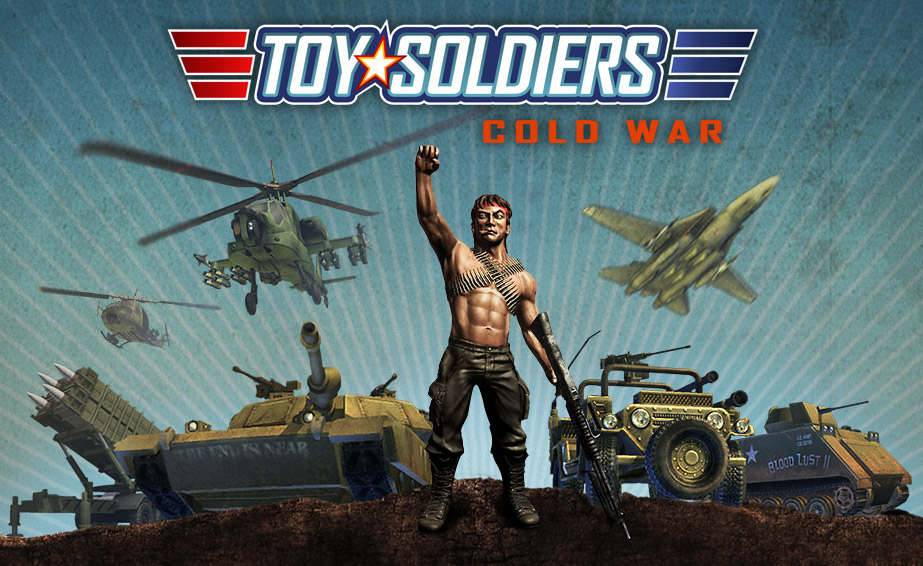
But Toy Soldiers: Cold War doesn’t really work! I’m not even asking for it to say as much as the original, but with the original, you really felt that Signal Studios loved old tin war toys and they were very comfortable making a game around them. Here, making a game set in the 80s, the “toy” setting feels far more pasted on, which is pretty odd unless everyone at Signal Studios is actually in their 80s and therefore have only the most surface understanding of the decade. I mean, the game has pre-level briefings that treat the war as if it’s for real, and not being played on a table top? And levels and enemies look super realistic, except sometimes there’s a cassette tape in the way?
It’s odd, because the setting promises so much. It takes most of the inspiration from things like Red Dawn, and overlooks what playing with toys in the 80s was: a glorious the-rights-holders-wouldn’t-allow-it mash-up. We’re talking GI Joes fighting with Transformers, green army men with ugly flash being ran over by Hot Wheels with all the paint scraped off.
They have the lightest claim that they’re doing this—the commando you can call in is larger than the enemies (GI Joe scale to army man scale) but he’s more a Rambo joke (which is actually pretty fun, I never got tired of his barks) and the final boss is a… thing. Why aren’t the enemies army man green though? Was it just in case anyone remembered those 3DO games that they made like a hundred of even though there is no human recorded in history who actually liked them?
Ultimately Toy Soldiers: Cold War just feels generic in the way that it absolutely should not. Indeed, I even found the tower defence play a little disappointing (the placement options are limited, and a lot of the game now is getting into a vehicle to kill as much as possible of what your towers can’t get, so the balance has shifted to an action game).
You can’t always get what you want, and I suppose what I wanted was a game with, I don’t know, My Little Pony towers that barfed Play-Doh at attacking Micro Machines. You know, some imagination.
Will I ever play it again? No.
Final Thought: If you wanna play one of these (but are biased against WWI for some reason) you should play Iron Brigade. I really liked Iron Brigade.
Developed/Published by: DICE / EA Released: November 12th, 2008 Completed: 23rd February, 2014 Completion: Completed the main game without shooting anyone. (I felt zero urge to mop up any other achievements.) Trophies / Achievements: 410/1250
Mirror’s Edge is one of those games I was sure I had to play. I definitely felt that peers had recommended it, and was certainly aware that some folks were super disappointed that it never got a sequel (only there is one promised now, so it’s ok.) Except now I’ve played it and… hmm.
It’s been five years since Mirror’s Edge came out, and playing it now is probably the first time I’ve been aware of just how long the “last” generation was. Because it feels dated. I can’t quite put my finger on it, but the fondness people feel (or felt) for Mirror’s Edge feels more like the way you might be fond of a cheap, scrappy sci-fi movie that sounds great, but really isn’t (at all.) You know, a Robot Jox or something. Something that’s super hard to get through without chewing your own face off, but you sort of want to like it anyway?
Actually: that’s not how I feel about Mirror’s Edge. Because it’s just so bloody boring. The core seems like a decent idea! A parkour FPS! And it almost sort of works—when you are under pressure to jump and run, and the level design supports that, there’s a kind of pace that keeps it interesting. The problem is that pace isn’t maintained—I’m not clear if that it could be, admittedly—with frequent moments when the entire game slows down and you’re expected to carefully puzzle out how to climb up (or get down from) somewhere high.
It doesn’t feel right. Parkour, every time you see it happen in one of them there action movies, always seems to be about characters being in the moment. They scan the rooftops while running, they see the next thing they need to jump off or over, and they do it. They don’t stop, walk around a bit, try jumping off a thing, realise the next thing isn’t quite close enough, die, and then repeat the whole thing about sixty more times till they get it. They just go for it.
Now, I’m not sure how much EA got involved—I could believe this had a turbulent development, but have no idea and can’t be bothered to do any research—but the cynic in me tells me that Mirror’s Edge coming out a year after Portal might have influenced the decision to make it all a lot more puzzley. (People probably are more intent to blame the gunplay on EA, but it’s crap, obviously not how you’re meant to play the game, and likely not an arm grafted on but a vestigial one that you couldn’t snip off for fear all the patient’s guts would fall out on the floor.)
So what Mirror’s Edge is supposed to be it is occasionally and it therefore works infrequently. Maybe that would be ok, but there are so many aspects that I’m pretty sure games are long beyond by this point: levels full of painted-on doors, guidance systems that are either spotty or unhelpful (this is the first game in years I’ve been lost in a small room in, and “runner vision” is bizarrely neutered) and challenge replaced with a determination to kill you over and over till you grind out a success by jumping just right or surviving being shot from every angle at once.
Oh, and I lied about not doing any research: I checked out if the generally lauded game writer Rhianna Pratchett was ashamed of having worked on this, because the story is absolute pish. She is. Pratchett claims her work was butchered by EA, but I’m struggling to see even a glimmer something better in it: there’s four characters in the entire thing, one goodie protagonist, one doomed goodie mentor, one a goodie who is obviously going to turn out to be a baddie (literally the second you see them, you’ll think “well they’re going to double-cross me”) and one is a possible baddie who turns out to be a goodie. You could write the entire thing on a back of a fag packet, crumple it up and throw it in my face and I’d have a deeper emotional experience.
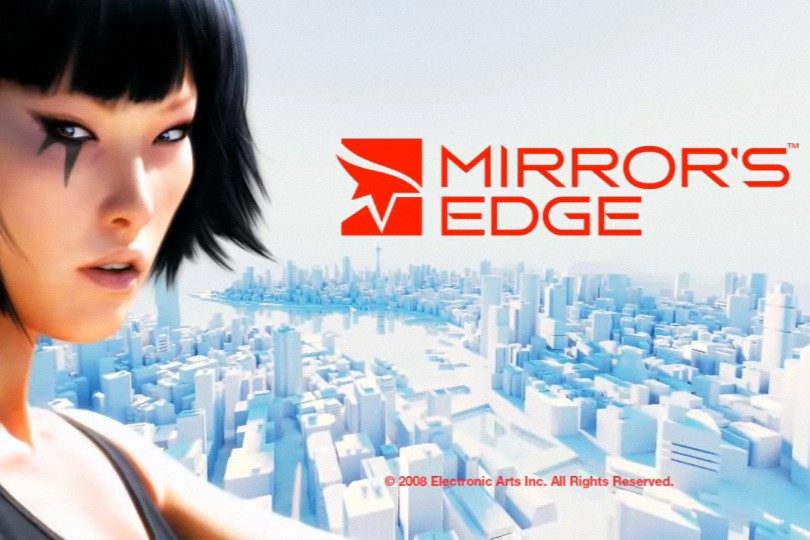
The stark white cityscape looks quite nice though.
Will I ever play it again? No.
Final Thought: Mirror’s Edge will have been deep in development by the time Portal came out but going on to make the credits song of your puzzley FPS with a female protagonist caterwaul “STILL ALIVE, I’M STILL ALIVE” over and over again is just asking for trouble, EA.
Developed/Published by: Capcom Released: March 5th, 2009 Completed: 11th February, 2014 Completion: Completed the main game on normal and then beat the two DLC chapters. Trophies / Achievements: 645/1400
Finishing Fable III and discovering I had apparently purchased the DLC for it led me to dig through my past purchases; found I’d also done this for Resident Evil 5 at some point in the past (probably when they were on sale.) So in a bid to—as with Fable III—get my money’s worth I loaded up the game that I originally finished on the 27th of February 2010 to play through the DLC.
So should this be my thoughts on the game, or the DLC? Because I’d be lying if I said I particularly remembered the game. In fact, here’s what I’d say if you were like “what did you think of Resident Evil 5?” last week before I played through the DLC:
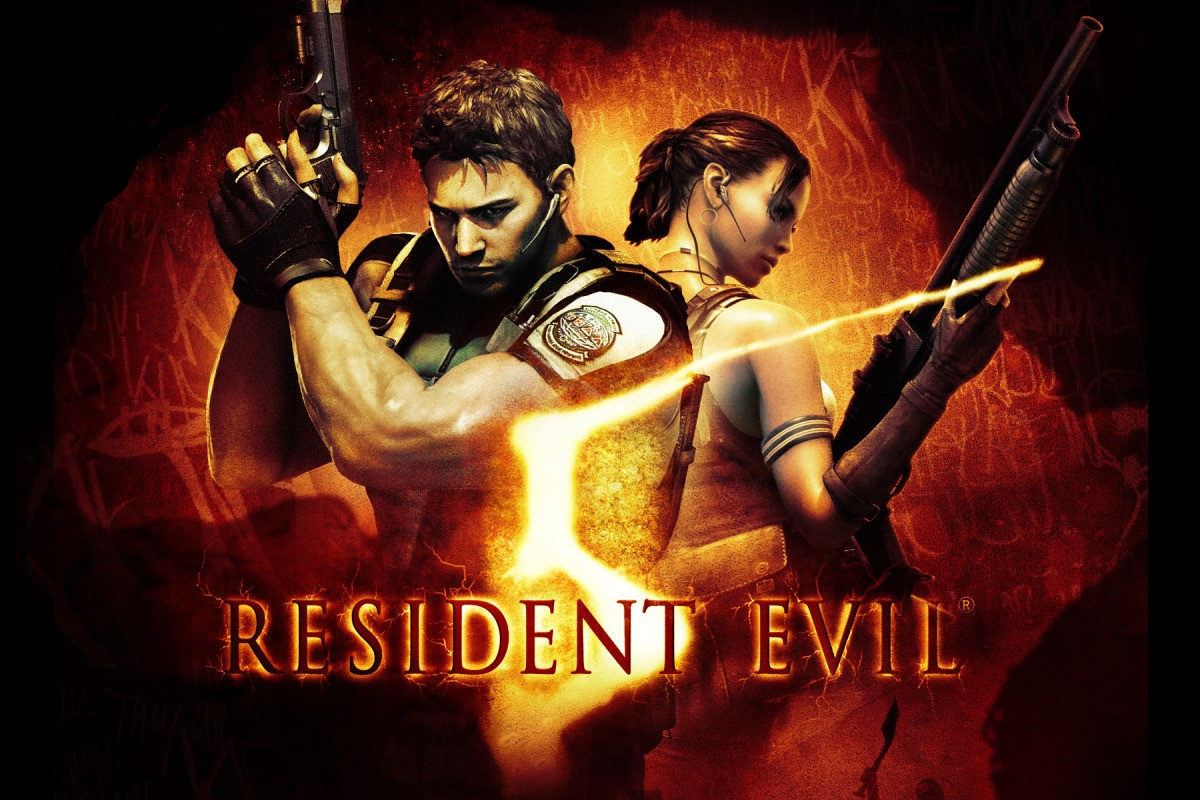
“Ehh. It was fine, I think? I feel like it replaced all the amazing pacing—that ebb and flow—from Resident Evil 4 with a relentless go-go-go that was pretty bloody tiresome. But then considering it was co-op, I guess they were working backwards from the Gears of War series, which took what Resident Evil 4 did and made it brutally Western. And Japanese developers are so desperate to appeal to the West even when… what they were doing already did. Story was definitely nonsense, and the African setting is the kind of thing you could do something really clever with, but your common-or-garden ignorance spoiled that obviously.”
Video games are weird. Here I am, doing my best to finish them, and, you know, within a few years I barely remember them at all. But that’s the case, really, with all media that I consume once. When I die, I’m pretty sure the only things I’ll remember are Father Ted and the good seasons of the Simpsons. A game either has to hit so hard it leaves a crater—your Walking Deads, your Sword and Sworcerys—or be so short or replayable I revisit it over and over, like a movie I love. These triple-A shoot-me-dos? All these things will be lost, like tears… in rain.
What was that from again?
Will I ever play it again? No.
Final Thought: Oh! The DLC! Utterly forgettable 45 minute long blips that showed what was going to happen with Resident Evil Giraffe-Blowy, which split up the game into discrete chapters with their own play styles. So one’s purely a classic RE scare-a-thon and the other’s a non-stop shooty-shooty-shoot. I forgot how nicely tuned (if tank-like) the player’s controls are, though! The end.
Developed/Published by: Asher Vollmer and Greg Wohlwend Released: February 6th, 2014 Completed: 9th February, 2014 Completion: This is an interesting one. I got a high score of 9,420 and decided it made the most sense that I delete it and never play it again. Trophies / Achievements: 240/1000, but who cares about that kind of thing on iOS?
Threes kind of completely breaks the idea of this blog, doesn’t it? You definitely can’t finish Threes. It’s not a thing you can do. There’s not even—like in many endless games—an amount of content you can see before you’re done, unless you definitely count seeing all the high numbers (who do have a bit of personality/back story?) as finishing it. That wasn’t going to happen.
However, I spent six hours—more or less exactly, I checked—playing Threes on Sunday and at the end I decided I didn’t really ever want to play it again. I think that, contrary to what people demand of reviews, the point where the person playing the game gives up is a super interesting and educational point, and not enough developers really pay attention to that. In general, I force past that point (hell, I beat Duke Nukem Forever through gritted teeth) and that sickness is why I started this—to see if finishing things does gain me more than giving up earlier, whether I like it or not.
So now here I am, trying to see if I learned something by stopping far before that point. In fact, my decision to stop with Threes was completely arbitrary. I didn’t top my high scores (I was third, that day, and I’ve slid down to fifth) I didn’t get some particular amount of achievement points; I just realised that to get a higher score was going to not simply require the expense of time, but that time would be exponentially increased by the randomness inherent in Threes.
Threes. It’s simple. You can combine 1s and 2s to make 3s. But anything above that must be equal to combine: 3+3=6, 6+6=12, and so on. The board is 4×4; you move tiles by sliding them and the entire board slides that direction (unless a row or column is full.) Every slide introduces a new tile on the board. The game is over when the board is full.
I probably didn’t need to explain it, but I did. It is—honestly—very very good. But after six hours I stopped playing. There’s a why to this, and one of the things someone might say to me is “ah but you didn’t understand…“ or “this isn’t a problem because…” no, you see… I already stopped. In six hours, the game actually un-clicked.
In Threes, when you slide tiles, a new tile slides in on one of the rows (or columns) you were sliding. So if you slide only one row, the next tile (which you see the type of in advance) comes in. Brilliant; you have a 2 at the end of the row, you know a 1 is coming next, and it slides in. Perfect.
However: lets say you’re sliding three rows. In one you have a 2, and a 1 is coming next. The other two rows? A 1 is really, really bad. You have a one in three chance of it coming in the right row.
OK, so maybe you should move something else, right? Get yourself into the right position. No, because that 1 is coming now.
This can scupper an entire game. Is it fair? No, but when I question “should it be?” As far as I’m concerned, yeah, it should be.
Another example: the white tiles. You’re not always sliding in a 1 or a 2; sometimes you slide in a bigger number. As a player, you almost always expect it to be a 3. Except, sometimes it’s not. Is there any way of knowing? Well, the designers have already stated they’ll be noting when the white tile is bigger than a 3 with a + symbol. Maybe this will help, but when your board has 3s, 6s, 12s, 24s and more on it, you’re more likely than not to end up sliding a new 12 right next to a 96, in a game-ending fashion. Is it fair?
These two examples are good examples of things that there are probably ways to change, depending on the type of game you’re trying to make. Maybe you want that randomness! I think what I’ve noticed is that in a very mathematical game, I don’t. Like… at all. But here’s one problem that seems more difficult.
You have a crowded board; a 96 and another 96 are some distance from each other. You want to combine them. However, every move you make brings a new tile on the board. So you have to spend most of your time making sure you are clearing the new tiles that come in—at a maximum, in general, you can allow a couple of moves before you start needing to clear multiple tiles in a single combo move—and every single one of those moves can just keep the 96s floating back and forth, never quite touching.
But of course, allowing (say) more free movement? Could break it totally. Decreasing the number of tiles that comes in? Will definitely make it too easy.
Now, I didn’t master Threes. If I had, maybe I’d be saying “this isn’t a problem, because…” as I was capable of (say) keeping the board so clean that I always had full movement, and could intuit moves allowing me to get my big numbers closer together (on the rare occasion they were far apart.)
But I didn’t, and I’m not. Because after six hours of obsessive play, I stopped and, other than writing his, I haven’t looked back.
Will I ever play it again? No, but there’s probably a version of this game I would.
Final Thought: I played the entire thing with the sound down. I didn’t even know there was an (apparently good) soundtrack until yesterday.
Developed/Published by: Lionhead Studios / Microsoft Released: October 26th, 2010 Completed: 6th February, 2014 Completion: Completed the main story (saving everyone), did basically all the non-collectables side quest and then, inexcusably, went on and beat both DLC. Trophies / Achievements: 725/1250
Fable II was, for me, one of those games that just worked. I remember when it came out, it was received with some reservations—it was buggy, particularly, but also the strange tone that meant you could walk into a village, fart forty times and leave beloved—but from beginning to end, bugs and all, it was an experience I met at its level and it worked perfectly. It promised so much for the future.
So you might wonder why it’s taken me four years to play Fable III. Well, because I’d heard (and in fact, seen) that it was complete pish. But for some reason I had bought it? And (apparently?) all the DLC? So I thought I might as well get it over with.
Let me say this: Fable III is a complete failure. It’s a failure of such magnitude that not only does it take what was good about Fable II and break it in several places in the name of improvement, you’re not sure Lionhead Studios were even trying.
It’s not the bugs! Well, in some cases it is the bugs. I mean, the criticised-for-being-slightly-too-hand-holdy breadcrumb trail, which worked completely in II, now disappears, doesn’t point the right direction, clips into the ground… it’s a disaster. The dog, a key part of II, is now totally unable to pathfind, barking for treasure before getting stuck on a wall and rotating on his axes. And “hand-holding” the innovation that Molyneux so carefully snake-oiled works only if you don’t run or, you know, go up a very slight incline or something, because then the other character can’t keep up and you both “hold hands” with six foot of air. Fable III is absolutely the buggiest game I have ever seen a major publisher put out. It’s pathetic.
But that’s all quibbly stuff, really. The kind of thing you can get over if the core is really solid. It isn’t. The core is a group of ideas that (potentially) sound like good ideas, but which after prototyping you’d definitely think “this doesn’t work” unless you’re (I guess?) on some kind of tight deadline where you say “fuck it, we’ve announced it, we’ll bodge it.”
A good example: No menus! So when you press start, you go into a magic room where you can do all the stuff you’d normally do in menus. Unless you pause in a cut-scene, when you get a menu. And if you want to do anything, like select a new weapon, it’s actually a menu, just in 3D and you have to use the triggers to control it. And if you want to see details you have to… use a menu anyway. Incredible.
The fact is that playing Fable III you have no idea why they’d make any decision they did unless they were some extreme pressure to finish something—anything!—because they’d already spent the money on John Cleese and Stephen Fry and Simon Pegg and… it’s most obvious when you finally get to the “real” game—acting as King of Albion.
This part is amazing. It belies a totally idiotic surface understanding of… fuck it, I don’t know, everything? You’re the king. You’re told “6.5 million people are going to die unless you have 6.5 million coins in your treasury at the end of the year.” Let’s put aside the biggest question of all (“How would having that money in the treasury help?”) and consider that, if you are playing an evil character, surely the aim would be to let everyone die? And why can’t you explain to people that there will be a war in less than a year and everyone needs to tighten their belt for a bit while you sort it out?
You end up in the absurd position where making tough decisions to get money in the treasury is simplistically treated as “evil” and good decisions—which cost more money—can only be paid for by owningallof Albion and collecting rent. So: to be a “good” king you have to buy houses from the people you will go on to rent to and profit from, therefore reducing the entire country to serfdom. So moral!
I’m actually pretty sure that they hacked the idea together anyway, considering that your evil brother tells you all the bad things he did were for the people, but there’s a cut-scene earlier where he explains how he’d see Albion burn before give it up (which doesn’t come to anything so I have to question if they remembered that they left that bit in.)
I think my favourite bit is the game tells you have a year, skips wildly between days so really there’s only something like five proper days (although in-game days pass, they don’t count, because who would find something like that totally immersion-breaking?) and when you reach “121 days to go” the game basically ends no matter what and without warning. Fuck’s sake.
Will I ever play it again? Fuck no. Though I had to play the DLC though to make sure it will never cross my diseased mind. It’s more of the same but mercifully brief.
Final Thought: Right at the beginning of the game you’re asked to let the girlfriend you’ve just met and have no feelings for because you’ve literally just met them die or some people you’ve definitely never met. If you let her live, your hero leaves the castle and you never see her again. You’ll wonder, at least briefly, why your hero doesn’t care and why she’s never even mentioned again, and you’ll later discover that there’s a quest where you can reconnect with her but it disappears for no reason half-way through the game because fuck you that’s why.