
Developed/Published by: T&E Soft / Toshiba EMI
Released: 11/1986
Completed: 08/04/2025
Completion: Liberated all 14 planets, but didn’t discover the enemy homeworld of Nirsartia.
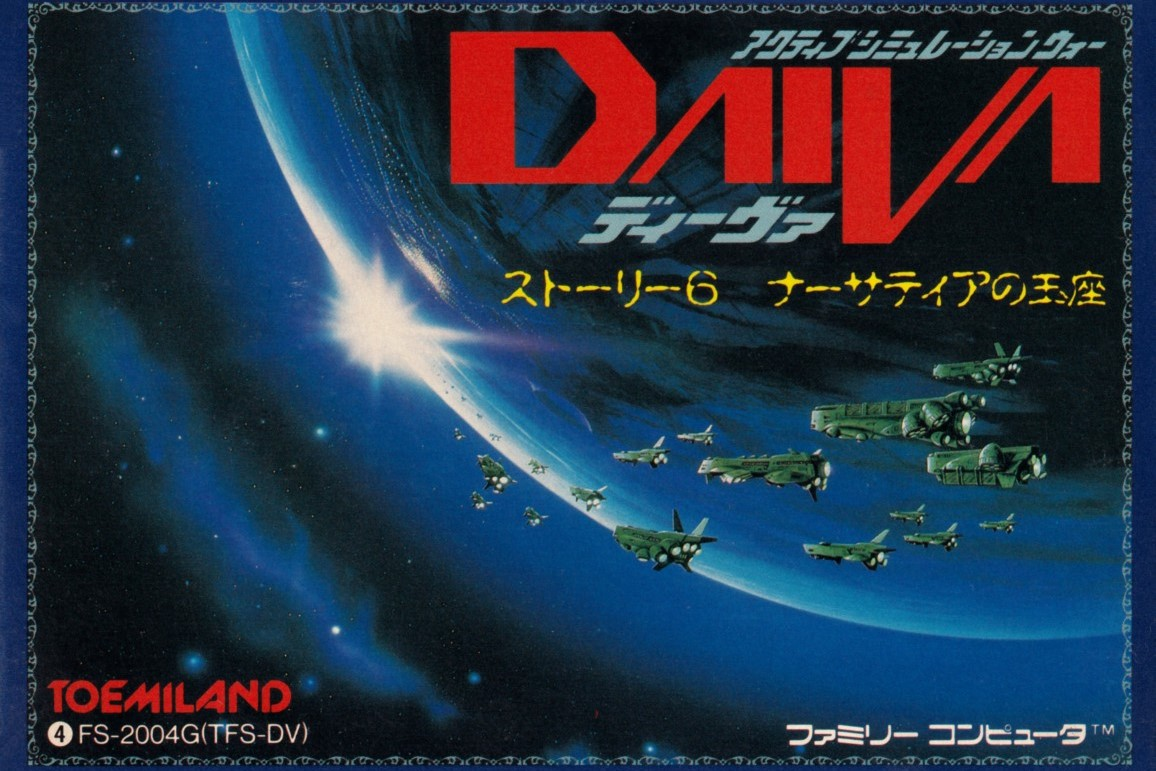
There are a few Famicom-only games that Nintendo have released in the West on their Switch Online service–and far more that they haven’t. Which makes it so absolutely bizarre that in 2022 they released this, DAIVA Story 6: Imperial of Nirsartia, an action/strategy hybrid that’s almost completely forgotten, on the service.
You could assume it’s that they were looking to fatten up the service with something where the rights were easy, but this was released before things like Golf and Mach Rider! And it’s not like it’s been released by a company who has put a lot up on Switch Online–as far as I can see, the current rights holder D4 haven’t released any other games via Switch Online before or since!
But let’s get into what DAIVA Story 6 is, because it’s… complicated. You see, in 1986, T&E Soft, largely still fresh off the success of Hydlide, wanted to make a new game, but couldn’t align on if they were going to make a strategy game or an action game. So they just… slammed them together. And then they had to face the question of what system to make the primary platform. Realising that if they made one game and then ported it to other systems they wouldn’t be using those systems to the best of their abilities, they decided on a completely bonkers plan: to make seven different games all of which use the same game design, but which make the most of each system and which feature a deep, interconnected narrative based on Indian mythology (but in space.)
According to information sourced from The Untold History of Japanese Game Developers Vol. 2, this undertaking would turn out to be so insane that the lead developer, Yasuo Yoshikawa, would go blind.
(Temporarily, but still.)
Strangely, despite being the sixth game in the series, as the simplest game, Daiva Story 6 was released first, with the rest of the games following shortly after (apart from the seventh and final which unifies the stories of the previous six–due to the aforementioned blindness, it would be released somewhat later and be somewhat different, being entirely a grand strategy game with no action aspect.)
To be honest–none of this particularly matters if you’re only going to be playing Daiva Story 6, because it’s got barely any narrative apparent in it. In Daiva Story 6, you cycle between three modes:

An overhead section where you control a space ship flying between different planets. Planets start the action levels, but there are also enemy ships in space that begin in ship-to-ship battles, and you can return to your home planet to increase your squadron of ships for said battles.

The ship-to-ship tactical battles, where you position your ships each turn and then watch them fire missiles and lasers back and forth with enemies.

The action levels: a side-scrolling shooter where you control a mech that can jump and fire. Before each level you get to place three power ups during the level–a smart bomb, some missiles, and a health refill.
Daiva Story 6 is… not good. If it was just the action levels, it would be a forgettably janky Famicom game–not quite Mystery of Convoy, but close enough. Really the main reason to know the lineage is it explains the why of why you’re doing these three disparate, undercooked modes: they feel like the kind of thing you’d play on a Japanese PC of the era and they are!
But they are so undercooked in an attempt to make them accessible. The overhead section is ultimately just a menu. The only thing that really stands out about it is that the enemy ships sometimes attack planets you’ve liberated, which is a lot less than the other games, which have you actively assigning defenses to planets, making manufacturing orders and so on.
The ship-to-ship battles seem to have almost no tactics at all, just being a war of attrition outside of some tricks like lasers but not missiles firing through asteroids. And I can’t tell if this was intentional or not, but you never have to do them. You can just let planets get captured and then redo the action level again, which is probably quicker.
The action levels, which should be the highlight are, uh… not. I love that you can place the power-ups, which is apparently a more detailed system in the PC versions (you can earn more power ups, etc.) but the power-ups outside of the health refill (aka “just place it before the boss”) need perfect foresight to place anywhere even mildly useful.
They also made the really strange decision to make you just… not collide with any of the level. The levels auto-scroll, which makes me think they just didn’t have a solution for what would happen if the character got stuck on the level. What this means is that while you can jump around, you are generally best just trying to keep your mech at the lowest part of the level.
Proper collisions have to be something they gave up on because, like, the levels have sequences that read like you were meant to hop across lava via platforms and stuff. Instead you just… stand still and scroll through it.
It feels insanely janky and unfinished, and as a result the game veers between “completely trivial” on anything but the hardest difficulty, and “complete fucking bullet hell” on the hardest–one of which is boring, and the other which is, well, unfair, because the controls are so crappy and floaty (every level has a differing amount of gravity, which could be sort of interesting, but it adds little.)
Unfortunately, the game requires you beat it on the hardest difficulty to unlock the “true” ending that ties into all the other games (which also, seemingly, had insane requirements to get their true endings.) I was not going to bother with this because… it’s boring! Even if the game didn’t feel crappy to play, it’s extremely samey–every action level feels the same, and because there’s no point to the ship battles, I didn’t do them.
Basically: not worth going blind over.
Will I ever play it again? I really do think it’s quite interesting that they made seven of these in a year. And listen, I did watch (skip around) some Youtube playthroughs of the different PC versions to compare and contrast. But I’ll never play any of them.
Final Thought: If your imagination was captured by this mania, the good news is that you actually could play (almost) all of them thanks to D4’s hilariously expansive Project EGG emulation service.
It seems that all of the games apart from the second, “Memory in Durga” for the FM-77AV are available on the platform, though it requires a monthly fee–and no, none of the games have shown up on Project Egg’s “EGGCONSOLE” releases for Nintendo Switch.
Although this has all reminded me of the existence of EGGCONSOLE, I wonder what’s there that I might like to play? Gotta be better than this, surely?