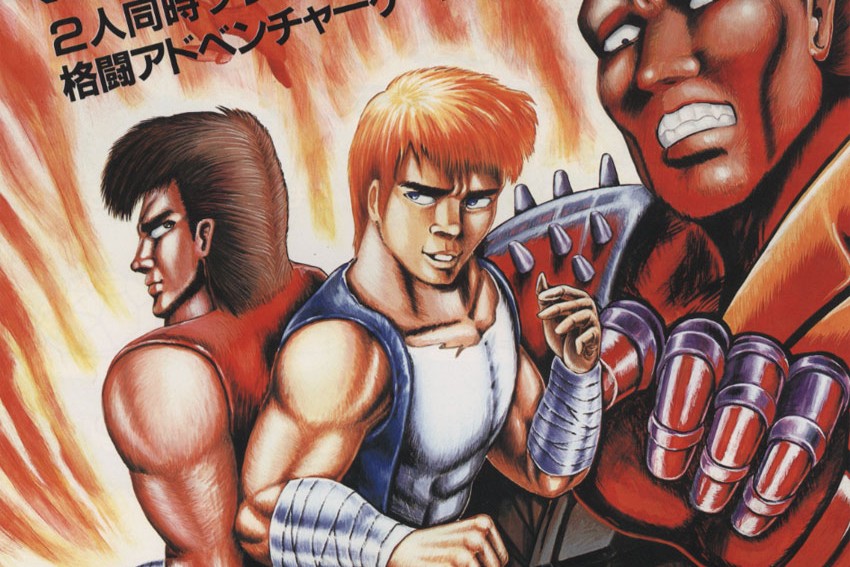
Developed/Published by: Technōs Japan (Published by Taito in North America.) Released: 22/04/1987 Completed: 12/03/2026 Completion: Finished it (no need for saving until that ridiculous final level.)
This essay on Double Dragon follows last week’s on Nekketsu Kōha Kunio-Kun as a tribute to the recently departed Yoshihisa Kishimoto, even though, to be honest, I’m pretty hard on it.
Well, in for a penny, in for a pound, and if I’ve got an Egret Mini II and I’ve paid to own Double Dragon again, then I might as well play it.
In my write up of the NES version, I mentioned that I’d played and completed the arcade original in the form of a now long-delisted Xbox 360 release (written up for Eurogamer.) I absolutely put the boot in, but re-reading that now, I notice how it’s definitely a review of the Xbox 360 release rather than an examination of the arcade original. But there’s something I mention in the review I had completely forgotten about: Double Dragon’s astonishingly poor performance.
I initially thought the Egret II Mini was at fault–I’d remembered someone saying that if the power supply is too low there are issues–but I’d plugged it in with a decent charger. It’s simply that the game’s original hardware wasn’t up to the game design, and the Egret II Mini stays authentic to that (it seems that people can, and do, overclock the game when emulating it through other means; it might have been nice if Taito had offered something like this, but I understand why they didn’t.)
Ultimately, the game suffers so much slowdown it is agonising to play. The game slows down as soon as there are as few as two enemies on screen, but speeds up if (for example) you’ve knocked one of them down. The speed of the game undulates in a way that’s completely discombobulating. It makes playing the game unpleasant in a way that’s unusually unique; like trying to build a card tower in front of a rotating fan. And you’ve got jam all over your hands.
Now… just because I feel that way doesn’t mean that the arcade audience of the late 80s felt that way, with Double Dragon “America’s highest-grossing dedicated arcade game in 1988 and 1989.” I find that baffling, because it’s nigh unplayable!
(The only assumption I can make–and it very much is an assumption–is that because the game was using older 8-bit chips, maybe the board was cheaper and so a lot of machines were sold, so it won by sheer numbers. But I certainly don’t have any sales numbers.)
The thing that makes this all a bit of a shame is that, well, even if it’s stupidly hard, I sort of like Nekketsu Kōha Kunio-Kun, and Double Dragon, as the next game from Yoshihisa Kishimoto–and the one that truly defined the side-scrolling beat-em-up by featuring proper levels that you have to progress through to complete–should be better than it is. Kishimoto is really trying to make another leap here, and you can feel the game straining within the limitations of the obvious technical problems.
For example: the game is clearly intended to improve on Nekketsu Kōha Kunio-Kun’s enemy AI, one of that game’s most interesting aspects. And while the enemies here do try and position themselves to take you on, the thing you’re most going to notice is that they’ll just refuse to get close to you if you’re holding a weapon (making holding weapons a complete waste of time) and then otherwise they’re really as dumb as rocks, happily walking into dynamite they’ve just thrown or off cliffs.
And the player’s abilities are supposed to be deeper, more interesting, more situational, with new moves like a headbutt and a spinning jump kick. But it’s ruined by the fact that–I’m sure inspired by Kunio-Kun’s powerful back kick–heroes Billy and Jimmy Lee have a “elbow smash” that attacks enemies behind them. Possibly aware that the back kick was frustrating–because you couldn’t use it unless you had an enemy behind you–you can now do the elbow smash whenever you like, and because it guarantees an immediate knockdown… the entire game becomes about turning your back on enemies, performing the elbow smash, and then performing it again as soon as they get up.
I want to be clear: I don’t think you can play this game “properly.” It’s simply too frustrating, with no sense that anything that happens is related to your own abilities because of the slowdown. So instead, the actual and I suspect only way to get through this game is to elbow smash every enemy you face–the ones you can’t make drop off edges, anyway.
The only reason this game isn’t an easy single credit win is because the final level is, frankly, nonsense. The first section features some blocks that spring out from the background and some spears that statues attack you with that knock off half of your health. They don’t have any tell (the blocks in particular are infuriating) and it means that you will almost certainly lose a life (and the default settings only start you with two.)
(There’s also a jump across a bridge in the previous level that will probably take a few lives from you, but at least you can see that.)
Once you get past all that nonsense, the main problem is just that every enemy has a ludicrous amount of health and (yet again calling back to Nekketsu Kōha Kunio-Kun) the final boss can kill you in one hit by shooting you. He goes down easily to the elbow smash like everyone else, however.
I really, really wish I liked Double Dragon. It’s a hugely important game, but when you play it, you almost can’t understand why. The design is coming from the right place. I can see that Kishimoto is trying to move the genre forward. But it’s still a bit half-baked, and the performance is too poor for you to appreciate it anyway.1 I wasn’t that hot on the NES version–with its awkward platforming, and still including those annoying stupid blocks–but it’s a much better way to spend your time than this.
Will I ever play it again? Right, that’s twice. That’s absolutely enough times.
Final Thought: You know what? There’s one thing they nailed straight off with Double Dragon. The theme music. Absolutely gets the blood pumping.
I’d love to read Florent Gorges’ Enter The Double Dragon to see if it has anything on Kishimoto’s experience making this, but it’s 1) in French and 2) not easily accessible. ↩︎
Writer and Game Developer Mathew Kumar joins an episode hosted by Esper Quinn, covering live service games, personalized Silent Hills, and the Kentucky Loan Ranger.
It’s been too long since I’ve been on Insert Credit! But I’m finally back and please enjoy this episode ably hosted by the excellent Esper Quinn where we delve a little too deeply into my subconscious.
Developed/Published by: Technōs Japan/Taito Released: 05/1986 Completed: 08/03/2026 Completion: Finished it (Saving after each level.)
It was announced on April 5th that the designer of Nekketsu Kōha Kunio-Kun, Double Dragon and more, Yoshihisa Kishimoto, had passed away. There’s a sad coincidence here, as I’d just played both Nekketsu Kōha Kunio-Kun and Double Dragon for an unrelated reason. These weren’t Kishimoto’s first games–he started at Data East and created some well-regarded laserdisc games, Thunder Storm and Road Blaster (also known as Cobra Command and Road Avenger) but they are his best known works, so as tribute I’ll be posting my articles on them this week and next.
Yoshihisa Kishimoto (1961-2026)
I hadn’t originally planned to play this–in fact, in my write-up of the Famicom’s Nekketsu Kōha Kunio-Kun I said I wouldn’t–but I had a research-related reason and the Egret Mini II’s most recent release, Arcade Collection Part I meant I suddenly had easy access to it, so it would have been an absolute dereliction of duty to not play it.
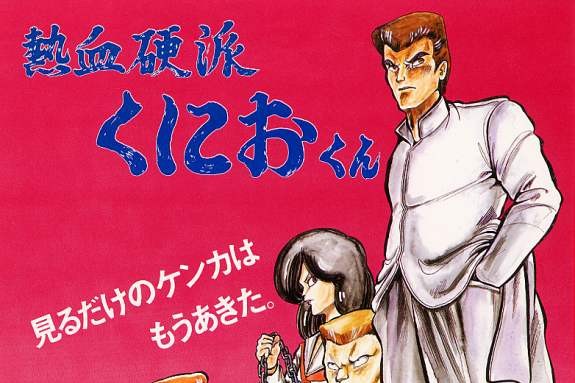
Best known as Renegade, Nekketsu Kōha Kunio-Kun is a cornerstone video game the likes of The Tower of Druaga or Xevious, in that it would spawn an entire genre that would end up in an almost entirely different–arguably simpler–place. It’s the original “brawler” style beat ‘em up (or, as it’s known in Japan, “belt scrolling action”) though as it exists pre-genre convention, it will surprise any modern player with its stages, which are arena battles (rather than continuous levels) and combat that requires savvy positioning and careful timing, as there’s no way to credit feed (although your health is restored after each stage, there are no continues.)
Renegade was created by Techōs Japan for Taito to appeal to a western audience and was directly inspired by Walter Hill’s New York-set The Warriors (despite that hardly being a contemporary reference; the film was over seven years old by that point) but Nekketsu Kōha Kunio-Kun is remarkable for being an early example of an–at least mildly–autobiographical game. Designer Yoshihisa Kishimoto based Kunio on himself, who as a teen found himself getting into fights on a daily basis.1 The game is strongly inspired by the unique culture of delinquency in Japan: the hero, Kunio, is a high school student driven into action to defend his bullied friend: first against “banchō” (male high school delinquents) then against “bōsōzoku” (custom motorcycle biker gangs) then “sukeban” (female high school delinquents) before finally the deadly yakuza.
The level intros, where your pal gets his beaten up and even shot(!) aren’t replaced with anything in Renegade, to its detriment, I think.
Nekketsu Kōha Kunio-kun is deceptive. It can be beaten in as quickly as six minutes, but only the very best players could even attempt such a feat. The game is crushingly hard even on its easiest difficulty, with enemies that intelligently swarm you and a boss in each arena who can seem invincible. The trick is that there are three buttons: a left attack, jump, and right attack. You hit the attack in the direction you are facing, and if there is an enemy behind you, you can hit the opposite attack to do a powerful back kick to make space. This is, honestly, pretty confusing if you’re more used to later games that quickly discarded such a system, but it’s a large factor in the game’s richness. You don’t try to overwhelm enemies in Nekketsu Kōha Kunio-kun; you have to carefully position yourself to avoid getting stunlocked by attacks from multiple directions, and when you face bosses, you have to consider your tactics. The bōsōzoku boss can be taken down easily with jump kicks, but the sukeban boss will always duck; meaning you’ll have to take advanced tactics like keeping a lower-level enemy on screen so that you can face them and instead use your powerful back kick on the boss.
It can be frustrating–and it certainly doesn’t feel fair–but the game is so quick that there’s a draw to trying again with a new tactic in mind. The game does push it a little too far with the yakuza level featuring enemies who all one hit kill. With the boss able to fire a gun and kill you from afar, you have to take extremely conservative hit-and-run tactics that can make a loss absolutely gutting (with a lot of luck you can just wail on the boss as soon as he appears; if the other enemies don’t surround you, they might similarly get stunlocked and you’ll survive; it’s far from a consistent tactic, however.)
I’m a bit surprised by how much I enjoyed this. Maybe it was the novelty of my Egret Mini II, maybe it was that I let myself save after every level, but I had fun trying to “solve” each level after getting over the initial hump of difficulty. There’s depth to the mechanics–you can throw enemies into other enemies, or off the edge of the train platform–and as your health gets restored after each level there’s a real value in trying to survive each brawl at any cost.
This motorbike section must have felt like such a slap in the face to those who finished the first level in arcades. You have to time your jump kicks perfectly.
Normally I wouldn’t be so in favour of a game this hard, but my memory of the Famicom version is that– though the game was far more expansive, with multi-stage levels, a motorbike mini-game, even a maze–it was just too easy to cheese your way through. It’s better, but not as thrilling. I felt like I really had to work for my win here, and for whatever reason, that just worked for me.
Will I ever play it again? No, but maybe this will lead to a reappraisal of Double Dragon, also on the Egret II Mini’s Arcade Collection Part 1, which I remember being straight cheeks when I played it on (of all things) Xbox 360.
Final Thought: As much as I like the Egret II Mini (despite some issues previously mentioned) they really dropped the ball on dip switches. Nekketsu Kōha Kunio-kun has four difficulties, but they’re listed in the menu as A, B, C, D, and it’s set to B difficulty. Feels like that would make it easy to assume that’s “normal” difficulty, but the default on the machine was normal, which would maybe make that actually A position. I beat the game on A, which I thought was easier than B, but honestly, having switched difficulties around, I can’t really tell. The game is balls hard no matter what, I guess. I’ve played it longer than I would admit and when I start a fresh run I still can’t beat the first level consistently.
This is sourced from a Polygon article in 2012, though as that article notes, there’s an entire book on Kishimoto’s career by Florent Gorges, Enter the Double Dragon, if you’re interested in learning more. ↩︎
Developed/Published by: Taito Released: 11/1979 Completed: 27/03/2026 Completion: Played it as long as I could stand, getting the high score (with a mere 5520)
It’s been some lean times over here at exp. Towers, but FOMO is real and lives beyond the realm of the sensible, meaning that I finally treated myself to a Taito Egret II Mini because–after foolishly not picking one up previously–the system got reissued in Japan after a period where they were only available for eye-watering prices.
That means, of course, that I can start playing all the Taito games I’ve got in chronological order! I’ve previously written about Space Invaders (exclusive to exp. 2601) and there’s not much to be said about playing that on an Egret II Mini, but the system also includes Lunar Rescue, which I hadn’t played before. So after a quick detour to play Head On, I decided to not get hung up on playing any earlier Taito games (Space Chaser is just Head On, Field Goal is a weird Break Out, etc.) even though I could easily get Taito Memories working on now after all that falderal with Sega Ages. I’m sure I’ll end up playing games that I didn’t plan to, but let’s try and put my best foot forward here.
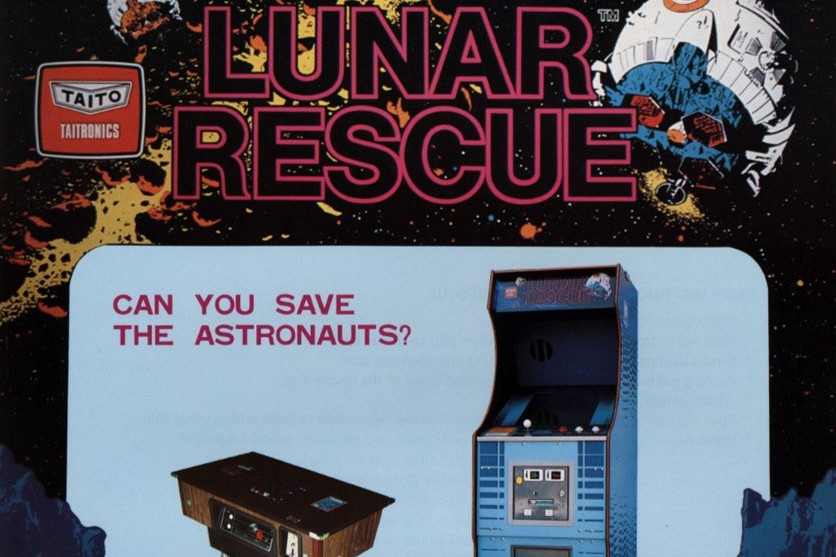
Lunar Rescue seems to be Taito’s most notable post Space Invaders title, and serves also as a notable post Lunar Lander game too. It’s an interesting one in this early wild west of plagiarism because it’s really not very much like Lunar Lander at all, but it does–surely intentionally–include the word “Lunar” in its title. Lunar Lander is–of course–simply a rip-off of Moonlander, which had been kicking about since 1973. So one does have to wonder if Lunar Rescue was merely inspired by the same “inspirations”, considering that Lunar Lander came out–if release dates are even close to correct, of which I admit I have no guarantees they are–mere months before, which does seem like a pretty short turnaround even for a cabinet which uses the same tech as Space Invaders.
There’s possibly even some simultaneous discovery going on here, because Lunar Rescue is basically a two phase game: you’re trying to land and rescue astronauts while avoiding asteroids, and then get them back to your mothership while avoiding space invaders. Yet Asteroids came out in the same month (dates allowing) so there’s really no chance that they were inspired by it!
Unlike Asteroids or Lunar Lander, however, Lunar Rescue isn’t about the physics at all. It’s all digital control in the style of Space Invaders. There’s no slow rotations or fine control over speed here. You move left, you move right, and you can slow your ship with the fire button when landing, or speed it up (and fire lasers) when taking off. The asteroids move from left to right (and vice versa) and so do the invaders.
As someone who genuinely appreciates Space Invaders, I had high hopes for this. Indeed, I can tell there’s some fondness for this game; a near-arcade perfect port was released for ZX Spectrum just a couple of years ago(!) but it’s slow, boring and unfair.
Landing is boring, and hard to mess up even with your limited movement. So the real issue is taking off, where because you’re flying up the screen into invaders who shoot at you, you can easily find yourself shot by bullets you couldn’t react to–and there’s the added quirk that some ascents feature comets which you generally don’t realise until you’ve died to one.
Despite not featuring anything physics-based, the game still manages to lose all of the lustre of Space Invaders; the rhythm, so important to this kind of game, goes from a driving march to a kind of slow waltz, but one where your toes are constantly being tread on. After a couple of goes I really just didn’t want to play it any more, but persevered till I could beat the first level without deaths–inconsistently.
It’s not exactly that Lunar Rescue is bad–it’s competent, but it’s just so unbelievably unexciting. Honestly that makes it one of the very worst things I’ve played in ages, which I know is unfair, but I longed for the snappy if punishing loop of Head On every second with this.
Will I ever play it again? No thank you!
Final Thought: Oh! You might be wondering how I feel about the Taito Egret II Mini. It’s great. Certainly the nicest example of one of these things you can imagine. My main quibble is that it doesn’t have any scanline filters, but that problem was somewhat solved for me by RetroRGB, who recently(-ish) recommended a HDMI to component downscaler that works well enough, so now I can plug my mini systems into an actual CRT. Which is good, because the scanlines on the Astro City Mini are horrific anyway, and I’ve got a game on that system on the backlog…
Took a little time off from the relentless grind of new articles to celebrate my favourites of the previous year. It gave me an opportunity to talk up Evil Egg in advance of me writing it up, because it’ll probably be a long time before I do—I’ve been busy and had to put it down for a while, so when I return to it I’ll have to grind my skills back up if I want to eventually beat the boss.
Hey, do you hate in-line advertising? We do too! We’re only ever going to do it here at the start of our newsletter posts because we want you to get these missives in your inbox a day early. Sorry!
Head On piece is a really great example of the perils of self-publishing. I probably should have cut all the Sega Ages waffle and drilled down on the story of Lane Hauck, but absolutely no one is making me kill my darlings.
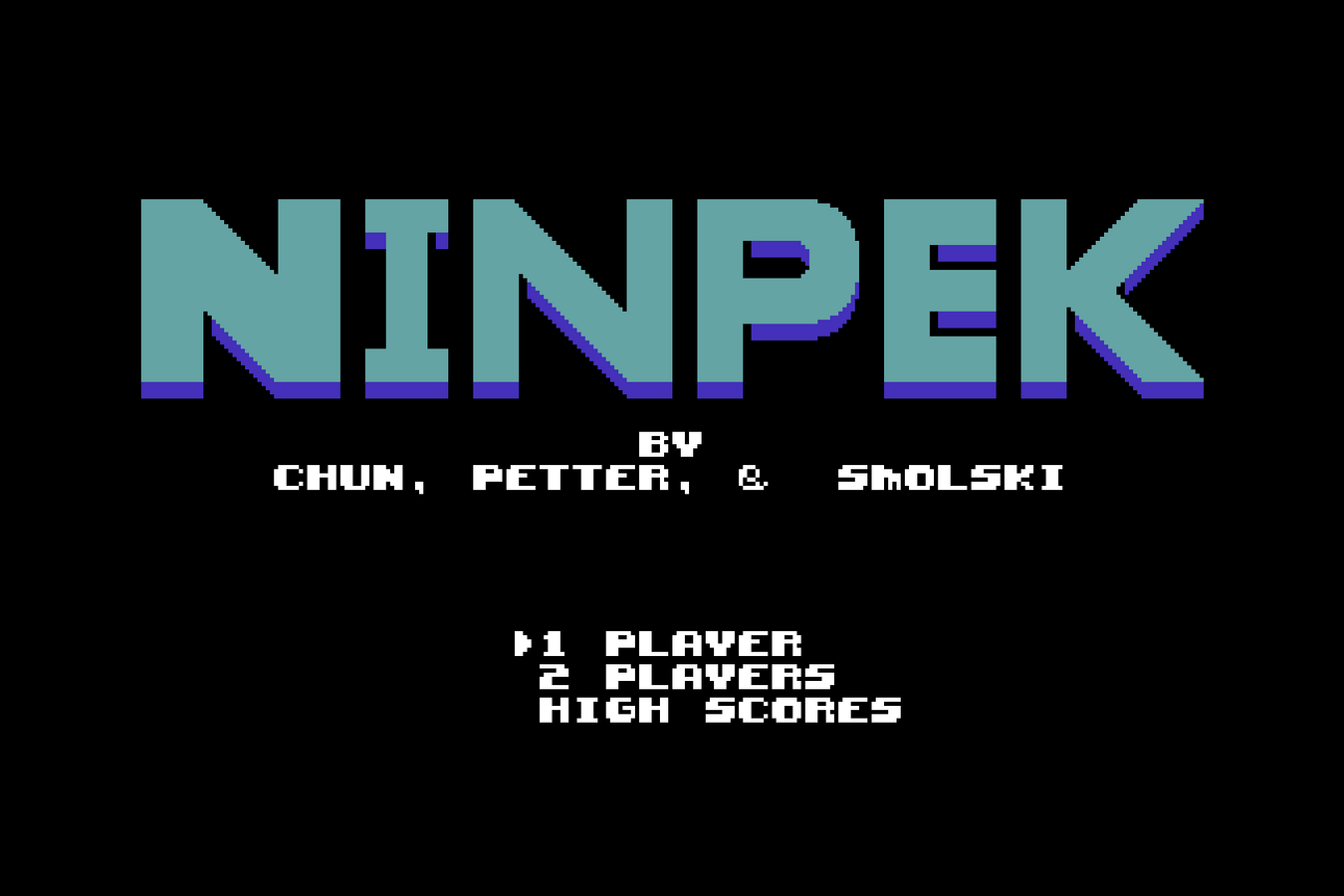
And in my latest UFO 50 subscriber exclusive, I really struggle with Ninpek. In later essays I’m going to be thinking a lot about difficulty when it comes to this collection, and I think it’s interesting to see how my feelings evolve as I face each game.
I’d held onto that Smash Ping Pong article for a bit thinking I might like Marty Supreme enough that I could do a mild Ping Pong theme week, but I didn’t find Mary Supreme interesting enough to write more than a few words about it. However, Smash Ping Pong is great, I genuinely recommend it. Consume Me… not so much. Not throwing shade, but I really do wonder how far the IGF juries actually got in it. But then I suppose we all know that the Oscars are largely voted on by people who see the ballot on their kitchen island and mark down the people they recognize (Sean Penn??? Again??? Come on.)
I finally get into 2015 with the exp. archive, and it’s interesting how much I played mobile games at this time, which I basically don’t do at all now—outside of the vice of a daily Puzzmo mini crossword, which just feels like something else entirely.
A movie that warns us of the completely soulless slop future that tech companies want and a completely soulless streaming slop movie produced by a tech company. Huh.
“Do you like wrestling? Are you sure? Did you maybe really like it once and now you’re trying to figure out why you aren’t as jazzed about it but also you found a copy of the American Wrestling Association’s 1998 pay-per-view SuperClash III and so you watched it to see how it felt and then you wrote about it but didn’t fully address the issues tied up with how you feel but you’d written a long thing so you published it anyway? I did.”
Hmm, that’s all I had bookmarked this month. Be sure to get in touch if you’ve got a zine that you’re trying to publicise!
And Finally…
TOJam 2026 has been announced! May 8-10th, with registration opening on April 2nd.
Developed/Published by: Sega/Gremlin Released: 04/1979 Completed: 18/03/20206 Completion: Finished one screen. High score of 2685. I’ll take it.
It’s been a while since I’ve dug this far back into gaming history, but, for reasons, I decided it was time. I’ve already played–and written about–the most important dot eater of all, Pac-Man, but Head On has incredible importance as the first maze chase dot eater. That sounds like a very specific genre, and when you look at Head On, not exactly a perfect description, considering it has really no maze to speak of. But Head On is still really important, so I went to some unnecessary effort to play it. [“You may wish to skip this following waffle. I’ll let you know when you can come back.”–Ed.]
You see, I can’t remember if I own Sega Ages 2500 Series Vol. 23: Sega Memorial Selection, the only home release of this game, or not. I know I don’t own a physical copy–lord knows I missed my window on that–but I’m pretty sure I own it on PS3 via the Japanese PlayStation Network.
However.
I’ve forgotten my login for Japanese PSN; and the PS3 I know I was logged into I don’t (currently) have access to. So that’s annoying. I could burn a copy, maybe, but why not just use it as an opportunity to finally dip my toe into the exciting world of PS2 emulation?
I know the first think you’re going to say. “Why emulate a 1979 arcade game via a 2005 PS2 compilation on a different machine? Why have a double layer of emulation?”
To be honest, I don’t really have a good excuse. But this Memorial Selection1 included a “updated” version of Head On, and that seemed interesting and worth the effort.
And there my troubles began. I installed Retrodeck on my Steam Deck; easy, so far so good. But then I had to find a PS2 bios. And then I put what I thought was a working copy of the Sega Memorial Selection into the right folder but the (emulated) PS2 kept giving me the red screen of sadness instead of loading it, leading to a (far too lengthy) amount of time where I kept trying different regions in the hope that would change something (it doesn’t) until I finally hit upon the idea that even if the PS2 emulator in question claimed it read the kind of file I was trying to use (CUE and BIN, which does sound like a show about a snooker player teaming up with a binman to solve mysteries) it… doesn’t? Or at least not this one?
So then it was having to download an ISO tool on Linux–because most people were like “oh just use the command line” and sack that on the Steam Deck–converting it… and then it worked!
Now, I know that wasn’t very interesting [“Do you? You still wrote it down”–Ed.] but it stood out to me a bit because it reminded me that the internet is completely fucking useless now. There are some oases; archive.org you beautiful bastard. But for the most part, you search for anything and you’re either getting scam websites, or AI garbage, and the more esoteric your problem the more useless even Reddit becomes. Just one of those evenings where you think “hmm, isn’t this hobby supposed to be fun?”
And all to play, uh… Head On.
[“You can come back now.”–Ed.]
Head On is interesting in Sega’s history because it comes from the (fairly short) window of time when they were Sega/Gremlin. Now any student of video game history knows that Sega began as Service Games and was founded by Americans (gasp… or not, I mean Taito was founded by a Ukrainian, it’s fine. People from all sorts of countries can found companies. You’ll survive). Probably fewer keep at the front of their mind that between 1969-1984 they were owned by Gulf and Western (a quirk which allowed them to put out a licensed Fonz game.) And in the late 70s, they were struggling. There’s some great context from The Golden Age Arcade Historian, a now seemingly defunct blog:
“Sega’s plan for U.S. domination had not gone very well. In fiscal year 1977, Sega actually lost almost $800,000 overall and its American arm was responsible for almost all of it … many operators were reluctant to take a chance on a new game in the midst of an industry downturn. As a result, Sega released just two new games in the American market in fiscal year 1978. If Sega was going to compete in the U.S. market they needed to do something – and fast.”
Gremlin was also struggling. The Golden Age Arcade Historian has even more excellent research on the inexperienced company’s disastrous entry into the arcade industry with Blockade, with companies such as Atari ripping them off with games such as Dominoes while they struggled to to get Blockade to market.
I’m sure the decision to purchase a different American arcade manufacturer came with a lot of boring business reasons that I don’t quite understand, but one wonders if they truly understood what they were buying was Lane Hauck, the company’s star game designer who, for some reason, is poorly remembered now (the best piece of writing about him is from a 1982 article in the San Diego Reader by a Jeannette DeWyze, thankfully online.)
Hired by Gremlin on the strength of a homebrew blackjack console(!) he was the one who eventually pushed the company from “wall games” (a kind of electromechanical game) into video games, notably designing first Blockade, the true original snake game, and Depthcharge, before creating Head On.
“the story here is that Destroyer definitely began as a rip-off: after ripping off Gremlin’s Blockade for Dominoes, Atari seemed like they really wanted to stick the boot in, ripping off Gremlin’s slow anti-submarine shooter Depthcharge with a far flashier game.”
Interestingly, I probably spoke too quickly. DeWyze:
“Frank Fogleman recalls that just a few days after Gremlin had applied for legal protection of the “Depthcharge” name. Atari showed up at the copyright office to file an application under the very same name for a game that was almost identical to Gremlin’s initial prototype. Because Atari then had to change its game’s name and refile, Fogleman says Atari suffered a slight delay in coming to the marketplace … Fogleman says the incident prompted hours of speculation within Gremlin over whether Atari had pirated the idea. ‘Finally, we decided it was just coincidence. But you always wonder.’
Hauck agrees it was probably chance. ‘When you spend a lot of hours, as I do, sitting around and trying to think up games, you soon realize that there really is a quite limited choice of what you can do.’”
Head On was actually designed before the Sega acquisition–with a two-player mode tried and failed–and benefited greatly from it. With Space Invaders beginning the “lives” era of arcade games–most of the games before just used a timer–a designer at the Japanese arm (Hauck: “An industry veteran there who had invented every game Sega had ever done … He was a very venerated guy on the verge of retirement”2) advised that they change the game from a timer to a lives system–resulting in a game that was so popular in Japan they’d, well, give it pride of place in a Sega Ages collection.
Even with the change to a lives system, Head On is very much a game of its time. It’s the kind of thing that you could imagine could have got an “arcade perfect” port on the ZX Spectrum. In the game, there are five lanes full of dots, with gaps in which you can switch lanes. You drive a small car and can push a button to go faster, and there’s another car (more than one, later in the game) that’s going in the opposite direction of you that’s trying to cause a horrific accident by smashing into you as fast as possible before you collect all the dots. The trick is that you cannot turn around. Your only option for avoiding this other car is to change lanes, but they can (and will) change lanes as soon as you do to try and keep their target in their sights, meaning you have to play the game by savvily modifying your speed–you can change two lanes when you aren’t going full speed, which the opposing car cannot do, and as they can only change lanes at the same places you can, you can try and ensure they don’t have the opportunity to change before you pass them.
To a modern player, Head On is… well, it’s not great. It’s punishing, because the entire map resets after every death, meaning that you can only move onto a future level if you do it in one go (though like Pac-Man, there aren’t different maps). It’s also really frustrating to control. You aren’t controlling the car like you’re driving it (push left or right) you’re pushing the car in the direction on screen you want it to go (so if it’s travelling across the screen, you need to push up or down to change lanes.) I found this unbelievably confusing; I feel like audiences in the 70s might have found this more understandable, but it’s such a different way of understanding your relationship to what’s happening on screen it’s almost unbearable, though I did (eventually) get comfortable with it. A bit, anyway.
It also struggles with, surprisingly, complexity. Like Pac-Man, it seems to be a pattern game: you are trying to find the ideal path through the level because the enemy car is largely predictable. This means that you want to (for example) go full speed at first, and not change into the second outermost lane until the last second, and then change into the middle lane after two turns, and so on. The problem is unlike Pac-Man, where you are only focused on turning, in Head On you need to be extremely aware of when and how to change your speed to “juke” the enemy. I don’t hesitate to believe that with many more hours of practice I could walk my way through the first level, but it’s somehow much more taxing than performing Pac-Man’s patterns.
If you put in the time–like I did, somewhat–it’s frustrating but moreish; I was determined to see the next screen. It’s responsive and quick to restart; the lure of collecting all the dots is irresistible and the lives system must have been a huge draw at the time even if–I suspect–the game was less attractive than just playing Space Invaders again (though that it’s so much faster has something to it.)
Head On (2005)
Obviously, I also played the “updated” 2005 version included in Sega Ages 2500 Series Vol. 23: Sega Memorial Selection; after all, I went to all that trouble. According to Sega Retro it seems to have been developed by Japan Art Media, and it makes the (strange, in my opinion) decision to change everything into lights rather than go with a car theme. There are some new collectibles that can do stupid stuff like make the map invisible based on when you pick it up, and they’ve tried to make the on ramp smoother by having more maps that start with many more ways to change lanes and enemy cars that, frankly, just don’t seem that bothered about attacking you.
It’s just… very ugly and inessential. The text in the middle of the screen makes it look like the game is being obscured by the pause menu (it’s not–there’s not supposed to be anything there) and if the original is fast to get going, and fast to restart, this takes too long to really feel like anything. The Sega Ages 2500 remake era is not fondly remembered, and largely with good reason; it would have made far more sense to not bother to include this rubbish and instead include Head On’s sequels and derivatives.
Head On has a pretty huge legacy, even before Pac-Man. There’d be a sequel (Head On 2) and clones a-go-go in the arcades (such as Taito’s Space Chaser) and at home (Atari 2600’s Dodge ‘Em, which I guess you’ll be able to read about in exp. 2603). It makes it all the stranger that having basically created two of the most memorable game designs ever that Lane Hauck isn’t not just better remembered but openly celebrated. But surprisingly, after 1980 he isn’t (according to Mobygames) credited on any more video games, only following Head On with Carnival. I reached the limits of my investigative skills here, but thankfully Ethan Johnson of The History Of How We Play is working on a book about the San Diego arcade scene with a focus on Gremlin, and he was able to let me know that the last game Lane finished that was released was Tac/Scan in 1982, and that (sadly) Lane was let go from Gremlin in 1983, “after Gremlin had been sold for pieces.”
Before that happened, though, there’s a maudlin conclusion to DeWyze’s article on him:
“I’m really torn. Sometimes I feel like I’m a Christian Scientist pharmacist. I mean, there are super-good things to do with microcomputers, but I don’t consider this one of them. Talk to any honest speaking game designer and you find him trying to legitimize what he’s doing. I feel that way. I want to grow up and do something legitimate some day.’’
In 2026 I hope he understands: everything he did was legitimate, and we owe him a lot.
Will I ever play it again? I will, in the form of Dottori-kun, which was included on the Astro City Mini.
Final Thought: In an absolutely bizarre “it’s a small world” detail, we owe him for more than just Blockade and Head On, because he was friends with Trip Hawkins’ dad.
“My father in the 1970s had worked in San Diego with a brilliant engineer named Lane Hauck who later made arcade games … Around 1971 Lane bought a PDP-8 kit and built it at home. It was a box about the size of a bureau drawer, with red lights and switches and was connected to a KSR-33 printer, the kind then used in newsrooms (like a ticker, only bigger) with the rolls of yellow paper, and it could pound out 10 characters per second. (I can hear the chugging sound even now.)
Lane built a game called MOO, similar to what later emerged as a board game called Mastermind, where you try to guess a four-digit number. You would enter a four-digit guess on the KSR-33 keyboard and it would then tell you how many moos and cows you had. A cow was the right digit in the wrong place; a moo was the right digit in the right place. On one round of the game I got the answer in three turns and Lane was upset, he didn’t think that was possible and thought I’d only made a lucky guess. Of course I already knew I loved games and was already interested in computers and was already making board games … Playing on Lane’s PDP-8 kit was a key event on my road to determining by 1975 that I was going to make computer games and found my own company.
Yes, I decided in the summer of 1975 that I would found EA in 1982. And as they say, the rest is history.3”
Updated 01/04/26: Ethan Johnson caught a few errors/omissions in the original article. The date of Gulf and Western’s ownership of Sega was corrected, as was the reason for Lane’s hiring, the sourcing of Shikanosuke Ochi, and Lane’s last game with Sega/Gremlin.
Annoyingly, Sega have a weird (bad) habit of re-using the name “Sega Memorial Selection” using it for two Saturn compilations and a PC compilation. And the first volume of the Saturn one includes Head On as well. So I could have emulated a Saturn to emulate it. But that would have been crazy!!! ↩︎
Wikipedia has this down as Shikanosuke Ochi, seemingly unsourced source: Ethan Johnson! ↩︎
I suspect some people might think we should blame Hauck for this, considering what EA has turned into. But I personally have a fondness for what Hawkins was trying to do with EA, at least at first. What the company is now really doesn’t seem like his fault.↩︎
Developed/Published by: Jenny Jiao Hsia, AP Thomson, Jie En Lee, Violet W-P, Ken “coda” Snyder / Hexecutable Released: 07/08/2025 Completed: 19/02/2026 Completion: Finished it, A++.
Hmm. You know, often with these essays I can tie myself in knots with structure, trying to introduce things gradually, poetically [“what are you talking about.”–Ed.] but sometimes I think it makes sense to just say things really plainly up front and then pick it apart from there. So.
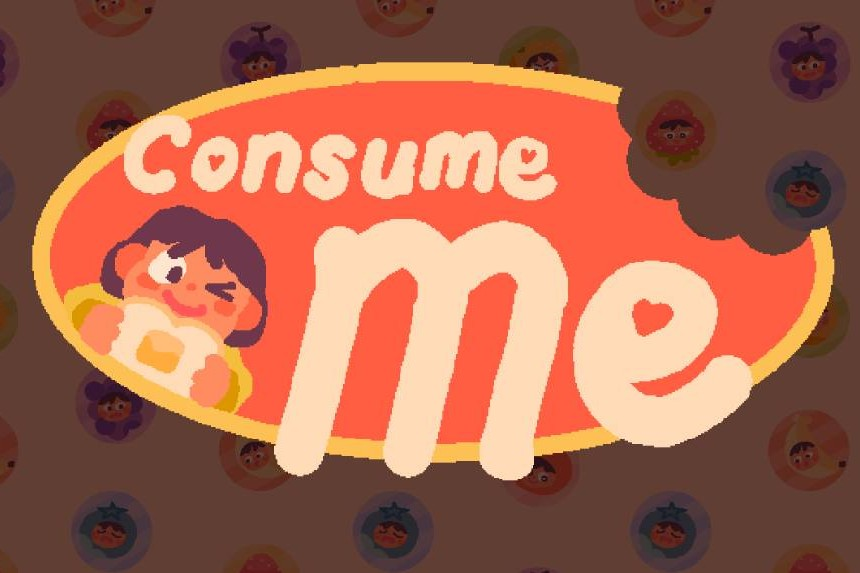
Consume Me is a solid, engaging life sim with immaculate vibes, held back by repetitive minigames, frustrating UI, ambiguous themes and an ending that is, I think, a cop out.
Phew.
Let’s try and work through that, eh?
Consume Me is an autobiographical game from Jenny Jiao Hsia and AP Thomson (who actually worked together on Fortune-499, which I didn’t even realise when I played that) and it absolutely cleared house at the IGF in 2025, picking up the Nuovo Award, Wings Award and the Seamus McNally Grand Prize. It’s self described as a game about feeling “stupid, fat, lazy, and ugly in high school” which I think basically everyone reading this probably recognises (you’re reading about a video game on the internet, don’t lie to me) and explores that via classic life sim mechanics and mini-games: days progress, and on each day there will be some set things you have to do (such as eating your lunch) and then you have a set amount of free time during which you can choose some other things to do, which affect your character’s growth, generally with the idea that you’re building your character to some ideal that either you or the game has decided. So, for example, in Consume Me you can choose to read a book to improve your academic skill; or work out to increase your athletic skill (and lose some “bites”, the game’s obfuscation of calories.)
Like in other life sims, these actions have a cost more than just using up a time unit; they can cost you happiness, energy, or even increase your hunger, which require that you perform actions that can restore them: so, for example, you can eat a protein bar to feel fuller, or read a comic book for pleasure rather than something educational.
Of course, your choices can be constrained. Each week you’ve got a series of goals that have (generally) been set by Jenny’s own expectations (represented by herself in the mirror making demands.) So Jenny requires that she keep to a strict diet–meaning you can’t eat too much at lunch or need to waste precious time on working out. Jenny might demand that she score particularly well on a test at school that week, requiring you read books or do practice tests–which might be difficult to fit in if she also needs to do chores. You need to walk the dog, clean the bathroom and keep up on laundry or you’ll be stuck wearing dirty clothes–though those actions at least earn allowance.
Split up into 5 chapters of a week each, this design really works. I really appreciate that the game is very open about what it is: a strict time/resource management puzzle where you’re trying to absolutely min-max everything to reach obvious goals. If you’re familiar with life sims, you probably know that even with the ones that promise a more fuzzy “play it out and see what you get” experience can quickly devolve into min-maxing and save scumming, because it’s almost impossible to stop yourself. Better just be honest and say “this is a puzzle.”
At first, too, it’s going to seem great. The art–by Hsia and Jie En Lee–is perfect. It’s simple and incredibly evocative; cute without being cloying. Along with the music and sound design (from Ken “coda” Snyder and Violet W-P) you feel absolutely wrapped up in Consume Me’s world. And the mini-games are pretty fun to learn. Lunches start with a balancing mechanic but that (unusually) gets completely discarded for a Blokus-like game where you’re trying to fit a small range of lunch options onto your plate without eating too many bites. When doing makeup or cleaning you control Jenny’s hand and swish it around to try and get as much done before the timer runs out. When exercising you try to position Jenny’s body to match hand and head markers, trying to move slowly because otherwise she flails around wildly. Laundry involves folding clothes; reading involves trying to keep Jenny’s eye on the book and away from distractions; walking the dog is a slightly odd game that reminds me of something or other where you’re tethered to the dog, and either you or the dog rotate around the other and you have to time actions to actually move forward (while also picking up money and letting the dog relieve themselves.)
The problem is that as a min-max focused life sim, you are going to want to nail these minigames, and if you don’t… you’re going to want to save scum. I think there’s some important stuff to say about this in terms of the game’s themes, but if we take it purely mechanically… you are going to get sick of these minigames. They don’t change in any way across the game, and some–notably the makeup mini game–you will do every single day, possibly more than once, and that they’re quick is not really an excuse, because it gets really boring once you fully grasp how to play them.
What’s arguably worse is that I never got comfortable with the UI. The game has that traditional life-sim look–you’ve got to have a big piece of art of the main character at all times, I genuinely agree with that–but it means that everything you need to do is in this infinite scroll menu at the bottom and other information is in the large sidebar. I don’t know what it is–maybe the way the game returns you to the main screen from mini games, maybe the lack of tiny icons for categories–but I spent significantly more time than I’d like scrolling through this menu back and forth even when I knew exactly what I wanted to do; it was easily as annoying as the interface in Zombi, and that’s from 1986 and by a group of French teenagers. I eventually worked out that by pushing the right stick(!) I could quickly switch categories, but that never solved the falderal of trying to use the sidebar, where your goals often have to be scrolled in order for you to see them all. Generally meaning that there’d be this long sequence where I had to flick back and forth between the sidebar and menu repeatedly to decide what I was going to do next, but actually doing way more scrolling and pausing the game than I intended. Not fun!!!
To be honest, I think I could have accepted these issues if as Consume Me went on I didn’t lose sight of what it’s about. When the game begins, it’s implying itself to be a life sim satire of the pressures on a teen girl, with meaningful growth replaced with an unhealthy drive to lose weight. Indeed the game opens with a sensitive warning that the game’s focus disordered eating might be stressful or upsetting, and I think most players will cede to the game’s unhealthy demands thinking they’re playing along until the other shoe drops; the one that recasts the behaviour the game forces on you. But it doesn’t really happen! After the first chapter, the diet aspect of the game recedes into the background as just one of your tasks, and the expectations of the rest of the game’s system don’t just force but reward even more extreme, unhealthy behaviour.
Now, that Consume Me has a nice, crunchy set of systems is perhaps the main pleasure of the game, I think it even makes sense that they’re open enough to be exploitable, but it’s interesting that the game actively encourages you to give Jenny an absolutely warped existence. At one point in-game you’re given an extra goal to do 16 activities in one day (you normally get 2) and there’s an achievement to write two essays in one day, which requires something absolutely absurd like 28 actions. This means that you have to abuse energy drinks, coffee and staying up late to hit your goals, and the issue is the game’s punishments are limited (headaches) and the things you lose–energy, happiness, fullness–are restored easily by abusing other actions like changing into clothes that increase them again or spamming zero time-cost actions.
As I said, I kept expecting this to all come down on Jenny’s head but it just doesn’t. Now, you could argue it would be too obvious, too moralistic, but I think it would have been interesting to use the player’s urge to min-max against them. To do something like show them that they kept Jenny up till 4am after drinking 12 energy drinks and then made her do eight yoga sessions in a row, and then show how genuinely unhealthy that would be. Maybe twist it so that it turns out that the puzzle you were supposed to be solving was giving Jenny a balanced life.
The game instead has a mechanical implication that you can do all of these things and get away with them, because Jenny’s big “I can’t do this any more” moment has nothing to do with any of that: instead it’s that her long distance boyfriend breaks up with her (like you obviously know is going to happen.)
Now, in some respects, I shouldn’t criticise this; it appears to be one of the most autobiographical things in the game. But at the same time, it draws into focus that Consume Me’s issue is that the decision to be autobiographical works in complete cross purpose to the game’s largely mechanically-focused play. It turns out that nothing you’re doing matters. The mechanics are not actually thematically important; indeed, after the break-up the wheels come off entirely and you experience an extensive (if interactive) endgame cutscene where Jenny imagines the future that she believed she was working towards and then the real future that Hsia has.
This segment reminded of Despelote, another game that pulls the curtain back at the end of the game in a way that I think could feel like a cop out, but which rings true because it more cleanly lampshades the game’s fictions to help push the player towards the underlying truth. Here instead the turn to full autobiography feels purely solipsistic. The Jenny you created–or thought you were creating–is secondary to the “real” one, and it ends up with (I think) a far more cliché ending: the “well, it seemed really important when I was a teenager, but I ended up who I was going to be and that’s alright. Good actually.”
Consume Me might be a pretty decent life sim–minigames and UI issues aside–but it’s complicated by how much it implies it’s about something important but it really isn’t about it at all. I’m not sure it’s ultimately about anything, really, which makes game rewarding you for min-maxing dieting feel… well, I don’t have enough knowledge to say if it’s actively harmful (I do think the game is pretty obvious and consistent that what Jenny is doing is ridiculous) but it does feel like there’s something ill-conceived about the entire thing.
Oh well. It is really cute though.
Will I ever play it again? I absolutely rinsed this, because of my min-max brain problems, so I have no reason to.
Final Thought: Something I didn’t mention–couldn’t quite find a place for it–is that more than for its potentially problematic mechanics, Consume Me has led to some controversy for featuring a religious aspect (a bit like and Roger…). I think the game’s store description is a bit disingenuous: it says of Jesus “don’t worry! He doesn’t do anything” but he actually does: he gives you a new mechanic, praying, that solves a tremendously frustrating issue you have in the game’s chapter 5 difficulty spike.
Probably the weirdest thing about the introduction of religion is it’s introduced with an unbelievably long section where a song that I can only describe as having “Mountain Goats energy” plays (Is it supposed to be funny? I honestly couldn’t tell.) I wouldn’t have minded religion appearing (I didn’t have a big issue with it in and Roger… and it is a part of a lot of people’s lives) other than it happens at the point in the game where you think Jenny’s demands on herself are catching up to her and the game is intentionally taking you to a point where you can’t keep up, and then it just straight up fixes the problem. It’s another example of the uneasy mix of mechanics and autobiography–I can’t believe I’m saying this, but it really does feel like Consume Me might have worked better leaning more on the and Roger…/Florence design, taking the player through the minigames to tell Hsia’s story without all the potentially problematic life sim cruft. It’s even got the same teeth brushing!
It’d be easy to dismiss this film as dadslop, and don’t get me wrong, it absolutely is dadslop, but really F1 is an exercise in reputation-washing; for F1, which itself only seems to exist to sportswash, and for Brad Pitt, who after abuse allegations needed a movie that portrayed him as the coolest man who ever lived.
It is absurd (though sadly due to the crushing length and absolute tedium of most of this film, never hilarious) the lengths this movie goes to to make Brad Pitt seem cool. Obviously, there are articles on the “charm offensive” that Pitt has undertaken, but this movie has the mania of a low-budget vanity project that just happened to cost hundreds of million dollars. You cannot watch this film and not see a man who seems to be willing himself to be the reincarnation of Robert Redford even though at the time of filming he wasn’t dead yet. If you told me Pitt was doing weird demonic rituals, burning frames from The Natural in the middle of a pentagram, snorting them, mixing them with his blood, crying, screaming, “make me Robert Redford but cooler” I’d shrug and go “seems believable.”
You could say I’m beating up on Pitt a bit too much here; after all Tom Cruise has been playing the greatest man who ever lived in every movie he’s made for years now, and his closets will almost certainly spring open one day with a comedy “BOI-O-OING” noise and shower everyone with a Paris Catacombs. But (bar the last) those movies seemed to still be genuinely engaged with entertaining, whereas F1 seems like it only sprung into existence because someone at Apple collated user data and worked out that F1 had a cross-cultural synergy across age groups when paired with X established actor and blah blah blah fucking blah.
Despite being pointlessly bloated, you almost have to respect F1’s monomania. Sure, the movie is like they grabbed sport movie clichés from a bag like Scrabble tiles and scattered them without care–the movie doesn’t even bother to feature an “evil” racing team of burly Swedes or something, and it really does miss them (a shot of Lewis Hamilton snarling doesn’t count)–but you can see that they needed to expend that effort on showing that in every situation Pitt’s character is not just right but unselfishly so. The other driver on the team he’s parachuted into hates him with the burning passion of a toddler who’s been told he has to let his brother get a shot on the steering wheel, and yet Pitt does nothing but work his arse off to elevate him. He gets (understandably) annoyed once, then immediately goes back to being a cool big brother who “lets him win”. The trad. “darkest before dawn” moment only comes because he’s just so damn angry on the team’s behalf. And the movie pulls an incredible “have your cake and eat it” move in the finale, where he wins the big final race because he was trying to selflessly not win it.
The movie drowns in hagiographic detail. There’s a section in this movie where Pitt’s character defends a member of the pit crew who made a mistake and then later gives her a pep talk; this character has basically nothing to do with anything else in the movie (indeed they have no character to speak of) and it immediately reminded me of the part of Tiger Schroff vehicle Heropanti 2 where he offers to help someone in a wheelchair who transparently doesn’t need help. You could cut this stuff!!! The movie is 155 minutes long!!!
I suppose your question at this point might be “well, is the driving any good?” and it’s… fine. Car go fast is good, obviously, though there’s not that much of it, because we need to hear from a lot of characters restating exposition instead, and as an Apple film they don’t want you to have to look up from your laundry too much anyway. And I did find the moment in the climax where we’re supposed to experience the transcendence of speed confusing because it really reads like Brad Pitt is about to die. Of course, the only way that would have happened in this movie would have been so he could meet god, who would be like “ah man, I can’t compete. You’re just so cool.”
Developed/Published by: Konami / Nintendo Released: 30/05/1987 Completed: 09/04/2025 Completion: Beat a computer opponent!
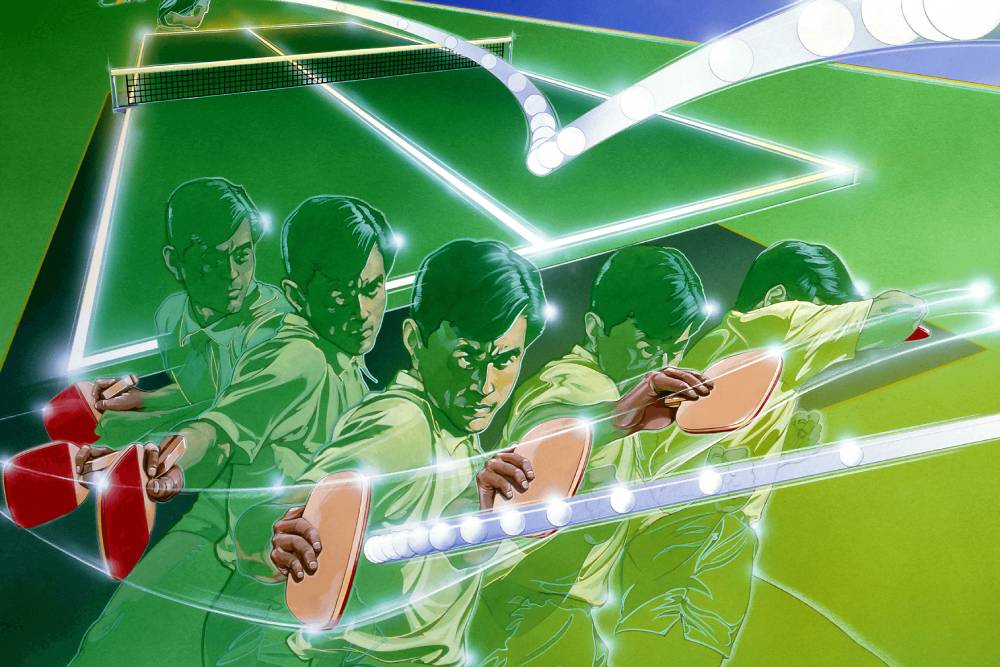
Smash Ping Pong is a bit of a mystery in the Famicom Disk System line-up, and Nintendo’s history in general. Created, and originally released, by Konami in arcades (and on other home systems such as MSX) as Konami’s Ping Pong, for some reason Nintendo put it out on the FDS themselves. This is especially odd when Konami were one of the few third-party developers to go all-in on the FDS–like Nintendo: their new releases were on disk, not cartridge.
There’s a few possibilities as to how Nintendo ended up publishing this, but it does seem to stem from its very likely background as a port that Konami had kicking around in the back of a cupboard unreleased. In fact, The Cutting Room Floor says as much: that there is “ample evidence” that it’s a salvaged cartridge release, most damning that the game code includes a serial number that aligns with “missing” serial numbers from Konami’s early Famicom lineup.
The question really is: why put a game that’s already a couple of years old by this point out on the FDS? Well, Nintendo will have almost certainly been looking for more games to help quickly fill out the add-on’s catalogue, and sports games are a perennial filler.
Or, perhaps Konami considered it more profitable to fob Smash Ping Pong off on Nintendo to handle all the publishing duties for, considering the Famicom Disk System’s licensing terms anyway, which requested partial copyright ownership and royalties compared to the complete wild west of Famicom cartridges.
But having said all that, it might just be that someone at Nintendo really liked Konami Ping Pong! Because… it’s really good?
I’ll admit to not having much experience with ping pong games before this–I’ve never played the much loved Rockstar Table Tennis, for example–so I don’t know if what Smash Ping Pong does is unusual or influential, but I am extremely impressed with a design that cleverly side-steps any questions like “well, why not just play a tennis video game, aren’t they the same?”
You see, in Smash Ping Pong, you don’t control the movement of your paddle. Your disembodied hand and paddle already track the position of the ball. The game is instead entirely about which strikes you use, and the timing of your strikes.
While this takes a bit of getting used to–and the speed of the game doesn’t help, but then it is ping pong–savvily the game only features three kinds of strikes: drive (a fast strike) cut (a slower strike) and smash (self explanatory?), chosen with a tap of the d-pad, plus the ability to change if you’re holding the paddle fore or backhand by holding A, which can change the direction of the strike.
It is shockingly elegant, and I think is one of the best examples of a game trying to replicate the experience of playing a sport at least at this early stage I’ve seen. You don’t have to think about positioning–in ping pong, it’s about hitting the ball, not about getting into position to hit the ball, right? And so it’s all about watching the ball and getting into a rally, trying to force your opponent into a mistake. You don’t need to think too much, but you do need to practice and learn how to guide the ball in an advantageous way, when to change strikes, when to change to fore or back hand.
Screenshots really don’t bring across how exciting this game is to play.
There is some “give” to the design though. When a strike goes awry, either from your or your opponent, a tone is played to make it clear this is a slow, easy ball that you can smash–usually an easy point unless you’re at the far end of the table and don’t change hand position.
It just… works, and while it does suffer from the classic “one player is at the back of the screen” issue of this kind of game (though it switches positions to keep it fair) Famicom owners who played it probably found this one of the most balanced and engaging sports games for two players on the system. Not as flashy as Pro Wrestling, but a good companion.
It does fall down a bit on single player though. You can select difficulties and play either first to 11 or first to 21 matches, but there’s no tournament or campaign mode; you just play a single match and you’re done, at best a practice mode to get you up to speed to play another human. They do try for some character–the Famicom Disk System mascot Diskun shows up, and Donkey Kong is in the crowd (he probably didn’t want to go see the tennis, what with Mario being there) but it’s not quite enough to keep the attention.
I guess you could imagine upping difficulty as a tournament, but it’s hardly satisfying.
I’ve talked previously about the kind of “curated” collection you would want to end up with if you were a Famicom collector–a selection of games you might actually play on occasion rather than just have on shelves–and this would 100% be in mine along with Pro Wrestling. Didn’t expect that at all.
Will I ever play it again? I would love to. It’s funny, while playing this I was struck by the question of how often “retro” gamers actually play these old games with other people, or if they do just sit in collections. Because this is ripe to be rediscovered–it doesn’t feel like a design where you’re better off playing a newer ping pong game instead, because it’s so focused and complete as it is.
Final Thought: I liked this so much I wanted to see if it was fondly remembered by Japanese players so looked it up Nintendo’s handy Famicom 40th Anniversary site, only to learn, tragically, that it didn’t even get a sniff at the “What do you think of when you hear ‘sports game’?” poll, which had rank rubbish like Volleyball in ninth.









 Unlock with Patreon