Developed/Published by: Capy Released: 08/04/2026 Completed: 10/07/2026 Completion: Made all the friends!
Feel like I’ve been going pretty hard on articles recently so let’s have a nice easy one this week, eh? I’m a fan and acquaintance of Capy–I think I’ve played everything they’ve released, I worked in their offices while working on Sound Shapes–so I’m not going to argue from any position of objectivity (though if you’re new here, I never do) but I think Find Your Words is adorable, worthy, and worth anyone’s time considering it’s free.
To be honest, it being free is almost an… issue? While it doesn’t quite grind my gears like Evil Egg–the freeness of which still seems completely wrong–that it’s free makes it feel a bit churlish to complain about Find Your Words. But the problem is that I think there’s just so much more they could do!
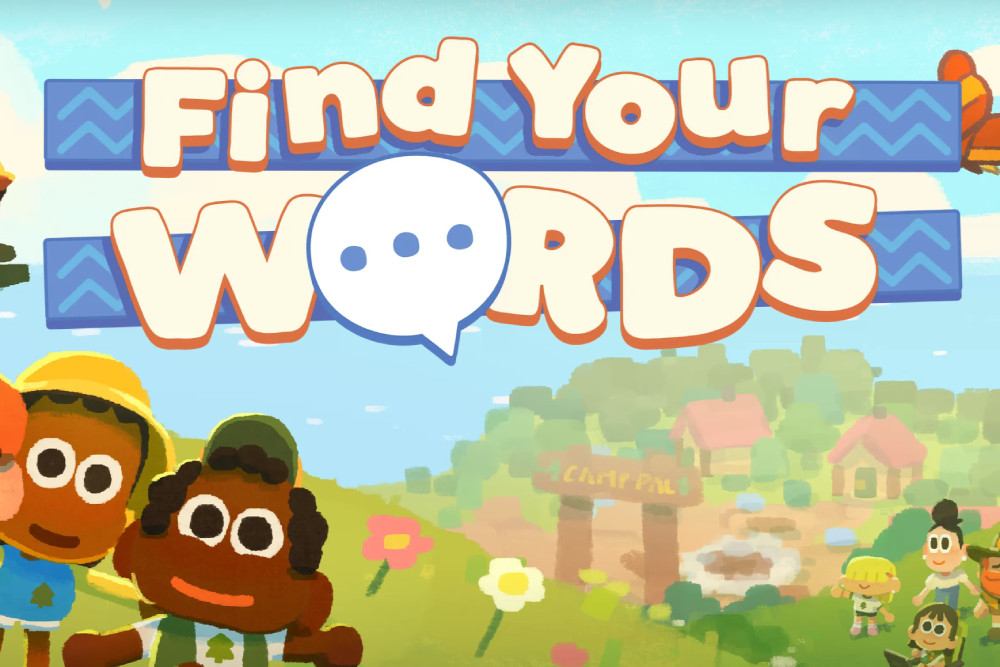
Inspired by designers Jon Maur and Vic Ngyuen’s experience as the parents of non-verbal children, Find Your Words casts you as a non-verbal child going to summer camp for the first time, and takes you through the experience of making friends via AAC, or “augmentative and alternative communication.”
The fun thing here–and it must have at least partially been the genesis of the project–is that communication books, a form of AAC, are perfect as a communication tool in a video game. With a communication book, you have a limited number of symbols and can combine them to make simple sentences: you could select “where” and “beach” let’s say, show it to someone, and they’d know quite simply that you’re asking where the beach is.
When trying to create a “natural” form of communication for a video game, this so… elegant. There’s none of the problems of having the full freedom of text input, and there’s similarly none of the strict, “that isn’t quite what I wish I could say” of pre-selected statements.
Yes, the more options you have, the more difficult it is to ensure that you hit a sensible answer for each possibility–meaning you have to keep your context small. I do think that’s why Find Your Words is limited to a single day at a summer camp (and there are still situations where combinations that you think would work lead to unsatisfyingly generic answers.)
However… I think it’s ripe for further exploration. I know systems like this have existed before–even something like Ultima’s original “Name, job, bye” system has similarities–but I think I like it particularly here because I feel like we’ve gotten so stuck in the mindset of strict dialogue trees. Playing Find Your Words I could see, like, a detective game starring a non-verbal hero (a silent protagonist, as it were…) using this quite easily.
Honestly, it’s my main criticism of Find Your Words. It’s delightful, and I think meaningful. But I wish they’d got a little bit more… designery with the actual game. The communication tool isn’t particularly important to the game’s puzzles: you mostly make friends by finding them and saying the same simple things in different locations. I suppose for that reason it’d be a great game for a kid, or to play with a kid–though I did struggle to find all the birds, I guess because it doesn’t really use the game’s main mechanic.
That said, it doesn’t take that long and you can be done with this game in an hour and change; possibly why they chose to make it free (better to sell a supporter pack to fewer people than face many a steam refund from jerks?) and I certainly didn’t feel like I wasted my time. I just… do more with this! Please!!!
Will I ever play it again? There really isn’t any reason to, sadly–there’s no branching or anything as far as I can tell. It’s sweet, but it is simple.
Final Thought: At the very least, if they’re not going to do any more with this concept they should make some plushies of the bird designs. I love them!!! (Even if they were annoying to actually find in the game.)
Crikey. I’ve liked Beabadoobee since she put out her Space Cadet EP, but I’d somewhat fallen out of keeping up with her, so I had no idea she was now so fancy and popular she was playing stadiums. Obviously that should put me off but her recent single Sun Has Set has an emo-ey anger that has absolutely kept me on side. Excited to see what the upcoming album Pylon has got going on, considering it’ll feature guest spots from both Hayley Williams and Chino Moreno.
Hey, do you hate in-line advertising? We do too! We’re only ever going to do it here at the start of our newsletter posts because we want you to get these missives in your inbox a day early. Sorry!
My Vampire Survivors piece has really chimed with a lot of people! It’s even been linked in the GameDiscoverCo newsletter (still on Substack, though: boo!) It does make me wish, perhaps, that I’d got a little deeper into an explanation of the theories I’m drawing on, so if you’re interested in learning more—and you don’t want to read an entire book—I can recommend Game Studies Study Buddies’ episode on Addiction by Design, which I’ve since listened to and I think is a pretty good primer. Still three hours, mind.
Also, you should play NUTMEG! (if you like football at all.)
I got absolutely nothing for my subheading “should be beta than this” and frankly I think that’s a scandal. Haven’t been able to catch The Odyssey yet, and in fact have accepted seeing it in (proper, full-frame) laser IMAX next week rather than doing it in 70mm IMAX because, at best, if I wanted that I’d be able to see it some time in September. I’ve got so much discourse bookmarked!!! I cannae wait that long!!!
“This is purely an independent, human-made (no AI) project made for the love of games. Diverse, independent games reporting is crucial to maintaining a thriving landscape and balanced coverage.”
Have a zine project you’d like us to share? Get in touch!
And Finally…
Chris Baker wrote a great article on the lost art of film strips, which are being diligently restored and archived online by Uncommon Ephemera. Unfortunately, it’s been posted on Substack and I’m trying to stick to a “no Substack” rule here (though I think a few have slipped through before.) So instead I’ll just link Uncommon Ephemera’s Youtube and advise you to explore this uncanny artform. “The Art Of Pantomime In Church” > Backrooms, sorry.
Next week on exp.: An alternative form of communication.
Developed/Published by: Atari Released: 09/1984 Completed: 05/05/2026 Completion: Destroyed the Death Star once, but on a later return trip Lando Calrissian and Nien Numb [“No! Not Nien Numb!”–Ed.] sadly died after destroying the reactor.
Uh… July the 28th… be with you? It had been a while since I played a Star Wars game, so May the 4th, despite being an annoying pun, did actually put me in mind to finally sit down and play Atari’s take on Return Of The Jedi seriously, a game that I’d say my entire of experience up to this point had been dying close to instantly because I found the fast isometric scrolling so difficult to look at, and the game so hard to control.
Here’s what I’ll say: even if you really put your head down, try and get used to what Return of the Jedi is serving up… it’s hard to look at and impossible to comfortably control (and before you ask: I did get some time with an actual machine1 with the yoke controller, and if anything that might have been worse.)
Atari’s take on Return Of The Jedi is sort of the black sheep of Atari’s Star Wars output. As it was released to capitalise on the film in a more timely manner than Atari’s Star Wars, it awkwardly precedes Atari’s arcade take on The Empire Strikes Back, and it’s the only game in the trilogy that doesn’t use vector graphics. In conversation with Retro Gamer, developer Dennis Harper recounted:
“Lyle Rains, our chief technical guy, gave me the assignment and he said that Atari had developed some innovative hardware that could store an enormous amount of playfield graphics using relatively little storage. Return Of The Jedi was to be the flagship game to show off this technology.”
Therefore–and inspired by Zaxxon–they decided to go for an isometric viewpoint, and create levels based on the climax of the film much the same way Atari’s take on Star Wars had: the speeder bike chase, the space ambush/attack on the shield generator, and the flight through the Death Star in the Millennium Falcon to destroy the reactor core.
In some respects, it’s a classic Atari arcade game of the era. It loops, you can choose to start on later levels for a score bonus, there’s as much digitised speech as they can jam in. But there’s something very unusual in it.
You won’t notice it if you start on the first level and don’t make it into the second, and so I imagine most people never saw it, because Return Of The Jedi is, as I said, extremely challenging to survive any length of time in. On the first level, you only get the speeder bike chase and the Death Star reactor core attack/escape. On the second, you experience the space ambush/shield generator attack level between them, and the game cuts between the action.
The only other example I can give of a game doing something like this, this early, is Karateka, which came out over a year later (I have no sense if Mechner had ever seen a Return Of The Jedi arcade machine) and which, arguably, is doing something a lot simpler with its cuts–simply letting you know there’s a dude running towards you. A closer comparison, really, would be something like Thirty Flights Of Loving in terms of cuts between action you’re still in control of, but that’s years later and, really, doing something different with its cinematic cuts.
In Return Of The Jedi, at one point you’re the Millennium Falcon with an X-Wing escort, fighting off TIE Fighters, then suddenly, you’re Chewbacca in a AT-ST, trying to dodge logs… then back again! Surprisingly, it’s not discombobulating at all (or at least, no more discombobulating than the game already is) and it does make me wonder, as Thirty Flights Of Loving did, if we haven’t missed something with the form by not engaging with cinematic cutting during play more. Harper believes he was the first to do this kind of cutting (I can’t find anything earlier, and I’ve annoyed the Gaming Alexandria discord enough as it is) and it came from a genuine attempt to recreate the parallel action from the film. The arcade flyer, interestingly, touts it as the “new ‘Split Wave’ movie technique.” Thanks to all that digitised speech, you get the sense of a battle across two fronts and the connection between them, with the level-ending cut-scene making clear that as you got the shield generator down on the ground, the Millennium Falcon can now get to the Death Star.
To be honest, I’m sure in a noisy arcade it just felt sort of random, and it really does require knowledge of the film to truly work, so it’s not exactly perfect, but I appreciate the attempt.
I’d probably appreciate it more, however, if Return Of The Jedi was just a little more… playable in the first place. The game is way, way way too fast when you’re actually playing it because the aspect ratio and isometric view mean you have almost no way to anticipate what’s coming. I didn’t get far–at all–and what I managed was pure grim memorisation. The isometric viewpoint plays strange little tricks, too. Flying into the Death Star? Fine. Flying out? Almost impossible. I’m certain for many people this game was just about surviving an escape from the Death Star even once–it certainly was for me.
Return Of The Jedi isn’t terrible, it just requires such a white-knuckle intensity that it’s never actually fun. If Star Wars gave you this great sense of “playing the movie” Return Of The Jedi keeps you at more of a distance and gives you a sense of “failing at recreating the movie.”
Will I ever play it again? I’ll always hop on a Star Wars machine. But this? It’s just not fun!
Final Thought: One thing I particularly like about this game, however, is the strange interpretation of Star Destroyers that have a real “what if Klasky Csupo designed Star Wars?” feel to them. It’s not quite enough, but it’s something!
Developed/Published by: poncle Released: 20/10/2022 Completed: 05/05/2026 Completion: Beat the final boss, saw the credits.
Vampire Survivors completely passed me by originally. But the genre it spawned–now apparently named “Bullet Heaven” by Valve, although I’m not sure if people have decided to accept it–is everywhere and it feels like I should probably know about it.
Off the back of Vampire Survivors, my feeling is that it’s… something I know about now.
In fact, it’s something that I was quite prepared to be done with very quickly once I understood it. If you’re unfamiliar with Vampire Survivors–and it’s not impossible, I really didn’t know anything about it until I played it–it’s a game in which your chosen hero is placed in the middle of an essentially infinite map and enemies spawn off screen in increasing amounts and make a beeline for them. The chosen hero attacks automatically, and really, there are only a few ways you affect their survival. First, by moving them around: not just to avoid enemies, but to collect the experience gems they drop. Secondly, by selecting the upgrades they receive by levelling up: new weapons, passive items, or simply upgrading the weapons and items you already have.
The pleasure of Vampire Survivors is the ramping up of your abilities versus the ramping up of enemies. The very first time you play, you think “how on earth am I going to survive this” as you walk around slowly with a whip that fires, occasionally, horizontally the direction you’re facing. It’s awkward, and not even really fun. You’ll probably pick weapons and abilities at random and die a few times, but then you’ll grasp you want to pick weapons or abilities that synergise [“well, obviously”–Ed.] and before long you’re playing a game where your hero basically stands still while a whirling tornado of attacks spin around them, energy gems are absorbed into them from a distance, and literally thousands of enemies die by the second in huge, incomprehensible mosh-pit.
What’s odd about Vampire Survivors is how quickly that occurs. At least, it did for me. Once you learn or luck into the realisation that if you pick the correct synergies of weapons and passives weapons evolve into ridiculously powerful new forms, the game reveals itself to be about… doing that. Each level-up, pick the thing that matches the thing you have. Simple.
In my recent(-ish) piece on Gore Verbinski’s Good Luck, Have Fun, Don’t Die, I wrote about the “machine zone” described by Natasha Dow Schüll’s Addiction by Design: Machine Gambling in Las Vegas. Designers in the gambling industry are engaged in an ever increasing arms race to create perfect, friction-free sensation and the absolute absorption of players in their games until, ideally, they never stop playing. Not that they couldn’t, that they’d never want to. A perfect skinner box.
Have you noticed how gambling is everywhere now? You can’t seem to escape it. If you watch any form of TV (remember when streaming didn’t have ads?) every ad break seems to be for an online casino or sports betting. Prediction markets are being shoehorned into awards shows and god knows what else.
It feels like as everything gets slightly worse in people’s lives, as all the money, all the resources get held by an ever smaller amount of people, as our high streets and third spaces get hollowed out, the offer being made is “well, gamble. Maybe you’ll hit it big, and join us.” Or at least, that’s the offer initially being made. The real offer being made is “Gamble, and lose yourself. Lose the outside world. The longest you’ll ever have to live is the moment between spins, and the best thing is the spins never have to stop.”
It is a persuasive, efficient, powerful form of design. I doubt the people on the ground, the ones engaged in user experience, recognising when an animation is too long or a particular button press unnecessary, are evil as such. I think we’re all able of abstracting far more horrific things away if our own comfort demands it. And you know, they’re designers in the gambling industry. It’s hard to be disappointed.
So is it unfair that I’m disappointed in the waves of game designers that delve into the dark patterns? It’s getting disturbingly transparent to see the slot machines and scratch cards; like a promise, “come join us in the machine zone. This one doesn’t even need you to spend all your money. Your time is good enough for us, here.”
I play a game like Vampire Survivors, and I think… where is the “play”? where is the joy, the creativity, hell, the “series of interesting decisions”? The time between level ups is just the time the reels spend spinning. After the first few, every level up is as automatic as pushing “spin again.” And after a certain point, you don’t even have to. Like an addict in the machine zone, you watch the machine play itself. If there is a vampire here, it is one that drains us of our time, our life, our joy.
I’m sure you probably think I’m being sort of histrionic here. I’ve complained about this before, honestly; when I wrote about Blue Prince. The idea that these games–which I admit unlike slot machines you can “win”–ask you to spend time on failing runs, waste your time, but feed you the incremental success (directly analogous to slot machine’s carefully spaced payouts, I feel) to keep you playing.
But it’s… shit. It’s games as commerce, not art. And I can hear the complaints, but I guess I’m at the point where they don’t wash. The spate of gambling themed games makes it clear that any distinction over the fact that games’ dark patterns were a parallel evolution is utterly meaningless. And sure, the games are fun, in many cases do require more thought–so then remove the dark patterns!
You’re creating games that you want people to play, right? Not setting traps for people to fall into?
As I said above: I don’t even think gambling designers are evil. I don’t think most game designers are thinking deeply about the value of design, actually; so much is genre convention already that I don’t think it’s interrogated.
The problem for me is when playing Vampire Survivors, there’s just so little to interrogate. I was done with it after my first half hour win, but–and it speaks of the insidious nature of it, and my own completionist tendencies–I realised there were a few things I could do to “complete” it properly, surmised it wouldn’t take much time or attention to do so, and saw the credits.1 But I felt nothing. No joy. No pleasure. No excitement or interest or… anything. Really. I just lived in the moments between spins.
Will I ever play it again? There are a lot of DLC with IP people love for this game now, but look… it’s like getting excited that they made a slot machine with the Golden Girls on it or something.
Final Thought: So I suppose the big question is: do I play Vampire Crawlers? Well, the problem is I fucking love dungeon crawlers and deckbuilders.
After all that… what am I like!
I probably wouldn’t have done this if it wasn’t for the fact that it’s really hard to look at the screen during about… what, twenty, thirty percent of an episode of The Pitt? ↩︎
Developed/Published by: Tose / Jaleco Released: 23/12/1988 Completed: 22/06/2026 SCompletion: Won the “Championship” (it’s obviously the World Cup, there’s a picture of the World Cup at the end) with Italy Scotland (look, they play in blue, ok?)
After the terrible experience of Match Day’s bare-bones port and antique play, I was definitely looking for something better to play to get my arcadey footy fix–but of course, the siren call of more retro beckoned. Steam, surprisingly, has a sort of burgeoning collection of retro games, I think because there are a lot of companies throwing games up in the hope they’ll make a buck or two. I learned my lesson well enough with Match Day to not bother with Microprose Soccer, even though I’d genuinely like to play that predecessor to Sensible Soccer–the version on Steam apparently doesn’t include the proper C64 game and doesn’t work on Steam Deck anyway.
However, I spotted Jaleco Sports: Goal! and it looked like it had a little more oomph to it, including two versions of Goal!, CRT filters, saving and rewind, and manuals. What I’d consider the bare minimum–but after Match Day, a welcome sight.
I usually don’t love tube-style CRT frames but it helps here to cover up a lot of the flickering/garbage at the edge of the screen…
It’s not even exactly the bare minimum. I appreciate that Sickhead Games/Rock It Games made sure to include all the different regional versions of Goal!–so you can, if you wish, play the original Moero! Pro Soccer version, or the PAL version (for some reason)1. And that even includes all the different manuals. Pretty good!
I suppose it’s hard to ask for more from a re-release of an late-80s footy game, because what are you really going to dredge up that’s that illuminating? So at best, you’ve got to hope that by 1988 we’ve reached “football as a video game” rather than “we tried to represent football as best we could ¯\_(ツ)_/¯”
After Match Day, or I suppose more contextually, Soccer, Goal! for NES feels like a huge step up in that it’s much more accurately representing the sport–full differentiated teams, tournaments, and all the rules including offside (although I never saw this play out… actually come to think of it I never even saw a foul given, but the manual does say they’re there!)
You can also feel it trying to be a video game. It’s trying to do what you want a video game version of a sport to do: create something that gives you the same feeling of the experience without being a slavish recreation. In Goal! You can feel the flow of a football game and those big moments: When you scored the goal needed to win the game with a header off a keeper deflection. When you had to desperately defend against an opponent that just keeps knocking on your door in the dying minutes of the game. All of those sorts of things.
It’s a shame that Goal!.. is not very good. Credited to Tose, I genuinely think they set out to make a good football game–and I think they did nearly succeed. But there are a lot of baffling decisions.
First up: that viewing angle. It’s not… what is that angle? It’s not isometric projection. I think it’s an attempt at military projection? But there’s something so off about it. It feels like you’re a giant with a crick in his neck, and it doesn’t even look like the players are drawn correctly for the angle anyway. Why did they do this? It’s not a viewpoint football is ever seen by (perhaps in the modern era by a failing drone, I don’t know.) Old footy matches were often shown at a bit more of an angle, but this is just ridiculous.
It’s what probably causes one of the most major issues with Goal!. It’s bloody impossible to line up your shots correctly. Blessedly the game has a pass and a shoot button (though the I feel layout is backwards) but by putting everything at an angle, and the cross of a d-pad famously not at an angle, it’s a nightmare. It doesn’t even feel like you can really line up your shot with the angle of the pitch!
But there are plenty of other glaring errors. The AI is atrocious. As much as you can still weave a story in your matches, the story sometimes features beats like “when the midfielder that wasn’t under your control suddenly stopped chasing the ball to run in the opposite direction.” I said jumpers for goalposts when talking about Match Day, but a lot of the time Goal! looks like children playing: literally everyone on the pitch just chasing the one person with the ball. And despite already having a low framerate with jerky players, when things like that happen the game’s speed craters. It’s Double Dragon level, though arguably worse because Goal! (thanks to the stupid angle) requires such precision.
The bad framerate is especially damaging because it makes Goal! so unresponsive. The game features a sliding tackle, but it literally took me several games to successfully pull off, even though the command is just “push a direction and press the tackle button.” It just doesn’t let you do it nine times out of ten. And if you’re trying to switch players to get closer to the opponent with the ball? Good luck. The game seems to have absolutely no system in place for selecting the closest player–you’ll often find it selecting someone miles away. Just for fun, I guess.
It’s not all bad, though. Goal! Does have one of the best things in a football game: aftertouch. After shooting, you can hold B and push a direction to bend your shot, and it’s one of the things you’ll need to do to beat the keepers, who are weirdly close to perfect if you get them on screen head on but useless if you try and bend it in around them before you even see them (another side effect of the weird angle is how close you have to get to even see the goals.)
Maybe it’s just that the game chugs along, is unresponsive, and awkward–you really do have to have a death grip on your controller to try and hit those angles–but scoring goals does feel really satisfying, so that’s nice. There’s a real dopamine hit that keeps you playing longer than you probably should.
And, honestly, I bet at the time it did keep a lot of footy-loving NES owners playing. Goal! Got some terrible reviews–39% in TOTAL!–and while it’s not exactly that I’d say they’re wrong (it’s not good) with so few footy games on the NES I understand why you’d make do when playing this–somehow I did just keep playing it until I won the World Cup. It was probably better in multiplayer, too, with both players struggling with the controls and tackling–I don’t know if the championship mode gets more difficult as you go, but it can be pretty frustrating playing against the better teams who are able to tackle at will.
In an attempt to offer value for money, there’s a weird extra mode in Goal! too. The “shoot competition.” This is a mode where you’re trying to quickly score a goal from a set piece against a couple of defenders, but… it’s got completely different graphics and plays differently.
Why would Tose do this? It’s not even very good. It’s easy, over quickly (score five times, you’re done) and doesn’t reward you with anything. I wonder if this was what the game was originally supposed to be, and when it turned out the graphics wouldn’t fit into memory with two full teams, they just jammed it in as a wee extra.
The weirdest thing about it is that you can play as one of three “stars”: Hansen, Roko or Juarez.
Hansen?
As in… Alan Hansen???
He was a defender!
And Scotland isn’t even properly in this game. Which, by the way, immediately halves the scores I don’t give out. Meaning I’d be rating this more harshly than TOTAL did. So they’re lucky I don’t.
Will I ever play it again? No, but as I said above: I would understand why people would. This is so nearly there, just let down by weird decisions and technical limitations/ineptitude.
Final Thought: Another odd decision: in adapting Moero! Pro Soccer as Goal!, I guess Jaleco felt they had to try and attract the US market, and so Goal! even in its European release has a Championship mode (World Cup, international teams) and a “Tournament” mode, but the tournament mode features American teams2, like literally anyone would care. It’s a shame as well because only the tournament mode features the “proper” knockouts of the World Cup, with the Championship mode instead featuring a strange double group stage. Really not sure what they were thinking with that. Anyway. Alan Hansen!!!
Sorry, I’ve let the side down here and didn’t actually boot this version up to see if it’s any different. The main way it should be different is it should be slower, at 50hz, and I imagine they didn’t go that far. Also, why would you want to play that! ↩︎
Something I like about this: Tose obviously didn’t have the memory to fit in stats for more teams (or couldn’t be arsed to make them up) and so they just made the American teams rebadged versions of international teams, and the manual happily admits this. ↩︎
Developed/Published by: Sumo Digital, Sumo Digital Academy / Secret Mode Released: 26/03/2026 Completed: 06/07/2026 Completion: Won the Egg Cup with Carlisle!
The World Cup grinding on finally gave me a reason to give my time to this, Sumo Digital’s “Nostalgic Deckbuilding Football Manager” because I was, at least in the group stages, going to have a lot of games on that I didn’t exactly feel I needed to give my full attention (but I still wanted to see the goals and that.)
Now, I’m not someone who really bothers with football manager games, but I like deckbuilders and I really loved the theming of this, chock-full of the kind of maximalist skeuomorphism that hasn’t really been seen in games since the likes of Yes, Prime Minister (and which does really feel like a very “British games” kind of thing.) It was definitely enough to make me get over the main issue I have: that I love football, but I just don’t care about club football at all.
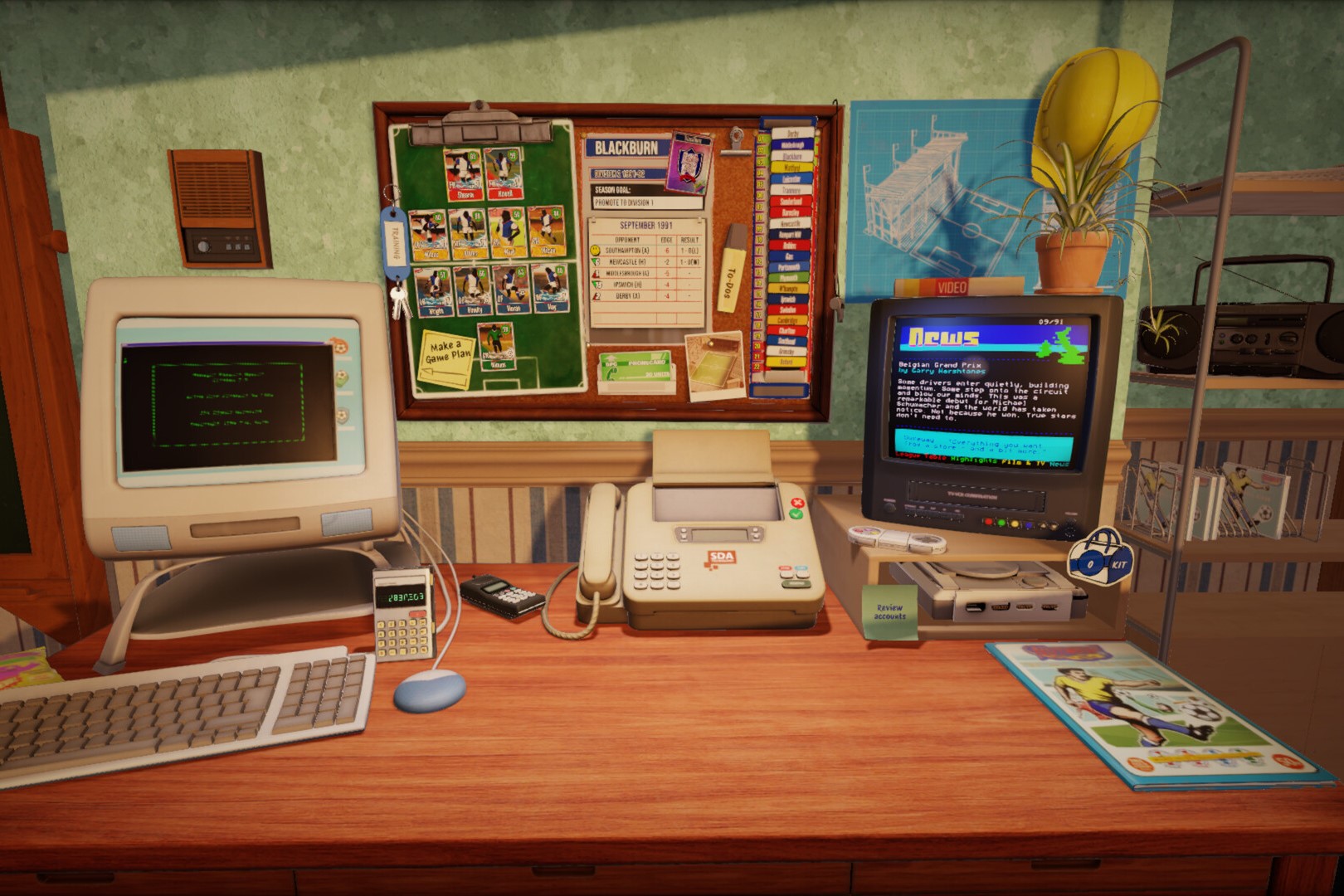
Love a game that gives you a desk: Yes, Prime Minister (Oxford Digital, 1987) vs. Nutmeg!
I suspect that’s an unbelievably unusual opinion, but if you’re going to feel that way, growing up in Scotland is probably what’s going to do it. Which I suppose makes it somewhat ironic that probably the most major issue I have with Nutmeg! is that it’s limited to the English leagues, which I care about even less. I get it: they’re recreating 20 years of football history right down to the real transfers happening at the right time, and that’s a lot of data entry (I suspect Sumo Digital Academy had to take on quite a bit of grunt work) and it’s probably the most famous and popular league in the world, but I hope that they’ll be able to add the Scottish leagues in future, so players can try and desperately make the top flight of Scottish football in the era even slightly interesting (sorry.)
But still, don’t say I don’t persevere. I simply picked the most northern teams I could get–first York, which I got to the second division–and then Carlisle, the most northern English football team you can get.1
In general, however, one of the nice things about Nutmeg! is that I don’t think you have to be a locked-in football fan to enjoy it. Thanks to setting itself to an era and going for a more abstracted take on the sport, Nutmeg! does manage to split the difference between being a “themed video game” and a “football manager” and that makes it worth playing even if you just think it looks interesting but you only know the barest about football.
Despite that, I do think the tutorial doesn’t explain the game as well as it should, which is why I’ve written an entire guide for it. However, in short, the thing that needs to be understood about Nutmeg! is that it’s not a deckbuilder about building a “perfect engine” that you use across the game, but instead a game about percentages. Nutmeg! is more like a streamlined, card-based XCOM than it is a football-themed Slay The Spire.
The majority of your time is spent actually being a football manager: you’re trying to build the best team of players you can, and to do that you’ll need to make money–selling merch and improving your stadium to sell more tickets–and hire the best staff to train and support them. The loop, really, boils down to acquiring the best players you can to win matches which allows you to make more money to buy even better players. Unless you chose to play in marathon mode, you aren’t going to play every game–meaning that you mostly go into games with a straight percentage chance of winning or drawing, and only a little leeway to affect that by choosing your team’s tactics and formation.
So quickly you learn: you can’t win every game, unless you want to engage in brutal, repetitive save scumming.2 You have to pick your battles–and the trick here is that’s where the deckbuilding game kicks in, with card-based matches.
I really love the matches. The system isn’t entirely elegant, but it does a great job of representing the highs and lows of a football match. Football matches are 90+ minutes and they tell stories that boil down easily into highlights, and this is how Nutmeg! works. Again, you can’t expect to simply build a perfect deck and win. First of all, any cards you use in a match get burned off, so your deck is constantly changing. Secondly, every action is that XCOM-like battle of percentages that you try to bend in your favour with your hand of cards. Want to score a goal? Well, if the goalie is incredible and your striker… not, you’ll have to spend the best attacking card you have and still not guarantee the goal.
Everything in Nutmeg! is a gamble, and that simply feels right for what they’re trying to do. Strong teams are better than weak teams, but absolutely unlikely things can happen… about as often as unlikely things happen. You won’t get a division 5 team beating a first division team, but underdogs can still win the day with the right cards, and there’s a real thrill in having saved a powerful card until you absolutely need it, like in a cup knockout game, knowing that if you lose it, you’re probably out till next year.
But there’s always next year.
Nutmeg! is a really nice “casual” take on football and management sims. How good players are is very clear–you really don’t have to pour over the stats–and the matches you play matter. But it’s not perfect. There are no issues that ruin it, exactly, but there’s definitely a culmination of niggles that could turn you off.
First, that UI. It’s charming, and I love that it evolves across the years, but it’s also really busy, overcomplicated, and slow to navigate. It feel like they’ve created a lot of redundancy to try and make it simpler to do more things, but it’s confusing, and made worse by the fact that the way they highlight what you’re selecting is far too subtle. And then when you actually switch screens there are animations, zooms… I’m aware that if they cut this down the game would feel very static, but especially as the game settles into a loop where you’re doing the same things flicking between screens over and over, you’re going to get very tired of it (and a bit dizzy, frankly.)
Then there are the weak points of the game’s loop. Ensuring players keep their skills trained up is just tedious busywork; I get the idea (you can’t keep all your players at their full potential) but couldn’t the game just… switch players at max out for me? They already ensure players change which skill they’re training when they max them out, so it’s not totally out of pocket to ask.
There are some subtler issues, too. Early in the game as you’re building up your team, the cards you’ll be getting usually work with the recipes you have. But with a well trained team, you might be getting only the top-tier “basic” cards, meaning that the recipes you want, which often use lower-ranked basics, you can’t make! I want the 50% goal card, not the 60% goal card that might fail, but if I never see a 20% attack card I can’t make it. It’s a strange–and probably not easily solved–design issue. Maybe give players the ability to split cards?
And ultimately, there’s a limit to how long you’re going to want to play Nutmeg! as there’s only the four divisions and the Egg Cup. The game offers twenty years of seasons and having played it for not quite half that, there’s a feeling of diminishing returns as the game starts to feel like it boils down to just waiting to make enough money to snipe the best players from other teams even if they cost millions and millions of pounds. There aren’t quite enough events or stories to be told once you’re topping the league unless you just want to start over with a different club. You know, adding the Scottish leagues would give players new things to aim for…
All that said, I had a blast in my time with this, as it somehow scratches the football itch, the deckbuilder itch, and even the XCOM itch. It’s not perfect, but it does exactly what it sets out to do and you really can’t say fairer than that.
Will I ever play it again? Although I led my team to a win in the Egg Cup, they haven’t lifted the first division trophy. I could be convinced to attempt such a feat if there are any future updates to the game. Like if they added Scottish leagues. Just worth mentioning. Again.
Final Thought: Of course, Nutmeg! Isn’t the only football manager to explore the XCOM concept, there’s also Football, Tactics & Glory, which also recently put out a World Cup update. I’m eager to compare and contrast at some point in the future, but I am a bit footballed out now–I played this for like 30 hours!
I could, if I was absolutely dedicated, have attempted to stuff my teams with Scottish players, but they don’t include nationality in the stats and the ones I recognised instantly were all knocking on a bit, even if it would have been pretty funny to field Frank “Wherza Burds?” McAvennie (sorry, I know this post is getting extremely regional.) ↩︎
You can choose to play the game seeded so you can make it impossible to save scum. I recommend this–but you’ll regret it every time you lose a match or fail to attract a new player, so be warned. ↩︎
I’ve been playing Nutmeg! Sumo Digital’s “Nostalgic Deckbuilding Football Manager” during the World Cup and enjoying it a great deal, but I found it difficult to get into originally due to a tutorial I didn’t quite get and the game’s extreme (if charming) skeuomorphic UI. The game actually has quite a simple rhythm to it and the actual deckbuilder—once you understand what it’s doing—is fun rather than frustratingly random, so I thought rather than just post up a review of it I could immediately recommend it and explain how to play it rather than have you waste half a season not sure what you’re doing. Of course, working that out might be part of the fun for you—I might be making it too easy for you here—but this is a solid foundation to play the game from, I think.
The Management Bit
So, the thing about Nutmeg! is that even though it’s a deckbuilder, it’s not really what you’re going to spend most of your time doing. You will, ultimately, be doing a lot of managing a football team, trying to manage costs, buy and train players, and give yourself the best chance of winning as many games as possible as you only play one card game out of five matches.
(If you like you can play every match by choosing “marathon mode” but one of the most important things you need to understand is that you just aren’t going to win every match, and especially in the early game while you’re slopping about in the fourth division that’s going to be quite deflating. You want to choose the games where you think playing will give you the edge.)
The game is played on a month-to-month basis. Each month you’ll play five games–possibly a sixth if the Egg Cup is on–and you can see your “edge” in each match, so you can work out which games you can delegate because you’ll probably win, or delegate because it’s a “scheduled loss” or play to win.
At the start of each and every month, you’ve got a lot of housekeeping to do. First, check your “To-Do” list (the highlighter on the board.)
This has a few things you need to do in order to get a free booster pack of cards. You want this booster pack, especially if you’re trying to drag a crap team up. The things it asks are pretty simple, and if you follow this guide you’ll know how to do them. Some, like winning games, are sadly a bit of luck unless you want to save-scum, but the main one you have to watch out for are the media interview requirements: you’re more likely to get them when you win games by a lot of goals, so you might want to broadcast some games you’re favoured in.
Now you want to go straight to the magazine on the table.
You want to check if you have the best staff possible. The game has three kinds of staff: coaches, support and office.
All staff can provide “recipes” which are necessary for the deckbuilding portion of the game. In my opinion this is a major priority: you want as many of the right recipes as possible. You may wish to keep a slightly weaker staff member for the recipe(s) they offer.
Coaches train players and ensure you have the right kind of cards for the deckbuilding game: defence, control, attack, goalkeeping, and stamina.
Support includes assistant coaches, which you want a lot of as soon as you have any players who have skills, as they are the only way to train those skills. There are scouts, who find players and give you their information. Other support include psychologists and nutritionists and things like that, who help with morale, provide half-time boosts and may need to be unlocked by building facilities.
Office staff are things like accountants and recruiters who help with your budget or help find better coaches and other staff. A good recruiter seems very worth the money.
There’s no downside to firing staff and hiring new staff on a month-to-month basis, so just always have the best staff you can!
You want to check the transfer market. Use your scout to scope out any player that catches your eye that you can afford (you can’t go into debt buying players) and hope they have some skills. You want players with skills!
When buying a player you need to make an offer, with a percentage chance of it succeeding. You only get one chance, so work out how much you want them. You may wish to make promise like playing in the first eleven or training to snag them–and when you’re poor, that will be necessary. But it becomes a ball ache later when the player simply isn’t good enough any more because you’ve gone up a division–you’re at the mercy of the market if you have to shift a player and they can hang around and cause morale issues.
Don’t forget to list players for sale that you don’t need, too. Obviously, just pick the ones with the lowest numbers, but be aware that some seemingly crap players have high potential, so you might want to hold on to certain younger players and hope they train up fast.
If you need to, check the front page of the magazine to see if you’ve still got a sponsor or not. If you don’t, hop on the phone, call the commercial director, and take a sponsor.
Sponsors largely have a negative effect on player, fan and board morale. I’m not entirely sure why this is, but it doesn’t particularly matter because you’re wanting to build that up by playing well, and you need money. Football is a money game even at the lowest tier.
Speaking of: go to the computer and check your merchandise. You want to try and match your merch to the season/how well things are going. To be honest, this doesn’t seem like it matters a ton, but if it’s winter, you want to be selling wooly hats. Summer, caps. As soon as you can, buy the merch facility because it allows you to sell four pieces of merch, meaning you can largely set this and forget it.
Phew! Now you have to do something every week:
Check your skills training. At first, this is going to be fine, because you’re going to have like one or two skill training slots and maybe a couple of players with skills. But you’ll end up with six slots and entire team of skilled players. Skills degrade, so you will have to juggle players around these slots constantly. Is this boring and annoying? Yes. But it’s also something you’ll want to do, because skills give you “crits” and the percentages can be high (like 50%) giving you situations where players automatically succeed passes and even at scoring goals.
Meanwhile, play or delegate the game each week.
When delegating, use your judgement on what positioning to use but be prepared for the percentages to go against you no matter what you choose. Injuries are really common in Nutmeg! so you’ll probably constantly have to shuffle players around–don’t think you can sell all your subs to save money. You’ll want a minimum of a couple of players spare for every position–this can be an issue definitely with forwards, because the game doesn’t have any formations like 5-4-1 so if you’re down to one forward you’re stuck playing a midfielder out of position.
Before the last game of the month, go back to the computer and check attendance. If you’re filling your stadium, go to the blueprints and buy an upgrade (if you can afford it) or plan to do so as soon as you can. It’ll get built immediately at the start of the following month.
You can buy facilities at any point as soon as you can afford them, because they get built instantly. You want the ones that make money or allow you to hire new staff. Past a certain point, it makes sense to leave a facility space open for sponsor facilities, which are free and make you the big bucks.
Playing Games
Before you choose to broadcast any match, go to training and make sure you’re chosen a coach to “focus”. One of Nutmeg!’s biggest issues it that you can’t see the hand of cards you hold already1 so you’ll have to remember if you are–for example–completely lacking any goalkeeping cards and so you want to focus on the coach that provides them. Once you’ve done that, choose to broadcast the match.
Before you actually play the game, you will open a “booster pack” of cards that you can add to your hand. But what you really want to do is to have a bunch of recipes–thanks to your staff, or players who also can provide them–allowing you to combine cards into much more powerful ones. You don’t want a basic Sidewinder card (+30% to saving a goal.) You want to merge that with another Sidewinder to get the “Penalty King” card, giving you +60%.
You always want to come into matches with some goalkeeping cards. You can never draw them from the tactics deck.
Frankly, I don’t know if formation really makes any difference in this game–in every delegated match 4-4-2 seemed to be the best option, so I never changed it. The classics are classic for a reason, I guess.
However, your positioning–to either drop back, push up or hold shape–absolutely matters, and you can change this between every game event if you wish. This is important because during a game you will be aware of what cards you have in your hand: if you have no attacking cards, but lots of defensive cards, you can “push up” to try and draw more attacking cards from the tactical deck, which are “free” cards you draw if your hand isn’t full. If you just want to try and park the bus after a few goals, “drop back.”
IMPORTANT: before playing games, you can look at your opponents players, and if any of them take your fancy, “headhunt” them using a scout action and have them show up for transfer the next month. This is an important way of growing your squad with better players–don’t forget to do it!
The way games are played is a match is boiled down to a series of runs. I’ll be honest–I don’t know quite what the system is that decides when in the game and how an event is chosen during runs–but if you watch the pitch map that gets drawn on the side of the screen, it might be fairly complex (or all smoke and mirrors.) In each run, you’re either defending or attacking, and a series of events are played until the run ends via an event that ends it (a goal, or a tackle, for example.)
Every time you can play a card, you are trying to affect the percentages of the cards on screen in your favour. Generally, there are three cards available per event during a run: one that benefits your opponent, one that’s neutral(-ish) and one that benefits you. You want to increase the percentage of “goal” over “miss” or “save” (to give the most obvious example) by playing the best attack card (so a Goal Rush card, that gives you +30%, is what you want to play.)
You can only play the kind of cards that match the event. So if you’re all out of defensive cards, you are at the mercy of the quality of your defenders. This can go wrong fast.
The most important thing to understand is that Nutmeg! is sort of… card-based football X-COM. You are going to get screwed by the percentages, and it’s going to feel even more unfair if you’ve just spent a bunch of cards to get to goal and your opponent crits and automatically saves your shot. The entire game is about putting yourself in the position to win–not guaranteeing your win. It is amazingly accurate to football in that way.
If you score a goal, you get momentum, which means you get cards back in your hand–so there is a benefit to spending your expensive cards chasing the win.
The most important thing about a match, however, is that you keep the cards you don’t playfor future games (apart from any free cards from the tactical deck you draw during the game.) This means that you have incentive to burn tactical deck cards and also to play conservatively when you can. Momentum is important here. If you’ve scored a goal and are winning, you might not want to burn new cards to score another–but you’ll lose the cards you’ve played even if they go back to your hand (where amusingly they look tarnished) so you can play them again. Similarly, if you’ve scored a bunch of goals, you might want to hold off on spending expensive defensive cards unless you’re facing an equaliser.
After a game, sometimes you’ll get called by the press to comment. This can’t go wrong, so just praise whichever stakeholder needs the boost unless your to-do list requires you praise someone specific.
Anyway, that’s basically Nutmeg! Have fun!
If you can see this somewhere I couldn’t find it, which I think is on the game, not me. ↩︎
Developed/Published by: Capcom Released: July, 1990 Completed: 31st May, 2015 Completion: Finished the game by slogging from level 1 to 50, using continues. Trophies / Achievements: 100/100
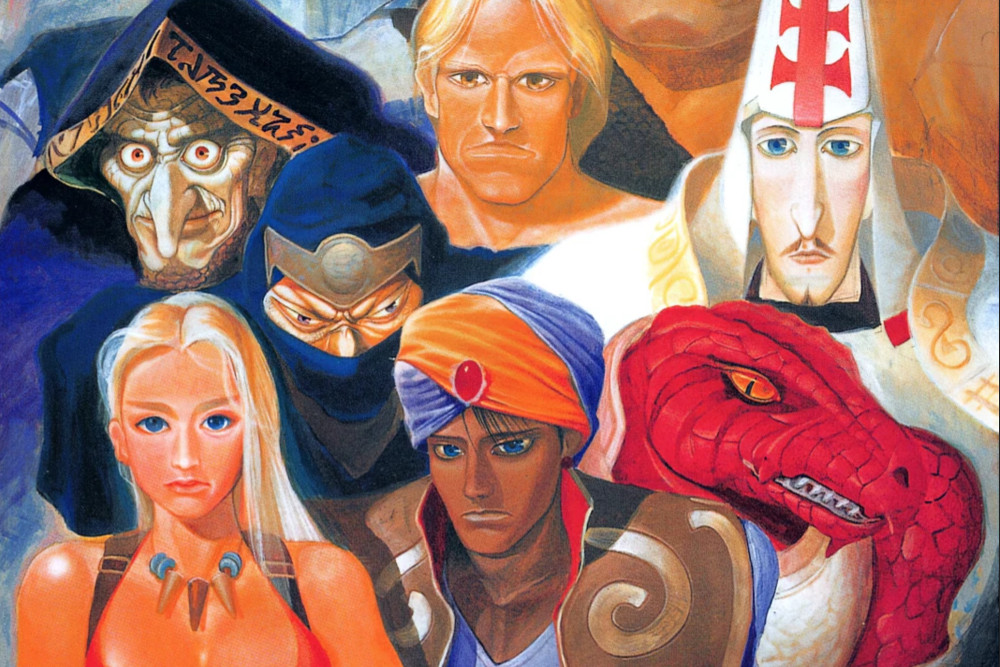
I must have played this back in the day in the arcades. I remember it really well; the way the attract mode looked amazing, with all these heroes on screen and all this lovely chaos. It’s possible I did but just died so quickly that it never made an impression? Whelp, I’ve beaten it now.
I like Magic Sword. That doesn’t mean it’s good, but I’m going to get that out of the way. It’s one of those slightly odd “lots of ideas, vaguely implemented” arcade games from the period; you’re a strapping, Conan-esque hero, on his way to kill Drokmar and destroy the Black Orb. You do this by climbing 50 levels of a dungeon, which are all of varying lengths and have secret exits and so on that can bump you forwards and backwards, and while you’re doing this you level up your weapon, and get keys that you can use to unlock other heroes to help you (sadly, only one at a time.) Oh, and each time you rescue a hero they level up too.
Oh! And your weapon is interesting in that you can’t button mash, you have to hit it carefully once your weapon has “charged” otherwise it’s not full power, which is pretty difficult because the screen is swarming all the time, pretty much.
I’ll be honest: Magic Sword is your basic coin muncher. While there is some skill (in fighting bosses, for example) you’re mostly just trying to survive, and games where there are points where you just can’t avoid taking a hit aren’t really to be encouraged, eh? But it’s charming, perhaps because of the nostalgia I (and I guess many people?) feel for this arcade era; big chunky and attractive Capcom art, great sound effects and music, and a responsive play-style that makes you want to hit continue.
At this point, I’m just making justifications for liking this, really.
Will I ever play it again? Shamefully, yeah. It’s quick and I’d enjoy playing through it with another player.
Final Thought: A quick discussion of the port: I played this in its Final Fight: Double Impact incarnation, and it’s great. All kinds of display options! There’s also (apparently) a ton of archival art and stuff but, annoyingly, you’ve got to unlock it all by playing the game in lots of particular ways and I just can’t be arsed. Ah well. Here’s an awesome bit of Magic Sword art that’s really stuck with me, though.
The YRF Spy Universe has produced a couple of my favourite films ever in War and (in particular) the criminally unsuccessful War 2 (my favourite film of last year!) but it is, let’s say… patchy. I mean… several of the films star a very bad man–just look at his absurdly long controversies entry on Wikipedia–but I’ve been willing to give the franchise the benefit of the doubt because I’m such a sucker for Hrithik Roshan’s beautiful eyes.
Christ you could drown in them.
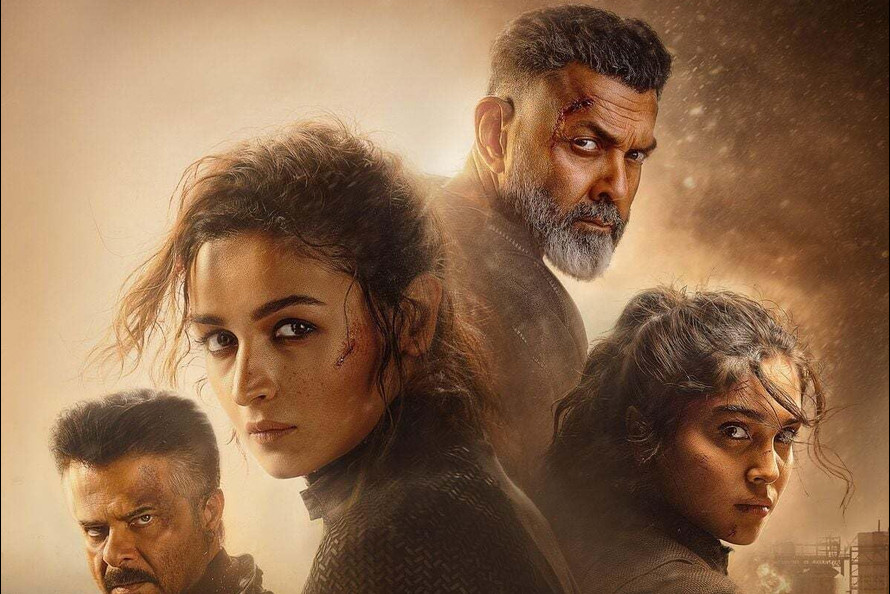
For a shared universe that only decided it was one three film in, Alpha–unfortunately–has taken the wrong lessons from the already burst Marvel/DC bubble and decided what the franchise needs is films that are exposition-stuffed origin stories that feel more like set-up for future cameos than they are, you know, enjoyable movies in their own right.
This is a real “when are they going to get to the fireworks factory?” of a film, and it’s one that constantly teases a fireworks factory before just… not showing you it. I’m not sure if it was the first time feature director Shiv Rawail1 just not being up to the job–the film was postponed for reshoots, apparently–but if you compare the film to War 2: that movie opens with an action sequence that would be the climax in any other movie, and Alpha opens by introducing a bad-ass group of super-soldiers who… take part in a training exercise where they don’t do anything cool, that we mostly watch from a board room.
Because really we’re only here to learn all about the R&AW chief’s struggle to have a child.
My favourite example of this–if you’ll allow me to skip ahead a bit–is that before the intermission, we see our heroes, seemingly trapped in an impossible situation, all primed to kick ass. “Finally,” you think, “we’re going to get a truly balls to the wall action sequence.”
When the film returns from intermission the two action stars are told by their dad to run away, which they proceed to do. They tee us up, make us anticipate, and then nothing cool happens.
(Our heroes literally spend most of the movie on a fun bonding road trip to a safehouse.)
There’s a real sense that they just didn’t have any idea what to do with this film. My suspicion is that this exists because someone noticed that maybe the War sub-series is just a teensy bit homoerotic and said “we gotta get some hot ladies up in this.”
It was decided, of course, that ladies are weak and meek, so they need to have a reason why they could be the equal of any man (super serum) but even then the film just doesn’t really do anything with our stars. I like Alia Bhatt, but it seems like they kind of shrugged and went, “I dunno… kind of make her look like Letty from Fast & Furious” and that was about as many ideas as they had. If you need an idea of how badly served Bhatt and her co-star Sharvari are, the film’s big cameo is (spoiler?) Hrithik Roshan, and he is already cooler than them sitting still and doing nothing. When he actually gets up to fight, he does three cool things immediately that are more awesome than anything Bhatt, the ostensible star of this film does at any point. And he’s just supposed to be a normal guy!!!
If there’s an elephant in this room, though, it’s that the YRF Spy Universe already does have a kick-ass female protagonist, Katrina Khaif’s Zoya from the Tiger movies, but she’s from Pakistan, and Alpha absolutely represents Indian cinema’s increasingly histrionic nationalism. Long gone are any calls for mutual understanding, and there’s a sense that even “there are some good ones” is beyond the pale. This isn’t the worst example of it I’ve seen in a while (Fighter, *shudder*) but it absolutely casts a pallor over the climax.
Not that the climax is that great anyway. I mean… it’s fine, I suppose. By the time you get to it, the movie has led you to not expect much, and when it doesn’t give you very much, it doesn’t really feel that worth complaining about.
A flop and a let down, then, and I’d think it’d likely be a nail in the coffin for this stumbling franchise but I suspect they’ll push through on a future Paathan movie. Indian men in their [checks notes] 60s are allowed to do cool stuff on screen so that one will probably work. Lord knows I’ll show up for it.
A long time assistant director, has done a TV show, and a nepo baby, but the last one is basically a prerequisite for being in Indian cinema, so it’s not like we can hold that against him any more than usual. ↩︎




 Unlock with Patreon