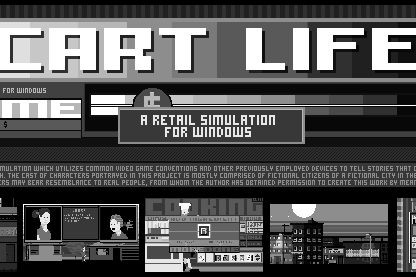

Developed/Published by: Richard Hofmeier
Released: July 29, 2010
Completed: 27th March, 2014
Completion: I didn’t. This is the first time on this site I have a game I can officially state I gave up on.
Trophies / Achievements: n/a

Before we get into the article: you can pre-order a copy of exp. 2602, my brand new zine, right now. If you haven’t picked up any issues yet, there’s a discounted bundle of all three zines! Patreon members get an even bigger discount: subscriptions start at just $1!
I wasn’t going to write about Cart Life! As I played it for a while and gave up on it, I was prepared to let it slink off into the dark. However, I was asked by a few people (not least Incredibly Strange Games’ Chris Charla) why I didn’t like Cart Life, so I kind of feel honour bound to outline why I couldn’t bring myself to even finish one of the stories in Cart Life.
Full disclosure: I played every one for at least two-three days of in-game time, and in every case multiple times.
So, Cart Life then. After this year’s IGF and GDC Awards, where Papers Please cleaned up, I decided to go back and find out what it was that made the last two award-show defining titles the titles you—at a glance—can deduce are obviously depressing, intentionally boring, and glibly worthy. I’ll talk about Papers Please in future! But I wanted to trust that these games were being chosen for what they actually are, not what they represent vis-a-vis a “trend.” (I’m not convinced.)
But what is Cart Life?
Cart Life is a weird sort of mash-up of adventure game and Lemonade Tycoon-esque simulator. There’s sort of a dash of The Sims, too. Basically, you have a hero—one of three street vendors—and they have a goal, something simple like “get enough money together for a deposit on a flat within a week.” They’ve also got to eat, sleep, and feed their addiction (smoking, or coffee, for example.)
So, what you do is you get them up in the morning, you get them over to their cart, and you spend their day doing monotonous tasks. Then you either do something vaguely social/story-related if there’s time, or go to sleep and have pointedly bad dreams. And there’s never, ever enough time in the day.
That there’s never enough time in the day is an obvious point for a game to make, but it’s a point that Cart Life is making, and it’s what kind of leads to what I consider my main criticism of it:
Without already being extremely video game literate, Cart Life is impossibly off-putting. Yet with an extreme level of game literacy, Cart Life presents a challenge that obscures anything it’s trying to say.
This is possibly a little hard to explain, but to put it roughly: Cart Life uses its video gamey aspects: world navigation, maps, menus, “mini-games” to represent the challenge the characters face. But if you’re not already very familiar with this kind of thing, the idiosyncrasies of the system and general lack of useful tutorials are insurmountable. And this isn’t something I could call useful to the meaning to the game, as it’s definitely a struggle with the “top layer” of the content.
Of course, if you can become familiar with how to play the game, as I did… it’s too easy to get drawn into a system where you are determined to absolutely murder the challenge; to “min-max” your play. Didn’t spend the day just right or make enough money? Reload the last save.
This is probably controversial! In fact, I can imagine that many (most?) players of Cart Life doggedly played a “failing” hero right to the end (where it turns out it’s the taking part that counts, anyway.) However, having played many, many first days where I made mistakes because I didn’t understand how to play, once I did I was in the mindset that I could always do better. It was after beginning Melanie’s story for the fifth time or so where I managed to run a “perfect” first day (set up the cart, get the permit and a bus pass, even walk her daughter home from school) that I was like “gah, fuck this.” (Admittedly because I’d min-maxed so hard that I went to bed at 6pm, woke up at 3am the next day and broke the game completely.)
In an earlier article I talked briefly about how when and why you stopped playing a game is also educational, just in a different way from doggedly getting to the end to suck the marrow from the bones of its design. With Cart Life, I stopped because I found the tension of “being a game” and “being meaningful” impossible to relate when presented the design of Cart Life.
There are several interviews with Richard Hofmeier where he talks about how the game is supposed to not so much be depressing, but to instil in the player that kind of pride a wage slave worker gets from doing a boring, repetitive task well. I’m going to set aside how arguably patronising that is—there’s a rougher, more polemic article I could write about how Cart Life’s success is related to a safe, private othering of the working poor by the kind of middle-classes who would write and talk about and vote for an “art” game—and say that having been a wage slave, Cart Life is weak at this. I know how it feels to cut the plastic ties on a bundle of newspapers or a cardboard box, and it doesn’t feel like switching my hands to the keyboard to type “cut the ties,” an experience which in every case I thought “urgh, how irritating.”
You don’t think “how irritating” when doing a job like that. You think “just a few more then it’s break time” or “fuck, these bindings are cutting into my hand” or you escape into your own mind entirely because it’s all you’ve really got to do.
I just don’t see the challenge of the game as accurately representing the challenge of these lives, something that I think Hofmeier admits (he’s stated in interviews that actual vendor cart owners respond least positively to his game, and I do understand his artistic urge to make dealing with newspapers involve text.)
But If you want a key example: Andrus is an immigrant. As an immigrant myself, one who was pretty sure he was speaking English, I discovered that when I moved to Canada I spoke Scots and no one understood me. Just talking to people became a difficult navigation of the right words to use. A challenge.
Andrus? He speaks awkwardly, yeah. But if I want to talk to anyone in the game, I just hit “up” and he does all the work for me.
Will I ever play it again? Hofmeier has made the game open source and I’m definitely interested to see if anyone is interested in picking the game up and murdering the bugs which plague it. I actually doubt we’ll see a complete, non-glitchy version of the game, but if we did, I’d consider taking another run at it, tempering my urge to min-max or “be a gamer.”
Final Thought: I wouldn’t let Andrus smoke. No matter how bad his cough got, how poorly treated by the cough drops from the store, I wouldn’t let him smoke. I never said the game didn’t succeed in some ways.
This essay is featured in Every Game I’ve Finished 14>24.