
Developed/Published by: Julián Cordero, Sebastián Valbuena / Panic
Released: 01/05/25
Completed: 18/06/25
Completion: Completed it.
Despelote is boring.
But maybe that’s what’s important about it.
—
We live in an age of AI encroaching on everything we do. An age in which in particular it is going to have a noticeable effect on creativity, as the big guys look to it as a solution to that pesky problem of “having all the value being created by workers” and (some) small guys look to it, perhaps naively, perhaps without diligence, as a way to create work that competes.
And indeed, this has already happened to Panic, the publisher of Despelote, who found their second season of releases for the Playdate handheld infected–and I will use that pejorative–by generative AI, by a developer looking for shortcuts (as covered in a recent article.)
This kind of use is likely to become endemic in the games industry–for another example, 11 Bit Studios’ The Alters has also been discovered to have used ChatGPT for “placeholder” text.
The question I have however, is if these developers understand that generative AI is a flattening force. It is a product created by feeding it everything we’ve ever created, built only to mulch it up and spit it back out as slurry. Now, the big guys don’t care. What they want is a fat pipe of chemical lowest common denominator.
But how are you going to stand out if you fertilise your fields with that? Little knowing that it eats the fields it lies upon?
Maybe those who are using it to “compete” don’t care either. Maybe you just have to get what you can and get out before it’s all over. Maybe you can fool yourself there’ll be a Mars here too, once the earth is salted.
—
But instead of that… why not embrace your humanity? Why not spend all your effort on making something that reflects… you? Instead of creating what is common, what everyone recognises, why not create work that not everyone recognises, but in which they can find commonalities? Why not make something like Despelote?
An AI could not make Despelote. Only a human can, because only we are able to make the non-obvious connections in the story of our lives.
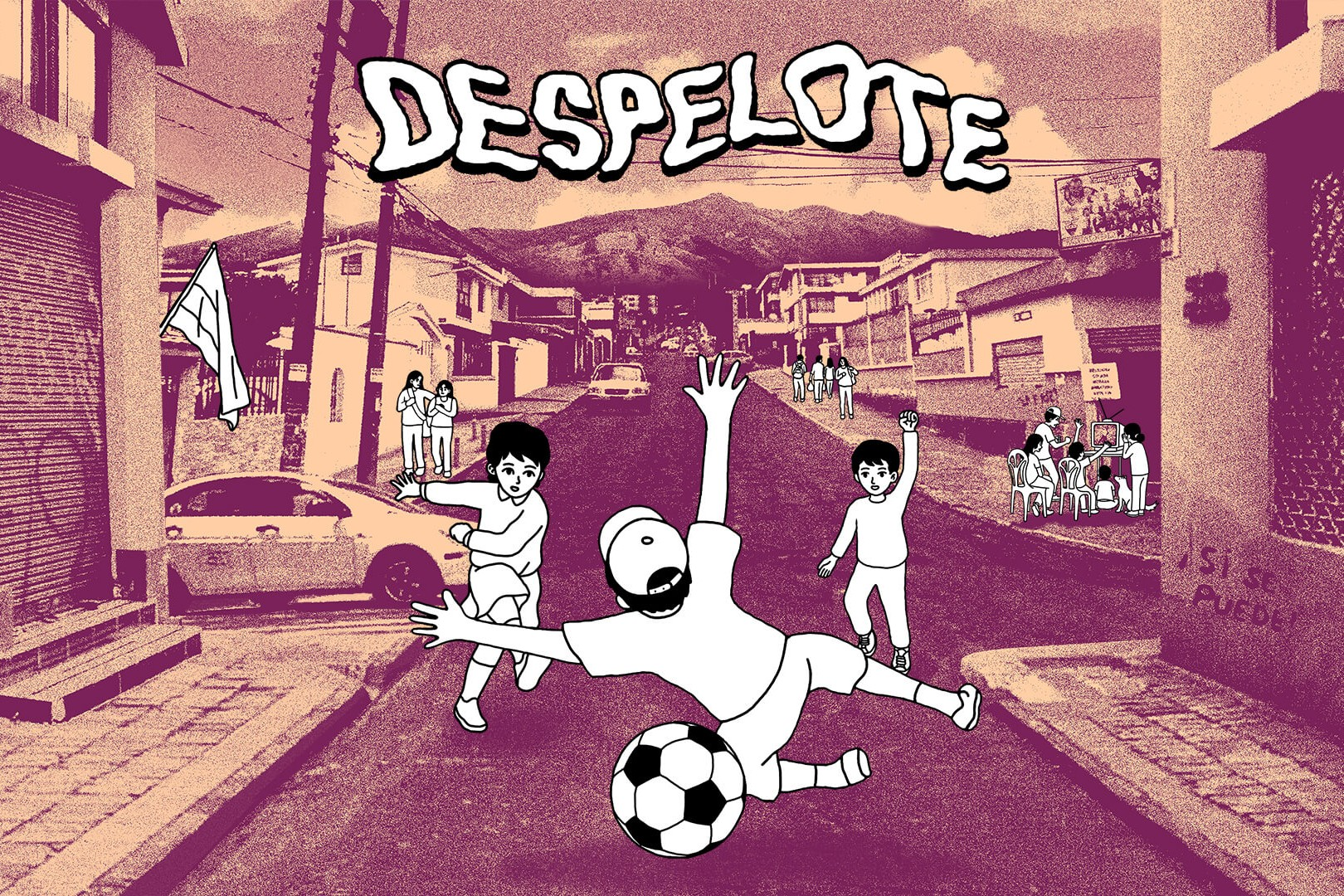
Here, designer Julián Cordero recreates the experience of being a child in Ecuador, but specifically during the Ecuadorian national football team’s historic qualifying campaign for the 2002 World Cup.
This is probably not the most obvious setting you can imagine when you are creating a game about the world of children and how it interacts with the world of adults. Similarly non-obvious are the decisions made in which to represent this, which it does in a form that I feel only video games could manage–while also introducing (in my opinion) a new kind of cinematic flair. One that does not look to mainstream cinema’s style but the art house.
It opens with you playing what appears to be a retro game: Tino Tini’s Soccer 99. Despite this being a reference to Dino Dini, and Kick Off 2 and the like being fucking rubbish (sorry, this is a Sensible Soccer house) this is actually a brilliant wee overhead-view football game that could be released on its own terms, with a simple and rewarding “flick-to-kick” control scheme. But as you play, you start to overhear your parents talking, and then, cinematically, quite unlike any other game I’ve played, the camera slowly pulls away from the television, until finally, your dad turns off the telly.
In Despelote, as it would have been for any of us, such is your lot as a child. You find yourself pulled around by your parents, told what to do–and given limited amounts of free time. And what matters is in that free time you don’t really have anything to do. You can run around, maybe you’ll find a ball to kick (beautifully, controlled just as in Tino Tini’s Soccer) but there’s nothing to hunt out, nothing to unlock, no rules for playing with the ball. It’s just you, some other kids who might want to aimlessly kick a ball about, and a world of strangers, almost all of whom are captivated by the ongoing football matches on the telly (unfortunately the game doesn’t really allow you to just stand and watch too–though you’re likely to run and check on the score when you pass a TV.)
I’m not going to lie–after the shine of kicking a ball wears off (which really does feel fucking great) and you realise what’s happening, Despelote is properly boring, and if you’re a progression-focused twat like me, you’ll probably really struggle with it. While it’s not exactly Jeanne Dielman (and you can play through Despelote in nearly half the time it would take you to get through that) it’s working in that kind of perhaps punishing milieu. It wants you to feel the boredom and frustration of the limits of childhood–and to strain against them as a child does.
Throughout, you get flashes of how Julián will grow up, how his love affair with football will evolve as he does; fragments of memory that ask you to remember that these childhood afternoons that maybe felt so boring were actually fleeting, and you can never have them back. It’s not as much about being Julián as it is about you–what these moments make you think about, how you remember your childhood. I remember my own childhood. Scotland in Italia 90. Then a flash of sitting in a car on a rainy day. Now I’m at an uncle’s, watching the penalties that ended the 1994 World Cup. Now I’m drunk for the first time, years later…
I remember.
I suppose there’s some concern about American exceptionalism here–after all, the Yanks don’t really like “soccer”. Maybe it’s unfair to imagine the American “gamer”, unable to take the steps from soccer to their own sports obsessions. After all, their “world” championships only include their teams [“And Canada’s!”–Canadiana Ed.] so that sense of a national collective that crosses political and societal boundaries may be a step too far. Maybe to many, Despelote is just foreign, and boring.
But that, to me, represents the state of the art. The boredom of Despelote is not what has stuck with me–what has stuck with me is the themes, the ideas. Someone is saying something–something about themselves, and hoping that it makes a connection with you, your experience.
It’s not perfect, but it’s human. These days, what more can I ask?
Will I ever play it again? It says all it needs to, once.
Final Thought: One of the more interesting background facts about Despelote is, of course, that Julián Cordero’s father directed Ratas, ratones, rateros, the “first Ecuadorian film with international-standard production values” which gives reason to why this game features (in my opinion) a different sort of cinematic influence. But I think this influence has also leads to one of the most amazing cameos I’ve ever seen in a video game: a DVD of Fishing With John!!!