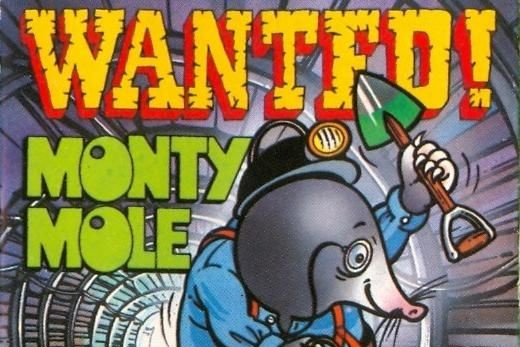

Developed/Published by: Peter Harrap / Gremlin Graphics
Released: 29/07/1984
Completed: 07/09/2026
Completion: Got to the end, having let myself save pretty liberally at screen transitions, and… somehow hadn’t collected all the coal so couldn’t actually finish it. Well, close enough!
The Monty Mole franchise is a classic British franchise, the series that put Gremlin Graphics on the map, but it’s not one that I’ve ever really engaged with before. As an Amstrad CPC owner, we didn’t get Wanted! Monty Mole, and I feel like I remember that Amstrad Action, the magazine which defined my childish tastes, considered something like the sequel Monty On The Run old and creaky by the time I was reading it.
However, the entire franchise is available to purchase on Steam and, in fact, in a collection on Nintendo Switch and Xbox. I do think it’s great that these games are commercially available, and I can’t speak to the Switch release, but the Steam releases are just the same low-effort porting job I saw in Match Day, and it’s kind of a bummer, because there’s history here that deserves more than just being lobbed up sans context.
Of course, it could be so much worse. I mean Manic Miner, probably one of the most important British games ever is being released in an AI-sodden remake that feels… it feels exactly as Hayao Miyazaki said, an insult to life itself.
The thing that gets forgotten, I feel–and I’m sorry, yes, we’re going to have another one of those “games history is global” discussions–is that even though it feels like platform game evolution went Donkey Kong–Super Mario Bros. there was so much parallel evolution going on. Donkey Kong was, of course, the originator, but if we look at the lineage of Wanted: Mighty Mole, it’s actually more like Donkey Kong–Miner 2049er–Manic Miner! Personally, I marvel about how deep and rich video games became so quickly, a Cambrian explosion ongoing at a time people think of being a crash.
I think it’s easy to say the fittest survived, but every time I return to this period–and especially when I’m touching the home computers of the era–I marvel at the ambition. It’s like people didn’t know what was possible, so they just went for it.
It doesn’t always work–to be honest, it usually didn’t work–but you’d get things that have still never quite been equalled like The Lords of Midnight. And while Wanted! Monty Mole is hardly at that level, it’s still possible to have a good time with it today–it was, after all, the winner of Crash’s Best Platform Game 1984.
One of the strangest aspects about Wanted! Monty Mole is its connection to the miners’ strike. It’s a complicated and controversial period in the history of organised labour, and I think it’s pretty easy to get the wrong idea about Wanted! Monty Mole, as it intentionally courted controversy with the setting as a marketing gimmick.
With the pitch that Monty Mole is dodging pickets, you might think you’re playing a scab (albeit a mole) who is mining in opposition to the National Union of Mineworkers, personified by its president Arthur Scargill. But it’s much more complicated than that, and it all relates to the actual facts of the strike, which had began in March 1984, just over four months before the release of Wanted! Monty Mole (designer Peter Harrap would complete the entire thing in just three of those months!)
You see, Arthur Scargill did not hold a national ballot to democratically authorise a strike, having lost three previous ballots, and instead either tried to force–or I believe in more charitable views, tried to allow the natural occurrence of–a national strike by domino effect, by supporting regional strikes and “calling for action” from all other local and regional chapters. The idea being that everyone would fall in line, especially under the pressure of “flying pickets” (striking miners who’d travel to other mines to picket them in an attempt to shame those miners into downing tools.)
I’m sure there is intelligent lefty analysis of this out there, so forgive me for my approximation (I at the very least recommend the BBC’s Miner’s Strike: A Frontline Story, which allows the miners to speak for themselves) but this does seem like just about the worst possible approach at the worst possible time. With not every miner on strike, this allowed some coal to still be produced, weakening the entire point of a strike, and flying pickets (pretty obviously) alienated many working miners who hadn’t been given a vote.
The strike would end in March 1985, with the miners comprehensively defeated by the Conservative government, ironically united behind Margaret Thatcher, who by all accounts viewed the entire thing as a convenient way to break the back of a union. It could, pretty much, not have gone worse.
And Wanted! Monty Mole represents just how tangled the situation was. Talking to Mark Hardisty in A Gremlin In The Works, Harrap is clear in his feelings, explaining that his father was a miner, and was directly affected:
“[Dad] was a democratic mineworker and he always used to say that the union would never be broken. We were solid because we had a vote … if we all voted on strike action, they would never break that. Even though Scargill was right in what he was saying … the miners never had a say. My dad never had a say.
[Scargill] is the baddie even though he was doing the right thing, or had the right intentions. He was doing it completely the wrong way.”
So Wanted! Monty Mole isn’t about a wee mole scabbing, and it’s right there on the tape inlay.

It seems that while Monty was initially intending to get down the mines and nick a bunch of coal to keep his home warm in winter, he ends up in conflict with Arthur Scargill as a result, and discovers that the only way to defeat him is the “secret ballot papers” and “vote casting scroll.”
The entire game is actually about the importance of voting and true union values in governance.
I think that’s incredible! The early history of video games does not feature a lot of games that are directly attempting to make a political point (even though, if I’m being honest, Wanted: Monty Mole is mostly “just” a wacky Manic Miner-inspired platformer.) Most obviously there’s Missile Command reflecting the nuclear anxiety of the time and making the argument that there is no winner in a nuclear war, maybe things like Dictator (a satire of banana republics) but I can’t find a game making an explicit, pointed statement like this at a moment where it could count.
(And they even offered the NUM 5p from every sale, which was foolishly ignored; considering the game sold 20,000 copies in the first six weeks, a lot of hungry miners and their families might have benefited from a donation of a thousand quid.)
Anyway. How good is Wanted! Monty Mole as a game, though?
It’s not bad, with caveats. Wanted! Monty Mole is pushing at the limits of the Manic Miner design without quite knowing where to take it. You aren’t just stealing coal across screens; you’re collecting items that you need to progress too, and the game’s world is one continuous level. But it’s all a bit… wonky. On the first screen you have to collect a bucket to see the coal at all, which is a good early teaching moment (take that, Super Mario! It’s not just Door Door that ate your lunch!) But from that point on it’s all a bit vague, generally being that picking up an item (like a drill) gives you a hit point that allows you to do things like touch candles, but if you touch an enemy first you lose that hit point and can no longer collect the coal.

Thankfully, there’s only a few sections where you have to backtrack in order to remove walls that block your way (although those are sort of buggy: collect all the coal on the screen with the wall before going back to collect a missed piece of goal and it won’t disappear) and the game is mostly “collect everything, avoid enemies.” The real issue is that collision detection is rough. Later in the game there will be a couple of sections that seem impossible without losing a life, or at one point relying on some very tight timing with a mine cart. But the design, more or less makes sense. Which is insane, because referring to A Gremlin In The Works again, Harrap designed the entire thing directly in machine code–he didn’t even plan for how screens would connect and had to match them up via testing!
On that level alone it’s a marvel it works as well as it does, especially because the world has such a sense of place–you actually do feel like you’re going down into a mine with a long chain of vertical screens. I do suspect this system is why the game doesn’t feel as tight as something like Manic Miner–screens aren’t stuffed with enemies or carefully designed challenge, it’s a bit quiet, and it’s mostly the collisions detection that you’ll come a cropper to–although there’s a chance that like me you’ll get to the end, not be able to defeat Arthur Scargill and not be sure why.
Does it “hold up”? No, not really. Did I feel a nostalgia for the era anyway, and appreciate its hidden depths? Absolutely.

Wanted: Monty Mole didn’t come out on the CPC–to be fair, the CPC 464 had only come out barely a month earlier–but it was released on the Commodore 64, in a slightly strange fashion: rather than have it ported, Gremlin founder Ian Steward took the decision to have Antony Crowther use his Son Of Blagger engine to make a parallel version of Wanted: Monty Mole seemingly without, apparently, letting either Harrap or Crowther aware they were making the same game. Once they knew (a couple of months into a three month project!) they did their best to create some parity by having the same opening screen, but the games are massively different, with Crowther’s a tight platformer with a maze-like single level featuring full directional scrolling.
It’s also absolutely awful, a single-life attrition platformer where Monty has a health bar and basically need to take damage constantly to progress because he’s almost impossible to control (maybe it was the emulation, but I found it a nightmare to get him to jump off a small platform, he usually just fell off.) The level design is extremely unclear (you have to notice which walls you can walk through) and features lots of backtracking and dead ends.
The worst thing about it? The climax with Arthur Scargill isn’t even in it–you cross an acid pit to a dead end and that’s it. You do get the poem that ends the ZX Spectrum version, at least.
There’s absolutely no reason to play this, but I suppose the C64 will have the last laugh–everyone prefers the C64 version of Monty On The Run because of the music.
Will I ever play it again? Onwards to Monty On The Run! Oh, hang on, I mean Monty Is Innocent, the one everyone forgets.
Final Thought: One of the nicest things about Monty Mole–although I didn’t directly experience it–is that it’s got a proper ending, with a poem that fills out the story and even hints at a future sequel. Considering in this era of home computer games games mostly just stopped because they ran out of memory (the absolute worst when you excitedly got an arcade conversion, accepting that it wouldn’t be “quite” as good, and found it stopping abruptly in level 3 or something) this is another example of the care put in here that makes this worth remembering.