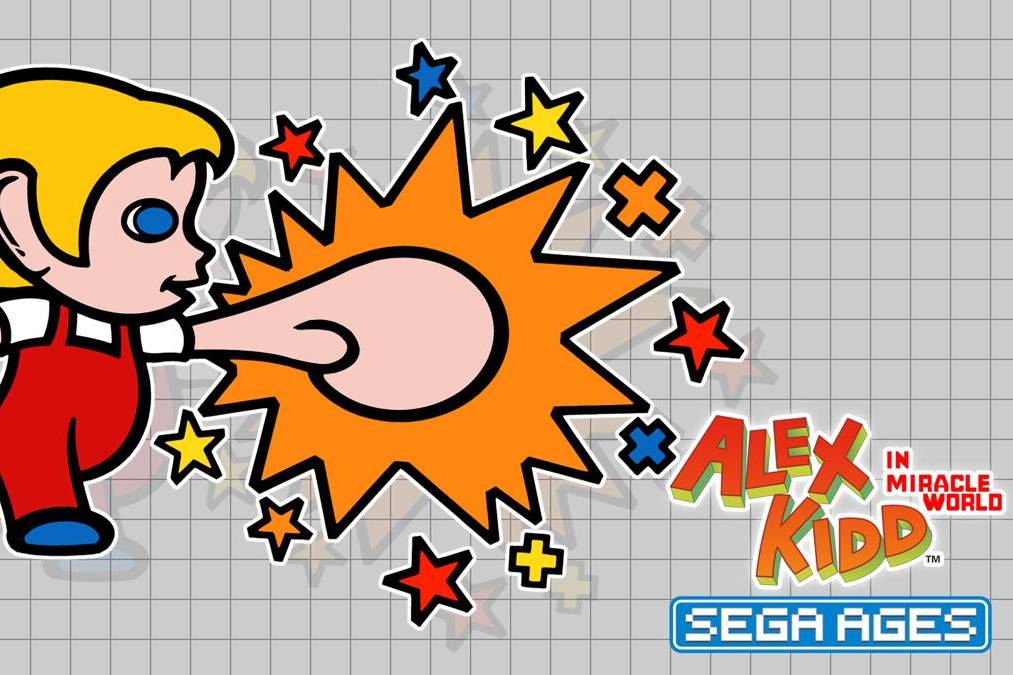

Developed/Published by: Sega
Released: 01/11/1986
Completed: 1/09/2025
Completion: Finished it. Save states were used (for some obvious reasons.)
The discourse has long moved on, but a while ago there was a “revelation” that the extremely French CEOs of Sandfall (of Clair Obscur fame) and Lizard Cube (of Sega remake fame) didn’t play Nintendo growing up. This was one of those classic “Americans learn that their experience isn’t universal… and decide that’s stupid and wrong” online spats where everyone got annoyed at each other’s ignorance. Usually it’s like, learning people in another country prepare or enjoy a food in a slightly different way, and it’s always a bummer: that yes, the US believes its culture is the “normal one”, that the US view is dominant and pulls focus so much that even people in other countries might not know their own history, and that it’s never a learning experience for anyone because the urge to dunk on each other rather than celebrate a diverse history is completely overpowering.
Which was interesting timing for me to play Alex Kidd in Miracle World. It’s really only the second time I’ve played a Master System game to write it up, having only previously played Fantasy Zone because I suddenly hungered to play a version of Fantasy Zone (because Fantasy Zone fuckin’ rules.) It’s interesting timing because the Master System, to me, represents so much about just how different video game culture is across the world, and how different people’s personal experiences of it can be.
I mean, first of all, it wasn’t even originally the Master System, releasing in Japan in late 1985 as the Sega Mark III, where it failed to compete in really any way with the Famicom. It was then released in North America in 1986 around about the same time the NES went wide, only to get crushed by Nintendo’s stringent licensing agreements with third-party publishers, leaving it with a deeply limited game library.
In Europe, however, it wasn’t released until 1987(!) and despite Sega managing to completely botch the UK launch, it managed to massively outsell the NES (as it would, quite famously, also do in Brazil under the Tectoy brand.) And then loads of games aimed at these specific markets would be released that wouldn’t see the light of day in Japan or the US!
So the Master System was, and wasn’t, a success. It did, and didn’t, have loads of games and mindshare. And even on that you need to get a little more specific, because if you’re thinking about Europe things get even more fragmented. You might think “oh, it outsold the NES, so it was the biggest thing in games.” But of course, if you know anything about the era, you know the biggest thing in games there were home computers–at release it was competing with the Amstrad CPC, ZX Spectrum, Commodore 64, even the Atari ST and the just released Amiga 500. And depending on what country you’re from, which of those was dominant could have been completely different–I’m sure for many of the developers at Sandfall and Lizardcube, the first 8-bit computer to mind is the Amstrad CPC due to its popularity in France1 [“It should be anyway”–CPC Ed.].
Of course, they might not have an 8-bit computer to mind at all, depending on their age. Because not everyone is tiresomely playing through games before their time (ahem), and the era you came of age in has a huge effect on how you see certain things. To get personal, I don’t think I was conscious of a video game “industry” until around 1991(!)–I am pegging this, roughly, to the point when I started getting issues of Amstrad Action [“Hurrah!”–CPC Ed.]. But I’m also aware that by then my entire experience of, say, the NES was those kiosks in Currys or Dixons that let you play Fester’s Quest for literally ten seconds. I certainly never knew anyone who had one.
Because I didn’t come of age–or at least, understanding–in the “true” 8-bit generation, the thing about the Master System that stands out to me–even as an Amstrad CPC owner in the twilight of the 8-bit systems–was that it felt like a “poverty” system.
This might seem cruel, and indeed, incorrect. Even in the 90s the true poverty system was probably the Atari 2600–or the 7800, still being flogged in catalogues–but you have to remember one thing: Sega’s own advertising. The Mega Drive had been released in Europe in 1990, and kids were seeing adverts like this:
It’s impossible to overstate how unbelievably cool this seemed to me as a child. A suave adult who lived in a truck with a spinning gaming chair??? You’re just going to have to trust me on this that it didn’t sound as bad then as it sounds now, because now that’s a real “hello, human resources???”
But the point is–why would anyone want a Sega that wasn’t the Mega Drive? That wasn’t as good as the Mega Drive, a system that looked this cool? Poverty! Poverty!!!
And it’s from this, perhaps, that you might argue Alex Kidd In Miracle World has caught a stray. Because as the in-built game on a poverty system, it just had to be rubbish. A wee game they included for people who couldn’t get any games with the system. I mean it had to be crap–it didn’t even come on its own cartridge!
First impressions don’t help. Sure, the Master System had really bright graphics compared to the NES’s muddy browns, but the NES was a complete non-entity in the average British schoolchild’s mind. And Alex Kidd opens with probably one of the least exciting first screens ever, where you head down and immediately have to get to grips with Alex’s weird, slippery movement.
As we know, platform game feel in 1986 wasn’t a solved problem–I’ve said it again and again that the original Super Mario Bros. just feels sort of weird–but Alex Kidd has a really slidey, sloppy feel, a little too fast in a way that looks wrong; you feel yourself sliding a collision box around rather than controlling a character, which isn’t helped by just how strict that collision box is–there are no close shaves here. Get even close to an enemy and die.
Alex Kidd really only makes sense, at all, once you learn that the developers were literally just trying to do everything different from Super Mario Bros. to compete with it. Shmuplations comes to the rescue again with a translation of sega.jp’s meisaku interview with developer Kotaro Hayashida, where he notes that one of the most famous things about the original Alex Kidd release–that the jump and attack buttons are reversed–was done just to make it different (“when I look back on it, it’s just nonsense” he admits.)
I mean it’s probably why you go down at first, right? Because Mario goes right, and they’re hardly going to make the game go left (for reasons. Although Alex Kidd does go left on some levels!)
But look, it’s 2025. Let’s not get lost in our first impressions, let’s not blame a game for going out of its way to not be Super Mario Bros. and for not being cool enough to be on the Mega Drive. I mean it’s cool enough to be included in Sega Ages, getting a great Switch port with new FM soundtrack, right? So, is Alex Kidd in Miracle World any good?
Ehhh… look, I really tried, but it’s a mess. It’s a game that absolutely feels like a group of people attempting to best Super Mario Bros. who not only didn’t understand that game, but didn’t know how to design one in the first place. Because Alex Kidd in Miracle World really feels like a completely random grab-bag of ideas outside of it featuring a wee guy who jumps around and can destroy blocks. The story is weirdly overcomplicated (The city of… Radaxian? Prince… Egle???”) and the levels don’t have any consistency. There is some Wonder Boy DNA as you often use vehicles that work like Wonder Boy’s skateboard, and there’s even some Balloon Trip in there too, but suddenly you’ll find yourself in a somewhat non-linear castle that feels more like a Mega Man rather than a left-to-right scrolling level as usual and you’re just expected to get on with it.
(Something that’s interesting to note, in retrospect, is how the slightly better graphics of something like Alex Kidd In Miracle World have a strange cost to them. In Super Mario Bros. you don’t mind that everything is just blocks, because there’s a consistency to the low-fidelity. In Alex Kidd, when you come to a screen with blocks designed very transparently to make you navigate them a certain way, it just looks sort of unfinished.)
I suppose, from another perspective, you could instead see Alex Kidd as a game that’s full of surprises and variety, and I don’t think you’d be wrong. It is bright, and cheerful, and there is a charm enough to it that keeps you playing. But it never feels good to play–keeping Alex Kidd from sliding to his doom becomes unbelievably taxing in the latter stages of the game–and there are a bunch of unbelievably annoying gotchas to kill you off all over the place (I haven’t mentioned the rock-paper-sissors bosses, but they do the same thing every time, meaning you either die and redo an entire level at best, or just use save states like a person who doesn’t have time to waste.)
So, in a weird sort of way, finally playing Alex Kidd, I have to admit that I was wrong in considering it poverty. It’s a full game that people put real effort into, not just a tossed-off pack-in, and if you’d got a Master System you’d have played the shit out of it. There was value there.
But I’m not wrong now in thinking it isn’t very good.
Will I ever play it again? Of course, that’s a very personal opinion! Circling back to what I was waffling on about at the start of the article, Alex Kidd is beloved enough in some cultures that it even received a full remake, Alex Kidd in Miracle World DX, by a Spanish team created explicitly to make it. And in the spirit of celebrating the wonderful diversity of video game cultures, I’ll probably play it. Why not? Alex Kidd isn’t that long, it’d be nice to see it from the idealising eyes of some Spanish lunatics.
Final Thought: I should probably make it clearer–and god knows that I mean to go through all the essays and clear up some of the categorising details–that because I don’t consider North America to be the most important market, when I “date” a game I just use the earliest date unless there’s a really good reason not to. So for example here with Alex Kidd in Miracle World, the release date is November 1986, the Japanese release date. This feels absolutely necessary when covering games like, say, Star Soldier, which would get released literally three years later in North America rather than Japan, completely removing it from the context required to understand it.
- See my article on Zombi, from just last week! ↩︎