
Developed/Published by: Pocket Trap / PM Studios
Released: 28/05/2025
Completed: 25/09/2025
Completion: Finished it, though with a caveat that will be explained more or less immediately.

Before we get into the article: you can pre-order a copy of exp. 2602, my brand new zine, right now. If you haven’t picked up any issues yet, there’s a discounted bundle of all three zines! Patreon members get an even bigger discount: subscriptions start at just $1!
Don’t really have a good reason why I chose to play this above nearly everything in my to-play list recently other than, in a weird sort of bloody-minded way, I just wanted to play something that wasn’t Silksong, but you could conceivably pick up because you wanted something like that… without being like that. And hey, it says “cursed” in the title. That’s sort of spooky-adjacent, right? Fits the pre-halloween mood? Maybe?
Pipistrello And The Cursed Yoyo was actually the perfect antidote for someone who was burned out on Silksong discourse without ever having touched it. Because feast your eyes on this:

Pipistrello And The Cursed Yoyo has the greatest difficulty settings I’ve ever seen. It’s genuinely amazing that it’s this granular. The game has a default difficulty and then you can just decide what parts are too much of a ballache for you. I know there’s been so much discourse over this–even before Silksong, John Walker has loved wading into it, god bless him–but here at exp. Towers we side with the idea that you should be allowed to play a game however you bloody well like. As much as I love thinking about and dissecting authorial intent in video games, as soon as the fucking thing is out the door you can treat it however you like.
If there’s one thing I’d possibly have wanted, it’s for the developers to include their own easy/medium/hard presets, but I actually think it works well enough that you can start the game, play for a bit and then realise what’s causing you unnecessary pain–and it doesn’t mean you’re breaking the game. It think it can be quite interesting to discuss, for example, when, where and how “runbacks” or other punishment mechanics can be a design choice that enhances, rather than detracts from a game, but I like that here they accepted that possibly you can just decide if it’s something you want to bother with or not, without fiddling with other levers if you don’t want to. I think you’re going to know pretty early if a mechanic like losing money on death feels fun or even legitimate to you or not–for me, I quickly turned it off because I was dying enough it was just going to lead to having to grind for cash, pointlessly bloating the playtime, and I’m, honestly, too old for that shit.
(About half-way through the game I would also turn off fall damage, because the platforming challenges get extremely finicky, and the extra reload time was enough to annoy me. The game’s upgrade mechanics include upgrades specifically to reduce fall damage and cash loss, so this felt perfectly within the spirit of the design. Just a little extra edge.)
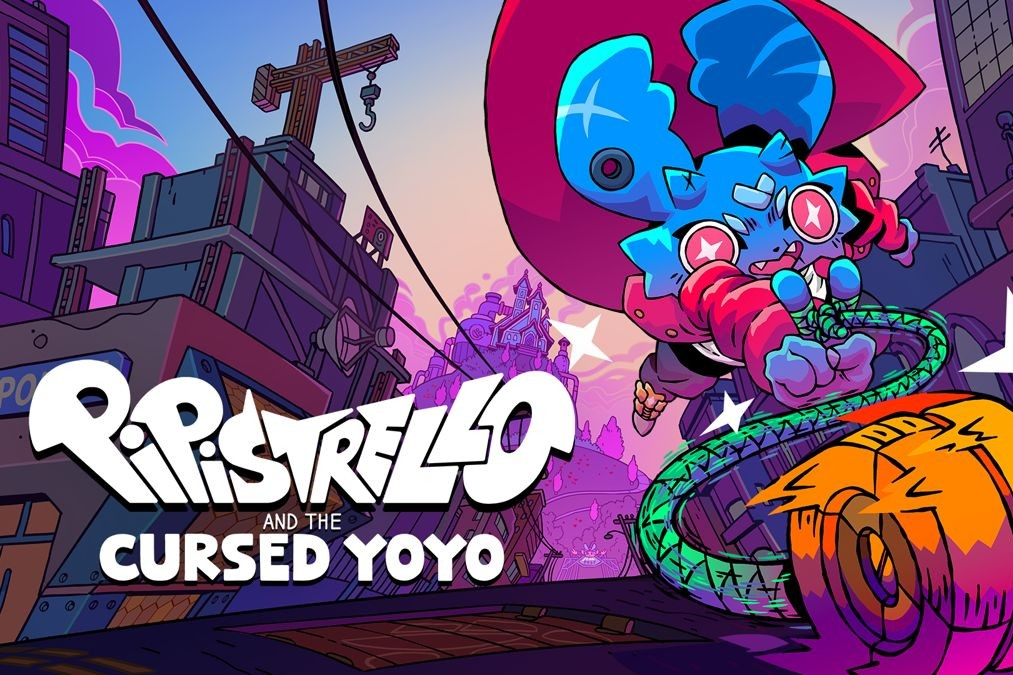
Anyway, Pipistrello And The Cursed Yoyo is described by Pocket Trap as a “Yoyovania” but that’s not really what it is–it’s more clearly inspired by The Legend of Zelda in the Link To The Past milieu. You play Pippit (weirdly not Pipistrello, that’s their auntie?) the yoyo obsessed failchild of a family that holds a monopoly over all the energy in the city where the game takes place. Due to the monopoly squeezing every last penny from the city’s companies, the leaders of the four biggest companies decided to kill the matriarch, Madame Pipistrello, by sucking her soul into four big batteries which will provide limitless energy for their capitalist dreams (this makes sense, for reasons.) But Pippit intervenes, a fifth of Madame Pipistrello’s soul ends up in their yoyo! So off you go on a pretty clear quest: head to each company, beat up the owner, steal the battery, then once you have all four, put your auntie back together.

This is all done via a charming, chunky top-down Zelda-a-like; designed almost exactly look like it’s being played on a Game Boy Advance (the game even opens with a 3D model of a GBA-look-a-like, and you can play the entire game on it if you want, with an LCD filter and everything.) When I started to play Pipistrello And The Cursed Yoyo, I was loving it. It’s bright, the controls are responsive, battles are fun, and there’s a great sense of progression as you explore the map collecting coins and finding new areas. But unfortunately, as the game loads on more mechanics, it starts to get… unwieldy. The bright and colourful graphics don’t have a lot of good clean “tells” on what you can do where, and while that might be because they want you to puzzle it out and experiment, it’s not so great when you’re in the middle of chaining traversal abilities to then have to work out what the next one you need to use is. And then actually executing traversal… well, it has the double whammy of the individual moves often being awkward to execute with the design expecting a high degree of competency. Every move has you pressing at least two buttons together, and moves only chain in certain ways, so when you reach the point–as you will–where you’re having to do something like six actions in one go or start again, it can get absolutely frustrating. (Again here, that the difficulty settings allow you to actually half the speed of the game is a life-saver. I won’t lie: I did it two or three times.)
The ultimate problem is that often you find yourself finishing a challenge and wondering–was that the way I was supposed to do that? Did I cheese it somehow? They can be so hard, or difficult to parse, that you never actually get to the point where you feel mastery, and that’s a problem. It’s even more of a problem in a game that feels like it should be open like its inspirations. Areas are obviously gated by traversal abilities, and it seems to limit you to two “dungeons” available at a time as a result, but each time it felt I went to the “wrong” one of two first and had to double back to the other one to actually progress. I really can’t tell if that is as designed, or if I just never understood traversal as well as I should have.
Battles are mostly fine–a good range of enemies, and intentionally designed encounters–but I think it’s here that the designers make arguably the strangest decision of all. The upgrade system is fairly normal–badges that give abilities or passives that you can equip, and permanent upgrades that you unlock–but the permanent upgrades require you to engage with a “debt” mechanic where you “pay off” the upgrade while suffering a hindrance. So, for example, you might have less life, or enemies won’t drop health.
At best this is just annoying. While I get the idea, the implementation just means that you spend the entire game weaker than you actually are (and you can enter certain situations completely screwed–nothing like facing a boss with one health and not being able to do anything about it unless you want to return the upgrade and get less money back than you’ve paid in.) If the permanent upgrades had designed hindrances, like “you must use this loadout” or “yoyo can’t be separated from string in battle” (just off the top of my head–not specific recommendations) it could be interesting, forcing you to play in different ways than you have, but it’s usually just “the game is harder” which should make you want to just go to the difficulty menu and make the game… not harder. Again, it’s just holding you back from any rewarding feeling of mastery.
These aspects–that the traversal is tuned towards extreme competence, and that the upgrade system means you never feel powerful–mean that Pipistrello And the Cursed Yoyo starts to outstay its welcome before you’re done with it. You can be done with the main path in something like 12 hours, and I really didn’t want to give it any more–which is sad, because when I started it I really had it in mind that I’d be searching out all the badges and unlocks, but the main path is so seemingly linear you don’t have much reason to go back on yourself with new abilities, and I just ended up wanting to push through to get it all done. It’s really only thanks to those difficulty settings that I could, honestly (if I had been stuck grinding for cash for the upgrades, I’d probably still be playing it.)
Was it worth getting to the end? For me, yes, because I had to see where the narrative went. Not because I was loving it, particularly, but because it’s so… odd. The game has you as heir to what is basically a capitalist crime family that’s led by an awful person bleeding people dry, and then the other companies are even worse? I mean it’s not exactly Bioshock Infinite’s “If a cow ever got the chance, he’d eat you and everyone you care about” but let me just say they hardly plant any seeds for the face turn that you’re expecting will show up. I’m not sure quite what they were going for–I suppose it’s supposed to be some sort of commentary on capitalism, but it’s muddled.
Anyway, here we have one of those classic examples of a game where finishing it kind of just put me off it, because the flaws just became more and more apparent. If it was half as long, or if I was the kind of person who was fine only playing half of something, I’d probably be raving about this. Oops!
Will I ever play it again? There’s a new game+, which probably gives you a reason to go through the early areas again with all the abilities, but… to what end?
Final Thought: I feel like I’ve been harsh on this one, so one thing I do want to say is that even if I did think it outstayed its welcome, it’s not for want of the designers trying. They go to extreme effort to make sure every area you visit has a new concept for you to deal with. Fans, lasers, switches, moving platforms, dark areas… each time they take an idea they leave no stone unturned, and so you’re always engaged. If you gel with this game–particularly when it comes to traversal–you really get your money’s worth here, and it’s even possible that if you’re just a little more aggressive with easing the difficulty settings than I was, you’ll hit a sweet spot either way. And for what it’s worth: I can see the counter argument that the team should have worked harder to tune the game to “avoid” having to include all these difficulty options, but the game’s issues are not ones that could be fixed by that.
If you like the look of this, I’d still consider giving it a shot. Just… don’t try to be a hero and stick to the defaults. I don’t think it’s worth the pain.