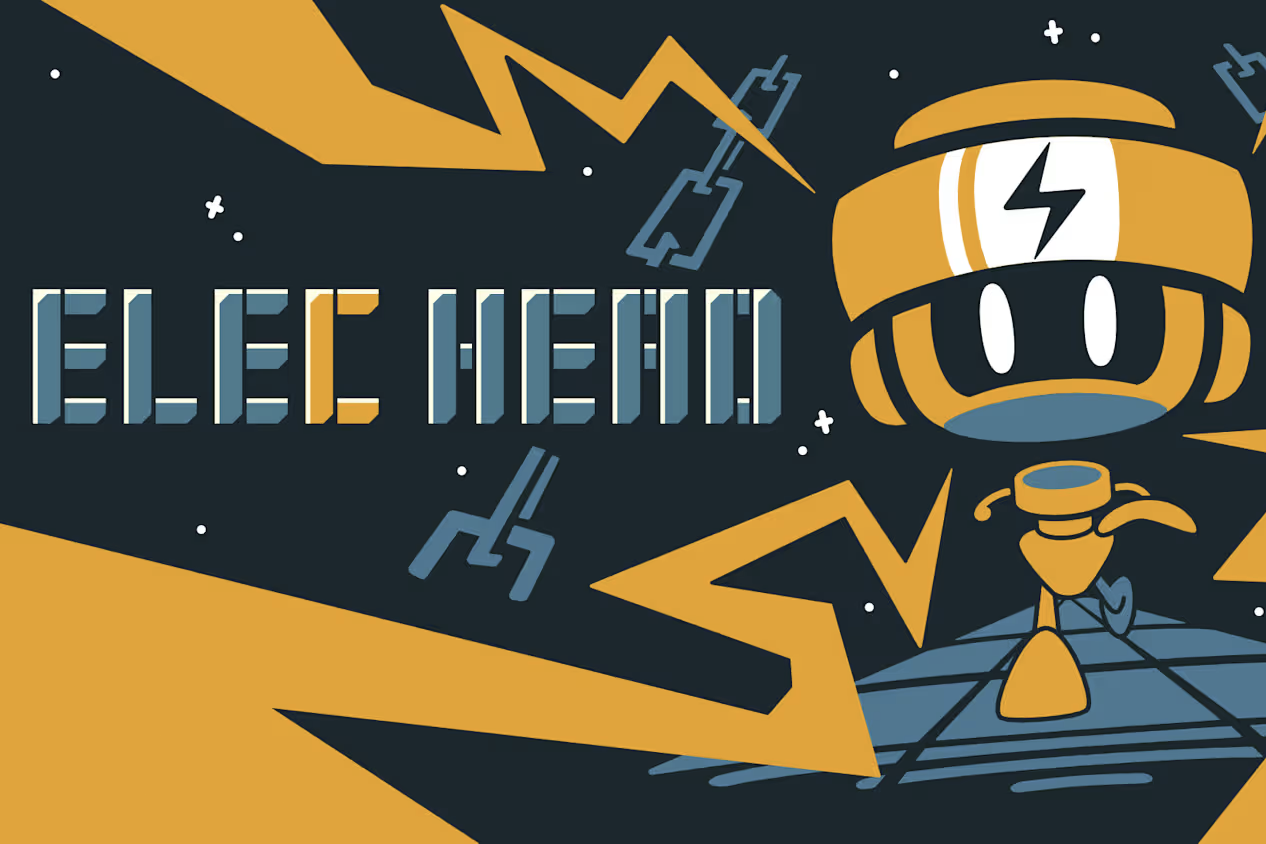

Developed/Published by: Namatakahashi, Tsuyomi / Namatakahashi
Released: 14/10/2021
Completed: 31/08/2025
Completion: Hard to say if the game has a “good” and a “bad” ending, so let’s just say I saw one of the endings.

Before we get into the article: you can pre-order a copy of exp. 2602, my brand new zine, right now. If you haven’t picked up any issues yet, there’s a discounted bundle of all three zines! Patreon members get an even bigger discount: subscriptions start at just $1!
Saw people talking about Öoo, the latest Namatakahashi game, so of course I had to look up what they’ve made before that, saw that they’d made a game called Elechead, and played that instead.
And I’m glad I did!
I talked a lot about process in my recent essay on Many Nights A Whisper, and I think Elechead represents a more expected way of centering a low number of game mechanics (or especially, single game mechanic) in a video game: not focused on the player’s process toward a singular mastery, but on playing with the player’s believed mastery, taking the mechanics and bending them, requiring lateral thinking and moments of inspiration to progress.
In Elechead, it’s something so simple and clever that I’m surprised I haven’t seen it before. It’s actually described wordlessly in game and even on the Steam page (perhaps, originally, to avoid localisation issues–even the settings menu relies on pictograms). You’re a wee robot with an electric charge. Anything you stand on is powered. So, for example, if you stand on a platform that moves, it moves. If you stand on a platform with some bulbs attached, those bulbs light (in game, creating a dangerous barrier.) As soon as you jump, everything turns off; when you land again, everything turns back on. Instantly.
The game plays like that for a bit longer than I expected it would, before it introduces its main twist: your head is what holds the charge, and you can fling it off and run around as a headless body for ten seconds. So where previously you might face a barrier and just have to jump to break the connection to get through it, now you might have to throw your head across to make a connection somewhere else–and then get there in time.
The thing that stands out about Elechead is that it sucks the bones of its concept, and that it does so with a thoughtful difficulty curve (well, to an extent). There’s always a new way at looking at your abilities or how they interact with the world, and what you will be able to do can be surprising. It’s generally deeply satisfying when you work out what you need to do, but if there’s an issue, it’s that the game relies on a couple of (in my opinion) bad mannered “tricks” to stymie you: hidden paths with no “tell” (in walls, or off screen) and a final upgrade that’s completely hidden behind one of them (my understanding is that you can beat the game without it, but I struggled even with it…)
It’s a bit of a shame, because the game leads to a climax that I really loved. If you’ll allow mild spoilers, the game is a linear trip through a series of puzzles (outside of some side paths to collectibles) and when you reach the end, you simply get a few hints to where you were actually supposed to go. But heading backwards requires you revisit puzzles you’ve already seen and solve them in entirely different ways as you reach what appear to be the game’s tutorialising “one way” valves!
So I don’t love that this game stretches the player slightly beyond what’s fair, but that does mean it fits into the milieu of Japanese video games inspired by Xevious and Tower of Druaga.
What, you thought I was going to get through an article without mentioning them?
Will I ever play it again? Probably not, but I enjoyed this so much I’m having to pace myself to not just start Öoo immediately.
Final Thought: Weirdly, after I beat this, I looked up some playthroughs on YouTube, and everyone skips showing the trip backwards, my favourite bit! They do the collectibles ending and take an unrewarding shortcut to the other ending. You’ll only have yourself to blame if you do this. Just remember that things can be hidden in walls and off screen and you’ll be fine.