Tag: 2021

  • Milk Inside a Bag Of Milk Inside A Bag Of Milk / Milk Outside A Bag Of Milk Outside A Bag of Milk (Kryukov, 2020/2021)

    Milk Inside a Bag Of Milk Inside A Bag Of Milk / Milk Outside A Bag Of Milk Outside A Bag of Milk (Kryukov, 2020/2021)

    Developed/Published by: Nikita Kryukov / Forever Entertainment
    Released: 26/08/2020 / 16/12/2021
    Completed: 22/03/2026
    Completion: Bought milk / Went to sleep.

    These psychological horror video games form a pair in a way that I can’t really separate them—and indeed, as they’re sold as a bundle now, I don’t think you’re really meant to anyway. This is somewhat annoying, considering their lengthy titles, which for the sake of completeness I will list in full here once and only once: Milk Inside A Bag Of Milk Inside A Bag of Milk and Milk Outside A Bag Of Milk Outside A Bag of Milk (phew.)

    Dealing with themes of trauma, depression, grief—though Milk Inside… in a more abstract manner–these games have a thriving analysis industry with all sorts of lengthy Youtube videos picking them apart, which I’m absolutely not going to compete with.

    In Milk Inside… you’re an inner voice1 trying to help2 the protagonist get to the store and buy some milk. Like many of the Canadian-inclined, although this game comes from Russian game developer Nikita Kryukov, I assumed they put milk in bags in Russia for similar reasons they do in (some parts of) Canada but it’s entirely a translation mistake3. In Milk Outside… you’re trying to help4 the protagonist go to sleep after buying some milk.

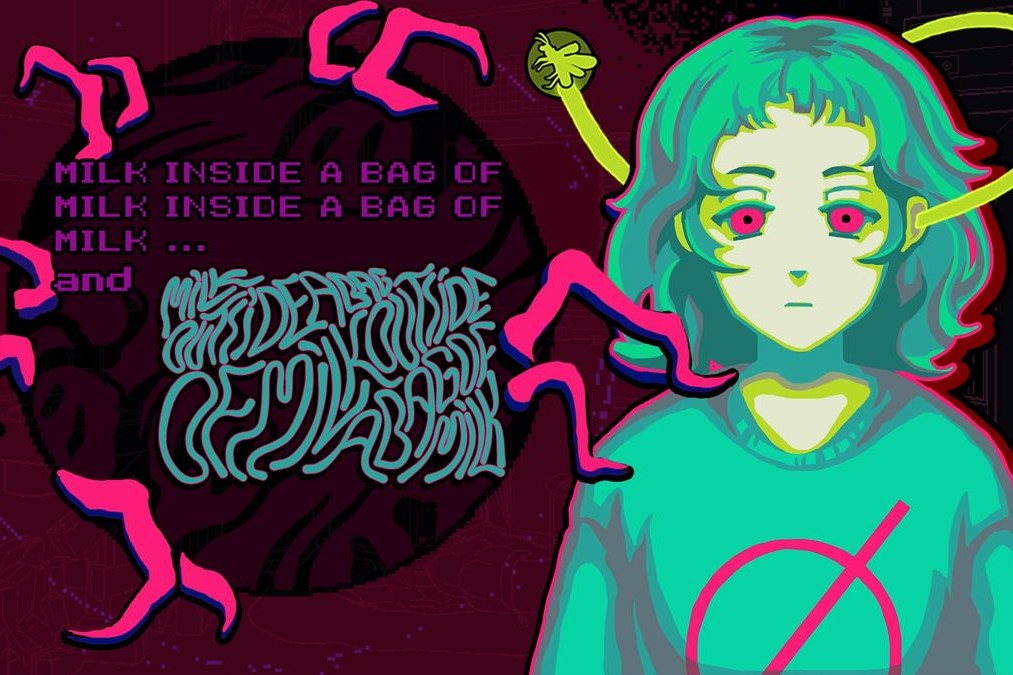
    These games are… fine! There’s an interesting sort of “Evil Dead to Evil Dead II” transition as the first game is grimy and unpolished whereas the sequel has a far glossier sheen, opening with a whole anime intro that reveals the protagonist is a girl cute enough to be dubbed “Milk-chan” by many fans (to be honest, it’s probably more of an “Evil Dead to Army of Darkness” level of glow up). There are more endings and routes to play with in the sequel too.

    It’s a matter of personal taste, I guess, but these games didn’t really connect with me. The first game is sufficiently creepy, but something about that it identifies you with a voice rather than the girl herself detached me from the experience, and the second game is a touch to cutesy for me, and feels strangely drawn out even at merely an hour (compared to the first game’s sprightly twenty minutes, anyway.) A point-and-click segment feels like it should have been a nice little twist, but I kind of resented it for drawing things out.

    It’s obvious I’m the outlier here; many people have connected with these games on a deep level, and while I found them interesting enough, they just didn’t stick with me. If they sound or look particularly interesting to you I think it’s likely you’ll respond better to them. 

    Will I ever play them again? There are a lot of paths I didn’t explore in Milk Outside… but I’m not especially interested, and the triggers are vague in a way that I think makes the game more conducive to a one-and-done. I don’t mind that, I do appreciate a game that wants you to play it once and get “your” story, but at the same time, I’m not sure if that was the intention here.

    Final Thought: While I’ve got you… I have to complain about the fact that milk bags in Ontario are 1.33 litres. You can’t buy a glass bottle in that size!!! You’re stuck using a grody plastic jug that you put the bag into or giving up and buying the even less eco-friendly cartons or expensive fancy milk in returnable glass bottles (for more money) unless you want to start doing annoying fixes like always immediately drinking .33 litres of milk, or decanting into either a bottle that’s way too big or into two bottles. There’s got to be a better way!!!
    1. Or not. ↩︎
    2. Also or not. ↩︎
    3. See the highlighted comment here! ↩︎
    4. Or not (again). ↩︎
  • Doomed Love (Cooper, 2021)

    Doomed Love (Cooper, 2021)

    Developed/Published by: David B. Cooper
    Released: 11/06/2021
    Completed: 22/03/2026
    Completion: Finished it with every ending!

    I feel like every article I start recently has me open it by going “I had a research-related reason to play this…” and even though that’s usually true, how much it matters is debatable. I’m a man of rabbit holes, and it just happens to be the rabbit hole I found myself heading down was one of visual novels, and I wanted to play some quick ones to feel them out again. Although it’s a genre I like, I tend to rarely engage with it1, and I don’t think I’ve played one since… Apollo Justice: Ace Attorney in like 2022?

    (I suppose it depends on how genre essentialist you are. Ace Attorney is an adventure game, in many respects, and Paradise Killer and 1000x Resist skirt close to visual novel. I’m not really that bothered about genre, but in this case I was looking for what people think of as “pure” examples.)

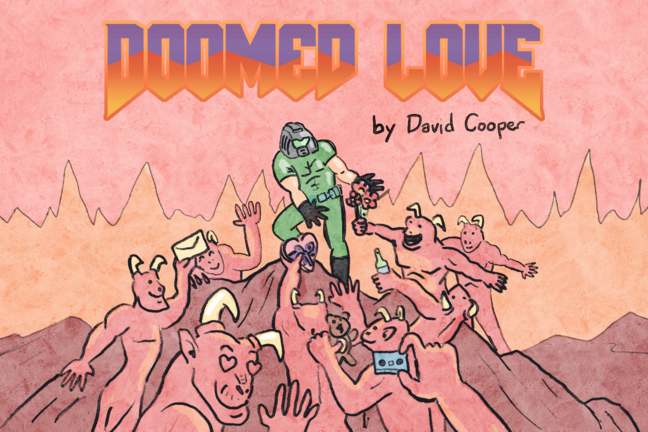
    Anyway, Doomed Love is in the dating sim parody genre? Sort of? It gives the reviewers of Edge what they always wanted (you can talk to the monsters) as you play a simple zombieman preparing for the “Icon of Sin Festival” with your friends Cacodemon, Revenant, Mancubus and Demon–one of whom you may wish to take to the festival…

    I believe visual novel-style dating sim die hards rankle a bit at the way in which the genre can be treated as a joke (especially as a marketing stunt, as seen with I Love You, Colonel Sanders) but Doomed Love (I think) joins the like of Hatoful Boyfriend in taking the style seriously–even if it doesn’t go to the absurd lengths that Hatoful Boyfriend does. 

    It’s a simple game–there’s only a couple of choices, and you can run through the game with every possible “date” within about twenty minutes–but it’s charming, and somehow there’s no friction with the game’s treatment of the cast of Doom as (essentially) high schoolers. I suppose you could complain that means that the Doom setting is really just a bit of set dressing, but I prefer that it takes the visual novel more seriously than it takes Doom.

    I mean, I was really surprised by how in the short runtime each little narrative pays off. My absolute favourite being the Demon storyline, where the Demon becomes comfortable expressing their own unique identity and choosing their own name.

    “It’s got a good heart” seems like a weird thing to say about a game about demons, but, well, Doomed Love has a good heart. 

    Will I ever play it again? I’ve rinsed it, so I’m good. 

    Final Thought: I googled David B Cooper and realised his name is… D. B. Cooper. Incredible to think he’d turn to writing visual novels after such a sensational crime.

    1. Weirdly, this is because usually when I think of playing one I look at my shelves of unread books and think “you know, if I’m going to do all that reading…” and then I just read a bunch of random Wikipedia pages or something instead. ↩︎

  • Elechead (Namatakahashi, 2021)

    Elechead (Namatakahashi, 2021)

    Developed/Published by: Namatakahashi, Tsuyomi / Namatakahashi
    Released: 14/10/2021
    Completed: 31/08/2025
    Completion: Hard to say if the game has a “good” and a “bad” ending, so let’s just say I saw one of the endings.

    Saw people talking about Öoo, the latest Namatakahashi game, so of course I had to look up what they’ve made before that, saw that they’d made a game called Elechead, and played that instead.

    And I’m glad I did!

    I talked a lot about process in my recent essay on Many Nights A Whisper, and I think Elechead represents a more expected way of centering a low number of game mechanics (or especially, single game mechanic) in a video game: not focused on the player’s process toward a singular mastery, but on playing with the player’s believed mastery, taking the mechanics and bending them, requiring lateral thinking and moments of inspiration to progress.

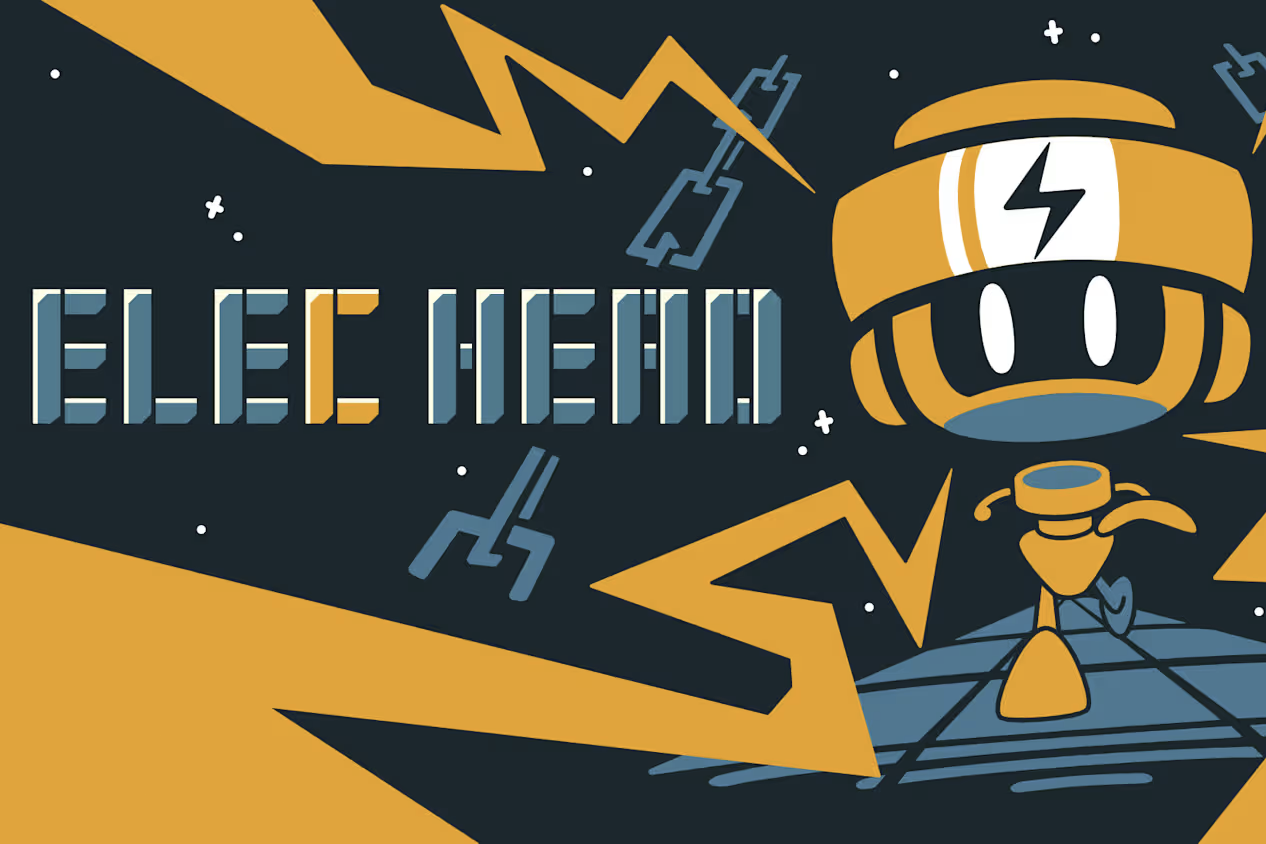
    In Elechead, it’s something so simple and clever that I’m surprised I haven’t seen it before. It’s actually described wordlessly in game and even on the Steam page (perhaps, originally, to avoid localisation issues–even the settings menu relies on pictograms). You’re a wee robot with an electric charge. Anything you stand on is powered. So, for example, if you stand on a platform that moves, it moves. If you stand on a platform with some bulbs attached, those bulbs light (in game, creating a dangerous barrier.)  As soon as you jump, everything turns off; when you land again, everything turns back on. Instantly.

    The game plays like that for a bit longer than I expected it would, before it introduces its main twist: your head is what holds the charge, and you can fling it off and run around as a headless body for ten seconds. So where previously you might face a barrier and just have to jump to break the connection to get through it, now you might have to throw your head across to make a connection somewhere else–and then get there in time.

    The thing that stands out about Elechead is that it sucks the bones of its concept, and that it does so with a thoughtful difficulty curve (well, to an extent). There’s always a new way at looking at your abilities or how they interact with the world, and what you will be able to do can be surprising. It’s generally deeply satisfying when you work out what you need to do, but if there’s an issue, it’s that the game relies on a couple of (in my opinion) bad mannered “tricks” to stymie you: hidden paths with no “tell” (in walls, or off screen) and a final upgrade that’s completely hidden behind one of them (my understanding is that you can beat the game without it, but I struggled even with it…)

    It’s a bit of a shame, because the game leads to a climax that I really loved. If you’ll allow mild spoilers, the game is a linear trip through a series of puzzles (outside of some side paths to collectibles) and when you reach the end, you simply get a few hints to where you were actually supposed to go. But heading backwards requires you revisit puzzles you’ve already seen and solve them in entirely different ways as you reach what appear to be the game’s tutorialising “one way” valves!

    So I don’t love that this game stretches the player slightly beyond what’s fair, but that does mean it fits into the milieu of Japanese video games inspired by Xevious and Tower of Druaga.

    What, you thought I was going to get through an article without mentioning them?

    Will I ever play it again? Probably not, but I enjoyed this so much I’m having to pace myself to not just start Öoo immediately. 

    Final Thought: Weirdly, after I beat this, I looked up some playthroughs on YouTube, and everyone skips showing the trip backwards, my favourite bit! They do the collectibles ending and take an unrewarding shortcut to the other ending. You’ll only have yourself to blame if you do this. Just remember that things can be hidden in walls and off screen and you’ll be fine.