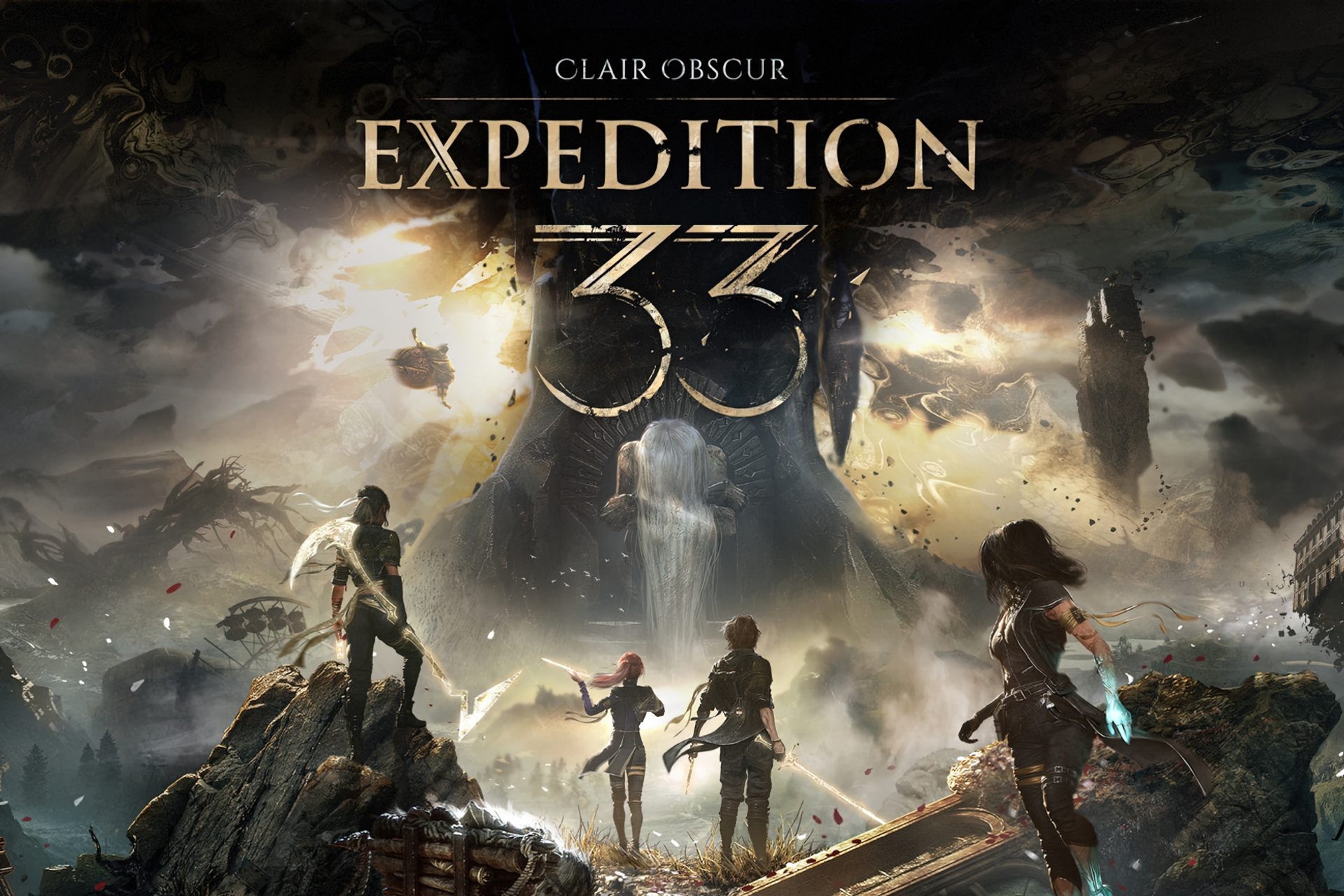

Developed/Published by: Sandfall Interactive / Kepler Interactive
Released: 24/04/25
Completed: 27/05/25
Completion: Completed it, but let’s not get ahead of ourselves with too many details yet.
Alright, so in order for me to critique Clair Obscur: Expedition 33, I’m going to have to go into far too much detail on why video games are hard to critique, a problem that left me as the only video game critic in the world (as far as I know.)
[If you really don’t want to read the next thousand-odd words at any point you can skip ahead. But don’t come crying to me if you don’t understand where I’m coming from.]
Video games are hard to critique because video games aren’t really just “one thing.” They don’t neatly fit into a single form where the audience can make an assumption that they know what the (ahem) experience of “experiencing” it is (is there a better way to say that?) While there are exceptions, of course, you can generally expect when you sit down to watch a film, you’re going to sit down and watch it. When you sit down to listen to an album, er, you sit down and listen to it.
(Other experiences are available.)
Now, absolutely, that’s the broadest expression of what you’re doing–consider it the first layer of experience. The hope, of course, is that in experiencing the work, you are absorbed to the point where you forget anything about your existence as a “person on a surface in a location” and instead exist in the world that is being presented–consider that the second layer of experience.
Now, that second layer does not remain static in the face of genre or stylistic choices. To take film as an example, editing, soundtrack, many “artificial” things happen that do not line up with our linear, continuous experience in the first layer. In some respects, these artificialites are not simply absorbed, we recognise them, we work with them. There can be some level of interactivity (if not affect upon) the works–we knit together a non-linear narrative as it goes. Our eyes scan the screen in a movie, our focus dances from instrument to voice at the insistence of the songwriting on an album.
Games, however, have a less “clean” line between the two layers of experience. “Play” is a different experience than “watch” in that first layer, and both change the type of absorption you experience in the second layer: you may be embodying a character rather than empathising. You may be in competition rather than conversation. And then within that genre and stylistic choices make different demands: maybe you are in “play” mode a lot. Maybe you are in “watch mode” a lot. Maybe the type of play changes.
As I’ve played a lot of old games by now, I’ve become interested in, and written about, the “transition points” of video games where technology has allowed newer forms to emerge. Don’t consider this definitive of the state of the art, but for the sake of my hypothesis, a summary:
- Games begin as competition: think Pong or Breakout. There’s no narrative. You are, essentially, playing a game as people know it either against another or “the computer”. A sport. You may be able to win, but you may just be seeking a high score. Play, not watch.
- Games evolve to have a narrative “reason” for the experience: think Space Invaders. There’s a framing, if not a narrative. If you can win, it’s not the “goal” as much as it is an end-point for “besting” the machine. Play, not watch, but with narrative context.
- Games make the narrative a distinct part of the experience: think even as simple as Super Mario Bros. Suddenly the game becomes about the story. You’re “rescuing a princess”. Narrative is doled out like “reward” for your success in the game. When you finish the game, it’s like finishing a book. You can put it down. Play and watch!
It’s here that the concepts of “diegetic” and “non-diegetic” story come into play. The diegetic narrative in Super Mario Bros. is that you’re rescuing a princess. The non-diegetic story is that you’ve run forward and jumped over a block and then you ran into a koopa and you died and then you came back to life and you ran forward…
In some respects, this non-diegetic story is part of the magic of video games, in that it affects both layers of experience at the same time. On the first layer, you’re not sitting and watching: you’re pushing left, then A. But it seamlessly translates on the second layer to running left, and then jumping. But it doesn’t represent narrative.
So then you get games that try and make the narrative a “part” of the play, at various levels of success. Maybe you’re finding the narrative in the world via logs (not great). Maybe you’re pushing buttons during the cut-scenes (eurgh.) Maybe your character’s death and rebirth is explained via narrative, or you get to make choices that change the narrative–at some level of manageable granularity. Maybe they simply try and make what you’re doing in the game make such rock-solid sense diegetically that it all works seamlessly. Maybe they do that by forcing the player to do things whether they want to or not (and then smugly admonish them for it later).
It’s not, exactly, a solved problem. Nor is it, essentially, actually a problem. It simply reflects the nature of video games as an experience. Sometimes you are playing them. Sometimes you are watching them. Sometimes the mechanics are thematic with narrative, sometimes they aren’t. The first layer you inhabit changes (“I’m watching. I’m playing”) though this may not affect the second layer (“I’m rescuing a princess.”)
I don’t think there’s a kind of game that represents this split better than the JRPG.
Now, again, I don’t want to imply that I think there’s anything wrong with the way JRPGs use narrative and play. But they have, to me, always represented a particularly aggressive split between watching and playing (though don’t let me stop you yelling “but what about Hideo Kojima” or something.) JRPG battles, something you do famously a lot, almost exclusively happen in an “alternate reality” from the rest of the game right down to how you interface with them. Not even play maintains a consistency of experience.
[cough]
So that’s why when I write about Clair Obscur: Expedition 33, it feels ridiculous to try and write about it as a complete work. Because my remembered experience of it does not reflect something I can critique as a whole. The game merges exploration and a battle system to a narrative which, to be completely honest, never engage in a way where one was in my mind during the other. It’s entirely possible that it’s different for you–I’d be interested to know what you felt the game might be doing to make that possible for you–but ultimately what it means this is a tale of two parts. A game and a narrative.
Er, though we need more preamble…

Clair Obscur: Expedition 33: The First Impressions
Now, the thing about Clair Obscur is that I wasn’t originally interested in it at all. With a surfeit of JRPGs available–in fact, a surfeit of Persona-style JRPGs available–the idea of playing a Western one with “realistic” seeming graphics didn’t have much interest for me at all. But then friend-of-exp. Justin Decloux (buy his Blu-rays!) gushed about how much he loved it while other buzz was swelling, so I thought–fuck it. I’m trying to keep up with the cutting edge now! It can’t all be obscure Famicom releases!
I went in almost completely blind: I knew it was about a bunch of French people taking on an enemy, the Paintress, who every year killed the segment of the population who had reached a certain age, and it was a JRPG. But it wasn’t until I began playing it that I understood it wasn’t a “Logan’s Run” style “once you’re thirty, you die!” situation but a “every year the age counts down–so time is running out for everyone” situation. Compelling!
And Clair Obscur has a wonderful introduction, as we’re introduced to the main characters on the day of the Gommage, the day each year that section of the population is lost, and the day before the expeditioners head off on their quest to defeat the Paintress. Very quickly you learn about the hero Gustave, his ward Maelle, and experience the pain of his loss of a “what could have been” in Sophie, an old lover.
As a purely narrative experience, I genuinely thought it was incredible. I’ve never been so moved by a video game so quickly, with tears coming to my eyes. All the stakes were right there. I was blown away.
Anyway, then the wheels started to come off a bit.

Clair Obscur: Expedition 33: The Game
I’ll preface this by saying I think Clair Obscur is a very solid game. But it’s messy. Overambitious.
I’ll also start with the criticism that you might think is the most unfair. The world of Clair Obscur, once you are outside of Lumière… I don’t like it!!!
Everything is way, way too visually busy, and yet there’s very little I think to be absorbed by. Every location seems to be over-textured, noisy, but my most major issue is with enemies, who feel completely characterless and often unparsable; annoying to look at not in the way Michael Bay’s Transformers are but in a way that made me think of them anyway. I had no sense of awe when taking them on.
Which is a shame, because really here it’s the battle system that’s the star.
I say that, probably, because the environments do not feature good level design. Like, at all.
Clair Obscur: Expedition 33 has led to a lot of column inches (well… social media posts) about the lack of a mini-map, and I have to say that I would generally not be terrifically bothered by that if it wasn’t for the fact that Clair Obscur just does the exact RPG map thing which everyone already hates: you come to a crossroads. Do you go left or right? Is there anything telling you which way to go? No? Uh…
Yep, this is a game where I’d say for a significant portion of the running time you don’t have any good sense if you’re going in the “right” direction, and I think the messy environment art doesn’t help at all. It’s particularly problematic when the game features super-hard “battle system skill check” enemies on side-paths, and in the very first area I reached one and was like “wait, why the fuck is this game suddenly impossible, how am I ever going to complete this” when the actual way I was supposed to go was nearby, but not obvious at all.
So the “no map” issue people keep bringing up is one of those things where you have to look at the “note behind the note” to understand what the issue truly is. Er, not that it helps. It’s too late to do anything about it.
To get to the battle system: it’s excellent, with caveats. On the basic level, it is a traditional turn-based battle system, but featuring both quick-time events and dodging/parry mechanics based on timing. This creates an interesting problem: you need the reward for doing these to be high enough that you want to do them, but not so high that they need to be done perfectly every time. It’s interesting that the intuitive design–attacks are QTEs with on-screen prompts, dodging/parries are purely reactionary–probably makes it harder to balance, as decreased damage output only prolongs fights, whereas taking more damage fails them more quickly, yet QTEs are simply easier than parries.
Not that I’d switch them around, but Clair Obscur doesn’t exactly nail the mechanics–and has a strange sort of take on them anyway. The decision seems to have been made that the baseline is that the player isn’t really supposed to be successful at dodging–certainly not successful at parrying–very much at all because it’s so powerful (you don’t take a hit at all!) so enemies from the very beginning of the game have annoying, tricksy attacks, with odd windups, slowdowns and so on, so you have to learn each enemy very well before you can survive a battle without taking hits.
But!
The game also makes a lot of attacks able to nearly one-shot your characters! Clair Obscur makes the decision to be economical in its enemy encounter rate–you see them in the levels, there aren’t that many, they only respawn when you reach checkpoints–but expansive in battle length, so the design decisions seemingly made here is that players will, during lengthy battles, survive via healing enough to get to the point where they can start to dodge and parry. And the game is quite forgiving with healing and revives, giving you a fresh set every checkpoint.
My belief is that they tried to create a battle system with no “lows” or sense of grind, where every battle feels winnable, but hard fought, and always engaging. And I’d argue that they were mostly successful once the player re-aligns their expectations to that.
For example: you don’t have to hold onto healing/revives, so just use them. And you shouldn’t be trying to parry until you learn how to dodge that enemy’s attacks, because the timing is so severe. (I basically gave up on parries completely.)
Even at that though… I did get bored and annoyed with it at times, and I do wonder how much that has to do with how overcomplicated, yet oddly derivative, the character designs are. Each hero has an extremely specific design style–several of which are wholesale cribbed from Slay The Spire, which I understand, but feels… odd–and they all have huge skill trees. As with largely giving up on parries, I’ll be honest and say that I didn’t get how to upgrade my characters until I just sucked it up and followed a “best builds” guide, but even when I played around, the issue seems to be that each character’s design is played in such a specific way that it can be somewhat samey. Slay the Spire character designs work because you don’t actually know what cards you’re going to have in hand each turn–you’re working to build your deck across the game until you do. Here, you know what you’re playing each turn, and you just do that while hoping to hit your timings.
Don’t get me wrong. It’s still good, it’s generally enjoyable, but I do notice that the weaknesses are never more stark than when the game asks you to hone in on mechanics such as when you’re fighting the optional bosses (that you generally stumble into by accident.)
But the game is also forgiving: you can bump it down to easy whenever you like at no cost, so you can do it whenever something gets on your tits. I played through this on normal, bumping down to easy on optional bosses (who can still one shot you at that level!) and only had a touch of grinding at one or two points, not that I can remember why.
If this was all Clair Obscur was: no narrative, just a dungeon crawl, people would still like it a lot, and I think I’d still like it a lot. But it’s not just that, is it.

Clair Obscur: Expedition 33: The Narrative

Clair Obscur’s narrative is a fucking bin fire.
[deep breath]
Sorry, ok. You probably remember me saying in my first impressions that “I’ve never been so moved by a video game so quickly” by the game’s prologue. Which is true.
But as for the rest of the game… I hope you like information being obscured from the player unnaturally! Like, one of your favourite things should definitely be characters not asking the obvious question anyone would in the situation!
Now, you can write a story however you like. Personal taste and all. But from my perspective, I consider it a weakness when I can tell a story has been written to get to an emotional or narrative beat no matter what. When reality or characterisation falls to the wayside because you have to hit this beat and you have to hit it here.
One of the interesting things about Clair Obscur is that as much as the game is divided cleanly between “play” and “narrative” the narrative feels like it doesn’t show up as much as you’d expect–at least, the backbone of the narrative. Each area (“dungeon” equivalents) plays out with a little chatter, but a lot of character work and story is relegated to when you make camp, and as you can only do that outside of the dungeons if often has to be forced. You really feel the segmentation, and when the big narrative moments come, they are in stark relief, and it’s at the end of each act this “need to hit the beat” is clearest.
I have come to the conclusion that the narrative has been designed to manipulate you into feeling certain ways only to then work to contradict your feeling. But they don’t have the chops to make this smooth or believable. In fact, this is the first game I’ve played since (cringe) Bioshock Infinite where I felt I should just look up a timeline to actually try and understand what’s going in the game to make sure I wasn’t totally off base with my feelings on it–while it wasn’t completely necessary, ultimately, it did help (and I highly recommend this one by Nor if you want a look yourself.)
But let’s get into it.
Obviously, spoilers are going to start showing up… now. If you want to play this, and I’m not saying you shouldn’t exactly, you should consider my conclusion “fun but flawed!” and flip away from this tab to come back to in like 26 hours. See you soon!
Look, I’ll give them something. I didn’t know, at all, that I was going to get Aeris’d. It should have been obvious with Gustave’s wee skill tree and everything and it’s incredible that when I looked up a build for him I never got spoiled. But this a perfect example of a “we have to make this beat happen.”
Gustave fights a guy who killed the entire rest of the expedition, while already wounded to… to what exactly? Maelle is trapped, he’s not buying her time. Why is the baddie killing Gustave at this point anyway? This just happened to happen after most of the party jumped off a cliff?
It’s bollocks, and it’s fake, and I felt annoyed, not sad.
So then new protagonist Verso shows up, and proceeds to… not be asked by any of the characters any of the questions you’d probably ask. They just go on an adventure with him because he showed up and so that a character can later find incriminating information and go “oh no!” that leads to… well it doesn’t lead to much at all does it. They get to the end, they kill the Paintress and then… oh no! That wasn’t the real baddie!
Which is revealed by Verso reading a letter from his sister. Meaning that Verso didn’t know something that, based on everything else (not least that he killed the Paintress to free her, my interpretation being with the knowledge this was his “real” mother) he would probably know. Ok!
At which point we learn that this entire thing was all bollocks anyway because everyone lives in a painting created by the “real” (dead) Verso and his mother and father were fighting in it using their powers of creation and destruction. Ok!
Look, I kind of get the Act One To Act Two switch, as poorly handled as it was. I think there’s something kind of interesting in ripping away a character that I really enjoyed to replace them with Temu Jack Sparrow and then let me mistrust them (more than my party did!) to the point that I don’t use them in battles and let them get really behind in experience (which eventually matters).
But the Act Two to Act Three switch is just utterly mental in a way that I don’t think any player can prepare for, playing a weird sort of trick on the player for being absorbed in the second layer of experience. “Actually all these characters you’ve grown to love aren’t real.” “What, you mean like because they’re in a video game? I know that, but I’m absorbed in the reality of the narrative.” “No, because they’re paintings that think they’re real people… in a video game.”
I’m not going to get involved in a “if you prick us, do we not bleed?” analysis of this third-order existence because the game doesn’t go deep on it itself, instead revealing that, ultimately, every time they talked about how the painting in which the entire game happens has a “part of verso’s soul in it” they meant literally, and his soul was essentially a small boy that was being tortured to keep the painting alive.
That’s right folks. It’s Omelas. You’ve been living in Omelas. How do you feel now!!!
Well, it turns out a lot of you people out there are fine with Omelas. I mean I don’t need to play a video game to know that, I live in a world where Palestinian children are being murdered every day to no end, but it’s stark to see people feel annoyed that the game ends with the question “do you destroy a painting full of paint people to free a real person’s soul or do you trap all the paint people in Peaksville?” when what they want is a happy ending and damn the child.
(To be fair, the game is really fixated on making it sound like the option is between “let Maelle’s dad burn the painting or let the painting continue to exist because everything will be fine, no really, everything will be fine”.)
I need to emphasise: this is not the game you have been playing. At all. I am so thankful that the third act is just one dungeon (Unless you want to do a lot of side quest stuff) because what the hell. There’s like this perfectly interesting game about a quest to get death back to happening normally that suddenly becomes a story about a bunch of characters you’ve never met fighting over a painting.
In conclusion:

Will I ever play it again? No.
Final Thought: Alright, that’s not really a fair conclusion to my thoughts on the narrative. My conclusion, really, is to ask people to consider: what is the story they’re actually trying to tell? Because Clair Obscur: Expedition 33 feels like a game of Exquisite Corpse on an act by act basis, where the epic conclusion completely subsumes any themes or narrative you had experienced to that point to… to what? To make sure players got a choice of two endings??? They put all this effort in to force beats and then none of them seem to matter anyway???
So yes, some respects, Clair Obscur is a cautionary tale of the damage narrative can do to the layers of experiencing a game. In others, it’s a fun, flawed game with a shite story. And those are ten a penny.