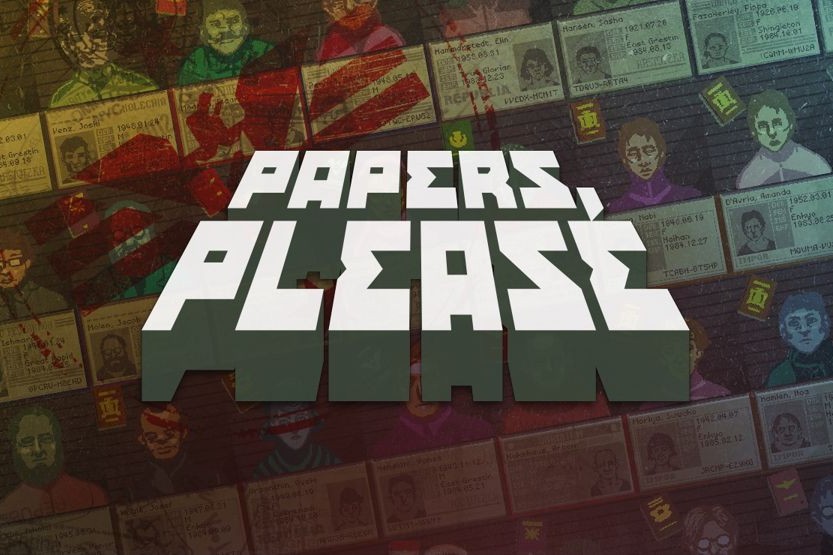

Developed/Published by: Lucas Pope
Released: August 8, 2013
Completed: 20th April, 2014
Completion: Finished it seeing five different endings (two that I’d consider “proper” endings.)
Trophies / Achievements: 10/13
I loved The Republia Times. Loved it. In fact, I think if you’re the kind of good-looking go-getter that reads this site, you should just go ahead and play it if you haven’t already.
…
Great, isn’t it? Especially the sting in the tail. Oh man, that’s what elevated it to a masterful piece of game-design-as-satire in my mind. It genuinely manages something that few games ever have, and to think it was just a wee warm-up for a game jam!
Anyway, here’s Papers, Please, set in the same “world” as The Republia Times, dealing with some of the same issues, and of course cleaning up at the IGF and GDC awards because it’s about real stuff and isn’t supposed to actually be fun.
Papers, Please… I am… ambivalent about it. Critiquing the game design alone, well, it’s sort-of… I guess I could describe it as a dynamic, timed hidden-object game. You only have so much time each day, you have to check people’s documents for errors, there isn’t quite enough space on your desk, and (intentionally) the controls are slightly awkward. So you’re trying to find the error (if there is one) and get to the next person so you can make more money. Each day there are more and more possible errors, more documents, and more mistakes you can make. And so your days pass, somewhere between a high-tension challenge and a boring grind. Somewhere in there.
I guess if you like hidden object-style games, it’s cool? The nice thing about The Republia Times is that it didn’t outstay its welcome. Papers, Please does, and hard. If you want to get to one of the proper endings, you’re going to be playing it for thirty days. After seven you’ll be like “ok, yeah, I got it.”
However, that’s not all there is to Papers, Please. There’s a story to the story mode (“duh”—everyone) and while it’s very very loosely sketched, you’ll make choices: people you might let through even if they don’t have the right papers, or to help some people and hinder others. The weird thing about Papers, Please is that these people all appear in exactly the same way every time. So while most of the people who stop in are generated, you know that the third person on day three is going to do a certain thing. Now don’t give me shit for this after my Rymdkapsel write-up but it seems strange that it has to be this way—there are a bunch of different characters who appear, and with a shorter game (fourteen days, maybe, rather than thirty) they could be randomised in, yes, a rogue-like-like style to make a different experience every time.
However, with the number of different endings you’ve achieved tracked and the saves cleverly branched by the game, it does seem that Lucas Pope has intentionally designed it so that you can replay the game from certain points with the knowledge you have from previous runs to make different things happen. It’s not how I’d have done it—or how I want it to be—but it seems fair enough (I’m interested in his reasoning, though.)
There’s a bigger problem, though. About halfway through Papers, Please I thought to myself “you know, this would be pretty cool on iPad.”
And then I realised something. Papers, Please could easily be put out on the App Store. In fact, I’m pretty sure that Apple would feature it. And this is a company that aggressively bans games based on content (Phone Story, Sweatshop HD, Endgame: Syria, Intern Saga… the list goes on) famously saying “If you want to criticise a religion, write a book.”
Why is that? Well, it’s because the satire of Papers, Please is toothless. Yes, you play a border agent, but who is being critiqued here? Generic Eastern European states in the eighties? One of the most astounding things about Papers, Please is how even when you are at your most strict, if anything the indignities you pile upon people trying to get into Arstotzka are less strict than those on anyone trying to get into America. And Arstotzka literally suffers a terrorist attack at the border every other day. Take your shoes off. Have your items x-rayed. If that’s not good enough, they can go through your bags. Don’t want to consent to a full back-scatter scan? “Enhanced pat-down.” Why are you travelling here? Business or pleasure? Where are you staying? What are you bringing in? How do you know these people? Are you trying to work?
And so on, forever. And the profiling—you only have to look at Did Rami Get Randomly Checked to see how pervasive it is.
If Papers, Please was about being an American TSA agent, it would actually be saying something just by actually representing how absurd it is the hoops they make you jump through—and to what extent your privacy is abused.
But it doesn’t, so it could easily be approved for the App Store.
Funny, that.
Will I ever play it again? Nope.
Final Thought: Maybe the saddest thing about Papers, Please is that unlike The Republia Times I can’t even see any satire in the story, anyway. Arstotzka is… bad? For some reason that isn’t super clear? You might want to escape, but maybe not? There’s one ending that comes close to making you feel that shiver of horror (I won’t spoil it, but it involves forged passports) but it doesn’t push it too far. The fact that there are “good” endings is actually pretty shocking to me.
Oh, and the game rewards you with achievements for making the “right” decision in several cases. Come on.
This essay is featured in Every Game I’ve Finished 14>24.