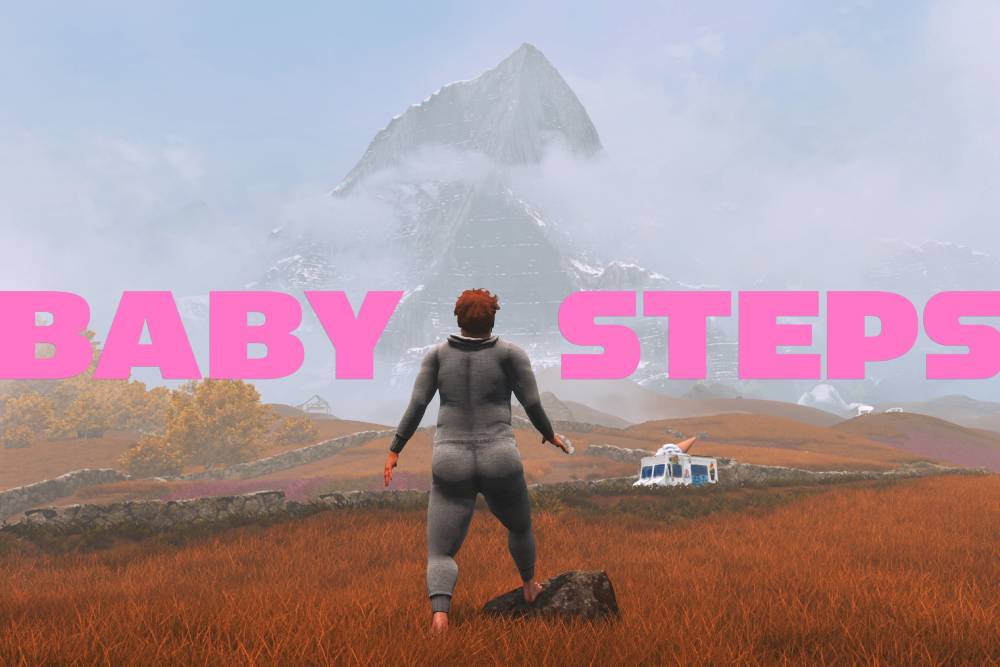

Developed/Published by: Gabe Cuzzillo, Maxi Boch, Bennett Foddy / Devolver Digital
Released: 23/09/2025
Completed: 13/11/2025
Completion: Finished it. I took the stairs, obviously.
Baby Steps is incredible. I think it’s almost certainly going to be the best feeling game I play all year, if it hasn’t locked it up already. I think it’s brilliant.
But have you ever played a game that you just… disagree with?
To be clear: not that it disagrees with you like it’s some clam chowder that got left out in the sun. That you disagree with it–say on a moral, or ethical level.
With Baby Steps, it would be too strong to say that I disagree with it ethically or morally. But I do think I disagree with the principles on which it was designed. On the… mindset in which it treats the player.
But before we dig into that, let’s talk about what Baby Steps is.
Baby Steps is designed by Bennett Foddy, who developed the game alongside Gabe Cuzzillo and Maxi Boch. You likely know Bennett Foddy from QWOP or Getting Over It With Bennett Foddy, games which find comedy, pathos and of course frustration in unforgiving physical simulation (or maybe you know him best from the Best British Games Spectacular I did with him on the Insert Credit Podcast. It’s certainly how I do!) In Baby Steps, you play Nate, who is transported to a mysterious alternate reality and who then… well, it’s not entirely clear what his actual goal is. He needs the loo and probably wants to get home, but mainly he walks, hopefully forward, because that’s what you make him do.
It is this aspect–the walking–that is such a revelation. Although I’ve played QWOP (I mean who hasn’t, you can play it right now for a while if you fancy) I have to admit I never Got Around To It With Getting Over It With Bennett Foddy. So while it’s possible that game felt fucking incredible, even if it did (does) because this is a new Foddy game explicitly about moving your legs I just assumed moving any distance at all was a grim nightmare of concentration and pain like QWOP.
But it isn’t that at all! In fact, moving your legs is almost easy! Using the triggers to control each leg, once you have a rhythm you can just push forward and tap each trigger and move forward at a pace that–while not exactly an open-world sprint–is almost effortless. You might think that minor changes in elevation or little rocks and things like that are going to fuck you? Honestly, once you’ve got used to walking… no? I don’t think I’d even been playing an hour before I got used to the micro-adjustments required to keep walking over a huge tree knot without falling over–you just see when the foot connects, and you move the other one. Simple!

It’s even more impressive when you actually have to do something that requires a bit of finesse. Almost immediately the level design presents to you a hat hanging from a pole, that you know you can only collect if you climb a small pile of bricks. In doing that you realise that as long as one of Nate’s feet are planted securely, you can take your time lifting your leg, using the analogue stick to swing it around and into position without fear–well, much fear, things can still go wrong–of falling over. The game goes from a steady tap-tap-tap to a more interesting puzzle–about how well you can judge placement, how much patience you have, and how well you can avoid overconfidence.
At its best, Baby Steps is a pleasure to play. It’s fun just wandering around, seeing where you can go. Falling over happens–and don’t get me wrong, just because you can get into a rhythm, it doesn’t mean you won’t fall out of it, or just not recognise the movement you need to make, and trip–but it’s alright, right?
The problem with Baby Steps, for me, is that it’s not just a fun sandbox. It’s a video game with a beginning and an ending. And so, ultimately, it expects you to progress. And as you progress, the game goes from “I’m having fun moving” to “I have to get this step exactly right. And the next one too, quickly, because if I don’t I’ll slip, and I’ll have to do another five minutes of climbing just to get here… ah fuck, I fell. Well, at least I’ve done all these other difficult steps thirty times, I won’t… fuck.”
Now, absolutely, you could say “well, you don’t have to do any of this. You can play it however you like. You’re putting all of this onto the game but you’re doing it to yourself, mate.” But the world is transparently designed with paths that funnel you into challenges and with environmental art that points you in the direction you’re “supposed” to go, and those challenges go out of their way to make sure you are punished for failure with complex runbacks that only get worse the further you get in an individual challenge.
Sure, sometimes they’re just trying to make trouble for you with the direction they’re pointing (and problematically, sometimes they don’t make it clear at all where you’re supposed to go, so hope you enjoying wandering around lost) but there were many points where I couldn’t find an alternative path than the one I was beating my head against, and I’m sure any others were a ballache anyway.
So it’s here that we come to our disagreement: why does Baby Steps have to be punishing?
I know, I know. It almost sounds completely ridiculous when I say it. But there’s a weird disconnect between the pleasure of movement, the opportunity for exploration, and the complete smugness of the level design that makes sure that your failures are multiplied–and which loves to place gotchas as late as possible in a climbing chain.
The punishment works at such cross-purposes to the world, too. You know you have to get to the big obvious landmark you can see in the distance, but it’s an open(-ish) world, and you can see something interesting you might want to go and look at instead. But if the perambulation required to get there is difficult–or worse, it’s going to be difficult to get back–I didn’t want to do it, because what if it wasn’t anything, or (worse) was a gag about how I’d just done something annoying and difficult for nothing? Apparently Baby Steps has 109 cut-scenes, of which I saw something like, I don’t know, nine. Because the rest I’d have to hunt out, and fuck knows how much time and frustration it could cost me when I wanted to actually progress again.
“Hang on,” you might be saying, “I thought you said movement in this game was a pleasure. It can’t be that bad can it? Surely?”
It’s interesting, because if I’d stopped playing this game after the first few sections, I’d say that’s fair. Initially it feels like the pathing the game guides you down doesn’t so much force you into repeating the same sections to progress, but there are a lot more falls where you slide off to somewhere else and have to get up a different route, which kept things interesting. But the desert area was the death of that. They introduce sliding–meaning you need to chain steps quickly–and then I found myself in a section where–unless I’m completely wrong–I simply could not find another route. And it required crossing a bridge that, if it fell required I restart the game.
Come on. That is rubbish.
But it’s not as rubbish as the part where I had to work my way up a cave system holding a lamp, where the ending seems purposefully designed to make sure I trip and drop the lamp all the way to the bottom and have to either do the whole thing again or turn my gamma up and hope for the best (the latter worked in the end.) I think that’s the absolute nadir, but at that point the magic was lost, and the rest was just a grim march to the end, with nary a smile from me.

In a New York Times profile1 contemporary with the release of the game, Foddy wondered:
“..When I’m making games that are intentionally frustrating or annoying or boring … I’m trying to do that in a way that people will derive pleasure from. Why do people continue to do things that make them unhappy? I think that’s maybe the great mystery of being a human being.”
Because the New York Times is crap, I don’t think they dig into that deeply enough. Foddy is intelligent enough to distinguish between “pleasure” and happiness: doing drugs provide pleasure but not happiness; you can be sad and still have a wank. (Indeed, there can be a near-sexual tension to frustration; the need for a release that isn’t coming, and if it doesn’t come probably a wank does the trick, but it’s not going to make you happy.)
The problem, from my perspective, is that the reason people do a thing (play a game) that makes them unhappy is because… they want to win! There’s a goal, a payoff. It’s not that deep, and there’s the smugness of “the only way to win is not to play” in Baby Steps, and I think that’s a limited form of thinking. You designed the bloody thing!
This way of thinking is impressed–in fact, enforced–by the narrative of Baby Steps. Nate is something of a cipher, but he has signifiers. He’s a loser, he doesn’t seem to be able to communicate with anyone, or anything, particularly well. He is–and this is important–seemingly completely unable to take assistance, never mind help, which is implied to relate to his sense of masculinity, though everyone else in the game reacts in bafflement to it (oh, everyone else in the game is a man, by the way. For a game that examines the problem with men, it is funny that it doesn’t let a woman speak once).
I don’t think it’s spoiling anything to note that while Baby Steps has a narrative, all the cut scenes are improvised (Cuzzillo as Nate, Foddy as… everyone else) and that does make me wonder how deeply they planned the narrative to begin with (it certainly seems somewhat… loosely sketched.) But it does have a couple of big beats, the most important of which is a decision the player must make to either take on an absolutely insane challenge or… take the clear and obvious easy route.
The problem with this is that it’s classic, top-down narrative design. You reach a point in the game with the signposted choice that reflects ~themes~ rather than, you know, it coming from the emergent play. It’s especially egregious here, because why the fuck does the game unavoidably make me do all this insanely hard bullshit first before it allows me to throw my hands up and go “honestly mate, I don’t give a fuck?”
Because I don’t. I’ve talked before about my opinion on save states and rewinds, the fact that I’ve always loved Jeff Minter’s “start a level with your best high score that you got to that point” design concept and all of that sort of thing. I just don’t think runbacks are fun, or even interesting past a certain point, and Baby Steps is the purest runback experience there is, because every time you have to return to the challenge where you failed, you have to work for every step.

If you ask me, I think there should be a Baby Steps: Gigachad Edition where as soon as you get tired of the game, you can press a button, Nate accepts his failings and via a magical girl-style transformation sequence Nate gets fucking ripped you can quicksave wherever you fucking like. This isn’t even a joke! I’d have explored so much more of the game and actually enjoyed the experience a lot more, and for me, the whole point of playing games is to enjoy them [“Is it? I’ve read your articles and I’m not sure I believe you”–Ed.] The “lesson” of Baby Steps doesn’t apply to me, and it certainly doesn’t at the point in the game where it’s trying to teach me it.
The point, of course, does stand in the opposite direction. “Maybe I like the misery.” If you do, no one is stopping you playing this the way you like, or with your hands behind your back or upside down. It’s all completely valid, unless you’re the kind of prick who resents the idea that other people might use the easy route. Hell you can have an extra achievement for never turning on Gigachad mode if that makes you happy. Have ten, I don’t care. But I reject when a game is like “You play it like this, and only this, and also I’m standing over here, pointing at laughing at you while you play it, for playing it.”
So yeah. Baby Steps. The best feeling game of the year, that I don’t agree with at all.
Will I ever play it again? Gigachad edition, baby! While this article has been critical, I do want to say that I actively recommend Baby Steps. But I do think you should just fuck about in it and not consider it a challenge to be beaten, because it’s so, so fun until it’s not. In fact you can make your own Gigachad edition if you like, though the quicksaving doesn’t save any items you’re holding so it’s not helpful if you’re say stuck in the cave. Uh not that I would know (I absolutely do know).
Final Thought: I really don’t know if this is adding insult to injury but one of the issues I had with Baby Steps, to be honest, is that I didn’t find the cut-scenes… that funny. Maybe I’m sugar coating that a bit: I didn’t find them funny. (Well, the one joke with the map2 that pops-up for a split second is really, really good.) Nate is so annoyingly whiny and obstinate, and if he’s just slid off a mountain forty times it generally makes you want to actually murder him (I assume Cuzzillo is spending his royalties on an armed guard.) Foddy’s characters are, mostly, twats. It’s all just so abrasive, and the game makes a point of trying to force you to watch them via skipping cut-scenes being a mini-game in themselves. Which I’m sure they also thought was funny.
But that said: even though it’s in the game as a punishment in itself, I enjoyed the twenty-eight minute cut-scene you get if you skip all the cut-scenes. It’s just Cuzzillo and Foddy being real with each other, it’s charming and easy and, unlike the rest of the game, warm. Should have had more of that!
- I’m not linking the NYT despite quoting them, because fuck the New York Times. ↩︎
- Something I wanted to mention here, because it didn’t really come up, is that I agree with Foddy that you can spend the whole time staring at a mini-map in an open world game, and that Baby Steps is nicer without it (on paper… the most samey-looking areas can fuck off.) ↩︎