Developed/Published by: Comcept / Level-5 Released: June 20th, 2013 Completed: 28th October, 2014 Completion: I finished all the missions, including the extra ones, unlocking all the tanks that you can unlock from said missions! Trophies / Achievements: n/a
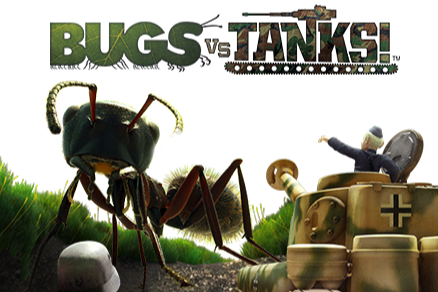
Bugs vs. Tanks is not very good. At absolute best you can sort of think of it like an Earth Defense Force game, except there’s no buildings being destroyed, or really that many bugs on screen at one time, or, uh, any particularly interesting weapons.
But it does have all of the slightly wonky graphics and rough controls you expect from Earth Defense Force? And giant bugs, obviously the main comparison point?
Basically, you play short levels where you shoot at bugs with your tank (though weirdly, firing is automatic at default.) occasionally finding new tanks. It’s very, very… blah. If not an Earth Defense Force game, it’s definitely in the ilk of the Simple Series that spawned it, feeling like a phoned-in cheapy title, but sadly not one with any interesting ideas to back it up as such. Keiji Inafune worked on it, apparently, in (probably) yet another case of a named Japanese developer saying “it would be cool if…” and then never checking in on the team again.
Having said all this though I still played it all the way through and went back to unlock tanks. Why, you might ask? Well, because tanks are quite interesting and when you unlock them you can look at them in a gallery, and read a tiny bit of text about them. It the ideal game for someone who’s slightly interested in WWII tanks, but not so interested that they’ve read up about them already? Specific!
Will I ever play it again? I have no excuse but if someone is ever like “want to play the co-op missions” I’d totally do it.
Final Thought: Bug vs. Tanks isn’t very good and yet I’ve just admitted I’d play it more. It simply passed some time in an agreeable fashion. I have no excuse… well, maybe co-op’s really good, you know? Like Earth Defense Force, the game that this game really isn’t very like at all (apart from the giant bug thing.)
Developed/Published by: Vanillaware / Atlus Released: July 25th, 2013 Completed: 25th October, 2014 Completion: Defeated the final boss. Trophies / Achievements: 21%
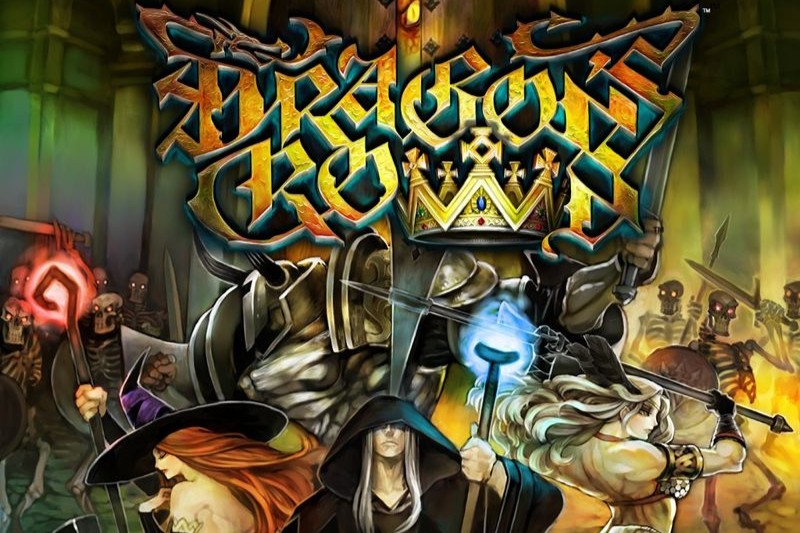
I really, really, really did not enjoy Dragon’s Crown. I think it’s crap. Really, stunningly, confusingly-because-people-seemed-to-like-it-and-as-a-result-I-was-looking-forward-to-it crap. Boring, repetitive crap. Have I said it’s crap enough yet.
So… what’s the deal, anyway? I’ll show my hand here and admit I’ve never played another Vanillaware game, despite also owning Odin Sphere (picked up for a fiver many moons ago) and Muramasa for Vita (I thought I’d play this first though?). However, I really do like side-scrolling punch-me-dos. I mean, I genuinely like the Dungeons and Dragons games that obviously inspired this. And obviously, it’s nice looking, even if the art isn’t to my taste really in any way at all.
I mean, it’s probably that art, which looks nice in stills, but makes the game seem really… I don’t know, static when you’re playing it. It’s totally one of those side-scrollers where you feel like you’re fighting cardboard cutouts, you know? Where if you’re slightly to the side you miss them completely. Which isn’t amazing when you’re playing the Elf, and every arrow you fire just seems to whizz past your enemies harmlessly because you’re a pixel off (I might be exaggerating here, but it’s how it felt.)
It just doesn’t feel rewarding to hit things, or move about, or really do anything moment-to-moment. It all feels clunky, and restrictive, and then you get your 3 AI companions (because, of course, you don’t get to unlock online play until you’re over half-way through the game) and if the game felt like cardboard cutouts before, now it feels like cardboard cutouts you’ve scribbled all over, thrown glitter at and then blown up with a small explosive. The screen just becomes a mass off, well, fuck knows to be honest, spells and attacks and bodies any time there’s a skirmish, and you pretty much dodge and then start to spam your most powerful attacks in the hope you’re really hitting anything.
(If you don’t, it’s fine because you’ll definitely survive to the end of the level anyway, it’s really not that hard. At least until the bastarding final boss, where you’ve got to do it in two lives and have to grind/hope you’ve unlocked powerful enough AI to survive it. Hurrah.)
Anyway. Yeah, I know you’re probably thinking like “how different is this from the Dungeons and Dragons games, really?” so… ok! I’ll have to go back and play those new ports then, eh? Rather than just base this on my memories of playing it years ago. Maybe I’ll be eating some humble pie!
Of course, that really won’t change that Dragon’s Crown is definitely crap.
Will I ever play it again? Never ever ever ever. Not even multiplayer. I played it a bit but zzz.
Final Thought: I really struggled to find something interesting to say about this, to be honest. I totally get that you’re supposed to really get into pushing your way through the levels as a group, playing the (cute but easily missed) cooking game and then, when spent, sort through your loot, but… man, if it just doesn’t feel good, why bother? I mean I’m talking about a game here that feels less good to me than repeatedly clicking the mouse in Torchlight or something. I mean really.
Developed/Published by: Pastagames Released: October 8th, 2014 Completed: 24th October, 2014 Completion: Hmm. You can’t really beat this, I just played the main arcade mode a lot and stopped. Trophies / Achievements: 47%
Oh dear, oh dear. It’s been a tough few weeks here at exp. Towers, with the last batch of games we’ve been playing all being… pish, to be honest. And we quite like the plucky chaps at Pastagames, who’ve made (notably) Arkedo Series 03: Pixel and Pix n’ Love Rush, which are both pretty durn charming retro-inspired titles, so we dipped into Pix The Cat in the hope it would lift the doldrums.
I, uh, don’t like Pix The Cat, though. I feel sorta bad about it! Best described as a rough reimagining of Pac-Man Championship Edition DX (that’s the second one with the ghost trails) you play Pix (the cat), who has to (for reasons obscure) hatch duck eggs by walking over them then drop said hatched ducklings off in particular zones. This is complicated by the fact he can’t walk into his own trail of ducks (or they all explode) or start dropping them off before he’s hatched all the eggs (because then he loses his bonus.) It’s a game about quickly working out the best route through the screen—or being able to wing it well enough—performing that and then moving to the next screen, getting faster and faster until you hit fever time and everything is worth loads of points, you’re going really, really fast, and if you hit one thing you lose it.
It sounds pretty good! Simple, yet solid. However, this is not the case. You see, while it’s inspired by Pac-Man clearly, with strict, Pac-Man-me-do controls, it’s got very open levels. This is a subtle complaint, but you know how in Pac-Man you’re always in a tunnel? it means that when you have to make a turn, you’re always sure you’re going to turn down the route you aim, even if you’re going really, really fast—because there will be a buffer between tunnels (the, er, not-tunnel bit.) In Pix The Cat, you’re often having to make very fast turns, even in instant zig-zags, to avoid hitting stuff like drop-off zones or enemies, and it’s super frustrating to suddenly miss an egg, or screw up your entire chance of a perfect because you turned a fraction too soon or too late. In fact I’d say 100% of my mess-ups are because of that. Now, you can easily say “well, you just need better reactions.”But my thoughts are more on the line of “why is this more fun than, say, designing the levels to avoid this problem?” I don’t think it is.
(You might say “but Snake has wide open levels, and that’s fine!” again I refer to the level design—successful versions of Snake don’t litter the level with things to avoid in difficult zig-zags as well as your own tail. So there.)
It’s got this one “main” arcade mode, which is again, like Pac-Man, in that you basically do the same levels in the same order every time. Now, they do change slightly. Very slightly. But they’re not different in any meaningful way. And there’s still a timer. As a result, the game reveals itself to be about absolutely perfecting performance through memorisation in order to get a high score. It’s so hard, actually, to get a good score that the game is entirely about not making a single error, hitting fever time and never losing it (which you won’t manage, it’s bloody hard). This is unfortunate! Because there’s a daily challenge mode, with a… I’d imagine random, but I’m not sure, level where you first time through aren’t going to know what’s coming and have to just muddle through as best you can. It’s more… roguelike-likey and I guess therefore it’s interesting how the seeping roguelike-likeyness of games these days means that ones that don’t do it seem at a disadvantage. I don’t really see why the main mode of this is so locked to memorisation and repetition rather than being at least a bit easier and more random to reward skilful play. It’s really weird, honestly.
Oh, it also does this thing that seems clever, that you “zoom” deeper and deeper into the screen as each level is a tiny part of a bigger level, but it looks all wrong because the tiny levels don’t… ah, god, I’m going to describe this wrong technically, but they’ve got a higher pixel density than the level you’re playing (or something) so it looks really, really bad and incongruous. Boo to that, man.
Pix The Cat just doesn’t work! On any level! It’s like they had a lot of good ideas, but got them all very slightly wrong. Like they all sat down to program, and put their hands on the keyboard one key to the left. Ah well.
Will I ever play it again? No. It’s too hard to unlock the “dessert” mode (hard, basically) and not rewarding enough to make me keep trying. And it’s got two other modes, “nostalgia” and “laboratory” which are full of short individual levels but I just could not bring myself to care.
Final Thought: You can play the daily challenge mode more than once each day. I mean, if that isn’t an example of not quite getting it I don’t know what is.
Developed/Published by: Hardlight / Sega Released: July 31th, 2014 Completed: 14th October, 2014 Completion: Unlocked the second island. Trophies / Achievements: 82/420
I love Crazy Taxi! Love it. In fact, I pretty much love all of Sega’s “experience” arcade games from roughly that era—Top Skater particularly, if you ever played that one—but Crazy Taxi the one that Sega seemed to be most fond of… exploiting (it just made a lot of money, I guess?) it with ports and sequels a go-go, even if some of them have been pretty stinky. And so it’s come to this. A free-to-play iOS game that’s obviously based on Temple Run, rather than, you know, Crazy Taxi. Reduced to a re-skin.
But wait! Supposedly series creator Kenji Kanno was involved! I mean, the game was developed by Hardlight, Leamington Spa-based developer of, uh, Sega’s previous Temple Run re-skin, Sonic Dash, but maybe it’s interesting?
I’ll be frank: I downloaded this thinking I’d play it for literally a few minutes just out of a morbid interest, dash off some words about how you can’t make something free-to-play without considering the context and design of the original game, and call it a day. However, I of course ended up playing this for about two weeks fairly solidly because, of course, free-to-play has to be compelling.
Don’t worry though! Crazy Taxi: City Rush is still crap. I just love Crazy Taxi, I’ve never actually played Temple Run and to be honest, this is probably my first deep time spent with the current brand of “give us your money, give us it now” style of free-to-play, so on some level it was probably just kind of educational.
Not that it’s particularly unique. It’s the usual thing. Everything you do you have to wait to do again. Everything you have to wait for you can spend to speed up. Everything you can buy, you can spend to buy it quicker, or to buy it at all; the really good stuff you want you can never earn enough of the right currency for. You’re always being given offers or special events that, surprise, you have to spend to enjoy or take advantage of. And if you don’t spend anything, you have to watch adverts all the bloody time.
Well, I didn’t spend a penny, in stark contrast to New Star Soccer. I probably would happily have spent a buck to disable adverts, but it started at $2.99 to do that (when you buy some diamonds, or whatever) or $4.99 for a starter pack, and that was too rich for my blood. I put up with the adverts.
The game itself is really—well, at least slightly—interesting as a case study. You’d think that Crazy Taxi would make a perfect translation into free-to-play land, with it basically being a game where you try to survive as long as possible by repeatedly getting fares. In fact, I would have assumed that’s how this game would have worked; move between traffic in a Temple Run style, pick up passengers and take them places, even if it’s just “on rails.” Get hit too much and it’s game over. However, it’s even lesser than that, in that there’s no timer-free “survival” mode. You simply take jobs, say picking up four passengers, from the menu screens, do a quick mission for about 20-30 seconds either succeeding or failing, and you’re done.
It’s really not very much like Crazy Taxi at all? I mean, it absolutely manages to nail that Crazy Taxi look. I wouldn’t have found it as compelling as I did if some receptor in my brain wasn’t telling me I was playing Crazy Taxi even though I plainly wasn’t, on some level. The decision to not use the “endless runner” template seems bonkers considering it was already encoded in the DNA, but if you’re wanting people to be returning to the game over and over, in bits, and feel forced to spend money, it makes more sense to offer such a lame piecemeal experience?
It’s got all the other gating that you’d expect from free-to-play too, with everything needing to be unlocked, your taxi needing to be upgraded, and so on, requiring non-stop grinding to get anywhere (and it’s not transparent about this: the main missions become too hard to compete with from the second one, and you need to basically fully upgrade a taxi to get anywhere.)
Interestingly, though, I really wanted to like this. Temple Run is copied for a reason and Crazy Taxi is a brilliant setting, but what broke my back was actually unlocking the second island, where I was forced to spend my hard-earned cash on a new, totally underpowered car (that I didn’t want) and then told I couldn’t drive my old car on the island. Obviously that’s to force me into the exact same treadmill I was on on the first island—grind, grind grind—but I rather mistakenly believed that the next island would just offer me tougher or longer missions that would (at some point) force me to upgrade to another car. Nope. Just the same boring loop, but now it felt arbitrary and unfair. Strange the things that can put you off, eh?
Will I ever play it again? Nope. Literally just deleted it. Goodbye, all my hard-earned upgrades and 261 diamonds (still not enough to buy the car I wanted, that I could only drive on the first island anyway.)
Final Thought: Kenji Kanno’s involvement on this game was, and I guarantee this, being sent a build at one point and sending back an e-mail with some vague and generally meaningless input. Or he said “you should put Hulk Hogan in the game for weeks and weeks” because that’s what they’ve done for some fuckin’ reason.
Developed/Published by: Millennium Kitchen, Aquria / Level-5 Released: July 18th, 2013 Completed: 3rd October, 2014 Completion: Finished the main story and all of the “episodes” other than that one which requires you to play the mini-game over and over and over and ov Trophies / Achievements: n/a
There are a couple of things recently in my life that have caused my face to seize up into a rictus of sheer joy. The kind of frozen, gawping wonder that you’d assume, had you caught me in the middle of it, that I’d just taken some brain candy and locked myself in the memory of going down “The Big One” in Blackpool at some innocent age, a long, long time ago.
Well, I’ve never been on “The Big One” so it wouldn’t be that. One of these two things was seeing Tilda Swinton in Snowpiercer, playing the ungodly spawn of Margaret Thatcher and Jarvis Cocker. I’m not totally sure why that tickled me so much, but it did. The other was Attack of the Friday Monsters!’s intro, which you can see here.
Oh my god, right? It’s so sweet. It’s sweet like having a man with fists made out of lugduname punching all your teeth out and then grinding them into dust to save you the indignity of watching them rot out your head because it is so sweet. The incredible on-the-nose nature of the lyrics; “I am a child,” “My dad is a dry cleaner.”
So much simplicity, but also, so much depth.
And on that level, Attack of the Friday Monsters! is an interesting one. You see, as a game, if we’re going to “review” it that way, Attack of the Friday Monsters! is deficient. It’s very, very basic. The game tells you to go a place, you go there, things happen. There isn’t really any puzzle-solving to be had. There’s a collectible card game that you’d think was really important, but you actually only play it about three times in the main story mode, and the game itself is a very simple rock-paper-scissors-a-like that might have some tactics to it but (frankly) they’re so subtle as to be basically pointless.
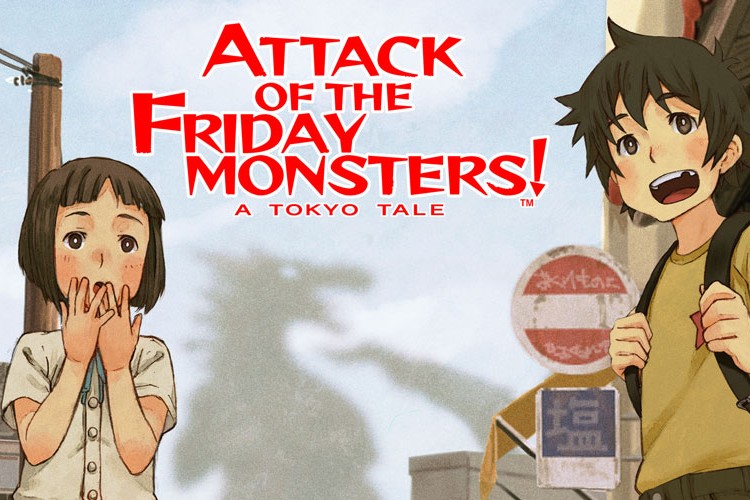
There’s really nothing to it at all. And yet Attack of the Friday Monsters! is deeper than many games by virtue of its setting and story. Set in a small Japanese town in a not-directly-defined period of time, it follows Sohta, who has just moved there with his family (his dad’s a dry cleaner, as pointed out in the song) and is set the task of delivering some freshly cleaned clothes on Friday, the day of the week huge monsters have a fight on the outskirts of said town (so he’s got to be home before that happens.)
It sounds “wacky” and “Japanese” to have a game where giant monsters fight near a small town and everybody just accepts it, but as is (obviously) the case there’s so much more to it than that. Directed by Kaz Ayabe, known for the (never released outside of Japan) Boku no Natsuyasumi series, Attack of the Friday Monsters! is similarly a reflection on Japanese childhood and a thoughtful take on the rhythms of Japanese life and culture that surround it. It’s much, much closer to, say, a film by Hirokazu Koreeda than it is another video game, which makes Ayabe absolutely unique as a game developer. You see, Attack of the Friday Monsters! isn’t really about the “play” as such. It’s about being a wee kid in a new town, about being told what to do by your parents, about being side-tracked, about meeting new kids, about not really feeing in control of anything about your life (because you’re a wee kid), about having to be introduced the games that the kids in your new town play, about how those games seem weird and silly, about the lies your parents tell, about the lies parents hold…
It’s about the golden age of tokusatsu in the sixties, when televisions became more usual in Japanese homes as the country left recovery from World War II and began to boom; in fact it’s about being a child at that period, and not having the experience of war first hand to see Godzilla as a metaphor the horror of nuclear warfare, but as a hero to cheer on when he battles Ghidorah, the Three-Headed Monster. It’s about that difference, that gap right there at a moment in history where Japanese adults saw something, Japanese children saw something, and that what the children believed became true, because after all, they believed it so forcefully, so unquestionably, and the adults had been helping them believe it. Because why not make believe, after so much struggle?
Attack of the Friday Monsters! is about so much more than rock-paper-scissors. It’s definitely about more than semantic quibbles of how good a “game” it is or not. It’s trying to say something bigger, and I think it’s easy to get lost and forget that’s entirely possible when we grind things down to their mechanics.
Will I ever play it again? Hmm. I’d love to play it again, maybe on a big screen, but on 3DS probably not.
Final Thought: That Ayabe can manage so much with an experience that clocks somewhere in the region of a couple of hours makes it a legitimate tragedy that Boku no Natsuyasumi has never been released for audiences beyond Japan. It would be a serious issue if Koreeda’s work had never been seen outside of his home country, for example. That art is accessible is important, and it’s something that the games industry still struggles with.
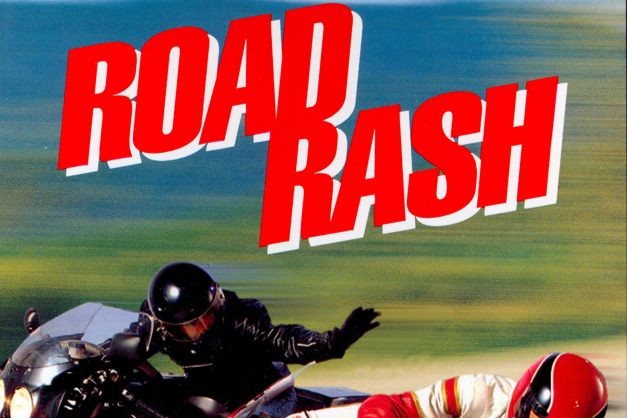
Developed/Published by: Electronic Arts Released: 09/1991 Completed: 30th September, 2014 Completion: There are five different tracks and five different “difficulties” which loop endlessly. I made it to the highest difficulty and stopped. There’s no ending or anything so I’m going to count this one. Trophies / Achievements: n/a
Why have I spent some time this last week playing Road Rash? On Mega Drive? On what possible whim? I really have no idea, but I guess I had a hankering to play one of these old-school, pseudo-3D racers, and I was always fond of Road Rash back in the day what with its scrapping racers and it’s EA, back when EA had that really cool logo, so it’s the one I went for.
(In retrospect, I should have picked up one of the delightful Sega 3D Classics for Nintendo 3DS, probably Super Hang-On if I wanted a bike-me-up. However, I had forgotten all about those existing. More fool me.)
So, Road Rash then. It’s actually pretty interesting! There’s not a lot of content, admittedly. Only five tracks—and to be honest most of them look the same—and your options are limited to eight different bikes. However, the game is wrapped in a “career” mode of sorts where you, unlike contemporary competition, don’t lose because you didn’t win (or you wrecked your bike, or were caught by the cops.) You just score some of the prize pot (or, pay for a wrecked bike or fine) and can have another go.
Except there’s this weird twist where if you do rank at least fourth in all the tracks, you’re immediately bumped up into the next difficulty, meaning that you can find yourself (as I found myself) struggling to keep up in the next difficulty because you just haven’t made enough money to buy a bike that competes. You really need to be coming first.
It’s flawed then. As is, really, the whole racing thing. Because the selling point is based on fighting the other racers, right? Fun! Except that you’re really not going to do that very often, because the tracks are tight, windy and you need to pay attention on the road, not on the other racers. It’s not the most nuanced racing system—you know, go fast, slow down for corners—but it’s actually a really nice engine, with a lot of things that these kinds of racers don’t include, such as cross-roads, significant gradients, and traffic moving in the opposite direction. In fact it’s the combination of the last two that make the game so challenging—nothing quite like cresting a hill only to smash into a car heading towards you.
It is nice, however, that the other racers—as much as the game makes you work to keep up—feel realistic (perhaps intentionally, perhaps not) compared to contemporaries. They also find themselves slamming into cars, and there’s probably no better feeling than sailing past a two or three bike pile-up (only to slam into a static deer that’s five seconds down the road, probably.) There some rubber-banding, but it’s not that apparent; racers behind you struggle to keep up once they’re out of your rear view, and crash basically at all and you’re probably not coming first.
So you don’t find yourself fighting very often, and are therefore mostly playing a very, very unforgiving racer. In fact I’d say past the second difficulty it’s really not very fun at all. If you were on Game Centre CX, where they’d probably say you needed to loop the game once to count it as finished, the best plan would probably be to just play the easiest level 25 times to raise enough money for the best bike and then try to grind it out. It’d be pretty painful though.
It’s fun for a wee while, anyway.
Will I ever play it again? No. But I could easily be convinced to play the later 3DO remake because I remember that being pretty good, if different, and hey, it’s got Kickstand by Soundgarden in it! I used to think that was the coolest song ever.
Final Thought: Is it wrong that I really want to play Skitchin’ now?
Developed/Published by: Sony Computer Entertainment Released: 15th April, 2014 Completed: 10th September, 2014 Completion: Beat all the levels? I think there’s more levels in a hard mode, but I don’t care. Trophies / Achievements: 57%
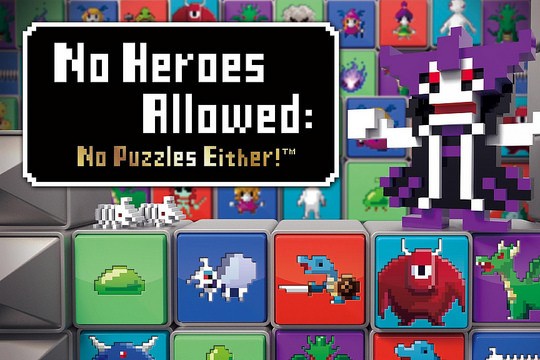
I’m stunned that I finished this, honestly. Stunned. Booted up shortly after I finished the PSP original, I imagined I’d play a few levels of this free-to-play match-three-me-do and hit the paywall and be done with it.
Perhaps admirably, there isn’t a hardcore paywall with No Puzzles Either! (God, that title’s annoying. Makes it seem like I’m shouting every sentence. I’m going to drop that exclamation mark.) Basically, the game tries to make you pay by being stingy with playtime. You can store a maximum of three “picks” without paying; each pick being one play of a level, each pick takes eight hours to be refreshed. The first time I saw this I thought it was eight minutes, and was like “man, that’s just annoying enough.” Eight hours is on a whole ‘nother level… except for the fact that it rounds up to 24 hours for all three to be refreshed, meaning that you can dip in and play this once a day. Which adds a rather ok rhythm, somewhat undoing any reason you’d have to pay up unless you were just desperate to play more immediately. I wasn’t.
And yet… cumulatively, I played this for sixteen hours. Sixteen hours total of me playing three match-three levels and unlocking and raising the monsters that form the block types. Sixteen hours that included days where I wasted my three plays totally on either grinding to try and capture one of the many, many rare heroes that allow you to upgrade monster blocks in particular ways, or bashing against one of the brick-wall tough levels that you either have to be over-levelled for or spend one of the paid-for consumables (which you can also gain randomly, but it’s even more rare than the rare heroes.)
Do I have any excuse for this? Not really. To be honest, it’s the odd side-effect of the fact that I could play it once a day and no more. It made sure that I returned to it, regularly, in a ritual—a low-rent Vesper.5—that also ensured I didn’t spend any money on it. Because what would be the point? The best thing to spend money on would be the consumables, but if I just kept playing long enough I’d win eventually. And why pay a tenner to unlock infinite playtime? I’d just play it in a sprint, and I probably wouldn’t even enjoy it.
I mean, not to say that I necessarily enjoyed No Puzzles Either. It was just this thing I did every day, apart from those days I didn’t. 2-3 minutes, frittered away, across months. But it’s done now.
Will I ever play it again? No.
Final Thought: The only reason I beat this was because I used my last block-clearing consumable on the last level at a point where I was sure I would win. I would not have bothered grinding to get another consumable or beat the level any other way, so I should probably have had some hella endorphins because of the high stakes. And yet… I didn’t. Man, I really didn’t view this game as anything except a timewaster.
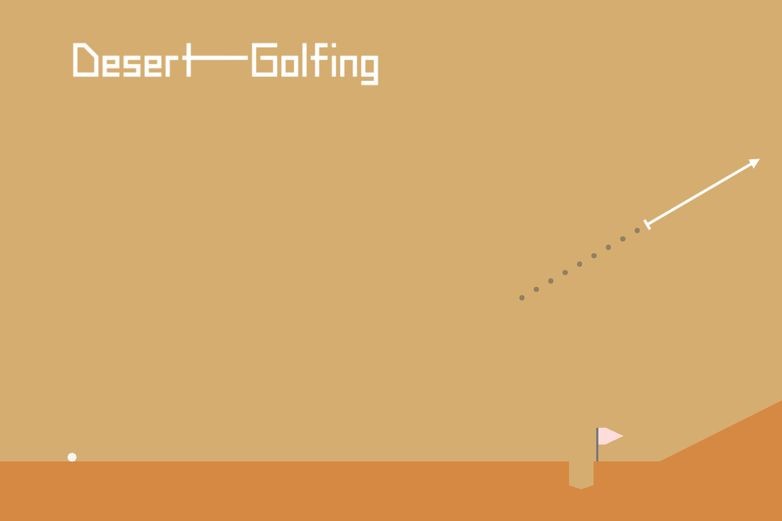
Developed/Published by: Blinkbat Games Released: 7th August, 2014 Completed: 2nd September, 2014 Completion: Conceivably, you could class reaching 1000 holes as completing it, so I officially gave up on this one. I got to hole 69 (hurr hurr) and quit. 197 strokes, a 2.9 par. Trophies / Achievements: n/a
“To play golf is to spoil an otherwise enjoyable walk.”—attributed to “the Allens” by H. S. Scrivener in 1903.
Will I ever play it again? No.
Final Thought: Here was me, worrying my time spent playing New Star Soccer, a game where you mostly aim an arrow to make a ball go a direction, would make me look a total fanny. Why did I worry?
(Desert Golfing is the purest representation of the idea that if you stick some surprises in your game, game designers are going to lose their shit over it. Why create an ecosystem like Spelunky’s when you can just, you know, stick a bitmap rock at hole 300 and slightly and slowly modify the colour palette? Video games truly are art, in that Desert Golfing allows those “in the know” to jerk themselves silly while the average punter thinks “a kid could do that.” It is our shark in formaldehyde, although one I’d believe made without guile, now we just need some dickhead to spend £8 million on it.)
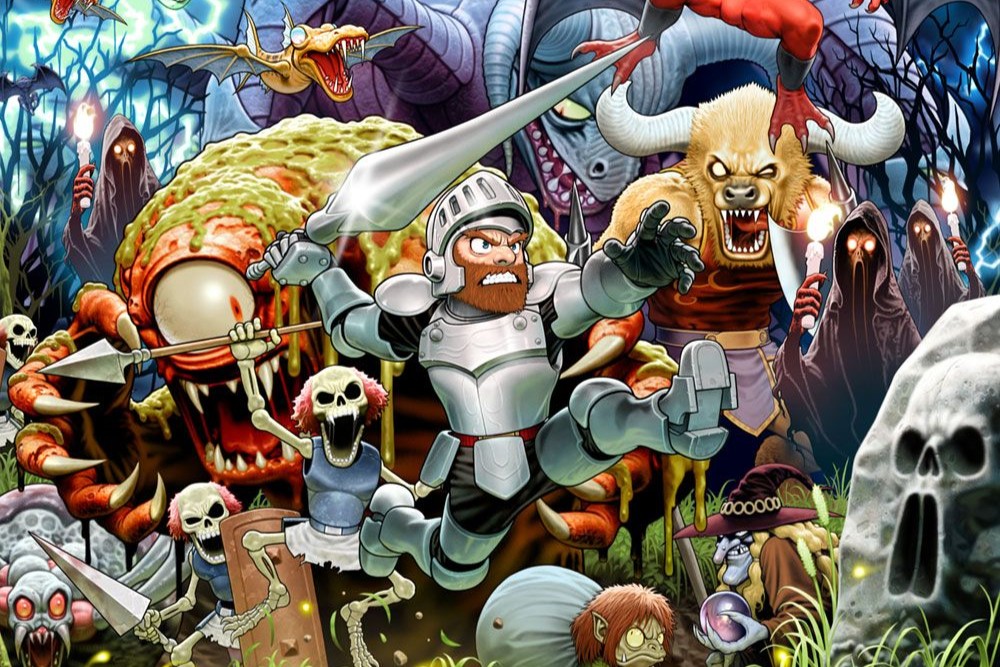
I’ve been watching Game Centre CX again! I’d fallen out of the habit, but recently I got off my arse and organised my collection of Iron Chef episodes and started watching them in order (can you believe they made fifty-six episodes of Iron Chef in 1994? That’s more than one a week!) and it put me in mood for some Game Centre CX too. And after watching the Kacho valiantly battle his way through Ghouls ’n Ghosts on Megadrive, I thought I might as well give this a shot, because it’s been in my collection for donkeys.
You probably know the drill with the Ghosts ’n Goblins series: it’s absurdly difficult, and it changes from “Ghosts ’n Goblins” to “Ghouls ’n Ghosts” and back again confusingly. Most of the games are incredibly similar, differing only vaguely in terms of hero Arthur’s abilities and enemies. But then, plenty of series are even more restricted than that (you know, look at any side-scrolling shooter series) and it’s not like we complain about them (unless we do? We might!)
Probably the most interesting thing about the series is that the very first hit right around the time of Super Mario Bros., so you have to remember that this didn’t come from a context where that was what platformers were. In fact, it kind of feels like a series from an alternate dimension where Super Mario never really happened.
It’s a dimension where a locked-in jump is the done thing. It’s also one where randomly spawning and aggressively player-seeking enemies are the done thing. So while your jump is completely predictable, the enemies aren’t.
Can you tell where this is going?
I mean, you obviously can if you’ve ever played the series. The games just aren’t fair. You can do your best to deal with these enemies—and I’ve seen players far above my abilities perform absurd feats—but you’re going to commit to a jump, or throw a weapon at the wrong time, and you’ll die (usually by being knocked off a platform.)
It’s not good! Or fun! In fact in level 3-2 of this—a level where you have to survive on a small moving platform for quite some time, while attacked from all sides—I was pretty close to breaking my Vita in half. I had to beat it twice, too (and in fact, to “fully” complete the game I’d have to beat it at least once more). The game doesn’t even really offer much in the way of the kind of streamlining we’ve come to expect from our masocore; no quick restarts, limited lives meaning you have to continue from the start of the level at some point and often struggle on with a lost cause number of lives, etc.
The worst thing that Ultimate Ghosts ’n Goblins does however is that rather than previous games, where you just have to survive the levels, in this one you’re supposed to find all the hidden nooks and crannies (and I do mean hidden: a large amount of the game is about triggering chests by jumping in certain, totally unmarked, parts of the levels) in order to gain enough gold rings, or witch ingredients, or magic spells, to complete the game fully.
The game chooses just about the most uncomfortable twist on the unlock abilities design possible, by making sure you can’t collect plenty of stuff until you have magic spells that do things you don’t expect (the turn-things-to-stone spell that causes gravestones to explode is… alternate dimension logical I guess?) or very specifically have this one shield that allows you to fly.
The shield’s a weird one, to be honest, considering the Ghosts ’n Goblins franchise has basically never involved this level of control in-air. It changes the game almost entirely from the minute you get it into one that’s not about the inflexible jumping but the much more flexible (if temporary) flying. It doesn’t make you die any less (well, maybe a bit less) but you’re much more in control. It’s an odd twist that the level design works around, and that doesn’t make you feel better about the levels you’ve struggled through to that point (and it doesn’t come until very late in the game…) In a game that’s otherwise A to B linear being asked to jump back and forth in insanely difficult levels that you feel, by rights, that you’ve completed, just to collect some things because you can now fly… it just doesn’t work.
It explains why they re-released this in Japan with all of that stuff removed, though!
Will I ever play it again? Uhh… I really did sort of want to collect all the rings and “fully” finish it. But the hidden bits are so annoying that life is just too short. If you could download the Japanese version to Vita, I would maybe consider it. But… no.
Final Thought: I’m not really sure what excuse I have for, ultimately, not having a bad time playing this, though. Not that I liked it, but that I didn’t feel that it was a total waste of time. The nice PSP-era graphics, which are maybe in that sweet spot of dated for me right now? That as stiff as the game is and unfair the enemies are, there’s this responsiveness that means that it feels good, and you want to succeed even in the face of frustration?
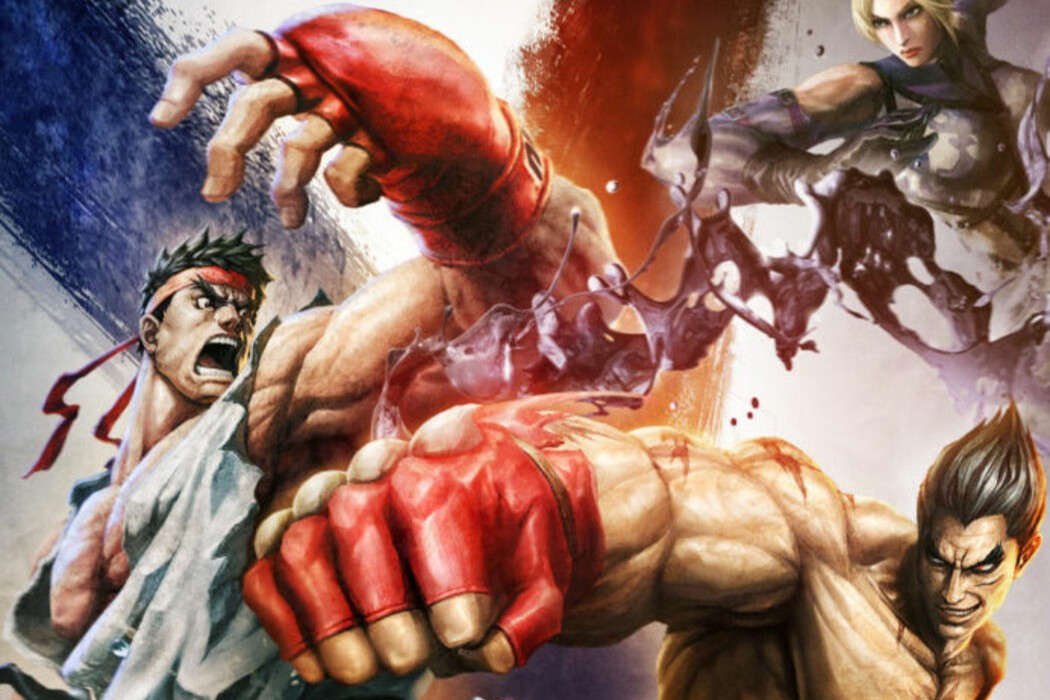
Developed/Published by: Dimps, Capcom / Capcom Released: 19 October, 2012 Completed: 3rd August, 2014 Completion: Beat the arcade mode a bunch of times (twice on the hardest setting, actually) and played a bunch of the other modes. It’ll do. Trophies / Achievements: 40%
Well, if a wee guy from France can win Evo by playing Rose with a PS1 controller, I’m sure I can stand to play Street Fighter x Tekken with a Vita, even though it’s only got four face buttons and they’re tiny.
No, I can’t.
Will I ever play it again? Nope.
Final Thought: Well, obviously I played it for ages, but it’s horrible. What’s with this gem thing? Gives you bonuses or something for playing in particular ways, or being weak in others? But you’ve got all these menus to navigate to select them, and they’re totally incomprehensible in the moment, like, you have no idea what you’re opponent’s packing and how to deal with it?
Just a total abomination.
However! I will give them a lot of points for making people who suffer through this game some utterly absurd cut-scenes. Abel, obsessed with petting the bear from Tekken, or Zangief and Rufus’ amazing transformation.