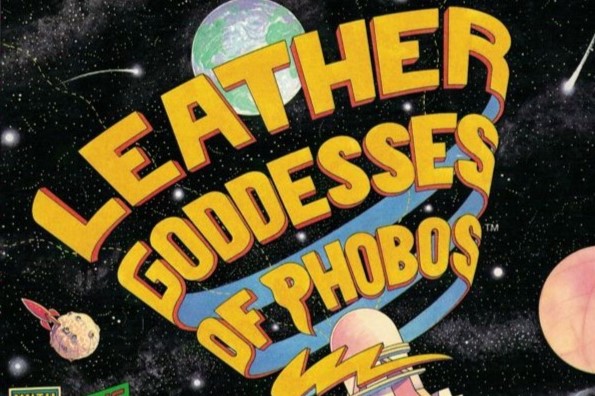

Developed/Published by: Infocom
Released: 22/08/1986
Completed: 18/04/2025
Completion: Completed it. 304/304 points (though points are random and I believe you get them all just in the process of beating the game.)
Phworr, eh lads? Etc.
Right, that’s me got all the 90’s video game magazine parlance out of the way [“you forgot ‘or something’ and to do a made-up Ed’s note”–made-up Ed.] so I can put my “pretending to be a serious games historian” hat on for the first Infocom game I’ve played since Trinity–surprisingly, all the way back in 2023. If you’ve been following along, you’ll be aware I’ve been picking and choosing Infocom games to play through, leaning towards the work of Steven Meretzky, and I’ve been looking forward to playing this for a while, his “return” to a more normal sort of adventure game after the big swing (and commercial miss) of A Mind Forever Voyaging.
Based on a joke title Meretzky posted on a whiteboard featuring upcoming releases for Infocom, Leather Goddesses of Phobos is a strange release, I think. Infocom had always made games for adults, but never “adult” games, and there hadn’t really been any commercial “adult” games for years at this point. Softporn Adventure came out in 1981, and unless you’re Portuguese and have fond memories of Paradise Cafe for ZX Spectrum that was about your lot. So it seems like quite a gamble for Infocom to release something that appears so risque–but then Leather Goddesses of Phobos isn’t really an adult game at all. In fact, it’s barely smutty at its most extreme, and Meretzky, wanting to drum up a bit of controversy after the failure of an anti-Reaganite art game, decided “sex sells” and Infocom as a group went for it: digging through Meretzky’s papers, he sent a sheet of possible game ideas to the other imps (this may have been the standard procedure at Infocom?) for his next game, and Leather Goddesses of Phobos won out, where its sexual content was expressed as “very soft-core; see Barbarella as an example.” (it doesn’t even go that far, to my eyes.)
(The sheet is quite illuminating in general, a kind of ideation that I recognise as a game developer. We have another attempt, I think, to court a bit of controversy with “The Interactive Bible”, an interesting if not-yet-fully-baked design idea “Blazing Parsers” and then something that’s optimistically trying to make making a game quicker, “The Viable Idea.” Personally, I’m sad we never saw an Infocom spaghetti western.)
Unlike some other Infocom releases, I don’t really have any personal history with Leather Goddesses of Phobos outside of memories of the (very) mildly titillating screenshots of its sequel, Gas Pump Girls Meet the Pulsating Inconvenience from Planet X! In fact, the main thing I have to say is that I only realised this wasn’t called “Leather Goddess of Phobos” after playing it for a bit, which won’t make me cry “Mandela Effect” as much as “Goddesses is such an inelegant word, it’s bizarre it isn’t just Leather Goddess. My brain was correct, reality wasn’t.”
But anyway, what is it actually like to play Leather Goddess(es) of Phobos?
I’ve been a bit up and down on the Infocom games I’ve played–some might say unnecessarily hard on them, judging them by the coddled standards of 2025. But Leather Goddesses of Phobos gets off to a good start. Unlike Trinity, where you essentially never know what you’re actually trying to do overall, Leather Goddesses of Phobos more or less immediately has a character hand you a laundry list of items to collect, and then you go “oh, I guess I just have to collect these, then.”
As good as that is, it’s also a little… underwhelming. Having picked and chosen, I’m aware that I’ve not seen everything that Infocom has to offer, but I’m still surprised that I haven’t played an Infocom game since Deadline (their third game) that gave me any sense of anything except a static world. Leather Goddesses of Phobos gives you a Floyd-like companion (Trent, or Tiffany) but they barely seem to exist, and even when you meet characters in the world they feel so… un-interactive. Maybe, at best, they take part in a little vignette.
I suppose with Leather Goddesses of Phobos I’m really realising–and perhaps chafing against–the limitations of the text adventure at least in the mid-1980s. In some respects, you want a text adventure to have the feeling of a book; limitless, enveloping imagination. But in other respects, you want to play it like a game. You want to be reacted to. It’s probably, why, to be honest, characters have been so sparse in these games–because when you try and interact with a character, and they don’t do anything, or it feels wrong, the illusion of being on an adventure is broken. You’re not reading a book, you’re on a dark ride and suddenly the lights slam on and you’re aware you’re looking at a mannequin, not the king of Mars.
Somehow, the fact that characters in Deadline might like… walk into another room just abated that, and I’m not asking for characters to roam across the planet here, but maybe if they piped up a bit more. Felt a bit more worth talking to. The issue with making a “funny” game is that so much of comedy is character work, and here, really, the only character is the parser.
But I’m being a bit harsh, because Leather Goddesses of Phobos is otherwise an extremely solid classic rooms and items, bread and butter text adventure. The best I’ve played since Meretsky’s own Planetfall, and arguably the best I’ve played full stop. It’s understandable, accessible, and I never had to use an Invisiclue to the point where it just told me what to do–well, except in one particular case.
That one I’m just going to spoil, actually. One of the things that makes Leather Goddesses of Phobos work so well is how well integrated the feelies are. Sure, I don’t have the box to hand, but there’s a comic which includes a couple of direct hints for some puzzles, a map which is unbelievably necessary and helpful, and a scratch and sniff card, which I’m sure nearly 40 years later is completely useless even if you opened a brand new box, but which is a really cute and silly B movie-adjacent idea that’s perfectly fitting. One of the things it does is prompt you to “smell” things in the game to work out what they are (which it thankfully tells you in text–scratch and sniff cards have always barely worked). Early in the game (for me–the game is fairly open ended) you sniff and discover some chocolate, which, of course, you’ll hang on to. Later, for reasons, your mind will be transferred into a gorilla. But you’re not strong enough to break out of the cage. I assume you can see where this is going: you need to eat the chocolate to get strong enough to break out of the cage.
You know, that famous thing about gorillas. That chocolate makes them strong.
This is, obviously, nonsense. The only animal-related fact I know about chocolate is that it kills dogs and I certainly wasn’t hanging onto it in the game expecting I’d use it to kill a poodle or something [“you said ‘or something’ after all”–90s Ed.] Considering that banana is one of the most recognisable smells you could possibly use on a scratch-and-sniff card, I had to assume that Meretsky simply thought that giving you a banana would be too obvious a solution so went with the impossible to work out chocolate, but I couldn’t find anything in his notes to reflect that. According to the ever reliable Digital Antiquarian, Meretsky tested the scratch and sniff scents on the other imps to select the most recognisable scents to then use in the game, and I do think it adds insult to injury that one of those chosen scents actually *was* banana! But it’s used elsewhere!!!
I even found a playtester who complained about this exact puzzle:
“It is reasonable to not eat the chocolate and even suspect the sugar rush, but why oh why would you put the chocolate in the cage?”
I suppose he’s more complaining that this game features more than one puzzle which requires hindsight, and to be honest, they should have fixed those too. But in general, Leather Goddess of Phobos is logical and fair, while still managing to make puzzles funny and clever–the best of The Hitchiker’s Guide To The Galaxy without the worst of it. There’s a puzzle about kissing a frog that will immediately put you in mind of the famous babel fish (and which made me laugh out loud) and a puzzle involving a mysterious machine and wordplay that is so perfect and silly that it’s maybe one of my favourite things in an adventure game ever–possibly worth the price of admission alone.
The game does still undercut itself though–for seemingly no reason. There are definitely ways to manufacture yourself a no-win, dead man-walking situation, for example, all of which I miraculously managed to dodge due to the order I did things in, and I definitely had a few puzzles where by all rights I was just lucky to not have to resort to clues. One object on your list you need to specifically look somewhere you might not look to find, and then you need to be really specific with the parser to do what you need to do to get it. Another requires a vignette that you need to be in time for (though that one I immediately sussed what was up–the “dead end” was just so suspicious to me. But I reached it almost at the end of the game–if I’d got there early, I could have had to replay nearly the entire game.)
The game’s maze–which people find famously annoying–is a perfect example of how the game undercuts itself. You have the map in hand. You have the required clue. If you’re patient, it’s actually really satisfying to navigate it, and I did so… and then the torch I was using burned out, and I had to do the whole thing again much more efficiently. Close to hundreds of turns. It was so unnecessary! I was having fun!!! Why punish me for not being perfect!!!
These moments, however, are far rarer than you’d expect. I noted above that the game is fairly open ended, and I’m not sure if there’s a “preferred” way to work through the game, but as I said above in my playthrough I never entered a vignette where I didn’t have something to hand I needed (though it’s possible, I’m sure) and if I got stuck somewhere there was always somewhere else to go for me to solve something else. I never put this down annoyed–well, apart from the fucking maze. Well, not the fucking maze–the fucking torch (I honestly did think the maze was clever.)
I think the thing about Leather Goddesses of Phobos is… it’s probably as good as one of these things is going to get without a much more modern design philosophy. You know what you need to do and every time you sit down and play it you get a little closer to doing it–and it’s charming while you do it. But it’s never sexy. I did play it on the “LEWD” setting and took every opportunity for a bonk, because I’m still thirteen at heart, but my dander remained unfrothed; it doesn’t even reach the heights of Alter Ego! I guess I’ll see how I get on with [checks to-play list] Leisure Suit Larry??? Eugh!
Will I ever play it again? You know, it’s possible. It’s not likely, but it’s possible. And I will play Gas Pump Girls Meet the Pulsating Inconvenience from Planet X!, which I don’t believe anyone likes. Because why not.
Final Thought: In some respects, Leather Goddesses of Phobos suffers for not being something special like A Mind Forever Voyaging, but it also sort of is, as the last true success Infocom would release before the company began an unstoppable slide into oblivion, and for that alone it should be celebrated. At the very least, if you like text adventures, though, you know how to play them, and you can live with the idea you might have to reload a save on occasion, this is a solid couple of tevenings. Oh sorry, I mistyped… tevenings. There must be a mysterious machine around here somewhere for that…