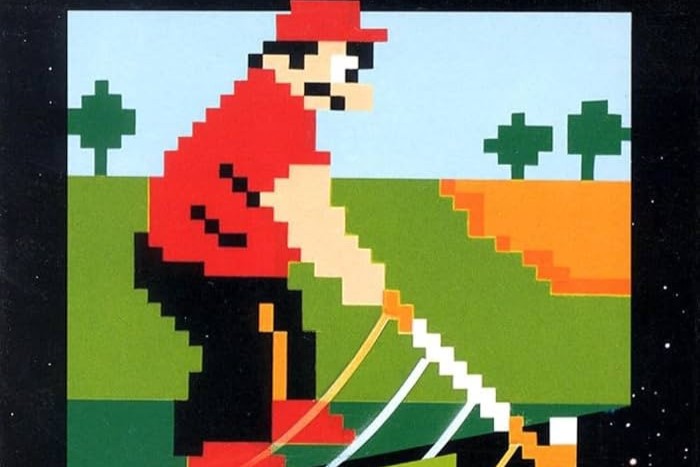
Developed/Published by: Namco, Tose / Namco Released: 19/09/1986 Completed: 28/04/2025 Completion: Completed it–but with a complete collapse in dignity, having to abuse save states starting around area 14.
Well, it’s been a while since the Xevious klaxon has gone off here in exp. towers–I think the last time we mentioned it was actually Tower of Babel–but here it goes off because we’re only bloody playing the first “real” sequel to Xevious! And it’s yet another Famicom game with Nazo, aka “Mystery” in the title. They were mystery mad in Japan in the mid-80s!!!
If three years feels like quite a gap for a game as successful and influential as Xevious to get a sequel, it’s worth mentioning that this is actually the fourth game in the franchise. Xevious in the arcades got an update in the form of Super Xevious (to which this has no relation) and then–and this is true–Xevious creator Masanobu Endo made a game starring an enemy tank from Xevious, Grobda, because he thought it’d be funny.
Grobda seems pretty forgotten now–and I don’t think “the top-grossing arcade game in Japan for December 1984” is quite enough to believe it was that much of a success. But of course, we know that Xevious itself was a huge success on Famicom–so it only makes sense for Namco to bang out a sequel. In this case, Endo probably didn’t think it was funny–he was on record as believing that a direct sequel to Xevious was unnecessary, and he’d left the company a year earlier.
With Endo’s guiding hand missing, Namco–with the aid of Tose–did something that I think on paper makes sense. They looked at the huge success of Xevious, an Endo joint. They looked at the huge success of The Tower of Druaga (oh dear, set that klaxon off as well) also an Endo joint. They looked at how Tower of Druaga’s mystery design had been implemented into basically every other game coming out at this point, and thought: well, it’s chocolate and peanut butter, innit? Smash ‘em!!!
So with Xevious: GAMP No Nazo, you play Xevious levels where you have to do a particular action to progress–this is actually a bit less punitive than the original Tower of Druaga, where you can keep playing through the game with no way to win because you missed something. This can be as simple as defeating a boss (hardly a secret) or as annoying as finding hidden things in the level or interacting counter-intuitively with enemies.
To put none too fine a point on it, this doesn’t work. At all. It’s obvious that at least Japanese players had become comfortable working through obscure fucking nonsense without the cameraderie of the arcade, but a vertically scrolling shooter puts pressure on you in a way that Tower of Druaga’s mazes didn’t–you can’t navigate back to something you’ve missed, and having to do an extra loop in GAMP No Nazo to get back there is brutally punitive.
Because GAMP No Nazo is miserably hard. There’s no sense here of the push-and-pull “intelligence” of the enemies of the original, just walls of bullets and, frankly, unfair bullshit from the very start. The first level sets the tone by featuring clouds that obscure enemies and bullets meaning you can be killed by something you can’t even see.
Trying to find what’s required to get to the next level just isn’t fun because of the high tension and sense of a “wasted run” when you get to a point and progress. The things you’re asked to do aren’t very interesting, either–while I’m hardly going to ask for the misery of The Tower of Druaga and having to, like, kill enemies in order, or something, the game only thinks to do something obvious like offer you different routes in levels like… twice.
You can choose to play this like Xevious: to see how far you get, how high your score goes by just memorising all the requirements, which isn’t actually so bad. And the game… sort of works. But it’s not as fun as the original, feeling more predictable and rote before getting ever more absurdly difficult, and I certainly wasn’t sure why I was bothering at a point–each time I’d think “maybe this is ok, actually” I’d start a new run to try and get further and get killed by enemies hidden by clouds immediately, sapping any urge to continue.
Namco might have been able to get away with this bar for the fact that it’s mid-late 1986 and the Famicom has already seen the likes of Gradius and Metroid, and Castlevania is out in a week. They went big with this one–no more numbered boxes, a special golden cartridge–which raises the question if they knew they had a pig on hand that they hoped more lustrous lips might help. Because it feels like Namco is getting left behind in both tech and design on the Famicom: GAMP No Nazo doesn’t look or play any better than the original, and that came out in 1984! At this point, the Famicom is Konami’s to lose…
Will I ever play it again? It isn’t worth it.
Final Thought: Namco, obviously, will be ok. But the sad thing, really, is that Xevious won’t be. The series that really started it all will limp on with a few sequels, but won’t ever be an important factor in the shooter genre ever again.
Developed/Published by: Sandfall Interactive / Kepler Interactive Released: 24/04/25 Completed: 27/05/25 Completion: Completed it, but let’s not get ahead of ourselves with too many details yet.
Alright, so in order for me to critique Clair Obscur: Expedition 33, I’m going to have to go into far too much detail on why video games are hard to critique, a problem that left me as the only video game critic in the world (as far as I know.)
[If you really don’t want to read the next thousand-odd words at any point you can skip ahead. But don’t come crying to me if you don’t understand where I’m coming from.]
Video games are hard to critique because video games aren’t really just “one thing.” They don’t neatly fit into a single form where the audience can make an assumption that they know what the (ahem) experience of “experiencing” it is (is there a better way to say that?) While there are exceptions, of course, you can generally expect when you sit down to watch a film, you’re going to sit down and watch it. When you sit down to listen to an album, er, you sit down and listen to it.
(Other experiences are available.)
Now, absolutely, that’s the broadest expression of what you’re doing–consider it the first layer of experience. The hope, of course, is that in experiencing the work, you are absorbed to the point where you forget anything about your existence as a “person on a surface in a location” and instead exist in the world that is being presented–consider that the second layer of experience.
Now, that second layer does not remain static in the face of genre or stylistic choices. To take film as an example, editing, soundtrack, many “artificial” things happen that do not line up with our linear, continuous experience in the first layer. In some respects, these artificialites are not simply absorbed, we recognise them, we work with them. There can be some level of interactivity (if not affect upon) the works–we knit together a non-linear narrative as it goes. Our eyes scan the screen in a movie, our focus dances from instrument to voice at the insistence of the songwriting on an album.
Games, however, have a less “clean” line between the two layers of experience. “Play” is a different experience than “watch” in that first layer, and both change the type of absorption you experience in the second layer: you may be embodying a character rather than empathising. You may be in competition rather than conversation. And then within that genre and stylistic choices make different demands: maybe you are in “play” mode a lot. Maybe you are in “watch mode” a lot. Maybe the type of play changes.
As I’ve played a lot of old games by now, I’ve become interested in, and written about, the “transition points” of video games where technology has allowed newer forms to emerge. Don’t consider this definitive of the state of the art, but for the sake of my hypothesis, a summary:
Games begin as competition: think Pong or Breakout. There’s no narrative. You are, essentially, playing a game as people know it either against another or “the computer”. A sport. You may be able to win, but you may just be seeking a high score. Play, not watch.
Games evolve to have a narrative “reason” for the experience: think Space Invaders. There’s a framing, if not a narrative. If you can win, it’s not the “goal” as much as it is an end-point for “besting” the machine. Play, not watch, but with narrative context.
Games make the narrative a distinct part of the experience: think even as simple as Super Mario Bros. Suddenly the game becomes about the story. You’re “rescuing a princess”. Narrative is doled out like “reward” for your success in the game. When you finish the game, it’s like finishing a book. You can put it down. Play and watch!
It’s here that the concepts of “diegetic” and “non-diegetic” story come into play. The diegetic narrative in Super Mario Bros. is that you’re rescuing a princess. The non-diegetic story is that you’ve run forward and jumped over a block and then you ran into a koopa and you died and then you came back to life and you ran forward…
In some respects, this non-diegetic story is part of the magic of video games, in that it affects both layers of experience at the same time. On the first layer, you’re not sitting and watching: you’re pushing left, then A. But it seamlessly translates on the second layer to running left, and then jumping. But it doesn’t represent narrative.
So then you get games that try and make the narrative a “part” of the play, at various levels of success. Maybe you’re finding the narrative in the world via logs (not great). Maybe you’re pushing buttons during the cut-scenes (eurgh.) Maybe your character’s death and rebirth is explained via narrative, or you get to make choices that change the narrative–at some level of manageable granularity. Maybe they simply try and make what you’re doing in the game make such rock-solid sense diegetically that it all works seamlessly. Maybe they do that by forcing the player to do things whether they want to or not (and then smugly admonish them for it later).
It’s not, exactly, a solved problem. Nor is it, essentially, actually a problem. It simply reflects the nature of video games as an experience. Sometimes you are playing them. Sometimes you are watching them. Sometimes the mechanics are thematic with narrative, sometimes they aren’t. The first layer you inhabit changes (“I’m watching. I’m playing”) though this may not affect the second layer (“I’m rescuing a princess.”)
I don’t think there’s a kind of game that represents this split better than the JRPG.
Now, again, I don’t want to imply that I think there’s anything wrong with the way JRPGs use narrative and play. But they have, to me, always represented a particularly aggressive split between watching and playing (though don’t let me stop you yelling “but what about Hideo Kojima” or something.) JRPG battles, something you do famously a lot, almost exclusively happen in an “alternate reality” from the rest of the game right down to how you interface with them. Not even play maintains a consistency of experience.
[cough]
So that’s why when I write about Clair Obscur: Expedition 33, it feels ridiculous to try and write about it as a complete work. Because my remembered experience of it does not reflect something I can critique as a whole. The game merges exploration and a battle system to a narrative which, to be completely honest, never engage in a way where one was in my mind during the other. It’s entirely possible that it’s different for you–I’d be interested to know what you felt the game might be doing to make that possible for you–but ultimately what it means this is a tale of two parts. A game and a narrative.
Er, though we need more preamble…
Clair Obscur: Expedition 33: The First Impressions
Now, the thing about Clair Obscur is that I wasn’t originally interested in it at all. With a surfeit of JRPGs available–in fact, a surfeit of Persona-style JRPGs available–the idea of playing a Western one with “realistic” seeming graphics didn’t have much interest for me at all. But then friend-of-exp. Justin Decloux (buy his Blu-rays!) gushed about how much he loved it while other buzz was swelling, so I thought–fuck it. I’m trying to keep up with the cutting edge now! It can’t all be obscure Famicom releases!
I went in almost completely blind: I knew it was about a bunch of French people taking on an enemy, the Paintress, who every year killed the segment of the population who had reached a certain age, and it was a JRPG. But it wasn’t until I began playing it that I understood it wasn’t a “Logan’s Run” style “once you’re thirty, you die!” situation but a “every year the age counts down–so time is running out for everyone” situation. Compelling!
And Clair Obscur has a wonderful introduction, as we’re introduced to the main characters on the day of the Gommage, the day each year that section of the population is lost, and the day before the expeditioners head off on their quest to defeat the Paintress. Very quickly you learn about the hero Gustave, his ward Maelle, and experience the pain of his loss of a “what could have been” in Sophie, an old lover.
As a purely narrative experience, I genuinely thought it was incredible. I’ve never been so moved by a video game so quickly, with tears coming to my eyes. All the stakes were right there. I was blown away.
Anyway, then the wheels started to come off a bit.
Clair Obscur: Expedition 33: The Game
I’ll preface this by saying I think Clair Obscur is a very solid game. But it’s messy. Overambitious.
I’ll also start with the criticism that you might think is the most unfair. The world of Clair Obscur, once you are outside of Lumière… I don’t like it!!!
Everything is way, way too visually busy, and yet there’s very little I think to be absorbed by. Every location seems to be over-textured, noisy, but my most major issue is with enemies, who feel completely characterless and often unparsable; annoying to look at not in the way Michael Bay’s Transformers are but in a way that made me think of them anyway. I had no sense of awe when taking them on.
Which is a shame, because really here it’s the battle system that’s the star.
I say that, probably, because the environments do not feature good level design. Like, at all.
Clair Obscur: Expedition 33 has led to a lot of column inches (well… social media posts) about the lack of a mini-map, and I have to say that I would generally not be terrifically bothered by that if it wasn’t for the fact that Clair Obscur just does the exact RPG map thing which everyone already hates: you come to a crossroads. Do you go left or right? Is there anything telling you which way to go? No? Uh…
Yep, this is a game where I’d say for a significant portion of the running time you don’t have any good sense if you’re going in the “right” direction, and I think the messy environment art doesn’t help at all. It’s particularly problematic when the game features super-hard “battle system skill check” enemies on side-paths, and in the very first area I reached one and was like “wait, why the fuck is this game suddenly impossible, how am I ever going to complete this” when the actual way I was supposed to go was nearby, but not obvious at all.
So the “no map” issue people keep bringing up is one of those things where you have to look at the “note behind the note” to understand what the issue truly is. Er, not that it helps. It’s too late to do anything about it.
To get to the battle system: it’s excellent, with caveats. On the basic level, it is a traditional turn-based battle system, but featuring both quick-time events and dodging/parry mechanics based on timing. This creates an interesting problem: you need the reward for doing these to be high enough that you want to do them, but not so high that they need to be done perfectly every time. It’s interesting that the intuitive design–attacks are QTEs with on-screen prompts, dodging/parries are purely reactionary–probably makes it harder to balance, as decreased damage output only prolongs fights, whereas taking more damage fails them more quickly, yet QTEs are simply easier than parries.
Not that I’d switch them around, but Clair Obscur doesn’t exactly nail the mechanics–and has a strange sort of take on them anyway. The decision seems to have been made that the baseline is that the player isn’t really supposed to be successful at dodging–certainly not successful at parrying–very much at all because it’s so powerful (you don’t take a hit at all!) so enemies from the very beginning of the game have annoying, tricksy attacks, with odd windups, slowdowns and so on, so you have to learn each enemy very well before you can survive a battle without taking hits.
But!
The game also makes a lot of attacks able to nearly one-shot your characters! Clair Obscur makes the decision to be economical in its enemy encounter rate–you see them in the levels, there aren’t that many, they only respawn when you reach checkpoints–but expansive in battle length, so the design decisions seemingly made here is that players will, during lengthy battles, survive via healing enough to get to the point where they can start to dodge and parry. And the game is quite forgiving with healing and revives, giving you a fresh set every checkpoint.
My belief is that they tried to create a battle system with no “lows” or sense of grind, where every battle feels winnable, but hard fought, and always engaging. And I’d argue that they were mostly successful once the player re-aligns their expectations to that.
For example: you don’t have to hold onto healing/revives, so just use them. And you shouldn’t be trying to parry until you learn how to dodge that enemy’s attacks, because the timing is so severe. (I basically gave up on parries completely.)
Even at that though… I did get bored and annoyed with it at times, and I do wonder how much that has to do with how overcomplicated, yet oddly derivative, the character designs are. Each hero has an extremely specific design style–several of which are wholesale cribbed from Slay The Spire, which I understand, but feels… odd–and they all have huge skill trees. As with largely giving up on parries, I’ll be honest and say that I didn’t get how to upgrade my characters until I just sucked it up and followed a “best builds” guide, but even when I played around, the issue seems to be that each character’s design is played in such a specific way that it can be somewhat samey. Slay the Spire character designs work because you don’t actually know what cards you’re going to have in hand each turn–you’re working to build your deck across the game until you do. Here, you know what you’re playing each turn, and you just do that while hoping to hit your timings.
Don’t get me wrong. It’s still good, it’s generally enjoyable, but I do notice that the weaknesses are never more stark than when the game asks you to hone in on mechanics such as when you’re fighting the optional bosses (that you generally stumble into by accident.)
But the game is also forgiving: you can bump it down to easy whenever you like at no cost, so you can do it whenever something gets on your tits. I played through this on normal, bumping down to easy on optional bosses (who can still one shot you at that level!) and only had a touch of grinding at one or two points, not that I can remember why.
If this was all Clair Obscur was: no narrative, just a dungeon crawl, people would still like it a lot, and I think I’d still like it a lot. But it’s not just that, is it.
Clair Obscur: Expedition 33: The Narrative
Clair Obscur’s narrative is a fucking bin fire.
[deep breath]
Sorry, ok. You probably remember me saying in my first impressions that “I’ve never been so moved by a video game so quickly” by the game’s prologue. Which is true.
But as for the rest of the game… I hope you like information being obscured from the player unnaturally! Like, one of your favourite things should definitely be characters not asking the obvious question anyone would in the situation!
Now, you can write a story however you like. Personal taste and all. But from my perspective, I consider it a weakness when I can tell a story has been written to get to an emotional or narrative beat no matter what. When reality or characterisation falls to the wayside because you have to hit this beat and you have to hit it here.
One of the interesting things about Clair Obscur is that as much as the game is divided cleanly between “play” and “narrative” the narrative feels like it doesn’t show up as much as you’d expect–at least, the backbone of the narrative. Each area (“dungeon” equivalents) plays out with a little chatter, but a lot of character work and story is relegated to when you make camp, and as you can only do that outside of the dungeons if often has to be forced. You really feel the segmentation, and when the big narrative moments come, they are in stark relief, and it’s at the end of each act this “need to hit the beat” is clearest.
I have come to the conclusion that the narrative has been designed to manipulate you into feeling certain ways only to then work to contradict your feeling. But they don’t have the chops to make this smooth or believable. In fact, this is the first game I’ve played since (cringe) Bioshock Infinite where I felt I should just look up a timeline to actually try and understand what’s going in the game to make sure I wasn’t totally off base with my feelings on it–while it wasn’t completely necessary, ultimately, it did help (and I highly recommend this one by Nor if you want a look yourself.)
But let’s get into it.
Obviously, spoilers are going to start showing up… now. If you want to play this, and I’m not saying you shouldn’t exactly, you should consider my conclusion “fun but flawed!” and flip away from this tab to come back to in like 26 hours. See you soon!
Look, I’ll give them something. I didn’t know, at all, that I was going to get Aeris’d. It should have been obvious with Gustave’s wee skill tree and everything and it’s incredible that when I looked up a build for him I never got spoiled. But this a perfect example of a “we have to make this beat happen.”
Gustave fights a guy who killed the entire rest of the expedition, while already wounded to… to what exactly? Maelle is trapped, he’s not buying her time. Why is the baddie killing Gustave at this point anyway? This just happened to happen after most of the party jumped off a cliff?
It’s bollocks, and it’s fake, and I felt annoyed, not sad.
So then new protagonist Verso shows up, and proceeds to… not be asked by any of the characters any of the questions you’d probably ask. They just go on an adventure with him because he showed up and so that a character can later find incriminating information and go “oh no!” that leads to… well it doesn’t lead to much at all does it. They get to the end, they kill the Paintress and then… oh no! That wasn’t the real baddie!
Which is revealed by Verso reading a letter from his sister. Meaning that Verso didn’t know something that, based on everything else (not least that he killed the Paintress to free her, my interpretation being with the knowledge this was his “real” mother) he would probably know. Ok!
At which point we learn that this entire thing was all bollocks anyway because everyone lives in a painting created by the “real” (dead) Verso and his mother and father were fighting in it using their powers of creation and destruction. Ok!
Look, I kind of get the Act One To Act Two switch, as poorly handled as it was. I think there’s something kind of interesting in ripping away a character that I really enjoyed to replace them with Temu Jack Sparrow and then let me mistrust them (more than my party did!) to the point that I don’t use them in battles and let them get really behind in experience (which eventually matters).
But the Act Two to Act Three switch is just utterly mental in a way that I don’t think any player can prepare for, playing a weird sort of trick on the player for being absorbed in the second layer of experience. “Actually all these characters you’ve grown to love aren’t real.” “What, you mean like because they’re in a video game? I know that, but I’m absorbed in the reality of the narrative.” “No, because they’re paintings that think they’re real people… in a video game.”
I’m not going to get involved in a “if you prick us, do we not bleed?” analysis of this third-order existence because the game doesn’t go deep on it itself, instead revealing that, ultimately, every time they talked about how the painting in which the entire game happens has a “part of verso’s soul in it” they meant literally, and his soul was essentially a small boy that was being tortured to keep the painting alive.
That’s right folks. It’s Omelas. You’ve been living in Omelas. How do you feel now!!!
Well, it turns out a lot of you people out there are fine with Omelas. I mean I don’t need to play a video game to know that, I live in a world where Palestinian children are being murdered every day to no end, but it’s stark to see people feel annoyed that the game ends with the question “do you destroy a painting full of paint people to free a real person’s soul or do you trap all the paint people in Peaksville?” when what they want is a happy ending and damn the child.
(To be fair, the game is really fixated on making it sound like the option is between “let Maelle’s dad burn the painting or let the painting continue to exist because everything will be fine, no really, everything will be fine”.)
I need to emphasise: this is not the game you have been playing. At all. I am so thankful that the third act is just one dungeon (Unless you want to do a lot of side quest stuff) because what the hell. There’s like this perfectly interesting game about a quest to get death back to happening normally that suddenly becomes a story about a bunch of characters you’ve never met fighting over a painting.
In conclusion:
Will I ever play it again? No.
Final Thought: Alright, that’s not really a fair conclusion to my thoughts on the narrative. My conclusion, really, is to ask people to consider: what is the story they’re actually trying to tell? Because Clair Obscur: Expedition 33 feels like a game of Exquisite Corpse on an act by act basis, where the epic conclusion completely subsumes any themes or narrative you had experienced to that point to… to what? To make sure players got a choice of two endings??? They put all this effort in to force beats and then none of them seem to matter anyway???
So yes, some respects, Clair Obscur is a cautionary tale of the damage narrative can do to the layers of experiencing a game. In others, it’s a fun, flawed game with a shite story. And those are ten a penny.
Developed/Published by: Namco Released: 22/08/1986 Completed: 15/04/2025 Completion: Got the “Happy Ending” by shooting down the Air Successor in Mission 26. Version Played: Namco Museum Archives Vol. 1
Sky Kid is, with some reservations, a wee hidden gem of an arcade game. I described it as a “strange little dead-end in the side-scrolling shooter universe” when I wrote about it, and while I stand by that, I wonder now if my framing is a little wrong because of the post-Xevious, post-Gradius context. Playing Sky Kid again in its NES port, I was struck by the thought that it might be as much inspired by something like Choplifter. While it doesn’t match in terms of design really at all, there’s a spiritual lineage: one is a “simulation” of being a helicopter pilot, and the other is a “simulation” of being a biplane pilot. The concerns in either are not that of Xevious/Gradius, where you move a frictionless collision box around, but one where you have to use your helicopter/plane using its actual characteristics to survive and succeed.
I do think taken in that framing I like Sky Kid even more. Revisiting the arcade version before giving this version a run through I was struck by how bright and attractive it is, the pleasure of doing loops, and how unbelievably rewarding it was to nail an enemy base with a bomb dead on.
Sky Kid on NES is an excellent recreation of that in terms of play, but unfortunately, it just doesn’t look anywhere near as good due to the NES’s more muted colors. At this point in the NES (or rather, Famicom) lifecycle, it’s a bit of a disappointment, with for example Ghosts ‘n Goblins doing a much better job of capturing the character of the original game despite having the NES palette to work with. It’s not as bad as Pac-Land, but it doesn’t look much better. Someone over at Namco was letting them down.
There is some effort made here to make this a different(-ish) experience from the arcade–there are more levels, a few of them are shooting galleries, you get some wee interstitial animations–but we’re still not at the point where NES games are diverging from their arcade counterparts to be particularly deeper or richer, and Sky Kid gets every bit as frustrating as it was in the arcade as you work your way towards the end of this. In fact, maybe more frustrating. As in the original, the design doesn’t support bullet hell, but bullet hell is what it gives you.
As with the original, this plays better as a score attack, but I think when you have the chance to come home with a copy of The Legend of Zelda or Metroid by this point… well, it’s not even been a year since Sky Kid came out in arcades and it already feels out of date. A biplane in a world of jet fighters: charming, but you ain’t picking it.
Will I ever play it again? I like the arcade version. I have the arcade version. This one isn’t necessary.
Final Thought: What I don’t have is Sky Kid Deluxe, the arcade update which has a range of minor differences. It was released by Arcade Archives for Switch and PS4, which I definitely support in theory, but absolutely cannot justify purchasing because… well, I’ve played Sky Kid twice now. That’ll do. Maybe I’ll see it in an arcade one day, I’d like to.
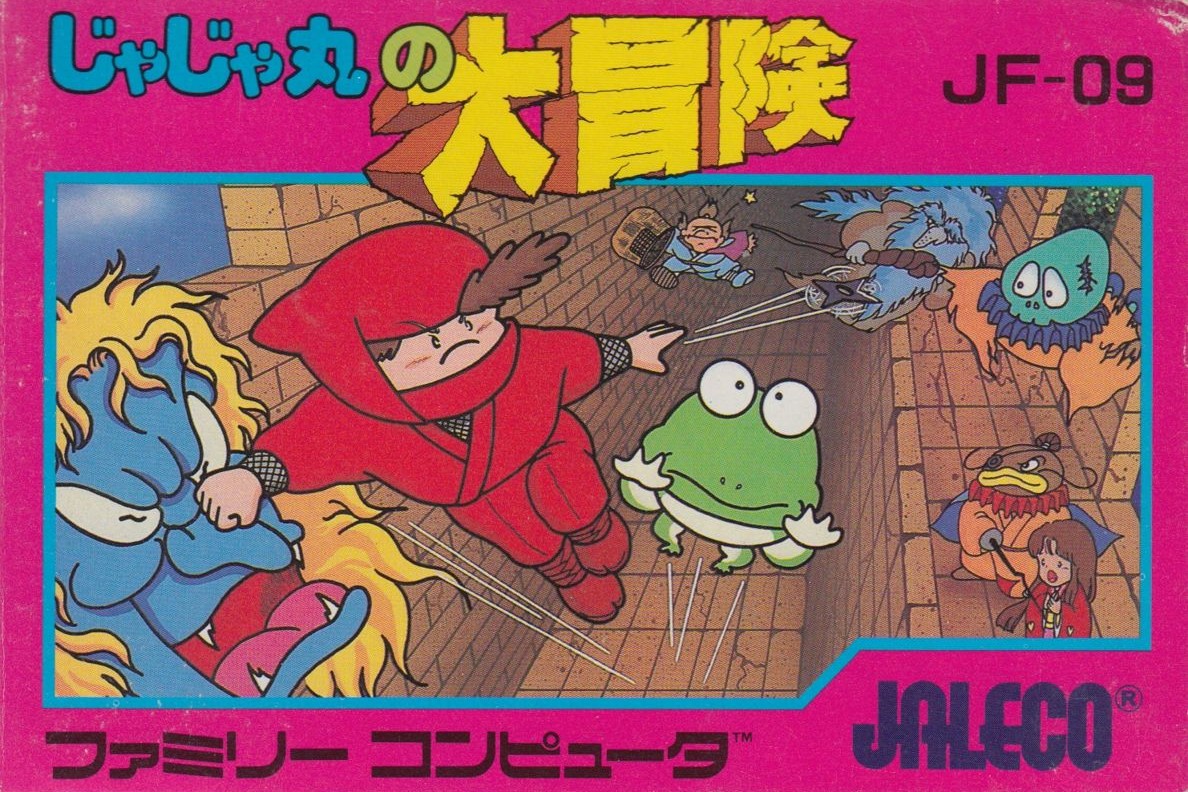
Developed/Published by: Jaelco Released: 22/08/1986 Completed: 13/04/2025 Completion: Completed all 20 different levels (it loops.)
Well, more fool me. When I wrote about Ninja Jajamaru-kun, the game that precedes this in the series, I wrote that it “[didn’t do] enough to make me put up with ININ’s bullshit to get the sequels.”
Unfortunately, having a bunch of Nintendo gold coins to use up before they expired and seeing the Ninja JaJaMaru: Retro Collection going for $2.99 made me go “well, it’s basically free, why not.”
I’ll tell you why not: because… do ININ even like retro games? Are they just an avenue to prey on a group of willing suckers–i.e. retro game collectors? Because not only is the Ninja JaJaMaru: Retro Collection bare bones, it doesn’t even work correctly.
Now, feel free to consider this anecdotal because I’ve only tested this on my Nintendo Switch Lite–and no youtubers or the like have really covered this release in depth (I imagine it’s niche enough to not have done that well.) But if you try and play JaJaMaru no Daibouken with the included CRT shader on it creates so much slowdown that you actually can’t play the game. It completely tanks.
It runs fine if you don’t have the CRT shader on, but, frankly, I’m a CRT boy. I don’t care if it’s even that good a shader or filter (notable exception: the excretable one on the Astro City Mini) just as long as it does something to muddy up the graphics. The games were literally designed to be seen on a tiny crappy telly via a noisy RF cable, so it just feels wrong to me to see them all crispy and HD.
So that was $2.99 down the fucking drain–but at least I haven’t dropped money on the Turrican Anthology or something [“yet”–Ed.] But let it not be said I’m one for giving up. Thanks to my trusty Trimui Brick I could quickly and easily get set up to play this through with an acceptable CRT filter, and I suppose that’s the way I’ll play the rest of this collection (god knows I’m not picking up a Switch 2 to try and see if it improves the performance of a CRT shader…)
But, uh, let’s actually talk about JaJaMaru no Daibouken, eh?
It’s rubbish.
Will I ever play it again? No!
Final Thought: Oh, alright, I should probably say more than that. So… I suppose the interesting thing is that JaJaMaru no Daibouken came out just under a year after Super Mario Bros. (Ninja JaJaMaru-kun was released after Super Mario Bros. too, actually) and it’s the first obvious Super Mario Bros. clone I’ve played chronologically. Sure, it’s possible Pac-Land for Famicom was rushed out after matter of weeks in development (though unlikely) but that was based on a pre-existing design, and Wonder Boy doesn’t feel that much like Super Mario Bros. when we’re being completely honest.
But JaJaMaru no Daibouken feels like exactly what you get if you ask someone to take the art and engine from Ninja JaJaMaru-kun and turn it into Super Mario Bros.: it’s got side-scrolling levels, blocks JaJaMaru has to hit with his head to get coins and power-ups out of, and… well, I mean, that’s enough. It’s not exactly the Great Giana Sisters, but the “hit blocks with your head” thing is enough. Case closed!
I’ve previously mentioned that the original Super Mario Bros. doesn’t actually feel that good to play–we’ve just all misremembered that, because the later ones do–so I can’t really beat up on JaJaMaru no Daibouken for not controlling that well (floaty jumps and that.) What I can beat it up for is just being so bloody half-arsed. Levels look like they just threw down blocks in any old combination, and although the game features 20 levels, but half of those are boss battles that you don’t even have to complete–if you die, you just go to the next level and don’t even lose a life. And the game doesn’t have an ending or anything, it just loops. Which actually leads to the ridiculous situation that you can reach the “final” boss, fail to rescue Princess Sakura, and then… just go to the second loop. Deeply uninspiring.
JaJaMaru no Daibouken keeps a lot of the flavour of the (by this point) established JaJaMaru franchise, though, which doesn’t as much feel like something they did to differentiate as much as it’s just what they had lying around. The power-ups act like they do in the previous game and JaJaMaru’s uncontrollable frog pal Gamapakkun shows up too, albeit rarely. Though weirdly, the most interesting mechanic from JaJaMaru-kun, that you have to jump on enemies heads so you can shoot them, doesn’t show up here! (Maybe they thought it was getting too close to Giana Sisters-esque “let’s get sued” territory.) There’s an annoying learning curve in that you’ll never know which enemies kill you on touch and which don’t until, well, you’ve been killed by them, and weirdly one enemy that shows up right at the end, the Tanuki, can’t be killed but you can jump on their head to stun them. So… half of a mechanic from JaJaMaru-kun, for one enemy, just to confuse us, as a treat.
It’s all very inconsistent, but because of the terrible level design, you quickly work out that you’re just supposed to run through the levels ignoring all the enemies as much as possible. While it’s true this is optimum for Super Mario Bros. too, the level design there ensures you engage with enemies in interesting ways. Here your engagement is generally things like “oh an enemy spawned directly in front of me and killed me with a projectile before I could react.” or… actually it’s usually that one.
JaJaMaru no Daibouken is over very quickly, so it’s a very minor waste of life. But it is a waste, I won’t lie.
Developed/Published by: Infocom Released: 22/08/1986 Completed: 18/04/2025 Completion: Completed it. 304/304 points (though points are random and I believe you get them all just in the process of beating the game.)
Phworr, eh lads? Etc.
Right, that’s me got all the 90’s video game magazine parlance out of the way [“you forgot ‘or something’ and to do a made-up Ed’s note”–made-up Ed.] so I can put my “pretending to be a serious games historian” hat on for the first Infocom game I’ve played since Trinity–surprisingly, all the way back in 2023. If you’ve been following along, you’ll be aware I’ve been picking and choosing Infocom games to play through, leaning towards the work of Steven Meretzky, and I’ve been looking forward to playing this for a while, his “return” to a more normal sort of adventure game after the big swing (and commercial miss) of A Mind Forever Voyaging.
Based on a joke title Meretzky posted on a whiteboard featuring upcoming releases for Infocom, Leather Goddesses of Phobos is a strange release, I think. Infocom had always made games for adults, but never “adult” games, and there hadn’t really been any commercial “adult” games for years at this point. Softporn Adventure came out in 1981, and unless you’re Portuguese and have fond memories of Paradise Cafe for ZX Spectrum that was about your lot. So it seems like quite a gamble for Infocom to release something that appears so risque–but then Leather Goddesses of Phobos isn’t really an adult game at all. In fact, it’s barely smutty at its most extreme, and Meretzky, wanting to drum up a bit of controversy after the failure of an anti-Reaganite art game, decided “sex sells” and Infocom as a group went for it: digging through Meretzky’s papers, he sent a sheet of possible game ideas to the other imps (this may have been the standard procedure at Infocom?) for his next game, and Leather Goddesses of Phobos won out, where its sexual content was expressed as “very soft-core; see Barbarella as an example.” (it doesn’t even go that far, to my eyes.)
(The sheet is quite illuminating in general, a kind of ideation that I recognise as a game developer. We have another attempt, I think, to court a bit of controversy with “The Interactive Bible”, an interesting if not-yet-fully-baked design idea “Blazing Parsers” and then something that’s optimistically trying to make making a game quicker, “The Viable Idea.” Personally, I’m sad we never saw an Infocom spaghetti western.)
Unlike some other Infocom releases, I don’t really have any personal history with Leather Goddesses of Phobos outside of memories of the (very) mildly titillating screenshots of its sequel, Gas Pump Girls Meet the Pulsating Inconvenience from Planet X! In fact, the main thing I have to say is that I only realised this wasn’t called “Leather Goddess of Phobos” after playing it for a bit, which won’t make me cry “Mandela Effect” as much as “Goddesses is such an inelegant word, it’s bizarre it isn’t just Leather Goddess. My brain was correct, reality wasn’t.”
But anyway, what is it actually like to play Leather Goddess(es) of Phobos?
I’ve been a bit up and down on the Infocom games I’ve played–some might say unnecessarily hard on them, judging them by the coddled standards of 2025. But Leather Goddesses of Phobos gets off to a good start. Unlike Trinity, where you essentially never know what you’re actually trying to do overall, Leather Goddesses of Phobos more or less immediately has a character hand you a laundry list of items to collect, and then you go “oh, I guess I just have to collect these, then.”
As good as that is, it’s also a little… underwhelming. Having picked and chosen, I’m aware that I’ve not seen everything that Infocom has to offer, but I’m still surprised that I haven’t played an Infocom game since Deadline (their third game) that gave me any sense of anything except a static world. Leather Goddesses of Phobos gives you a Floyd-like companion (Trent, or Tiffany) but they barely seem to exist, and even when you meet characters in the world they feel so… un-interactive. Maybe, at best, they take part in a little vignette.
I suppose with Leather Goddesses of Phobos I’m really realising–and perhaps chafing against–the limitations of the text adventure at least in the mid-1980s. In some respects, you want a text adventure to have the feeling of a book; limitless, enveloping imagination. But in other respects, you want to play it like a game. You want to be reacted to. It’s probably, why, to be honest, characters have been so sparse in these games–because when you try and interact with a character, and they don’t do anything, or it feels wrong, the illusion of being on an adventure is broken. You’re not reading a book, you’re on a dark ride and suddenly the lights slam on and you’re aware you’re looking at a mannequin, not the king of Mars.
Somehow, the fact that characters in Deadline might like… walk into another room just abated that, and I’m not asking for characters to roam across the planet here, but maybe if they piped up a bit more. Felt a bit more worth talking to. The issue with making a “funny” game is that so much of comedy is character work, and here, really, the only character is the parser.
But I’m being a bit harsh, because Leather Goddesses of Phobos is otherwise an extremely solid classic rooms and items, bread and butter text adventure. The best I’ve played since Meretsky’s own Planetfall, and arguably the best I’ve played full stop. It’s understandable, accessible, and I never had to use an Invisiclue to the point where it just told me what to do–well, except in one particular case.
That one I’m just going to spoil, actually. One of the things that makes Leather Goddesses of Phobos work so well is how well integrated the feelies are. Sure, I don’t have the box to hand, but there’s a comic which includes a couple of direct hints for some puzzles, a map which is unbelievably necessary and helpful, and a scratch and sniff card, which I’m sure nearly 40 years later is completely useless even if you opened a brand new box, but which is a really cute and silly B movie-adjacent idea that’s perfectly fitting. One of the things it does is prompt you to “smell” things in the game to work out what they are (which it thankfully tells you in text–scratch and sniff cards have always barely worked). Early in the game (for me–the game is fairly open ended) you sniff and discover some chocolate, which, of course, you’ll hang on to. Later, for reasons, your mind will be transferred into a gorilla. But you’re not strong enough to break out of the cage. I assume you can see where this is going: you need to eat the chocolate to get strong enough to break out of the cage.
You know, that famous thing about gorillas. That chocolate makes them strong.
This is, obviously, nonsense. The only animal-related fact I know about chocolate is that it kills dogs and I certainly wasn’t hanging onto it in the game expecting I’d use it to kill a poodle or something [“you said ‘or something’ after all”–90s Ed.] Considering that banana is one of the most recognisable smells you could possibly use on a scratch-and-sniff card, I had to assume that Meretsky simply thought that giving you a banana would be too obvious a solution so went with the impossible to work out chocolate, but I couldn’t find anything in his notes to reflect that. According to the ever reliable Digital Antiquarian, Meretsky tested the scratch and sniff scents on the other imps to select the most recognisable scents to then use in the game, and I do think it adds insult to injury that one of those chosen scents actually *was* banana! But it’s used elsewhere!!!
I even found a playtester who complained about this exact puzzle:
“It is reasonable to not eat the chocolate and even suspect the sugar rush, but why oh why would you put the chocolate in the cage?”
I suppose he’s more complaining that this game features more than one puzzle which requires hindsight, and to be honest, they should have fixed those too. But in general, Leather Goddess of Phobos is logical and fair, while still managing to make puzzles funny and clever–the best of The Hitchiker’s Guide To The Galaxy without the worst of it. There’s a puzzle about kissing a frog that will immediately put you in mind of the famous babel fish (and which made me laugh out loud) and a puzzle involving a mysterious machine and wordplay that is so perfect and silly that it’s maybe one of my favourite things in an adventure game ever–possibly worth the price of admission alone.
The game does still undercut itself though–for seemingly no reason. There are definitely ways to manufacture yourself a no-win, dead man-walking situation, for example, all of which I miraculously managed to dodge due to the order I did things in, and I definitely had a few puzzles where by all rights I was just lucky to not have to resort to clues. One object on your list you need to specifically look somewhere you might not look to find, and then you need to be really specific with the parser to do what you need to do to get it. Another requires a vignette that you need to be in time for (though that one I immediately sussed what was up–the “dead end” was just so suspicious to me. But I reached it almost at the end of the game–if I’d got there early, I could have had to replay nearly the entire game.)
The game’s maze–which people find famously annoying–is a perfect example of how the game undercuts itself. You have the map in hand. You have the required clue. If you’re patient, it’s actually really satisfying to navigate it, and I did so… and then the torch I was using burned out, and I had to do the whole thing again much more efficiently. Close to hundreds of turns. It was so unnecessary! I was having fun!!! Why punish me for not being perfect!!!
These moments, however, are far rarer than you’d expect. I noted above that the game is fairly open ended, and I’m not sure if there’s a “preferred” way to work through the game, but as I said above in my playthrough I never entered a vignette where I didn’t have something to hand I needed (though it’s possible, I’m sure) and if I got stuck somewhere there was always somewhere else to go for me to solve something else. I never put this down annoyed–well, apart from the fucking maze. Well, not the fucking maze–the fucking torch (I honestly did think the maze was clever.)
I think the thing about Leather Goddesses of Phobos is… it’s probably as good as one of these things is going to get without a much more modern design philosophy. You know what you need to do and every time you sit down and play it you get a little closer to doing it–and it’s charming while you do it. But it’s never sexy. I did play it on the “LEWD” setting and took every opportunity for a bonk, because I’m still thirteen at heart, but my dander remained unfrothed; it doesn’t even reach the heights of Alter Ego! I guess I’ll see how I get on with [checks to-play list] Leisure Suit Larry??? Eugh!
Will I ever play it again? You know, it’s possible. It’s not likely, but it’s possible. And I will play Gas Pump Girls Meet the Pulsating Inconvenience from Planet X!, which I don’t believe anyone likes. Because why not.
Final Thought: In some respects, Leather Goddesses of Phobos suffers for not being something special like A Mind Forever Voyaging, but it also sort of is, as the last true success Infocom would release before the company began an unstoppable slide into oblivion, and for that alone it should be celebrated. At the very least, if you like text adventures, though, you know how to play them, and you can live with the idea you might have to reload a save on occasion, this is a solid couple of tevenings. Oh sorry, I mistyped… tevenings. There must be a mysterious machine around here somewhere for that…
Developed/Published by: Supergiant Games Released: 20/05/2014 Completed: 10/04/2025 Completion: Finished it.
It’s been a couple of years since I went through Bastion(!) so I thought I’d boot up another Supergiant game, and decided to just move forward chronologically when I checked and saw Transistor was pretty short–I just keep putting off anything that seems like it’s going to take ages to complete these days. Plus it’s always nice to see how a studio evolves.
Not knowing anything about it, I assumed–what with the isometric graphics, and the lady with the big sword–that Transistor was “more Bastion” in terms of being an action title with light RPG elements, but it’s actually something much weirder–an awkward meld between Bastion-style real-time mechanics with a turn-based battle system that’s similar to something X-COM, or more specifically like Valkyria Chronicles, with free movement and action-point system.
I’m so sincerely not a fan when promo screenshots hide all the UI–in Transistor’s case, they go as far as completely hiding the entire battle system (which looks like this.)
There’s also a bit of the deckbuilder to it. While the game doesn’t have a huge or ever-changing range of abilities, each time you level up you select new abilities and each is able to work as an action on its own, an upgrade to another action, or a passive ability, leading to a pretty wild amount of combinations which are meant to emphasise your chosen playstyle. So you can double and triple down on your favourite ability by adding upgrades and passives that support it, or you can try and make a “hand” of abilities that work in conjunction–maybe you want to tank damage; maybe you want to be a glass cannon, maybe you want to spawn helpers or play stealth. It’s all some amount of possible.
It sounds really good, and interesting, but I’m sad to say it doesn’t work, because the combination of real-time and turn-based combat is never comfortable. It’s not so much like eating a chocolate and peanut butter cup as trying to eat spoonfuls of peanut butter while chocolate pours from a faucet that you can’t turn off. The game seems to be balanced around using your turns in a tactical manner, but you have to wait for your action points to regenerate in real time. You are defenceless during that period (unless you upgrade one of your abilities to be used during recovery) so you’re stuck running around being attacked until you can get back into a turn.
This isn’t fun at all! The enemies are fast and the action frantic, so any time you’re not in a turn you feel like you’re barely keeping your head above water, soaking up damage. I’m sure there are mitigations, and it’s entirely possible if you’ve played this you created a hand of abilities that made the experience smooth, but Transistor really fails at explaining anything about how to play it.
It’s probably part of the game’s storytelling–it starts in media res and slowly reveals what’s going on–but it feels like there’s no help in getting comfortable with the mechanics. There’s a “backdoor” area that appears periodically where you can take part in “tests” that throw you in at the deep end so you can learn by trial and error what different abilities do and how to combine them, but I’ve finished this and I’ll say that I’m actively unsure if I ever played this game correctly. I ended with a build focused on long turns to allow me to debuff and do massive melee damage, which sounds really rewarding, but I still spent most of the time taking damage and running away, even with one attack set for use during recovery. If that’s intentional, I just don’t get it.
The upgrade system really probably does have too many options and is fussy to interact with.
It really feels like one of those designs that someone came up with because it sounded good, and then you get to this point in development where you have it all built but you can’t find a solution to a problem like “what do people actually do while waiting for turns to recover” because the core of the design, ultimately, just doesn’t meld. It seems likely they found people being able to use all their abilities in recovery (for example) made the turns either unimportant or overpowered and then couldn’t solve it so just powered ahead because it roughly works. I’ve watched a few playthroughs of Transistor and everyone else seems to have played it similarly to me–different abilities, but same tactics. It doesn’t really look any more satisfying a play experience than the one I had, which is a bit of a shame for a game that puts such effort into having an insanely modifiable range of abilities. You just never feel like you’re excelling, just surviving.
To speak positively, Transistor’s arms-length narrative did grow on me. I think largely down to the performance of Logan Cunningham as The Transistor; he sells the game’s noir-like setting while expressing deep pathos; he’s talking to someone he loves, and you can always hear it in his voice. You could argue it overpowers everything else in the game; the enemies have no character and the main antagonists are barely there. The central characters are the only ones you’ll care about–thankfully, they’re sensitive to that, and when the game ends, at least that feels satisfying.
Transistor really isn’t a game I could recommend, though, even as short as it is. It just doesn’t come together.
Will I ever play it again? I’m generally glad when a game includes a new game plus, and while I could unlock more abilities and so on, this is one of those stories that feels like such a nice closed loop, why ruin it by playing it again? Never mind that I didn’t actually really like how it played that much…
Final Thought: A thought you might have about Transistor is “why isn’t it just totally turn-based?” but it’s obvious once you’ve played it for a while that the overhaul required to make enemies work and balance it would be almost an entirely new game. Sometimes you just go down a path and there’s no going back.
Developed/Published by: Jon Ritman, Bernie Drummond / Ocean Software Released: 05/1986 Completed: 01/04/2025 Completion: Finished it. God help me I finished it.
It all seemed so simple.
Jon Ritman and Bernie Drummond’s “Head Over Heels” is a big video game (or should I say, computer game) in the personal history of Mathew; bought because it was so lauded in the likes of Amstrad Action, it really did blow me away once I played it: a true adventure featuring two protagonists with different abilities that you have to use together. It seemed like a work of genius to me.
So when I was looking over 1986’s releases, I noticed the pair’s previous isometric action adventure, Batman, and thought it might make sense to play. See if the magic of Head Over Heels was there from the beginning, and set the table for a replay of Head Over Heels at some point in the future.
I’d consider Batman a bit of a joke in the non-UK gaming community, probably because anyone who is looking up Batman video games is going to discover that the first Batman game is a ZX Spectrum release that features Batman wandering around an isometric, bizarrely decorated Batcave looking for parts of the “Batcraft” where the enemies look like melted dogs and basically touching anything kills you. It’s just so weird, lol!!!
What’s generally forgotten in the discussion is that in the mid-1980s, no one gave a fuck about Batman. It had been nearly twenty years since the TV show and Wikipedia notes that even Batman comics circulation had reached an “all time low” by 1985. His fortunes would turn around rapidly–The Dark Knight Returns would actually start being published before Ritman and Drummond’s Batman would come out–but considering the era, from Ocean’s perspective it will have been an opportunistic gamble: grab a cheap license on death’s door and try and squeeze some more juice out of it. And they did give it to one of their best developers, who’d already given them a lot of success with the Match Day franchise. Clearly it wouldn’t matter too much that he could barely remember who Batman was…
Anyway–I’m just going to cut to the chase here and say that this took me about six months to finish, and as a result I’ve lost most of the specific game history I’d dug up about it and all that remains is a lot of vague “I read somewhere that Ritman said…”. So don’t quote me on anything but my memory is that Ritman has been quoted as saying that he wanted to best Knight Lore, and then Drummond came in and started drawing like a cyclops head with flippers and he was like “alright!”
Knowing this, I should probably have played Knight Lore first, but getting into Rare’s entire back catalogue would be a whole other thing, so I can just say that even with a prior understanding of the isometric action adventure, Batman is a brutal experience.
First things first: it’s really hard to parse visually on the original ZX Spectrum. The environments are surprisingly detailed, but because it’s all in monochrome, it’s really quite hard to discern what everything is, and no way to tell what’s going to kill you when you touch it. I had hopes that the Amstrad CPC version with its wider range of colours might fix that, but there’s no consistency from room to room so it sort of just looks insane.
If you want to play this in 2025 with normal human eyes, there’s a fantastic remake by Retrospec (that’s, er, fifteen years old itself), or you can go back and play “Watman” a DOS remake from 2000 (so closer to the release of the original than now.) However if you’re really determined to play this (which I don’t recommend) what I recommend is to play the MSX2 remake. It’s pretty much what you’d imagine the ZX Spectrum original to be if it had full color–right down to the performance.
And, of course, then you get the ability to quicksave and load, because without that I’d have never been able to finish this in a million years.
The version I played looked like this. Significantly easier to parse.
It’s not simply that Batman is full of things that kill you. It’s that the game is designed to force you to play perfectly from the first screen. Enemies seem to have a truly random movement routine (hope you love shuffling around waiting for them to select a direction away from you) but that’s not an issue as much as that there’s no leeway in the collision detection, and in fact the game is designed around that, generally requiring that if you want to make a jump you actually have to position Batman so he’s got about one pixel left on the platform he’s “standing on” so you can reach the next. Hilariously, the manual makes excuses for this:
“To make certain jumps it is necessary to hang by the ‘merest thread’ on the edge of the Carbon Re-inforced Batcloak – you may need practice to perfect this feature!”
This isn’t even the funniest excuse in the manual, which also notes,
“The Joker and the Riddler do not appear ‘in person’ in the game, as Batman is all too familiar with their image. The henchmen they have selected are unfamiliar to Batman and this further complicates his task.”
So yes, the game is exacting. And with 150 rooms to explore, it’s also bloody confusing. It’s actually not as non-linear as you might think–a lot of directions you go don’t really head anywhere–but once you get deeper into the game your head will spin, and every game over feels like being kicked full in the groin when you realise how difficult it’s going to be to get back to where you were (although the game features a save system of sorts based on when you pick up particular collectibles, it’s unforgiving at best.)
And on top of all that, the puzzles are intense. I will have to go back to Knight Lore to see just how complicated things are there, but it’s a bit like when you go back and look at things like Wizardry or The Bard’s Tale. You’d expect that these genre originators would be simple, but somehow they’re significantly more complicated and off-putting.
Here, you can sense Ritman almost understanding how to provide an on-ramp for players as the game is designed that you first collect Batman’s gear, slowly growing his abilities as you go (you can’t even jump at first) in a smaller section of the map that’s particularly linear. But one of the very first puzzles will kill you multiple times because it requires that you walk the wrong way on an invisible conveyor belt and then do a pixel perfect jump????
It soon gets absolutely absurd. I’m not going to lie. After beating my head against this game for months off and on–struggling to understand the maps I was able to find (isometric maps on paper are confusing!)–I eventually just started watching and carefully following someone’s playthrough on YouTube (a playthrough that, notably, they die a bunch of times on.)
I usually love using contemporary maps and walkthroughs. But you try and work this from Amstrad Action Issue 9 out (it spreads over two more pages!)
This revealed to me that certain screens had insanely unintuitive solutions that I just don’t think I’d ever have worked out. The screen where you have to catch a wizard’s hat and then catch an enemy on top of said hat otherwise they’ll block your path. The screen where you have to manipulate several teapots to reveal a completely hidden piece of the batcraft. Or my favouite, the screen where you have to time dropping a spring on the top of an enemy’s head so you can ride them and jump off at the right time to get to the exit???
I have no idea how anyone did any of this in the first place. Playing Batman has to be ones of the most demoralising gaming experience I’ve ever had, genuinely feeling like being trapped in a carnival funhouse until I can solve a rubik’s cube while a car alarm goes off (don’t play this without making Batman’s footsteps silent…)
I’m aware, though, that a lot of people don’t feel this way, considering it’s been remade so many times! Which actually makes me extremely worried that Head Over Heels isn’t the masterpiece that I remember it being.
Well, guess I’ll find out soon enough!
Will I ever play it again? I played it more than anyone ever should.
Final Thought: Certain things just aren’t worth beating, and I’ve definitely given up on things before, but my fealty to my memory of Head Over Heels really was overpowering to the point where I thought I had to, that I would simply find something here. And to be fair, by the end of my playthrough, I was dying far less, and I could probably get through a significant chunk of the game now legitimately if I really wanted to.
Developed/Published by: Nintendo Released: 01/05/1984 Completed: 30/03/2025 Completion: Finished 10 courses–there’s no ending.
Another early NES title that seems to go largely unremarked and unremembered, Mach Rider surprises me because since I began working through all the games I own/have access to in (vague) chronological order, this this is actually the earliest raster-scrolling racer I’ve played. I mean, of course in my history I’ve played Pole Position and the like, but I guess I just assumed I’d have had easy access to something more iconic in the genre before this. You can argue that Super Hang-On counts, because the original version of Hang-On was out before this, but it feels like a bit of a cheat. And indeed, I’m now quite baffled that Pole Position wasn’t included in Namco Museum for Switch.
And now I’m remembering the Pole Position TV show and its banging theme song. Can you believe that it only ran for 13 episodes and it’s completely seared into my mind? I really wished they’d make toys of the cars when I was a wean. Ah well.
(You’re here for these digressions, right?)
To get on topic, Mach Rider is a strange one because Nintendo passed up releasing F1 Race, a much straighter racing game, in the West, and released this as the first racer on the system. But it’s not, exactly, a racing game. In Mach Rider, you play the titular hero in the year 2112 [“Rush Klaxon!”–Canadiana Ed.] who is racing across a devastated future landscape looking for survivors. Your superbike is equipped with four gears and forward guns, and as you race you have to avoid, shoot or bump off course enemy “quadrunners” while also avoiding ice, oil slicks and other debris in the road.
Most unusually, the game has a strangely split design in its story mode (“Fighting Course”) where for some reason on the first level you are racing with energy counting down, and you can’t game over (unless the energy runs out) but the quicker you can finish the level the more lives you earn for the rest of the game, where you can game over. I’m not entirely sure why this is, but it might have something to do with the major secret of Mach Rider.
You see, the first time you play Mach Rider–and probably for a bunch more goes, maybe all the goes you ever have of Mach Rider–you’ll notice something. It’s hard as balls. Actually–it’s unfair as… is there a kind of ball that’s unfair? Lottery balls? It’s as unfair as lottery balls (you can use that one if you like.)
I love a rear-view mirror in a video game (who doesn’t remember the one in Rad Mobile, with the Sonic toy dangling away from it) but here you have to really pay attention as you immediately die if you collide with anything that you aren’t at least matching speed with. What this means is that you really need to be taking the courses at full speed because otherwise cars just shoot up behind you and crash into before you can do anything. But if you are going at full speed, when you go around corners you can’t see and react to, say, rocks or barrels in your way, so you just crash into those before you can do anything. It could be said you’re in between a rock and a hard… car.
This feels… rubbish. You can get into a groove of, say, racing along in third gear, going up to four when someone is on your tail, and then slower on corners, but it can’t protect you from completely unseen hazards particularly well, and you will, probably, put the game down in frustration. Because it’s just sort of annoying.
But I mentioned Mach Rider has a secret: a power-up system that I doubt many know about because it features such a (sigh) Tower of Druaga-esque series of requirements:
To become invincible to on-course obstacles:
Shoot and destroy exactly 3 blue drums at the side of the course and then bump enough enemies off course to their death that you end with over 180 bullets (“blocking” enemies gains bullets.)
Infinite ammo and auto-fire:
Destroy exactly 12 black drums on a level that has them.
All shots are one-hit-kill:
Destroy exactly 6 bomber balls on a level that has them.
Now, I honestly thought this might be made up because the requirements seemed so stupidly hard. But on the first level, you have the ability to practice without fear of game over, so if you just start by slowly shooting three drums and then practice on the course you can eventually unlock the invincibility and then… Mach Rider becomes quite playable!
Now, you do lose these power ups if you die–but you might not have that many lives to begin with, and the invincibility makes the game close to trivial as you can blast through all the levels in fourth gear, only really having to worry about bomber balls, which can still kill you out of nowhere (the main reason you probably want to go out of your way to get autofire–but it’s much harder to get that consistently or consistently early.)
It’s like the team at Nintendo–or rather HAL, who put this together–couldn’t really work out a way to make the game not frustrating without making it too easy, so they bodged in a system where the pro-strat for Mach Rider is to get really good at unlocking the first power-up on the forgiving first level and then hang onto it for dear life.
I suppose it doesn’t really matter–the game doesn’t have an ending (you do ten levels, then there are ten more, then it just loops) so the game is ultimately only a score attack. But I don’t know if I’ve ever played a game like this before–one where it’s passable if you know one weird trick and absolutely rubbish if you don’t!
Will I ever play it again? I gave myself a cheeky save state after the first ten levels but I don’t see much reason to go back.
Final Thought: Mach Rider is ostensibly named after a toy Nintendo put out in 1972–a hot rod racing toy that they licensed from Hasbro–but I don’t see any meaningful connection between them. It’s possible Nintendo used the name simply because they had the trademark?
More likely though I think they used it because the game feels so inspired by the always popular Kamen Rider–the Mach Rider even sort of looks like a Kamen Rider, and included a setting inspired by Mad Max (which also featured biker gangs.) One could even posit that “Mach” and “Max” sound a bit alike.
(But that last one doesn’t really work because Mach Rider is transliterated as “Maha Rider” in Japanese.)
I have great respect for the craft and effort put into Blue Prince.
But I don’t think Blue Prince respects me.
…
Before I dig into that, let’s actually explain what Blue Prince is. At a high level, it’s a puzzle adventure deck-building rogue-like-like (phew) in that it takes design cues from things like Myst or the 7th Guest. So you wander a mysterious location–in this case, a stately home–solving logic puzzles and pulling levers in the hope they do something you can at least vaguely understand, all in an attempt to get to the “antechamber” room you can see at the other end of the map.
However, in this mysterious location, every time you enter a new room, you place that room on the map from a “hand” of locations drawn from an (unseen, but slightly manipulatable) deck. Rooms feature up to four exits (though may be dead ends) and can contain puzzles, objects or actively negative effects, and can influence other rooms. So, for example, you can draft a utility closet and turn on the power for the garage, whether or not you’ve drafted it already–so you might prioritise drafting it if you haven’t.
You place these rooms, moving through them until you either are stuck placing only dead ends or run out of steps. Each day you’ve got a limited amount of rooms you can move through (including backtracking) and once that ends, your day is immediately over and you must restart with everything reset–other than any permanent upgrades you’ve managed to unlock or bonuses for the next day, which include new areas, upgraded rooms, and things like daily allowances of the game’s currency (gems and coins) or even extra steps.
If this sounds like a great piece of design–it is! Blue Prince has taken a format–the rogue-like-like deckbuilder–which isn’t always a slam dunk, and tied it logically to 3D exploration in a way that feels both surprising and exciting. The simple puzzle of putting the home together–trying to use dead ends in a way that doesn’t cut you off from the antechamber, placing rooms you haven’t seen before, hoping for the rooms you know you need–is “one more go” par excellence: you want to place another room, and each room leads to another. And if you fail? Dead ends, out of steps? Well, if you start again you’ll already get to place more rooms. So start again!
But here’s where respect comes in. Where, for me, the cracks begin to show. Because Blue Prince isn’t a “fair” Rogue-like-like. You can quibble the concept of fairness in games in the lineage of Rogue–after all, the original game is doubtlessly impossible to complete on the majority of runs–so let me state first that I believe that Rogue derivatives should aspire to every run being winnable. Doesn’t mean that the player wouldn’t have to play perfectly but it should be possible.
Why does this matter? I’m certain that a lot of people already disagree with me on this as a starting position–and if they’re already primed to defend Blue Prince, note that the game actually has an achievement for finishing it on a single run from a clean save, which I’ll get to. It matters because I’ve got an addictive personality. It matters because Blue Prince, more than any other game I’ve played, made me wonder why we love Rogue derivatives but hate loot boxes.
Yes, ok, loot boxes cost money. But Rogue-like-likes cost time. A game with loot boxes, sure, a whale can spend thousands–they miss a hit? That dopamine rush is just another spin away. A Rogue-like-like? You died, you made a bad decision, you didn’t get to the end? That dopamine rush isn’t just promised by completing the game. It’s soaked into the entire thing. You get a hit on every draw, every placement. Every tiny success is a tiny loot box being opened, chipping away at one big one offering success or failure.
But the trick is you fail on one, and that entire loot box is taken away. And in an “unfair” rogue-like-like, sometimes that bit loot box just contains “failure”. Nothing you could have done about it.
The game cost you an hour, maybe more, of your life, and said “give me more of your life. You’ll enjoy it. This time you might win! Think how good that would feel.”
Call this moralising if you like, but I know myself, and I find that promise very, very hard to walk away from even when you know the game is rigged. I’m good with money. I’m not good with time. I’m the king of time as a sunk cost–but I also know when I’m having my time wasted.
And Blue Prince wastes your time.
Look, there are many times in the game that you’ll make a mistake that will end a run. But I also had many runs where it either became obvious I couldn’t win–I never saw the object I needed for a room, or I never saw a room I needed full stop–or that the game just gave me a clear fail state: hands of dead-ends, or most egregiously, only rooms that would block off the antechamber (after I’d unlocked it!)
In these cases, the expectation is, I suppose, that you’re doing something else to help “build” your ability to win on the next run–a classic Rogue-like-like move. Setting aside that I had many (many!) runs where I was able to give myself nothing on the next run–many rooms that give you a “next run” benefit being dead ends or otherwise frustrating if you’re trying to “win” on each run–such design gives the game away that your time is being wasted. You weren’t going to win. Give Blue Prince an hour, it’ll give you a wee bonus next hour. Just one more hit. Aren’t you having fun?
The most egregious thing, however, is that in all of these cases I was trying to “win” the game by doing what it told me the “win” state was–entering the antechamber. I was aware there was a further “room 46” and that Blue Prince is a game of cascading mysteries, but I’m not sure I’ve ever experienced a “fuck you” as blatant as the experience of reaching the antechamber for the first time. I won’t detail it, but Blue Prince does nothing to celebrate or reward you for this, or really any wins. It’s not even justifiable as a critique of the Rogue-like-like loot box: it’s more like being told you’ve been given a present, and being given an near-endless Matryoshka gift box where when you get to the end there’s just a note that says “This isn’t the present.”
It really does feel to me like Blue Prince goes out of its way to waste your time. Much has been made of the “pay attention to everything” puzzles, which can have a cryptic crossword-esque trick to them, but the issue with them as with everything else in this game is that they’re a one-trick pony–and in a Rogue-like-like, you have to see the pony do that trick over and over again! I can see absolutely no reason why after I unlock a safe once I have to go to it and tediously type the code in again every run, but the nadir are the puzzle rooms, where you do things which are barely puzzles. I mean just weeks ago I was trying to find some good in Donkey Kong Jr. Math, where you just do simple math puzzles, but in Blue Prince there’s a room where you literally just do Donkey Kong Jr. Math-level puzzles over and over again! Even if you love Blue Prince’s core and don’t consider multiple runs a waste of time why would you ever want to do any of these puzzles more than once? It’s not like you’re doing something entertaining in itself, like a Picross or something. It’s just… do some maths!
Never mind that if you even want to understand a lot of the early game, you want the Magnifying Glass item, which I didn’t see on like my first… three or four runs (so hours into the game.) Meaning that in maybe my second go I’d unlocked a room, solved the puzzle that would allow me to look at things in that room, and then… gained nothing from it, because I didn’t have another item. I literally solved a puzzle and got nothing. Nothing!!! Too bad, RNG said no.
(To be completely fair to Blue Prince, what persists and what doesn’t is strangely inconsistent. A few rooms do keep things set between runs–probably because they involve such a huge amount of running between levers.)
This fucking thing.
Here’s my take, ultimately. A video game lives or dies on its mechanics. I’ve written previously on the transition between games as pure mechanics–you play them for the joy of play–and narrative–you play them to see the end. A Rogue-like-like is one of the purest attempts to split the difference, and the requirement, in my own framework, is that the game doesn’t misplace the “reward” (i.e. “I beat a run”) in the timescale of “I have seen either all the content or enough content to understand the systems so completely I am no longer surprised.”
Players who love the systems, get, with Rogue-like-like, the ability to play the game as long as they want–like an old school arcade game, almost. Players who want the experience, the reward, can move on feeling good rather than feeling beholden to it. A game like Slay The Spire or Balatro is successful–a winning run is possible from the start, and doesn’t individually take too long, but there’s far more depth if you want it. You can stop whenever you want, because there are no carrots to dangle. Just your own enjoyment.
The joy in Blue Prince’s mechanics becomes short-lived, and I don’t think so much because placing and exploring rooms isn’t fun–it’s because everything around it becomes such a pain. By my last runs, I was literally running full speed through the mansion, and every action I’d done a million times already felt like a punishment. But the insidious promise of success–that my luck would come around, that the RNG would release me–kept me there, like a drunk down bad at the blackjack table. You can say I should know how to walk away. I say: they’re done everything in their power to keep me there, and they aren’t even playing fair. Who’s really to blame?
Blue Prince didn’t respect me, so I stopped respecting it. It has all the worst impulses of Rogue-like-like design all wrapped up into a deceivingly attractive package, and I’ve left it with a completely oppositional viewpoint. I think this game tries to flatter you that you’re a genius while really it’s turned you into a rat mindlessly pushing a button hoping for treats, a donkey endlessly chasing a carrot that’ll never come.
Logic and reasoning are the reason we’re human, don’t waste them on this.
Will I ever play it again? No, and frankly, it did a lot to make video games feel like a completely waste of my time in general. A truly empty experience.
Final Thought: Above I mentioned that you can beat Blue Prince on a fresh save file. But obviously, no one could beat it first time and I believe, at this point, that RNG would make it impossible to beat the game every time even with full knowledge of the game first (though I’m willing to be proven wrong–it doesn’t change much.)
*Spoilers follow*
If you’re wondering when I explicitly lost respect for Blue Prince, it actually wasn’t when the Antechamber had a key and a note in it and not even like, an achievement for reaching it (a weak reward, but at least something.) It was when I discovered that the route I’d found to the underground (the fountain) using that key led to… an area where all I could do was move a minecart, and if I tried to change the lake height to get to the actual “endgame” I could no longer use that door. Which led to the realisation I could complete the game without ever actually going to the antechamber first.
I will give Blue Prince one point here–the game does feature a lot of different routes for solutions–but it’s really there I discovered Matryoshka gift boxes weren’t empty: they were a cascading collection of “fuck you”s.
For example–and this is likely to surprise anyone who has played this–I beat the game without ever placing the “foundation” room. Blue Prince’s RNG is so weirdly punitive I think I only saw it once, or twice, and didn’t place it as I needed other rooms (for real though, why is it a rare room. Why doesn’t it just always come up after the first few runs?) In the end I beat the game by using only the tomb and pump room, which requires an annoying amount of the game’s already annoying RNG and doesn’t even need the key, which made everything I’d spent so much time doing feel like even more a complete waste of time.
Developed/Published by: Nintendo Released: 01/05/1984 Completed: 29/03/2025 Completion: Finished all 18 holes. *cough* 50 over par *cough*
Golf. Generally accepted as being invented in my home nation of Scotland, if there’s something we can all agree on about golf, it’s that it’s shit, a terrible use of land (and a terrible use of the huge amounts of water that is needed to maintain the courses on that land) but that it somehow makes for an entertaining video game.
I mean, you don’t have to take my word for it! It was banned multiple times even in Scotland as early as the 1400s because young men should have been practicing archery instead, and frankly, maybe if we hadn’t invented it maybe we’d still be an independent country. Although maybe that’s just a sign of not thinking outside of the box. Couldn’t our young men have turned their ability to hit balls with a stick into holes into some sort of a offensive weapon? By the time of golf gunpowder had reached Europe, so imagine pinging grenades towards the English front lines with deadly accuracy…
Uh, where was I?
Oh, yeah, golf. That it’s shit, but it makes a good video game.
Something surprising about golf is that despite it being one of the earliest kinds of games to be turned into a video game–as early as 1970, apparently, with Apawam, a text-based game for mainframes where you’d input your swing and see how close you got to the hole–there really isn’t much history online about it as a genre; it usually just gets shuffled under the umbrella of sports games.
Thing is–there were absolutely fucking loads of golf games in the early days of video games. It’s Pong-like in its ubiquity, but unlike Pong, which is… Pong, golf wasn’t as easy to “solve” for developers, leading to a variety of different interpretations. As usual, Magnavox put out a version as Computer Golf for Odyssey 2, and then Atari (basically) ripped them off with Golf for Atari 2600, but every one had a go, really: 1980’s PGA Golf for Intellivision, 1981 Data East had a go with 18 Holes Pro Golf in arcades, Taito in 1982 with Birdie King, and so on.
But it wouldn’t be until 1984 where it’s possible our old friend simultaneous discovery showed up that golf games would actually firm up into a genre, and while I’ve absolutely not done enough research (you go through every golf game in Mobygames’ list!) list it really does look like 1984’s Golf for Famicom–from the hand of Shigeru Miyamoto as designer and Satoru Iwata as programmer–is ground zero for what we now know as a golf video game, featuring probably the most important aspect: the “golf swing meter” where you have to hit the button three times: to start, to select your power, and then to manage the amount of curve on the ball by either getting it dead center or to one side–with the tension and skill being in if you can actually get the power and curve you want.
It’s hard to overstate how, even now, this simple mechanic makes Golf extremely playable. The game doesn’t feature any of the niceties of more modern golf games such as automatic club selection (which other games of the era managed, it seems) but it’s otherwise basically all there because golf really is this simple. You hit the ball, and then you hit it again until it goes in the hole, dealing with wind, hazards, and your own poor club choices or inability to get the timing right.
Golf is also a fondly remembered game in Satoru Iwata’s oeuvre, so much so that it was used in a rare (and limited) easter egg on Nintendo Switch. It wasn’t the first game Iwata worked on for Nintendo–according to a 1999 interview in Used Games magazine (via shmuplations) he toiled for two months on a Joust conversion that Nintendo ultimately couldn’t release then programmed Pinball. But it seems like Golf is where he made his name, doing something that no one else could do–fit an 18 hole golf course into the Famicom’s memory.
And it’s a good course! While there aren’t ever that many twists to a golf course, this one features easily understood tricks that make it fun to work out which club to use and how much power to go for–and a nice aspect of golf is that you can’t “fail” a playthrough, so you can just play all 18 holes with the worst possible score and then try again.
There are issues–the short game is near impossible, so you can find yourself racking up insanely high numbers of shots when you have to nudge your ball around rather than hit it any distance–and in the cold light of 2025 a single course isn’t going to keep you warm for very long. But almost every other golf game is inspired by this one, so if you want to play more of this but a different course… just play one of those!
Will I ever play it again? Probably not?
Final Thought: Interestingly, HAL would put out another golf game in 1984, Hole In One for the MSX. The game isn’t dated more specifically, but it’s interesting because it’s got a lot of suspicious similarities to Golf, but doesn’t do the single bar golf swing meter! It splits it into two bars, power and curve–though functionally it still requires three presses. It’s a strange decision, though I wonder if it was to try and simplify, or make clearer the the design compared to Golf.
Well, it didn’t stick–by the time of Hal’s Hole In One for SNES, they’d have gone back to the (by then) traditional golf swing meter.




![Sky Kid [Famicom/NES] (Namco, 1986)](https://expzine.com/wp-content/uploads/2025/06/sky-kid-nes-front-cover.jpg)