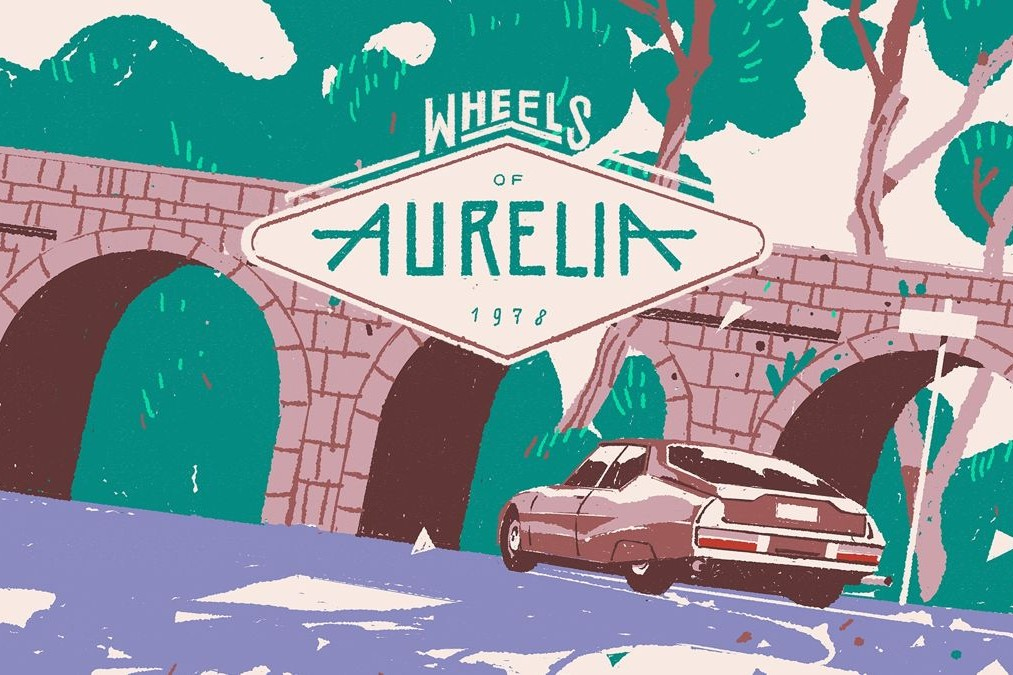

Developed/Published by: Santa Ragione
Released: 20/09/2016
Completed: 16/07/25
Completion: Completed seven endings and unlocked every checkpoint.
Wheels of Aurelia is being delisted from the App Store on July 25th because of Apple’s anti-art App Store requirements, and as it’s been made free by the developer in response, I thought I should pick it up and play it through. While Wheels of Aurelia will be available on other platforms–and if you’re reading this after it’s been delisted, you can pick it up there–it’s not exactly a preservation issue, it really does speak to the complete devaluation of creative work in our tech industry-led culture. Companies like Apple expect apps to be updated regularly, but of course, a game can just be… what it is (never mind the fact that a lot of apps don’t really need to be updated or changed much, if at all, either.) And let’s not forget the cultural vandalism of binning off everything from the old 32-bit App Store rather than working to keep them accessible.
Apple are cunts, basically. And I think this matters in the case of Wheels of Aurelia for the same reason I wrote about Despelote in the context of our AI slopscape: Wheels of Aurelia is a genuine attempt to make a human work, but one that is still, specifically, a video game.
Set in Italy in the 1970s, the player is cast as Lella, a woman taking a road trip to France for mysterious reasons, accompanied by Olga, who she met only the night before and has her own reasons for taking the trip. In some respects, the game could be described as a visual novel, but I think that’s a little reductive–I’d call it a “car conversation simulator”, because it captures the feel of something any driver will know well–when you’re engaged in a conversation while driving and are able to split your attention seamlessly between the conversation and the road.
Here it’s cleverly provided by making the driving as simple as possible. You head forward automatically and can switch lanes to overtake and speed up (a bit) by swiping but that’s really it. While you’re driving, the conversation flows, and you can choose between a few different responses each time you’re prompted. So as you drive, you’re mostly listening, or thinking about what you’re going to say next, only occasionally making a point of taking active control of the car.
I really have to emphasise that this is the ideal video game interpretation of the car conversation. If the driving was literally any more complicated, I’d have to think about it, and when I’m driving, I don’t think about it. I’m just… driving!
Something else I appreciate about this is that it doesn’t tell one long narrative. It actually does the one thing I always want games to do–make it impossible to see it all in one playthrough, make each playthrough short, but make each playthrough tell a whole story. Wheels of Aurelia, if you play it once, is very short–less than twenty minutes. But as you play, you can pick up hitchhikers. You can change your travelling companion. You can choose which town to head to next. And you can always choose to say something different.
I thought I’d be done with one playthrough, honestly, but through the dialogue the game doesn’t just progress a narrative, but paints a portrait of Italy in the late 70s. Like Ecuador in the early 2000s, it’s nowhere I know anything in particular about, and the game (cleverly, I think) gives you encyclopedia entries (sourced from Wikipedia–now that’s some savvy effort-saving) to fill out anything in detail that you like–though I was happy to let it just flow, to feel immersed in my lack of perfect context.
The thing I would say surprised me most is that I actually wished it was a little longer per playthrough! I appreciate that the game doesn’t shy away from serious, adult topics, but the endings feel a little sudden, like you haven’t spent quite enough time with the characters to get totally comfortable with them. While you draw more of them out each playthrough, it feels like you’re just capturing a snapshot of someone’s life–and the endings imply a little too much by comparison. It can feel unearned. And if you’re a completionist, I suspect that trying to see every ending here will get pretty repetitive–better to just play it until you’ve had your fill and leave some things unknown.
Sometimes there are just games that just… do what they’re trying to do. Wheels of Aurelia is one of them. There’s no “update” that they could make that would be worth it to make Apple happy: it deserves to exist, and be played, as it is.
Will I ever play it again? There are many endings I haven’t seen. Ironically, this is kind of a perfect iOS game–I can imagine picking it up and giving it a run through to get an ending I hadn’t seen at some point in the future while I’m in a waiting room or something.
Final Thought: I was interested to read that one major inspiration for this was the Italian film Il Sorpasso, as the movie it immediately put me in mind of was the Italian film Rabid Dogs. Though that is tonally incredibly different…