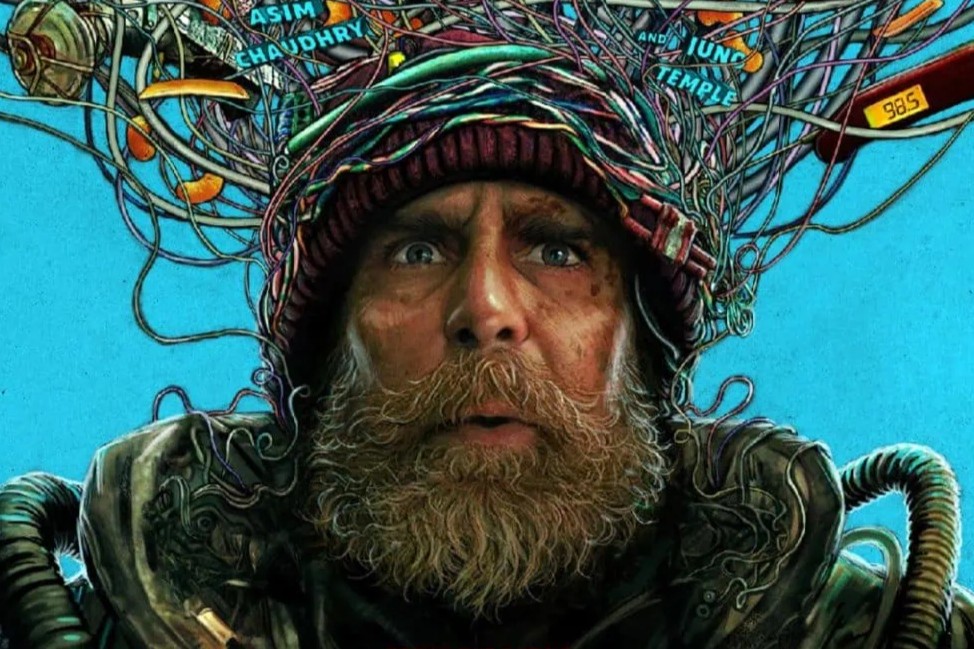
In Good Luck, Have Fun, Don’t Die, Sam Rockwell stars as a man who claims to be from a future where AI has wiped out half the population and the other half live unable to escape their personal “perfect” AI realities. He takes a NORMS hostage with the belief that some combination of the restaurant’s diners will be able to reach the creator of the AI so they can install safeguards before it’s too late (the film, intelligently, accepts the inevitability of AI and has a sensibly scaled goal as a result.)
Good Luck, Have Fun, Don’t Die–immediately–takes aim at our modern affliction: that we’re all looking at our phones, all the time. The satire feels a bit broad, with entire classrooms of students all just trapped in an endless scroll, and I’ve seen more than one sneery “ok boomer” take on this.
But.
Last year I worked background for a while on a TV show, which is a job I rather like; there’s a lot of downtime where you can do things like finishing editing that zine you were working on. I haven’t done it in years, and the one huge thing I noticed was that while there was still a small contingent of people who brought books, or wanted to chat with whoever they were sitting next to (whether they wanted to or not…) the largest cohort of people—who were of all ages—just looked at their phone. Now, I look at my phone a lot too, but I was taken by how the majority of them used it: on Instagram or Tiktok, scrolling at high speed, endlessly. Like they weren’t actually seeing anything. Just scrolling, scrolling, scrolling. For hours.
It looked exactly like it does in Good Luck, Have Fun, Don’t Die.
Serendipitously, I’ve been reading the recent reprint of Natasha Dow Schüll’s Addiction by Design: Machine Gambling in Las Vegas, which details the concept of the “machine zone.”
From the book’s description:
“Natasha Dow Schüll shows how the mechanical rhythm of electronic gambling pulls players into a trancelike state they call the ‘machine zone,’ in which daily worries, social demands, and even bodily awareness fade away. Once in the zone, gambling addicts play not to win but simply to keep playing, for as long as possible—even at the cost of physical and economic exhaustion.”
Social media, as it currently exists, has been designed in exactly the same way slot machines have. It has been continuously and intentionally evolved, using every trick gambling designers have come up with (and more) to make sure people pick up their phone at the merest hint of boredom or discomfort. And now AI is here to make the skinner box even more personalised than the algorithm has already managed, with the ultimate goal that, eventually, you don’t put the phone down. Ever.
A perfect smooth-brained populace, circuses so good they don’t realise there’s no bread.
You might think I’m being histrionic, but addiction is a disease, and we now live in a climate of a designed disease. We’re all addicted—to varying levels—and we need to start treating it the same way we should be treating any addiction: by being hard on those who peddle the addictive substance, and treating the addicted with care and respect rather than punitive measures. And we need to wake up to this now, before it’s too late.
Good Luck, Have Fun, Don’t Die get it.
It feels absurd for a Gore Verbinski movie to be the first thing I’ve seen outside of Adam Curtis documentaries to get it, but welcome to the resistance, I guess?
Don’t get me wrong. This is a big, fun, silly film. It’s trying to make its point by being entertaining, not preachy, and here’s none of the nihilism of a Black Mirror. It embarrasses Edgar Wright’s The Running Man, a movie that seems like it’s trying to say something angry and real about the world we live in and manages to say nothing at all. And not only is it not a sequel, remake, or part of a franchise, it’s also not “new IP.” It’s just a movie, which is almost the most subversive thing about it.
It’s a little scattershot, could be a little shorter, Asim Chaudry’s accent is… not good. But it refuses to fall into some traps that might blunt it (there’s no “AI can be good if we just use it correctly” here) and frankly, I’d follow Sam Rockwell anywhere.
There’s not a lot of movies where I think “I hope a lot of people see this” but this is one of them, not least because it’s just a straight up enjoyable film. I admit I wrote this to post online, on a social network, but Good Luck, Have Fun, Don’t Die chimed so much with my own experience that I now notice, just a little more, when I pick up my phone for what feels like no reason, and to then try and interrogate it.
Sure, the movie might only be mildly illuminating on the dangers of our encroaching, all encompassing “machine zone”, but sometimes a little extra light on the problem is all you need to actually see it.
Follow Mathew on Letterboxd.