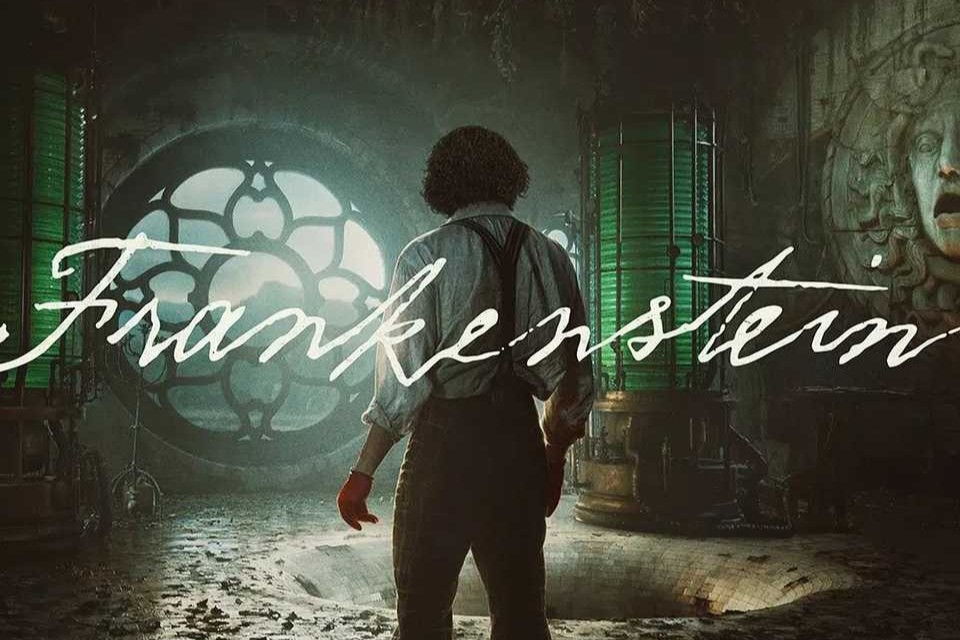
Guillermo del Toro seems like a lovely guy who cares about the craft of cinema, but if it wasn’t clear by now, Frankenstein hammers home once and for all that he has absolutely no sense for story at all. At all!
Even though it’s been adapted so many times before, I’ll give him that Frankenstein is a bit of a weird one to adapt because it has a layered structure to rival Inception, where at one point you’re reading a letter in which a sea captain is explaining the story that Victor Frankenstein told him based on the story that the creature told him. There’s a reason most adaptations don’t bother with this naive storytelling style, and it’s because it’s immediately absurd when a character tells another character their entire life story full of what would (in context) be irrelevant detail, and del Toro doesn’t help himself by picking and choosing when to be faithful to Mary Shelly and when to not. Frankenstein tells his life story to a sea captain? Check. This happens after the creature goes beast mode on the crew like you’re watching a fucking Marvel movie? Uh… check?
There are just so many bizarre and wrong-headed decisions here that it’s hard to know where to start. There’s a lot of waffle in Mary Shelley’s original novel, but Frankenstein at least creates his creature in, like, the fourth chapter. Here, del Toro shuffles all the component parts so he can spend spend literally an hour and a half on a new build-up where Elizabeth is Frankenstein’s brother’s fiance and her father (an invented character, not in the original book) is bankrolling his experiments… for his own nefarious reasons!
Even once the creature shows up, we get more invented scenes where Frankenstein abuses it because [auteur klaxon] del Toro needs to make sure we love the monster. Even though the creature’s already existing story is there to do that!
Del Toro called Frank Darabont’s script for Kenneth Branagh’s adaptation “pretty much perfect”–a version that is far closer to faithful than this, but which is reviled because it’s completely over the top–and considering Darabont has so publicly made a point that Shelley’s original work was “subtle” it’s genuinely hard to understand why del Toro has changed so many things to make them more obvious (I hope you enjoy seeing “Chekhov’s escape flume”) and then thought Oscar Isaac should in turn chew scenery with such gusto and only offer him glasses of milk to wash it down with.1
Look. It’s an adaptation, and del Toro can do what he likes, but I think that ultimately these changes add up to something that at points is so wrong that I’m not sure that del Toro is able to see anything beneath the surface. Del Toro seems determined to make anything that could be subtle unsubtle, anything quiet loud. A character literally tells Frankenstein that (gasp) he is the monster. I hope audiences cheered when that happened.
Maybe it’s just that del Toro falls so in love with the monsters and the set decoration and doing stuff that’s cool in his eyes that he loses sight of honouring the original work. In the original Frankenstein, the creature longs to be accepted but isn’t because of his appearance. He is rejected by Frankenstein, then accepted by the blind patriarch of a family that he hides from while learning from, only to be chased away by the family when they actually see him and are terrified.
Here, instead, we see the creature find the blind father killed by wolves who he then kills in an omg epic fashion before the family find him with the father’s corpse, misunderstanding things and so he has to run off. This is not the same!!!2
It seems like this is all there so [auteur klaxon] it can be clear that the only person who truly sees the monster for who they are is… a beautiful, intelligent, lonely woman. Who could have foreseen this!
I suppose what’s funny about that is the auteur touch doesn’t even really matter, because the whole thing is leading to an ending so unbelievably unearned, so forced that I almost couldn’t believe it. Frankenstein recognises what he means to the creature and they have a meaningful ~father and son~ moment. That doesn’t sound that bad but it plays out only a step below the film ending with them heading up to the ship’s deck to play catch.
Don’t get me wrong, I understand what del Toro is trying to do, but it’s like every instinct he had was wrong, completely blinded by how much he falls in love with his own vision rather than trying to make something that speaks to anyone who isn’t already fully bought into it. His Victor Frankenstein is such a relentless, one-note villain, his creature so over-the-top vicious at points yet infantile and innocent at others, that there’s no ring of truth to it. No meaningful closure. No tragedy.
No tragedy, I guess, other than del Toro believed this to be his dream project, his pinnacle, and then this is what he made.
Follow Mathew on Letterboxd.
- What is the deal with Oscar Isaac? He’s so good in so many things, but then he shows up in this and things like Moon Knight with absurd, unbalancing energy. Is this what the directors want? If so… why? ↩︎
- And while I’m here, and I know this is a personal bugbear, but wolf attacks are historically rare, and it’s so fucking lazy to portray them as insanely dedicated, vicious killers. And it’s especially disgusting to do that so you can show the monster you want to fuck killing them graphically (which would be even worse if it didn’t look so brutally CGI.) You’ve got all this imagination to come up with coffins with face windows and you can’t come up with something better than fucking wolf attacks? ↩︎