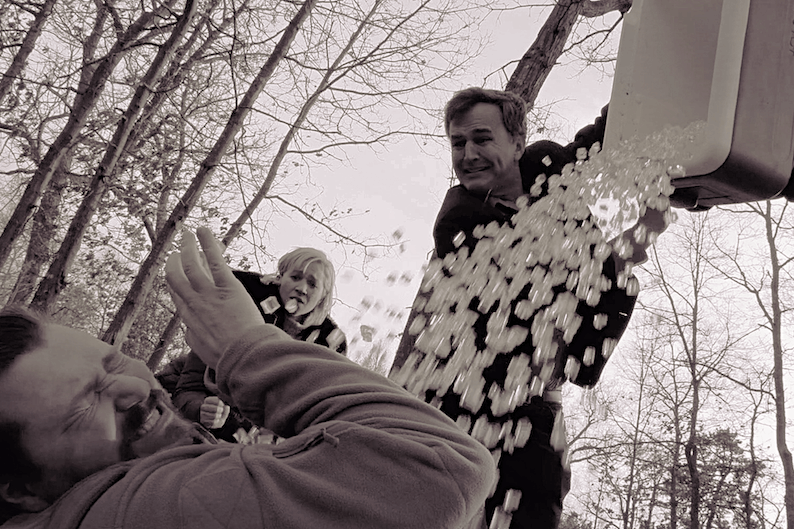
So, uh, stick with me here. Have you ever seen the movie Winterbeast? No, not “Don’t Let The Riverbeast Get You!” I’m talking about the horror film from 1992 that was shot across six years with so little continuity that it doesn’t even manage a consistent format, bouncing between 8mm and 16mm as noticeably as actors’ costumes and facial hair change.
It was during a screening of Winterbeast, years ago now, that I realised that, pretty much, all the things that you think are important in filmmaking aren’t. Professional acting? Continuity? It doesn’t matter a jot.
What matters is if you’re able to invite the audience into the world you’ve created. Because once the person watching is enjoying themselves—if they care about (or are even just amused by) the characters, if they’re following the story—well, at that point, it doesn’t really matter if the main character is suddenly wearing a different costume and has a poorly glued-on moustache. Because a powerful cognitive dissonance has been unlocked, one that’s existed since actors took the stage: the audience’s ability to be aware they’re watching something that is not reality—even appreciate it—but also buy into the work’s internal reality.
It’s not as simple as the viewer “letting” the fake moustache pass, or not noticing it; they don’t let it pass, and they do notice it. In fact, they enjoy it. It’s silly, and weird, but that friction can be similar to the experience of marvelling at spectacle. You’re in that world, but at the same time, you’re observing the work.
The thing is, of course, it’s not actually that simple. It’s not that there’s no rules, you can’t make something intentionally crappy because then there’s no friction (as you never truly invite the audience into the world), and if creating something that hooks and then maintains an audience’s interest was so easy…
Which is, I suppose, my roundabout way of trying to get to what makes the work of regional filmmakers Charlie Roxburgh and Matt Farley so special. They’ve taken what they have—no budget, non-professional actors made up of friends and family, and fleeting moments to film—and have created, in their way, a cinematic universe.
These are works done, transparently, with open hearts. Works that understand you do the best with what you have, and take pride in that. Works that don’t sneer at themselves (although full of intentional laffs) and in turn, make it almost impossible for me to imagine being sniffy about (if you mock people doing their best… you’re a jerk).
And don’t get me wrong. Roxburgh and Farley don’t make “inept” movies like Winterbeast. Noticing Farley’s wedding ring (why remove it and potentially lose it?) is barely an IMDB “goof”. They’re “just” movies with non-professional actors reading intentionally overwritten dialogue that drip with the frisson of cognitive dissonance. Telling you what is so inviting about them is as hard as trying to quantify how to hook and maintain an audience’s interest. You can read Robert McKee’s Story for that (and still probably fail).
It’s also entirely possible that you won’t be on their wavelength; that you won’t be able to resonate with the signal. The earnestness, too, might trip you into fauntrum. Not everyone can meet a movie in the middle. But you should pick a Roxburgh/Farley joint and try.
Anyway in Magic Spot two cousins use a magic rock to assist their uncle.
Follow Mathew on Letterboxd.