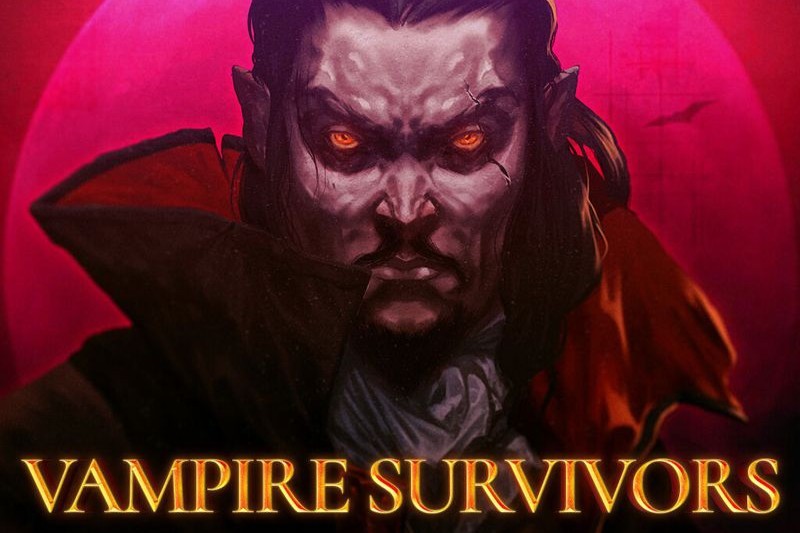

Developed/Published by: poncle
Released: 20/10/2022
Completed: 05/05/2026
Completion: Beat the final boss, saw the credits.
Vampire Survivors completely passed me by originally. But the genre it spawned–now apparently named “Bullet Heaven” by Valve, although I’m not sure if people have decided to accept it–is everywhere and it feels like I should probably know about it.
Off the back of Vampire Survivors, my feeling is that it’s… something I know about now.
In fact, it’s something that I was quite prepared to be done with very quickly once I understood it. If you’re unfamiliar with Vampire Survivors–and it’s not impossible, I really didn’t know anything about it until I played it–it’s a game in which your chosen hero is placed in the middle of an essentially infinite map and enemies spawn off screen in increasing amounts and make a beeline for them. The chosen hero attacks automatically, and really, there are only a few ways you affect their survival. First, by moving them around: not just to avoid enemies, but to collect the experience gems they drop. Secondly, by selecting the upgrades they receive by levelling up: new weapons, passive items, or simply upgrading the weapons and items you already have.
The pleasure of Vampire Survivors is the ramping up of your abilities versus the ramping up of enemies. The very first time you play, you think “how on earth am I going to survive this” as you walk around slowly with a whip that fires, occasionally, horizontally the direction you’re facing. It’s awkward, and not even really fun. You’ll probably pick weapons and abilities at random and die a few times, but then you’ll grasp you want to pick weapons or abilities that synergise [“well, obviously”–Ed.] and before long you’re playing a game where your hero basically stands still while a whirling tornado of attacks spin around them, energy gems are absorbed into them from a distance, and literally thousands of enemies die by the second in huge, incomprehensible mosh-pit.
What’s odd about Vampire Survivors is how quickly that occurs. At least, it did for me. Once you learn or luck into the realisation that if you pick the correct synergies of weapons and passives weapons evolve into ridiculously powerful new forms, the game reveals itself to be about… doing that. Each level-up, pick the thing that matches the thing you have. Simple.
In my recent(-ish) piece on Gore Verbinski’s Good Luck, Have Fun, Don’t Die, I wrote about the “machine zone” described by Natasha Dow Schüll’s Addiction by Design: Machine Gambling in Las Vegas. Designers in the gambling industry are engaged in an ever increasing arms race to create perfect, friction-free sensation and the absolute absorption of players in their games until, ideally, they never stop playing. Not that they couldn’t, that they’d never want to. A perfect skinner box.
Have you noticed how gambling is everywhere now? You can’t seem to escape it. If you watch any form of TV (remember when streaming didn’t have ads?) every ad break seems to be for an online casino or sports betting. Prediction markets are being shoehorned into awards shows and god knows what else.
It feels like as everything gets slightly worse in people’s lives, as all the money, all the resources get held by an ever smaller amount of people, as our high streets and third spaces get hollowed out, the offer being made is “well, gamble. Maybe you’ll hit it big, and join us.” Or at least, that’s the offer initially being made. The real offer being made is “Gamble, and lose yourself. Lose the outside world. The longest you’ll ever have to live is the moment between spins, and the best thing is the spins never have to stop.”

It is a persuasive, efficient, powerful form of design. I doubt the people on the ground, the ones engaged in user experience, recognising when an animation is too long or a particular button press unnecessary, are evil as such. I think we’re all able of abstracting far more horrific things away if our own comfort demands it. And you know, they’re designers in the gambling industry. It’s hard to be disappointed.
So is it unfair that I’m disappointed in the waves of game designers that delve into the dark patterns? It’s getting disturbingly transparent to see the slot machines and scratch cards; like a promise, “come join us in the machine zone. This one doesn’t even need you to spend all your money. Your time is good enough for us, here.”
I play a game like Vampire Survivors, and I think… where is the “play”? where is the joy, the creativity, hell, the “series of interesting decisions”? The time between level ups is just the time the reels spend spinning. After the first few, every level up is as automatic as pushing “spin again.” And after a certain point, you don’t even have to. Like an addict in the machine zone, you watch the machine play itself. If there is a vampire here, it is one that drains us of our time, our life, our joy.
I’m sure you probably think I’m being sort of histrionic here. I’ve complained about this before, honestly; when I wrote about Blue Prince. The idea that these games–which I admit unlike slot machines you can “win”–ask you to spend time on failing runs, waste your time, but feed you the incremental success (directly analogous to slot machine’s carefully spaced payouts, I feel) to keep you playing.
But it’s… shit. It’s games as commerce, not art. And I can hear the complaints, but I guess I’m at the point where they don’t wash. The spate of gambling themed games makes it clear that any distinction over the fact that games’ dark patterns were a parallel evolution is utterly meaningless. And sure, the games are fun, in many cases do require more thought–so then remove the dark patterns!
You’re creating games that you want people to play, right? Not setting traps for people to fall into?
As I said above: I don’t even think gambling designers are evil. I don’t think most game designers are thinking deeply about the value of design, actually; so much is genre convention already that I don’t think it’s interrogated.
The problem for me is when playing Vampire Survivors, there’s just so little to interrogate. I was done with it after my first half hour win, but–and it speaks of the insidious nature of it, and my own completionist tendencies–I realised there were a few things I could do to “complete” it properly, surmised it wouldn’t take much time or attention to do so, and saw the credits.1 But I felt nothing. No joy. No pleasure. No excitement or interest or… anything. Really. I just lived in the moments between spins.
Will I ever play it again? There are a lot of DLC with IP people love for this game now, but look… it’s like getting excited that they made a slot machine with the Golden Girls on it or something.
Final Thought: So I suppose the big question is: do I play Vampire Crawlers? Well, the problem is I fucking love dungeon crawlers and deckbuilders.
After all that… what am I like!
- I probably wouldn’t have done this if it wasn’t for the fact that it’s really hard to look at the screen during about… what, twenty, thirty percent of an episode of The Pitt? ↩︎