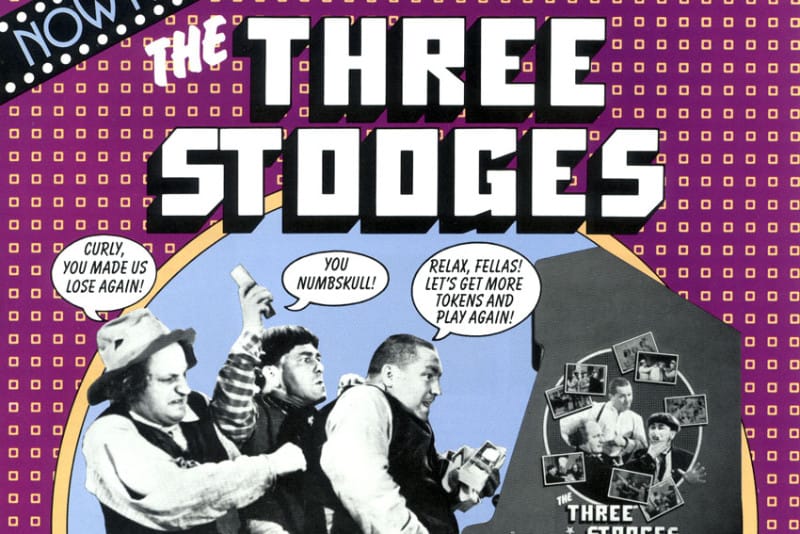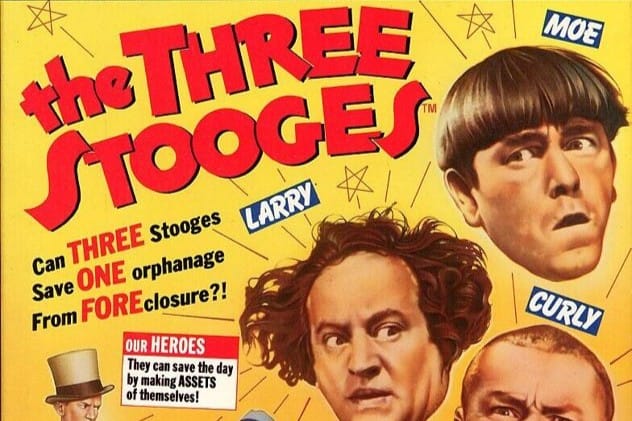

Developed/Published by: Incredible Technologies, Cinemaware / Cinemaware
Released: 1987
Completed: 30/01/2026
Completion: Raised enough money to repair Ma’s orphanage… but not enough to get married to her three beautiful daughters. This is the “real” best ending; who’d inflict The Three Stooges on some women?
As celebration of the release of The Journal Of Stoogealogical Studies Vol. 2, I’m proud to share this final excerpt from my article in said journal, “A History Of The Three Stooges In Video Games”. The Journal Of Stoogealogical Studies Vol. 2 is available only physically, and only from Amazon: .com, .ca, .co.uk (or your regional variation) so run out and get a copy today! Well, you don’t need to run anywhere, but you know what I mean.
If there’s something that stands out about Cinemaware’s take on The Three Stooges–certainly before we have to get into the thorny issue of the game’s quality–it’s that it is the kind of work that absolutely deserves the cliched phrase “a love letter to…” because it is, from the moment you open the manual, clearly a love letter to the Stooges.
Cinemaware’s manuals are famously more supplements providing historical context–the manual for Defender Of The Crown has pages on The Norman Conquest and the veracity of Robin Hood–but nothing matches The Three Stooges, which includes a massive thirteen page essay from “A Dedicated Stooge Fan” recounting the entire history of the Stooges from Moe running away from home in 1914 until his untimely death (and yes, that means it references Joe Besser and Curly Joe DeRita, though they obviously don’t feature in the game1). Someone at Cinemaware clearly loved the Stooges enough that they wanted to license what was–in 1987–hardly a gold-standard license, and treat it with more respect than it had likely ever been treated before.

It’s a slightly strange outlier in Cinemaware’s output. The company’s games were heavily influenced, of course, by the golden age of cinema–Defender Of The Crown Errol Flynn swashbucklers, It Came From The Desert ‘50s B-movies, and so on–but there was never any sense that they had to be licensed rather than just give off the affect. It’s possible that slapstick was chosen as a genre to tackle and they found it just doesn’t work without iconic characters to back it up; I find it much more likely that Cinemaware’s founder, Bob Jacobs, was just a stoogehead. After all, The Three Stooges doesn’t really fit the more “grown up” air the company was attempting to cultivate; The Three Stooges may have been from the era of classic cinema, but it was certainly the fodder of children (indeed, you only have to click on a few Youtube videos of playthroughs of this game to see how many people picked this up excitedly as children.)
Interestingly, even if Jacobs was a stoogehead, designer John Cutter wasn’t (though he’d tell Youtuber Matt Barton that “by the end of the project I definitely was a fan.”) Designed by Cutter at Cinemaware and implemented by Incredible Technologies (who would go on to create the Golden Tee Golf games you probably remember from bars) The Three Stooges is similar to Defender Of The Crown in that it mashes together board game inspiration with minigames. Like in Defender Of The Crown, the issue with the design is that it isn’t very cinematic despite the company’s founding principles, and so it similarly relies on the idea that if you have big, flashy splash screens powered by the Amiga’s graphical capabilities things will seem cinematic. And The Three Stooges has, well, the Stooges to help: Cinemaware were able to use digitised images of the Stooges and frames from their shorts to push the illusion.


Speaking of Defender of the Crown, The Three Stooges references it in what I think is the best joke in the game: it opens with Defender Of The Crown’s title screen, before the Stooges walk on and realise they’re in the wrong game. It works particularly well because you could easily believe Cinemaware accidentally mastered the wrong game on the disks, and I assume it caught a lot of people out.
There’s a simple framing device–the Stooges discover an orphanage is going to be foreclosed by an evil banker if they can’t raise $5000 in a month to pay the rent; the Stooges decide they’ll take on the task. Unlike Mylstar Electronics’ The Three Stooges, aka “Brides is Brides”, there’s no fiction that this represents a specific new Three Stooges short, but if it did, it would be one of the later ones where they use a lot of old footage, because Cinemaware’s Three Stooges pulls heavily from Punch Drunks (1934), Men In Black (1934) and Dutiful But Dumb (1941) with the other minigame generally inspired by the Stooges pie-throwing antics (the manual specifically references Hoi Polloi (1935).)
The selection of these shorts is at least vaguely interesting to me. Frames are digitised directly from Punch Drunks and Dutiful but Dumb if not Men In Black; the shorts had been released on VHS by this point, but they hadn’t come on the same tape or anything. Punch Drunks and Men In Black are (basically) the first Stooges shorts (Woman Haters doesn’t count, with all that weird rhyming) but… why Dutiful but Dumb?
(I’m getting ahead of myself here, but it particularly stands out because it’s a reinterpretation of the sequence where an oyster in Curly’s soup keeps eating his crackers as a cracker eating contest, which–look, I know I’m splitting hairs here–makes no sense because even in game Curly is dressed as a “Vulgarian” officer. I have to believe it’s because someone at Cinemaware just really loved that sequence.)
As with all of Cinemaware’s output, the attention to visual detail (well, on things other than “what Curly’s wearing”) means The Three Stooges looks great. But similarly it comes at the cost of a game that is… bad. Based largely on the Game Of Life, the idea is that 30 days equals thirty turns, and on each turn you “roll” (in this case, hit the fire button to stop a hand) for your preferred event. You want to hit on the movie-inspired mini-games or free money; you don’t want to hit on the banker (at best, you lose a turn) or the mousetraps, which just snap on the hand and cost you a day.
It’s actually here that the game’s only interesting tactical consideration lies. As the days progress, the hand gets faster and faster until it’s sheer luck what you hit. To mitigate this, you can select the “eye poke” space, which wastes a day so that you can get involved in some classic stooge hijinks where as Moe you beat the everliving fuck out of Larry and Curly as punishment for… wasting a day I guess. Doing this, for some reason, slows the hand–unless you miss repeatedly on your eye pokes and shin kicks, in which case you can end up in a worse situation than you started with. So the game, at least, involves a bit of risk/reward, in that you want to ride the game as far as you can without having to waste a day on slowing the hand–but if you wait too long, you’ll struggle to hit the required space, and probably screw yourself completely.

That said, it’s not like the game is that punishing if you just want to muddle through it. Money isn’t hard to come by–though if you’re truly aiming for a high score (and marrying the orphanage’s comely daughters) you have to play quite strategically (you make so much more from mini games than the free money spaces that a free money space is actually a hindrance.) Anyway, those mini-games.
Not great! If there’s something I can’t shake about The Three Stooges, it’s the idea that–like Defender Of The Crown–it was made with great intentions but also an arbitrary release date that means that it comes across as a bit unfinished. Nothing really makes this clearer than the comparison between the Punch Drunks mini-game and the others.


In the Punch Drunks mini game, you can see that some of the developers have inserted themselves into this classic Stooge short.
In the Punch Drunks-inspired mini game, not only do you get a proper digitisation of some of the beats of the short (Larry breaking his “Stradivarius”) the play screen features this entertaining split screen where you see the fight ongoing as you race to get a new violin. It also plays… fine, as you move up and down on the screen to avoid obstacles and can leap them too. It’s nothing special, but it feels like it’s what it’s intended to be.

The Men In Black-inspired mini game is almost like what you get if you tried to do the same thing with absolutely no cinematic flair whatsoever. Inspired by the racecar sequence, you get a overhead view where you really can’t tell you’re playing The Three Stooges as they race up the screen avoiding patients, and a nurse in front of you drops stuff that you can pick up (but because you’re a massive, three car collision box, you don’t really have to move to do it.) Indeed, because the nurse moves out of the way of collisions, you can just follow her movements at top speed and that’s… it.


Curly, clearly wearing the costume of a “Vulgarian” guard.
You could argue that the Dutiful But Dumb-inspired mini game at least uses digitised art, but it’s actually a hindrance. You’re trying to collect crackers with Curly’s spoon–which controls horribly–but the game constantly cuts back to the splash screen of Curly so we can see him react to the oysters. Basically the only way to avoid this is to be superhuman at the game and stop the oysters ever stealing a cracker, but it’s beyond me or probably anyone’s patience.
There’s a strange sort of dilemma with The Three Stooges: when you play a mini-game that doesn’t have sufficient Stooge content, it feels unrewarding. But when you do (like in the Punch Drunks mini game) you get sick of the repetitive intro and outro and all the horrifically slow loading that results. In fact, in a full playthrough on Amiga, it feels like you’re waiting for the floppies to load more time than you do anything else.
The repetition also doesn’t make sense in a game that expects you to do the same minigames over and over. Alright, Larry can break his violin and have to run and get another one day after day; but why does the hospital keep hiring the Three Stooges? Why do they keep getting hired as waiters if it always ends in a pie fight?2
You can say I’m putting too much effort into trying to make this Three Stooges game make sense; the shorts, after all, barely do. But it speaks to that Cinemaware’s concept of game design was upside down. I’ve got a great sympathy for games that try and be maximally replayable, but it’s obvious that rather than this awkward attempt at the Game Of Life, The Three Stooges should have been a kind of supercut of Stooge shorts that you just played linearly.
I suppose one bright spot for Stoogeaholics might be the trivia sequences, which feature absurdly trivia questions that veer from easy to bafflingly hard (do you know where Larry liked to drink?) and unarguably this is a more interesting, more authentic take on the Three Stooges than Mylstar Electronics’ attempt. But it outstays its welcome almost as quickly.
Will I ever play it again? Cinemaware loved releasing their games on every system they could, but the differences between Three Stooges versions are lower than in Defender Of The Crown, for example. I’ll be honest… there’s a chance I’ll stick the GBA version on my Trimui Brick.
Final Thought: If there’s one thing to be said for Cinemaware’s The Three Stooges, it’s that Moe’s daughter, Joan Howard Maurer expressed that seeing it would have been a “thrill” for her father to see it, very sweetly saying it allowed her to “join in during a pie fight and zap [her] father for the first time.”

For that alone, I’m glad they made it.