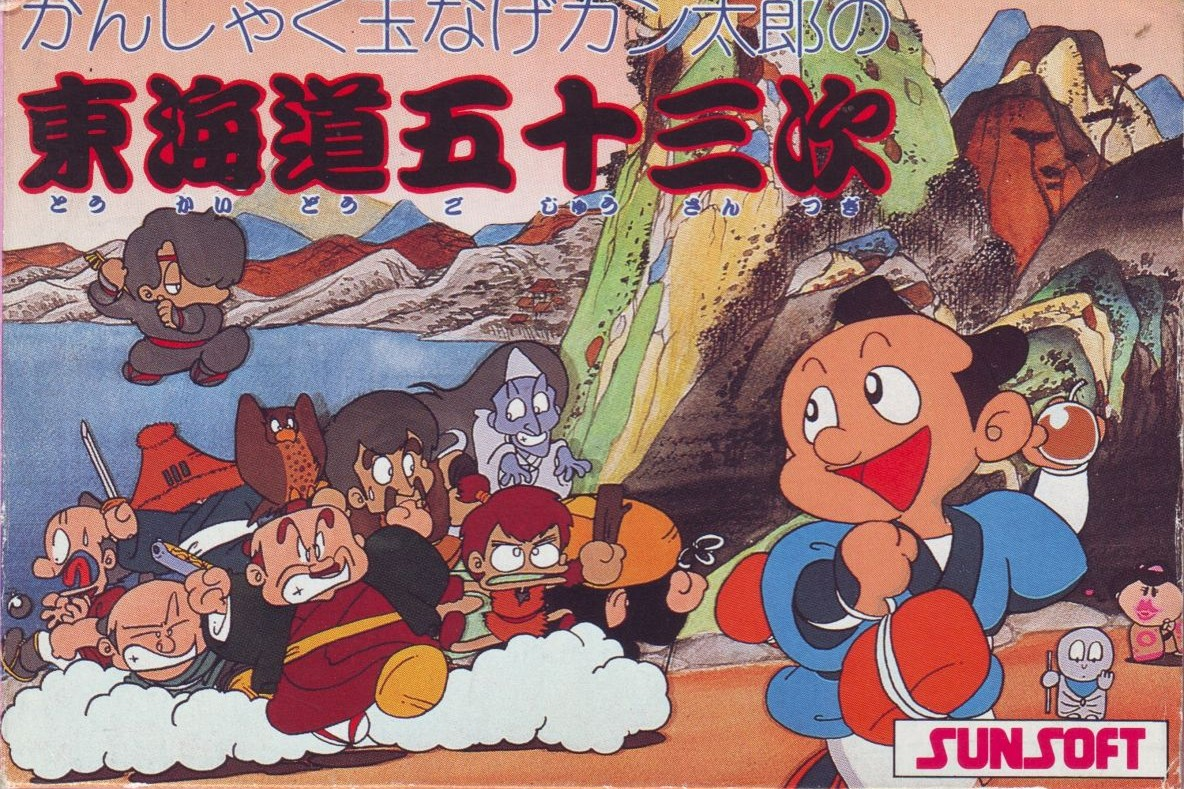

Developed/Published by: TOSE / Sunsoft
Released: 1986
Completed: 24/07/25
Completion: Kantaro got all the way to Momoko–but I did use a warp at the last possible moment. Saved at the start of every level.
Strange happenstance that after so recently writing about a game that features a country’s most famous road that I should write about another, in this case Japan’s Tokaido. I guess I’ll have to pick up a copy of King of Route 66 next (yes, I’m seriously considering this.)
With a name so long it could probably be a light novel (or, *cough*, JAV) Firework Thrower Kantaro’s 53 Stations of the Tokaido (directly translated from the original Japanese, かんしゃく玉投げカン太郎の東海道五十三次) is a deeply forgotten game that has really only bubbled up for being included in Sunsoft’s recent “Sunsoft Is Back!” retro compilation. But I will say: it’s actually fairly interesting: an Atlantis No Nazo-a-like.
Released less than three months later, Firework Thrower Kantaro (is there a good abbreviation for this? FTK53SOTT? I guess the answer is no) seems to be an attempt to take the Atlantis No Nazo playstyle, improve it and situate it in an (almost) completely linear experience compared to Atlantis No Nazo’s bonkers, warp-heavy speedrun design.
While I don’t have a source for this outside of The History of Sunsoft Volume 1, Firework Thrower Kantaro was apparently created by TOSE rather than internally at Sunsoft (as Atlantis No Nazo was) so it does seem like the company was tasked in making “another” Atlantis No Nazo at short notice, possibly to the point that they were given the game’s code. I have no source for that and have no idea how common that would have been in Japan at the time–it does seem unlikely, but maybe TOSE were already deeply trusted by that point–but the characters control similarly and defeat enemies by throwing slowly arcing projectiles. In Atlantis No Nazo you’re throwing dynamite and having to wait for it to explode but in Fireworks Thrower Kantaro you’re (thankfully) throwing fireworks that actually explode on impact, which immediately makes things a lot more playable.
And while the game is essentially a linear trek through the fifty three stations of the Tokaido–a shocking bit of false advertising, by the way, there are only twenty-one levels–it’s not as simple as that. Because (get your klaxons at the ready) continues the endless inspiration of Xevious [honk] and The Tower of Druaga [honk] as well as Super Mario Bros. [hon-squee] (I’ll have to get my klaxon replaced, I’ve worn it out. Not surprising at this rate.) While you can attempt to “brute force” your way through the levels, you are actually expected to consistently find hidden items in the stages which allow you to get past certain enemies and obstacles.
In fact, you can’t beat the game without doing so. Thankfully the game doesn’t require you do any stupid nonsense like The Tower of Druaga and instead just relies on the original Xevious’ system of just shooting unmarked areas of the stage to reveal the pickups.
What that ultimately means is that you just have to be hammering the fire button at all times and then trying to remember where things appear. Annoyingly, the game is weirdly exacting about where explosions happen for things to appear, and this game is so generally unloved that the only solution that I could find that pointed out where a lot of (but definitely not all!) items were was in Japanese.
As a result of this design, I actually started Fireworks Thrower Kantaro over several times before giving it a “proper” go, and the collectible system has some give in it, but it seems highly related to how skilled you can become at the game as you play it–because it is hard.
Like Wynn before him, Kantaro can be sluggish at the most annoying times, and the game has some weird, probably buggy quirks like an inability to duck when you’re directly next to objects. While you’re never going to be overwhelmed by enemies, they are unpredictable and kill you instantly, meaning that even if you’re only facing off against one old man leaping about and another one who shoots you periodically with a gun one wrong move can screw up your run.
But the game does have forgiving checkpoints and some early opportunities to rack up extra lives for those who’d like to iron-man it. If you can collect three scrolls–which you use to ward off evil ghosts that appear and kill you otherwise–you get a pair of geta so light that Kantaro can hop across the clouds, where you can find the occasional cloud that just racks up so much high score that you come away with three lives (unless you land wrong and vibrate off it–frustrating.)
Other collectibles also have specific uses. You need ofuda to pass certain checkpoints or the enemy there will cling onto you, slowing you down. You need to spend an eye-watering five coins to ward off the prostitutes(!) that chase you around in the areas that (in the name of historical accuracy) they actually stalked. You need swords to take down… weird looking blokes (I’m not sure what their deal is.) And you need two coins to pay to make “bridges” to cross certain water features.
Not all of these are an automatic failure–with skill, you can for example jump across rooftops to avoid eager sex workers. But certain things, like showing up without the coins you need for a bridge, end your run entirely.
Of the collectibles, the coins have the most interesting economy. If you can collect ten you are actually able to warp three or six levels ahead, which makes you really not want to spend them on anything but bridges. I was only able to do this right at the end of the game and I struggle to see how you could do it much earlier, but I suspect even with the help of a guide I was either missing a decent number of collectibles or just not good enough at the game (if you faff around too much bombing everywhere, eventually the game does start to spawn enough enemies that you just won’t survive.)
Anyway. Having said all of that, Fireworks Thrower Kantaro is, at best… fine. It’s not as interesting or as replayable as Atlantis No Nazo, though it does feel much better to play. It’s somewhat unique in how specific the setting is, though if you wanted to get your feudal Japan on, the first game in the Goemon franchise did come out just a few months earlier. The hidden objects that can ruin runs aren’t as annoying as, say Xevious: GAMP No Nazo, but they don’t exactly make the game more fun, just a memory or note-taking test. I enjoyed it while I was playing it more than say, JaJaMaru No Daibouken, but as I’ve said before: in 1986 you could already have The Legend of Zelda for your Famicom, or just wait a month for Metroid.
Will I ever play it again? I’m good!
Final Thought: As far as retro collections go, Sunsoft Is Back! Is… decent! The CRT filter is too clean and bright for the NES/Famicom in my opinion, and doesn’t allow you to turn off curvature, which I dislike, but it’s alright, there’s a wee museum, you get the manuals (untranslated, but just hold up your phone and google translate if you absolutely have to?) and it’s just generally pleasant enough. You can quibble them only including three games, but you can already play Route 16 Turbo and Atlantis No Nazo on Switch Online I suppose (well, the former if you install the Japanese version of the app, which you should.)