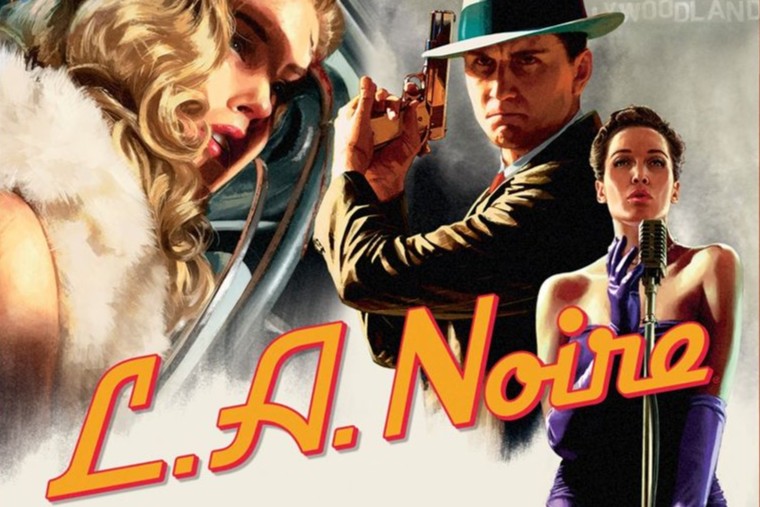

Developed/Published by: Team Bondi / Rockstar Games
Released: 17th May, 2011
Completed: 31st May, 2015
Completion: Finished the story (all cases with five stars) and half the street cases.
Trophies / Achievements: 50%
Someone on Twitter—actually wait, christ, that’s the second or third time I’ve started one of these by referencing Twitter, I’ll have to sort that out but I guess I’ve committed—mentioned this game apropos of nothing, saying something along the lines of “Ah, L.A. Noire, a terrible game executed brilliantly, or the other way around, I can’t remember.”
He got it right the first time.
Taken purely as a spectacle of effort and polish, L.A. Noire, even four years later, is a marvel. The kind of marvel where you’d have to respect what Team Bondi did, if it wasn’t for the fact that it came at massive human cost (according to rumour) and got the company murdered by Rockstar Games anyway. Here they’ve recreated way, way too much of Los Angeles in 1947 in absurd (if imperfect) detail, have created an insanely subtle facial animation system, and it’s all generally quite stunning, except for the fact that the game system is a terrible garbage hidden-object adventure dribbled into a generic Rockstar third person-em-up.
Actually—I don’t really hate Rockstar’s “all of our games feel the same” thing that much; there’s something to be said for consistency and they’ve very slowly improved it since the PS2 era, I guess. Certainly, I adored (and remember fondly) Bully, and didn’t hate Red Dead Redemption even though, much like L.A. Noire, there are aspects that are just so garbagey it undercuts everything. What’s funny here, though, is you do the “video gamey” stuff so rarely—you know, the shooting, brawling and car-chasing—that every time it happened I’d forgotten all the buttons, leading to hero cop Cole Phelps usually struggling to detach from cover, or popping out of cover and not knowing how to fire his gun.
But look, basically L.A. Noire wants to be a really good neo-noir flick, right? Not so much a Big Sleep but a Chinatown or (most incredibly obviously) L.A. Confidential. So you play Cole Phelps, a goody-goody cop with a secret tragic backstory that relates to the war, as he wobbles his way up the ladder, trying to solve lots of awful lady-murders while also dealing with wider conspiracy and corruption.
Sounds decent enough! Unfortunately the game is this: go to a place. Walk around the place, waiting for music cues that let you know if you can pick a thing up. Is it a clue? ok. No? Put it down then, ya dingus! Then, interview the suspect that’s there. They say things, and you have three options: believe them? Doubt them? Or are they telling a LIE! While working this out, the subtle facial animation system is used so that liars will do clever, subtle things like look off to the side and screw their mouth up in a “what I just said was untrue” way.
(This is really hard to explain in text, but the actors were clearly told to mug as hard as possible. It’s really, really stupid looking.)
Best thing, of course, is that despite the mugging they usually make ambiguous statements that it’s really hard to know whether to “doubt” or call a lie, often because they’re functionally true. I’d actually say the whole system is broken—the original options were “coax” “force” and “lie,” which is a bit better, but the weird “you only get one chance to get it right” thing is just pish. Shouldn’t a good cop probably doubt everything a suspect says? Lies always force you to use a piece of evidence to prove it, why can’t I just use the evidence against the suspect in the first place? And so on, forever.
Anyway, you do these two boring things for the entire game, sometimes broken up with shooty-fighty-drivey times. It’d be nice if this was worth it thanks to the story… but it’s not. Now, I could write a very long article about how ill-thought out the story is, in how it’s presented to the player and, in general, constructed. But I’m just going to give you one good example. The entire middle of the game, when Phelps is working homicide, is more or less on the trail of a single serial killer. You keep arresting people for the crimes, even though you, the player, are like “this is stupid, the wider plot is telling me these people didn’t do it” (even though the game keeps placing these suspects with massive amounts of evidence against them.) So you keep being forced to do stuff you know is wrong, but “correct” to progress. That’s great. What’s even better though is as you play you’re like “hmm, who is this killer going to be, anyway? Has to be someone meaningful, otherwise this breaks all story rules. And how did he plant all that evidence, anyway???”
No, it’s just some fucking guy that you saw for about three seconds earlier in the game. And they never explain how all the evidence like bloody weapons and stuff got planted. And it doesn’t matter anyway, because not one second of this extensive section of game has anything to do with the overarching plot. At all.
It’s roughly as worthwhile as the middle hour of LA Confidential, if the middle hour of LA Confidential was the main characters going to Des Moines, Iowa, and taking part in a hula hoop competition. Which it isn’t.
L.A. Noire is a disaster. It’s lovely to drive around for a while in it, walk about, take in a digital LA… but god, don’t play the “game” part.
Will I ever play it again? No, I really did suck the marrow from the bones of this, even getting mayhem related achievements to see if that made it more fun, etc. It didn’t.
Final Thought: I have to admit that, having been to LA many times, I wasn’t that blown away by the recreation because it’s not perfect. So something like Cole’s (originator of the French Dip!) isn’t really there, it’s a cafe that looks a bit like it. The Bradbury building is there, but you can’t go inside so… I guess 1947 is, surprisingly, just too far in the past for it to really connect any deeper than, say, looking at photos of old LA. I do wish for an LA that kept streetcars and had a more… how can I say… consistent downtown, but that’s another story entirely.