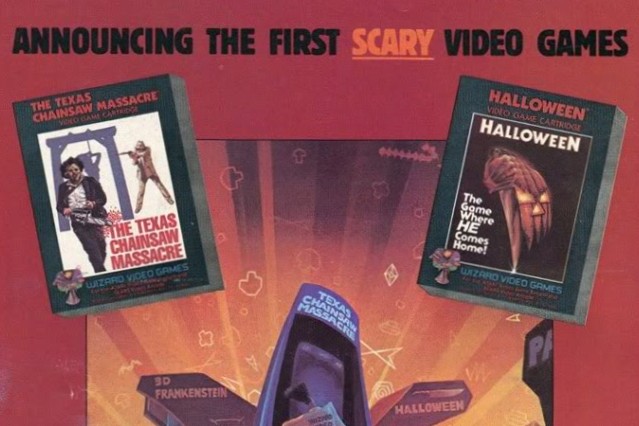
Developed/Published by: Ed Salvo (The Texas Chainsaw Massacre), Tim Martin and Robert Barber (Halloween) / Wizard Video Games
Released: 1983
Completed: 22/10/2025
Completion: I played ‘em!
The schedule for new articles has gone a bit squiff due to life difficulties (let’s just say: if you weren’t already a subscriber, I’d be asking you to subscribe here with big wet wobbly eyes) and I had planned to do a really interesting game–the first from a very well known company, yet it doesn’t get talked about much–this week, but it’s simply taking too long to get through. So I’m going to lean on the crutch of some crappy Atari games (not least because I only mentioned The Texas Chainsaw Massacre in my Poltergeist essay) and then of course write far, far too much about them anyway.
I’m combining them because it’s sort of hard to talk about them separately without repeating yourself relating their provenance, which relates very much to the absurdities of the pre-’83 gold rush and the resulting fallout.
It begins with Games by Apollo, a company formed purely as cash grab by someone with no knowledge of video games–unusual at the time, but surely not the first, and absolutely not the last. That company would have its own “gang of four”-esque exodus led by Ed Salvo (who would go on to develop The Texas Chainsaw Massacre) because the company was apparently so mismanaged: The founder, Pat Roper, grew the company beyond its means to compete with Activision, and frustrated with traffic in Dallas got distracted with a plan to create two-person helicopters(???) Within a few weeks of the exodus the company collapsed.
Somewhat desperate to get their fledgling company, Video Software Specialists (VSS) off the ground, a very strange saviour would swoop in, obviously attempting to cash-in in what was–by then–a rapidly collapsing market: Charles Band’s Wizard Video.
If you’re familiar with Charles Band by this point, it’s probably due to his relentless, desperate exploitation of whatever IP he happens to have to hand and can make something as cheaply as possible with. Perhaps you’ve seen one of his eight (eight!) Evil Bong movies [“Don’t forget the Gingerweed Man spin-off.”–Ed.] or one of the fifteen (fifteen!) Puppet Master films? [“At least some of those are… ok?”–Ed.]
At the time however, most of those films were but a twinkle in Band’s eye, and Wizard Video was his home video distribution company through which he was able to distribute titles such as (yes) The Texas Chainsaw Massacre. On Band’s own website he describes the decision to get into video games thus:
“A forward thinking company, Wizard foresaw the potential for massive growth in home video gaming and produced adaptations of THE TEXAS CHAIN SAW MASSACRE and HALLOWEEN for the Atari 2600, which were in effect the very first horror console video games ever released.”
I genuinely love the use of “in effect” there, because they absolutely weren’t, and they literally chose to do this while the market was crashing, which makes the portrayal even funnier.
Either way, it seemed that Band’s idea was to exploit the IP of the most popular videos they’d been distributing, and try and make hay with the fact that these were adult video games (Mystique’s “Swedish Erotica” games had come out the year earlier.) There were three planned games, and ironically the most adult, Flesh Gordon–based on the 1974 sex comedy–would never see the light of day with not even a prototype found1. The other two games would however, with both The Texas Chainsaw Massacre and Halloween seeing release at some point in 1983–seemingly close to the Halloween season if we can base that off the timing of contemporary review (we probably can’t).

The Texas Chainsaw Massacre
According to Ed Salvo, this was developed in “about six weeks” and he told Digital Press that he was “not real proud of this one, but we had to eat.” Which is actually a change of tune, because in 1983 he wasn’t even willing to admit he’d worked on it, with an aside in the announcement of the title and Flesh Gordon in the Feb 1983 Videogaming Illustrated stating:
“We were asked–make that begged–by the designer of these Atari-compatible cartridges not to reveal his/her name. We won’t.”
(They actually hint that you can work out who it was by reading the previous issue, but I couldn’t. I found this funny quote from Bette Davis though?)
Frankly, it’s completely fair that he wouldn’t want anyone to know he worked on this, because it’s absolutely terrible, even by the low bar set by any Atari 2600 game (buy exp. 2602, etc.) As Leatherface, you run right (or left, doesn’t matter) to chase “tourists”, trying to avoid fences, thickets (makes sense) cow skulls (ok) and wheelchairs (lol) to catch up so you can chainsaw them to death.
There’s supposed to be some tactics to this; your chainsaw is constantly idling, creating a timer via remaining fuel and when you actually run the chainsaw the fuel runs out faster–and you only get extra fuel for a certain number of successful kills. But it doesn’t work at all, because there’s no meaning in which direction you run as tourists always appear, and then when you try and chainsaw them they… teleport behind you? Repeatedly?
There may be some kind of timing aspect to starting your chainsaw otherwise they “dodge” you–but I couldn’t work out the timing at all. Worse, probably, is getting stuck on one of the obstacles, where you get awkwardly frozen for what feels like an age. The wheelchairs that fly onto the screen are very very funny–clearly one of the few things they pulled from the film, which apparently they hadn’t even seen before getting the contract–but it’s otherwise just annoying.
The game also has a bizarre coda when you lose all your lives: one of the tourists runs onto the screen and appears to kick Leatherface in the balls. It made me laugh the first time I saw it, but it does, well, make a mockery of the whole thing.
I’m going to go out on a limb here and say that this game was originally planned to be a touch more in-depth–because you can move left and right, I assume they were planning a kind of Defender-like system where you had to run around the level getting all the tourists to then move onto the next, but in six weeks they just ran out of time or (more likely) just couldn’t be arsed because they knew they were shoving out a dog to a company that didn’t know what it was doing during a historic market crash.

Halloween
Ed Salvo, again via Digital Press, notes that although this was produced by VSS, it was actually contracted out to a couple of different ex-Games By Apollo developers, Tim Martin and Robert Barber. It’s possible that these names ring a bell if you’re a real old-head, as they’re two of the founders of MicroGraphic Image, and there they would develop the beloved (sort of!) and influential (also sort of!) Spelunker!
As with VSS and The Texas Chainsaw Massacre, the money from Halloween allowed Martin and Barber to found MicroGraphic Image along with a fellow called Cash Foley [“when you riffle a stack of paper against a microphone”–Sound Dept. Ed.] and all three would develop Spelunker.
I think there’s something very serendipitous about the shlockmeister Charles Band indirectly helping the creation of one of the most infamous “kusoge” (and to be honest, that’s the kind of thing that he should trumpet on his website rather than statements that aren’t vague enough to not be obviously incorrect.) Unfortunately, the company wouldn’t last too long even with his largesse; the reason Spelunker is so well known is that it was ultimately sold off to Brøderbund at which point (sadly) Barber and Foley’s names would fall off the marquee. Foley explained on his blog:
“Spelunker was Tim’s original idea and programmed the game logic. When the game was released, we made a strategic decision to put Tim name out front. Besides, we were all convinced this was the first of many games and we would all have our turn.”
Sadly, they didn’t, and Martin and Barber don’t seem to have discussed their time developing Halloween online at all, so I am stuck, as usual, with a lot of supposition and my own interpretation. Foley, for what it’s worth, says:
“The game was really very good considering the restrictions of the the Atari 2600 and was ahead of its time in content and usage of the Halloween theme music.”
I’m gonna say he’s being too kind here–although I do think he’s more or less correct about the music.
With The Texas Chainsaw Massacre, I’m really stretching to say that they had plans for the game beyond what you see, but with Halloween there is, genuinely, an actual attempt at game design, and it almost works.
The screen shows two levels of a house, in which you (in this case an unnamed babysitter) must navigate to find children that you are attempting to rescue from the (also weirdly unnamed) “killer” (you know, Michael Myers2.)
To do this, you can move through the house left or right, and go into doors which teleport you to another room. When you see a kid, you can press the fire button, at which point they “lock” to you as if you’re holding hands, allowing you to run to the “safe rooms” at the end of each house where Michael won’t show up (there’s no reason given for this, and I wonder if akin to The Empire Stikes Back, they simply didn’t have space to add graphics to make this make sense–like bundling the kids out of the house via a window, or something.) In the safe rooms the doors more obviously move you between the top/bottom levels, which isn’t that important in the game as released, but I imagine felt more important in the game as designed.
While this is going on, Michael is pursuing you in an amusingly relentless way. I don’t know for sure, but I assume he just spawns from a random screen entrance within a random range of time, meaning that you can run off a screen where he was and have him appear from the other side of the screen within a couple of seconds. Each time he appears a honestly decent (for Atari 2600) recreation of the Halloween theme plays, and you know what? It’s effective! You want to get the fuck off that screen! Immediately!
Against Michael you have only a few tactics. Obviously, there’s running away. Alternatively, you can try and juke him; if you’re leading a kid, you can let go so you can dodge and then try and grab the kid again, which is high risk. Rarely, you might find a knife in the level, which allows you a very short range stab that can hit Michael if you can get the timing right. It doesn’t give you any extra downtime or anything, but it’s worth points.
As I’ve said, as a game this almost, sort of, works. Collect kids, avoid the enemy, occasionally get the chance to turn the tables. Unlike The Texas Chainsaw Massacre, even the deaths are rewarding–the babysitter and even the kids(!) get decapitated with a wee Atari blood spray, and there are other touches that show that they seemed to be invested in making something, you know, actually good: some rooms have “electrical blackouts” so the light flicks on and off–you might find yourself in the room, see nothing, have the lights go out, and Michael suddenly appear. That’s fun!
The problem is that there isn’t really a good solution to the game design’s one obvious flaw: you can get stuck running back and forth between rooms trying to avoid Michael when you’re trying to rescue a child, as he will repeatedly spawn in front of you. Obviously, you’re supposed to juke him; but in practice, it’s much easier to run away and hope that the random number generator will work in your favour, giving you enough time that he spawns behind you instead.
It’s possible that players who spent a lot of time with this game did get the dodging down pat and get something out of it–E.C. Meade in a contemporary review in Videogaming & Computergaming Illustrated surprisingly called it a “wonderful game”–but there’s just not quite enough here. Like The Texas Chainsaw Massacre, it needed to be a Defender-like succession of levels with a set amount of children to rescue and with punishment for letting Michael kill them for this to really pop.
But at least there’s an actual idea here. In fact, if you wanted to be really generous you could say this still prefigures things like Clock Tower or the immortal enemies in things like the Resident Evil franchise, or even the hand-holding of Ico. I mean, I wouldn’t go that far, but you could.
Will I ever play them again? Oh my no.
Final Thought: But whither controversy? Interesting to note that although E.C. Meade was a fan of Halloween–though cooler on The Texas Chainsaw Massacre–his co-reviewer Jim Clark was much more prudish. On Halloween he stated “It takes a sick human to enjoy this sick game” although weirdly he found The Texas Chainsaw Massacre “marginally less offensive.”
A few months later Phillip Edwards of Fresno CA would send in a letter to Videogaming & Computergaming Illustrated to say “Make no mistake about it, the games Texas Chainsaw Massacre and Halloween are harmful and dangerous. A disgrace. Jim Clark’s reviews and perceptive insights were right on.”
But that seems to be about it!
- Amusingly, at AtariProtos.com the (anonymous, but possibly Ed Salvo?) programmer claims that Wizard Video stole the near-final version and intended to publish it without paying. ↩︎
- What’s annoying here is that they could have referred to him as “The Shape” as in the film’s credits. But I suppose that might have been confusing for Atari 2600 gamers expecting an actual cube or triangle or something, considering that’s what most of the fucking games look like. ↩︎