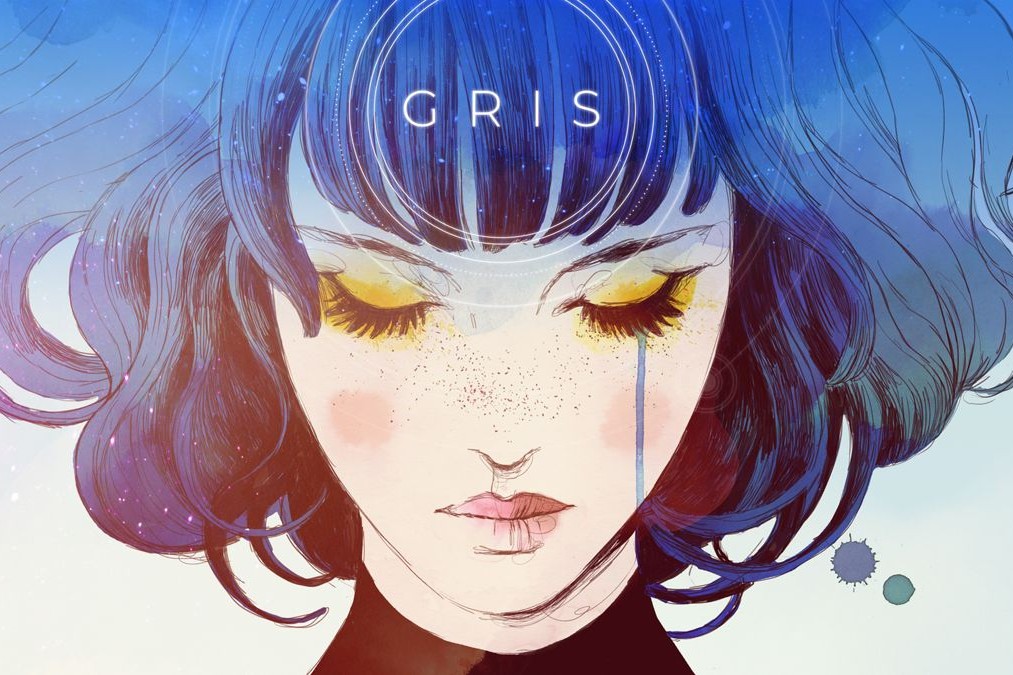

Developed/Published by: Nomada Studio / Devolver Digital
Released: 13/12/2018
Completed: 05/04/2026
Completion: Finished it. Did most of the extra puzzles for the first couple of sections then lost the taste for it and only did extra ones by accident.
Gris has sold over three million copies and been out for eight years, so I think I can get away with saying: it’s bad!
I can be pretty hard on “artistic” games, by which I make a distinction from pure “art games” and the more commercialised form. The kind of game that may have ~themes~ but still feels like a product. Games that, often, don’t really feel like they’ve got anything to say–or at least, nothing that challenges the audience (not that all art has to be a slog.)
I’m aware that this may be uncharitable; after all, it can be personal preference. We come to anything with the knowledge we already have; a work that might seem obvious and derivative to me might be completely mind blowing to another person who has never seen anything like it. So I shouldn’t–really–beat up on Gris too much for being trite.
In Gris, you play the titular character who–after waking up in the palm of a crumbling statue–travels through a 2D platformer world gaining abilities, collecting stars and facing off against a black creature who seems to want to stop her bringing colour back to the world.
There’s no dialogue, but the game is–blatantly–about grief and the “black dog” of depression, and if you think that “binging colour back to the world” and being chased by a big inky black creature that’s trying to stop you is sort of an embarrassing way to explore those themes, well, snap. But I did intend to be charitable on this aspect, so let’s just let that slide.
What I can’t let slide is that Gris is simply not enjoyable to play, with a catalogue of design flaws that make it–despite what should be a breezy, sub-four hour playthrough–miserable. First: the game does an absolutely horrific job in making it clear what is something you collide with or not. What’s foreground, background and so on.
The game is very art-forward, which is understandable, but it feels like there’s no consistency. There are so many sections–especially in a later swimming section–where I repeatedly just hit myself against walls because it looked as much like background as anything else. I admit was on an Steam Deck, so you could argue the game’s reliance on zooming out a huge amount is at fault, but I don’t really think “you need a big monitor or telly” is much of an excuse, or even true.

The level design is also full of the kind of decisions that should have been caught long before release. Pretty much every level begins with you being dropped somewhere so you can head either left or right… with no hint of a critical path. Indeed, sometimes the game takes you back to a hub and every time it happened I thought “oh, I’ve made a mistake here” but I hadn’t. You could argue that’s kind of a magic trick–I was always heading in the right direction–but if I’m still feeling uncertain and unclear, it’s not so much a magic trick as “something confusing that happened.”
A lot of the problem relates to the fact that the game doesn’t make movement especially fun. Gris makes the classic error of making your movement unpleasant at first so it can get better later (rather than starting good and getting excellent; I admit I just complained about this in Promise Mascot Agency.) If I enjoyed movement, I’d be more inclined to explore when hit with a variety of directions I could possibly go.
Gris feels like she’s moving very slowly in those massive zoom-outs (you’ll beg for a dash) and when they introduce swimming, it’s so frustratingly slow and gummy it’s just awful (and don’t think you can try and double-jump your way out of the problem–each time you get dunked, making it feel even slower.)
And yet ironically, one of the worst things about Gris is that in key narrative moments–big chase scenes–you lose control completely1 reducing you to a mere spectator of the beats that should be thrilling. It’s not a relief to not have to move Gris; it just makes you wonder why you’re bothering to play any of it at all.
For a game that wants to be about overcoming adversity, it’s a problem that the actual adversity that the game provides is simply a catalogue of tiny frictions that make every interaction with it low-level annoying. The puzzles–which use Gris’ growing range of abilities–are basically fine and paced acceptably. Indeed, one aspect of the level design I appreciated was how they tucked the “extra” puzzles for collectibles around the critical path puzzles so they kind of worked as a second challenge on the “same” puzzle. But after the first level, I just stopped doing them, because I wasn’t interested in struggling with the game feel any further than I really had to.
If I’m being completely fair to Gris, even if I found the narrative at best basic and obvious, you could go over this game, get rid of all of its frictions and you’d have a solid–if maybe uninspiring–puzzle platformer. It feels very much like a problem of not getting the feedback when it could have made a difference, not listening to it, or simply not having the time to act on it. But who am I to speak? As I said, this sold millions of copies. They’re fine!
Will I ever play it again? I’m good. The team went on to make Neva, and I suppose I have some interest if they were able to fix the problems of Gris with it, but not enough to find out.
Final Thought: There’s an extra cutscene for getting all the collectibles, and something I suppose I do find sort of interesting is it makes the exact theme of the game explicit. Now, you might think I’d be against that, considering everything I’ve said, but in a weird way the cutscene does “cap off” the narrative in a way the normal ending doesn’t, and I think it’s kind of a shame that they hide it from most players. I contain multitudes.
- Pedants may wish to note that you can slightly move Gris left and right or up and down in some of these. But it’s meaningless. ↩︎