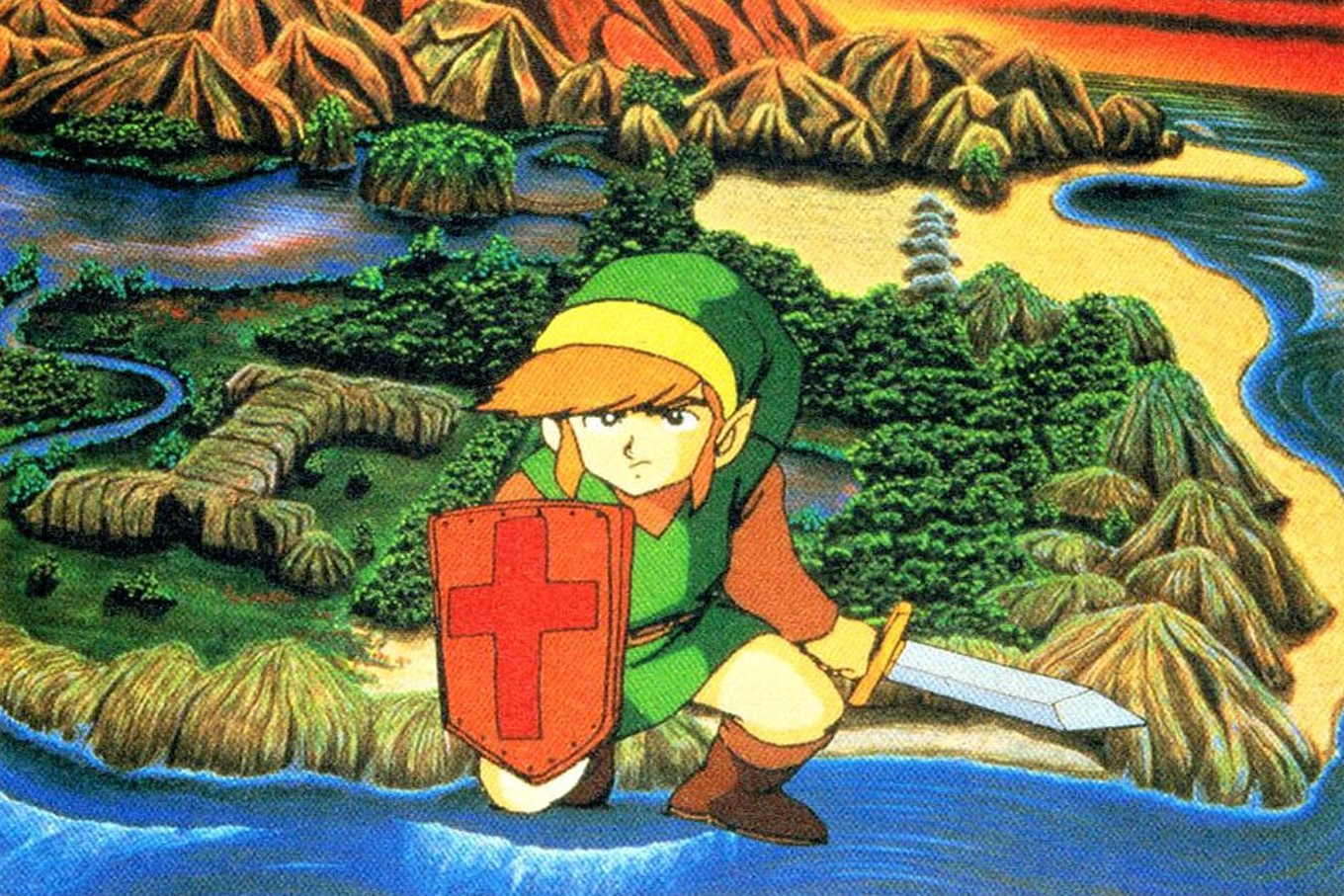

Developed/Published by: Nintendo R&D4 / Nintendo
Released: 21/02/1986
Completed: 17/08/2025
Completion: Beat it for the second time!
Well, I can’t be playing obscure ones all the bloody time.
I have a long history with The Legend of Zelda, as a lot of people do, though like many–if not most(?)–non-Americans/non-Japanese, my history does not begin with the original game. For me it started with Link’s Awakening, and I wouldn’t play the original until 2004 when I was able to treat myself to a Famicom Edition Gameboy Advance SP and a copy of the Famicom Mini Series Legend of Zelda. I remember being so excited to finally play such an iconic game, picking it up, getting completely lost, dying a million times when struggling with the stiff controls, and then deciding the cute little box was just a nice thing to have on my shelf and moving on with my life.
I would go on to finish The Legend of Zelda years later–trading off the controller with BancyCo’s Benjamin Rivers–and even wrote a limited zine about that experience (I keep meaning to do a proper “history of exp.” page on this website, and I will, but today is not that day.) That completion–around 2011–meant I classed The Legend of Zelda as “previously completed” on the big “I’m not neurodivergent I promise” spreadsheet I keep, and I didn’t intend to return to it until I read in Wes Fenlon’s excellent newsletter Read Only Memo (worth subscribing to! As long as you’ve subscribed to mine too, obviously) about romhacker infidelity’s SNES port, which could be considered completely faithful while still featuring a bunch of lovely quality of life fixes. And considering I have a wee emulation device I adore, and found myself with a bunch of downtime due to some work I’d picked up that involved a lot of sitting around waiting for things to happen, I thought… why not? It’d make a nice change, and refresh my context for 1986.
Something that is really important to mention, though, is that this time I came prepared. Now, I can’t remember if the wee Famicom Mini version of The Legend of Zelda came with a reproduction manual or not–I don’t have it to hand–but I’m assuming it didn’t (or if it did, I overlooked it, because what is this, a manual for ants, etc.) but I’ve long learned my lesson since I was downloading Infocom games and being baffled by them–you read the manual. And when you do, well… The Legend of Zelda isn’t baffling at all.
Well, for a bit. And it’s still hard as balls initially, but we’ll get to that. I was shocked when I read through the manual–and this is true of the Japanese manual too–that it literally explains, cleanly and clearly, all the things you can get, all the enemies you’ll face, gives you instruction on what you’re trying to do, and then includes a complete walkthrough on how to get to the first dungeon (and guidance on how to get to the second.) I guess I’d never looked at the box closely before, where it literally says “Includes invaluable maps and strategic playing tips.”
I’m reminded of that classic bit of weirdly banal Shigeru Miyamoto lore, that he likes to learn a city by walking it (who doesn’t) and imagined him going “I mean I do start with a map and a destination though. It only makes sense. I don’t just walk out the door and start wandering. I’d get lost.”
Because, of course, this does all make sense! No one at Nintendo is thinking “well, people will be playing this without the manual in the future.” Back then, the manual was part of the product, and it really does a great job in getting you through the early stage of the game… at which point you can throw yourself into getting properly lost, equipped with more hearts and weapons to survive it.
Historical Aside
Christ, what’s going on here? A boxout? I haven’t done one of those before. Now, despite what I’m saying about the manual here and the game being intended to make sense with it, there is a possible–if unlikely–alternative which relates to a rumoured influence on The Legend of Zelda. John and Ste Pickford are quoted as saying that one of the Stampers, founders of Rare, had referred to The Legend of Zelda as “Miyamoto’s rip-off of Sabre Wulf”. Now, The Legend of Zelda actually does have notable similarities to Sabre Wulf and Rare’s earlier title Atic Atac, and one of the interesting things about Sabre Wulf is it comes with a manual that tells you almost nothing at all–I suspect many players didn’t even decipher that they were supposed to collect four pieces of an amulet from it.


Separated at birth?
So if you take the Stampers at their word–and remember, they were tight as fuck with Nintendo, meeting with the company potentially as early as 1985–the complete bafflement I and many players first met The Legend of Zelda with could have been as intended as anything.
The thing about the opening of The Legend of Zelda though… no matter what, it’s fucking hard. You’ve got three hearts, a weedy sword unless you’re at max hearts (which won’t last long) a shield that barely blocks anything, and you have to get comfortable with moving and attacking only on the four cardinal directions while your opponents seem to move near randomly. Playing it “for real” I died a lot, but the game is also shockingly forgiving for the era, bringing you back to life at the start with everything you’d collected intact–even dying in dungeons just brings you back to the start.
This has the great effect that exploration and experimentation always feels worth it. You can delve into a dungeon just to see what’s down there, wander to a new area to see what you can find, and do “suicide runs” to get a necessary item if you know where it is. It’d be sort of perfect if the game wasn’t so stingy that you respawn with just three hearts filled no matter how many you have, because they have an abysmal drop rate. (I won’t lie, towards the end I did abuse save states just to quickly cheat at the gambling game so I could keep myself stocked up with potions. Life did eventually start to feel too short.)
Because the game is so open, it does resort to (klaxons at the ready?) the Xevious/The Tower of Druaga “find the hidden stuff to progress” design. I am inclined to be a little more forgiving than usual here because of the open world and that the game does drop hints, even if they are obscure in Japanese and mangled in English. Back then everyone had a lot more time, a lot fewer games to get through, and the communal solve experience had continued from The Tower of Druaga in arcades to The Tower of Druaga at home (in Japan at least.) But I’m sure many kids, stymied, just took to bombing every wall and setting fire to every bush, and I can’t really justify that–the game definitely doesn’t drop enough hints, and there are definitely too many moments that can bring your progress to a dead-stop without outside help.
Thankfully, in 2025 I was just able to refer to Phil Summers’ incredible Hand-Drawn Game Guide, which… look, it’s cheating, it’s a walkthrough, but it’s got such an easy, homegrown charm, it’s like your pal is helping you through the game. I can’t recommend it more highly if you’re approaching this game for the first time–read the manual, follow it, then as soon as you get too bored or lost, or just don’t feel like you’re making enough progress, just start referring to it.
And anyway, you still have to beat the bloody thing yourself! If I have a real criticism of The Legend of Zelda it’s that it just doesn’t feel that great to play. The extremely stiff feeling of combat never goes away, and the enemies that require you manoeuvre carefully to hit them like Darknuts and Wizzrobes can absolutely suck a dick. Wizzrobes in particular, which are fucking everywhere in the last few dungeons. Unsatisfyingly, the end of the game does feel like a bit of a sprint as you basically try and dodge as much combat as possible, because it offers no reward. The terrible health drop rate is quite a negative, honestly.
Saying it doesn’t feel that great probably sounds completely disqualifying for The Legend of Zelda, but I do have to mention again that it exists in the context of 1986 in Japan, and was still close to cutting-edge when released just over a year later in the rest of the world. Despite what the Stampers might have said, and even despite the existence of things like Ultima IV, at this point no one has put as complete a package together as Nintendo has. For the second time after Super Mario Bros. they’ve created something new out of whole cloth and no one else even saw it coming.
Will I ever play it again? After all of this, I’m suddenly reminded what I was actually going to do when I intended to “replay” this was to play through BS Zelda for Satellaview. Oops. Well, I can still do that whenever I like.
Final Thought: The craziest thing about Nintendo creating something this new, this different, this polished?
They’ll do it again in a matter of months.