
Developed/Published by: Millennium Kitchen, Aquria / Level-5
Released: July 18th, 2013
Completed: 3rd October, 2014
Completion: Finished the main story and all of the “episodes” other than that one which requires you to play the mini-game over and over and over and ov
Trophies / Achievements: n/a
There are a couple of things recently in my life that have caused my face to seize up into a rictus of sheer joy. The kind of frozen, gawping wonder that you’d assume, had you caught me in the middle of it, that I’d just taken some brain candy and locked myself in the memory of going down “The Big One” in Blackpool at some innocent age, a long, long time ago.
Well, I’ve never been on “The Big One” so it wouldn’t be that. One of these two things was seeing Tilda Swinton in Snowpiercer, playing the ungodly spawn of Margaret Thatcher and Jarvis Cocker. I’m not totally sure why that tickled me so much, but it did. The other was Attack of the Friday Monsters!’s intro, which you can see here.
Oh my god, right? It’s so sweet. It’s sweet like having a man with fists made out of lugduname punching all your teeth out and then grinding them into dust to save you the indignity of watching them rot out your head because it is so sweet. The incredible on-the-nose nature of the lyrics; “I am a child,” “My dad is a dry cleaner.”
So much simplicity, but also, so much depth.
And on that level, Attack of the Friday Monsters! is an interesting one. You see, as a game, if we’re going to “review” it that way, Attack of the Friday Monsters! is deficient. It’s very, very basic. The game tells you to go a place, you go there, things happen. There isn’t really any puzzle-solving to be had. There’s a collectible card game that you’d think was really important, but you actually only play it about three times in the main story mode, and the game itself is a very simple rock-paper-scissors-a-like that might have some tactics to it but (frankly) they’re so subtle as to be basically pointless.
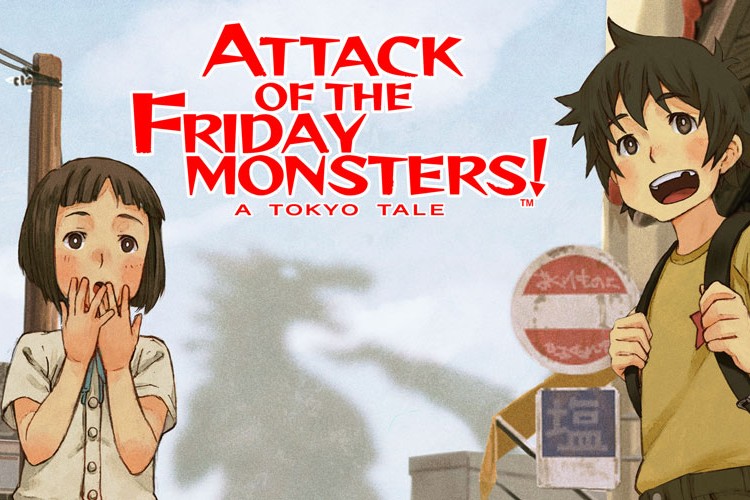
There’s really nothing to it at all. And yet Attack of the Friday Monsters! is deeper than many games by virtue of its setting and story. Set in a small Japanese town in a not-directly-defined period of time, it follows Sohta, who has just moved there with his family (his dad’s a dry cleaner, as pointed out in the song) and is set the task of delivering some freshly cleaned clothes on Friday, the day of the week huge monsters have a fight on the outskirts of said town (so he’s got to be home before that happens.)
It sounds “wacky” and “Japanese” to have a game where giant monsters fight near a small town and everybody just accepts it, but as is (obviously) the case there’s so much more to it than that. Directed by Kaz Ayabe, known for the (never released outside of Japan) Boku no Natsuyasumi series, Attack of the Friday Monsters! is similarly a reflection on Japanese childhood and a thoughtful take on the rhythms of Japanese life and culture that surround it. It’s much, much closer to, say, a film by Hirokazu Koreeda than it is another video game, which makes Ayabe absolutely unique as a game developer. You see, Attack of the Friday Monsters! isn’t really about the “play” as such. It’s about being a wee kid in a new town, about being told what to do by your parents, about being side-tracked, about meeting new kids, about not really feeing in control of anything about your life (because you’re a wee kid), about having to be introduced the games that the kids in your new town play, about how those games seem weird and silly, about the lies your parents tell, about the lies parents hold…
It’s about the golden age of tokusatsu in the sixties, when televisions became more usual in Japanese homes as the country left recovery from World War II and began to boom; in fact it’s about being a child at that period, and not having the experience of war first hand to see Godzilla as a metaphor the horror of nuclear warfare, but as a hero to cheer on when he battles Ghidorah, the Three-Headed Monster. It’s about that difference, that gap right there at a moment in history where Japanese adults saw something, Japanese children saw something, and that what the children believed became true, because after all, they believed it so forcefully, so unquestionably, and the adults had been helping them believe it. Because why not make believe, after so much struggle?
Attack of the Friday Monsters! is about so much more than rock-paper-scissors. It’s definitely about more than semantic quibbles of how good a “game” it is or not. It’s trying to say something bigger, and I think it’s easy to get lost and forget that’s entirely possible when we grind things down to their mechanics.
Will I ever play it again? Hmm. I’d love to play it again, maybe on a big screen, but on 3DS probably not.
Final Thought: That Ayabe can manage so much with an experience that clocks somewhere in the region of a couple of hours makes it a legitimate tragedy that Boku no Natsuyasumi has never been released for audiences beyond Japan. It would be a serious issue if Koreeda’s work had never been seen outside of his home country, for example. That art is accessible is important, and it’s something that the games industry still struggles with.
This essay is featured in Every Game I’ve Finished 14>24.