Tag: konami

  • Castlevania (Konami, 1986)

    Castlevania (Konami, 1986)

    Developed/Published by: Konami
    Released: 26/09/1986
    Completed: 09/09/2025
    Completion: Finished it. I did do a save state before Dracula though, to avoid repeating an exploit.

    I’ve been in the trenches of 1986 for such a long time by this point that I feel like, sometimes, I lose a bit of perspective, so as I reach Castlevania, released within two months of Metroid (and also on the Famicom Disk System) it’s good to take a minute to reflect again on the strength of the release calendar for the Famicom. It’s not just Nintendo’s groundbreaking output, for example, it’s also incredible arcade hits such as Gradius and Ghosts n’ Goblins coming home in solid ports.

    And with the influence of The Legend of Zelda and especially Metroid going to take more time to disseminate, I think it’s important to consider Castlevania within the post-Super Mario Bros. milieu where the arcade still reigns supreme as the state of the art. You went to the arcade and wanted to play games that good at home, and developers wanted to sell people on their “arcade quality” experiences, even if there was no arcade title attached.

    I’m assuming you can see where I’m going with this, but the interesting thing about Castlevania is as much as it is tied to the Metroidvania genre–and would begin dipping its toes into that within a month–the first game is no more attempting to create an expansive, “home” experience than Konami’s earlier port of Gradius is. If you’re being generous, you could claim that Castlevania is Konami’s attempt to make the style that’s already worked so well for them in the scrolling shooter for the arcade–short, hard games with impactful, unique levels and standout bosses–translate to the side-scrolling action game/platformer for the home. If you’re not being so generous, you could say this is Konami’s rip-off of Ghosts n’ Goblins.

    That one probably works better.

    I don’t think it’s unfair, really! Ghosts n’ Goblins is a good port, but it looks weedy. It’s hard not to imagine Konami, given the extra power of the Famicom Disk System, thinking that they could simply do something better, and the hallmarks are all there. A spooky setting. A stiff, inflexible hero who struggles with platforming. Limited power increases and different weapons to collect, which all have important situational uses. When you look at the original Japanese titles it looks even more sus. Ghosts n’ Goblins is “Demon World Village” Castlevania is “Demon Castle Dracula” (to not get too into the weeds on this, Demon isn’t spelled exactly the same, but they do both use the kanji 魔.) And if you don’t consider that case closed? Well, there’s also the difficulty.

    The bloody difficulty.

    Unlike Ghosts n’ Goblins, Castlevania absolutely lulled me into a false sense of security at the start. There’s no Red Arremer here as a harsh wakeup call, and the first boss, a bat (which does have a bit of the Red Arremer about them) is easily dealt with if you have the axe subweapon, which is literally in a candle right before them.

    Once you’re in the second level, however, all bets are off, as you’re suddenly facing the dreaded medusa heads paired with the fact that you lose a life if you fall into a pit (easy to do as you get stunned and knocked back on getting hit) and it only gets worse from there. There are some absolutely hair pulling moments.

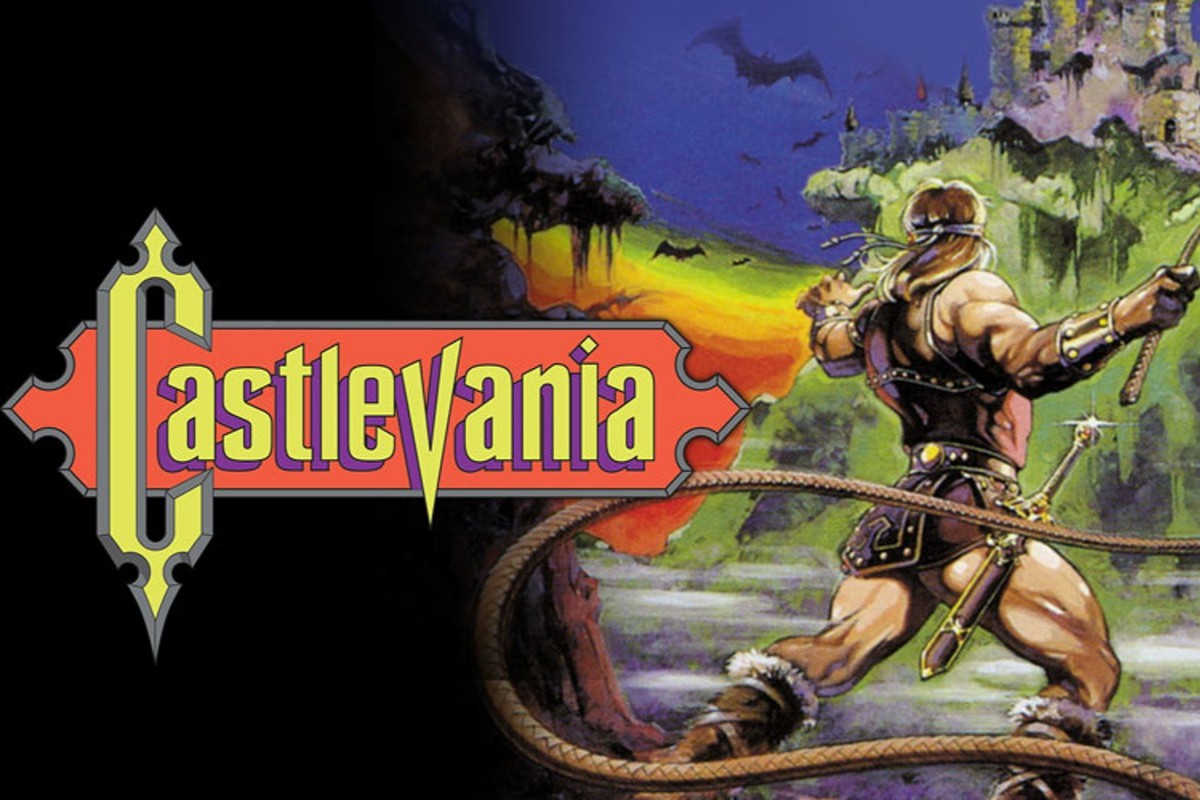
    Really, Castlevania feels like a game that shouldn’t work, because hero Simon Belmont is so slow and it’s such a challenge to react to anything. But the game has a weird sort of pleasure in its heavy, exacting feel. Simon slowly moves forward and really feels like he’s absolutely thumping the enemies in front of him, and a bit like a shooter it’s all about finding your racing line through the game, collecting the right subweapon at the right time and learning where the meat Dracula has stuffed in his walls are for safety (good poll if they ever add polls to Bluesky: would you eat Dracula’s wall meat? Yes / No / If I was really hungry, I guess). 

    There’s also an intriguingly vestigial sort of hidden, sort of experience system–if you use subweapons a lot enemies eventually drop upgrades that let you have up to three on screen–but it’s foiled by the fact you want to switch subweapons a lot and you lose the upgrades when you do (why!!!) but if you can master it you can absolutely cheese some of the bosses–I mean, it’s how I saw the end of this…

    I even like that Dracula’s Castle sort of makes sense as a layout. I mean, it doesn’t really, but I like that they made the drop that happens after you fight the mummies sort of the correct length, and then you might be surprised that the “clock tower” section of this game is so short, but it’s tall and thin… like a clock tower!

    The brutal difficulty of Castlevania makes some sense on the Famicom Disk System because you could save at any stage(!) and when the game was re-released on cartridge in Japan it got an easy mode–although it removes knockback on hit, which just seems weird (if you’re interested, it’s included in the Rumbleminz SNES port, the method by which I played this.)

    Ultimately, if Konami set out to best Ghosts n’ Goblins… well… they did!

    Will I ever play it again? I will play its many, many remakes and… side-makes?

    Final Thought: Yeah, so, the weird thing about Castlevania is that it came out on Famicom Disk System just a month before it came out on MSX2 (a version generally known as Vampire Killer, as it was titled that in Europe.) Although Vampire Killer shares graphics, enemies, and is still a trudge through Dracula’s castle, individual level design differs completely, as levels are non-linear and you’re expected to search them for a wider range of items, upgrades and keys to unlock doors to the next level!

    Annoyingly, I can’t find good information on why the games are so different, outside of pretty generic speculation (“now, PC games drive like this [mimes driving like a huge nerd] and Famicom games drive like this…”) so it’s really hard to say what concept “came first.” if the MSX version was the original idea, then my Ghosts n’ Goblins hypothesis–my Ghosts n’ Goblothesis–is incorrect. 

    I do feel like it would be a bit unusual if both games weren’t directed by the same man, elusive series creator Hitoshi Akamatsu, and Castlevania II would go on to be much more of an adventure, which would be a mark against my goblothesis, but weirdly according to an amazing shmuplations translation, Akamatsu was inspired by The Maze of Galious, which is itself a post-Vampire Killer design, so who knows. I guess I can get closer to finding out if I play it, so let’s see how long I can avoid that for.

    Update 2025/10/01: Actual game historian Kate Willaert got in touch over on Bluesky with some critical context:

    “My understanding, from delving into this era of Konami, is that the two versions of Castlevania were developed in parallel, with the teams possibly sharing ideas with each other, and so neither game is “first” nor the “real” one. See also MSX vs. FC Goonies, which laid the groundwork for this game … While it’s possible that Ghosts N Goblins inspired some surface elements, my personal theory is that the foundation of Castlevania can be found in the computer game Aztec, which was fairly popular among a particular generation of Japanese game devs.”
  • Castlevania: Aria of Sorrow (Konami, 2003)

    Castlevania: Aria of Sorrow (Konami, 2003)

    Developed/Published by: Konami Computer Entertainment Tokyo / Konami
    Released: May 6th, 2003
    Completed: 15th November, 2014
    Completion: 99.8% map completion. I have no idea which tiny secret area I missed. Gah. However, I saw all three endings anyway.
    Trophies / Achievements: n/a

    Look, if you tied me to a chair and demanded I tell you which Metroidvania is the best Metroidvania, well, first I’d say “Jesus, you didn’t have to tie me to a chair. I’ll just tell you, ok?” and then I’d say it’s…

    It’s Metroid: Zero Mission. There’s no debate here. If you’re planning on tying me to that chair again to attempt to change my opinion to something stupid, like Super Metroid, well, you’re going to have to… actually to be honest I’d probably just agree with you long enough to get out of the room/basement/storage locker/wherever it is you tend to do your tying of people to chairs to find out and then change their opinions.

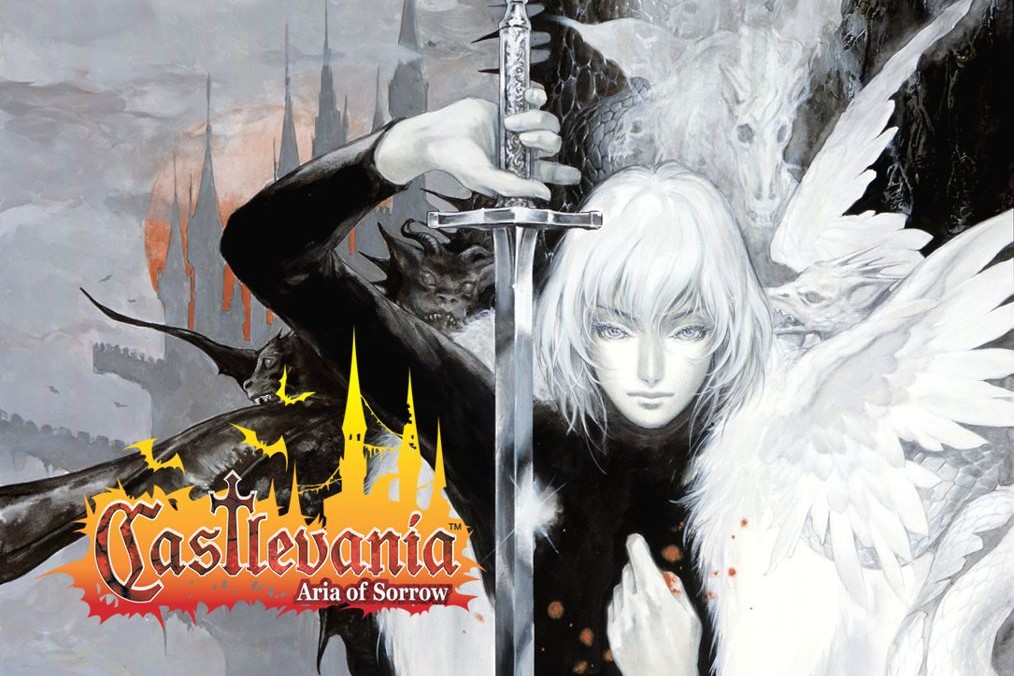
    Anyway. Metroid: Zero Mission is great, and it’s on the GBA, which had a lot of good Metroidvanias (remember when there was a turf war where some people wanted to call them Castleroids? Ah, simpler days.) Case point: Aria of Sorrow! It’s a good one! I probably liked Harmony of Dissonance more, even if the music in that sounds like a piano being dropped down a fight of stairs onto a mariachi band. Oh, and the the graphics are kind of bonkers; meanwhile Aria of Sorrow looks amazing—very consistent in a way that Castlevania games sometimes struggle with.

    I dunno, though. Look, it’s your basic IGA-led Castlevania, you know? Really big, sprawling castle that makes no spacial sense. There’s a setting-related excuse thought—the castle is some sort of dimension of its own, as a result it’s just mad—but in this one I was really struck by how, I dunno, randomly designed Castlevanias can be. There’s definitely a thread to the design—players are going to go here first, before they can go there, because they need that—but you often get a sense that the rooms are just “well, this one is a corridor, and this one is a 4×4 cube” and the challenge is designed this way “put respawning skeletons in that one, and a bunch of axe armours in that one.”

    I mean, there’s a good reason people wax lyrical about Dracula X (or the other, more linear Castlevanias) they’re very carefully designed into a moment-to-moment experience. Here, there might not be a clear “encounter” or design to a room; it’s just a space with some stuff in it. In retrospect it’s that which makes the castle design feels weird in Castlevanias; the rooms don’t have to make sense (a kitchen doesn’t have to be a working kitchen) but they have to make sense as a designed play-space. Mario levels make no sense at all, but they’re so carefully designed as experiences that we accept that Bowser’s castle is constructed of wobbly blocks that dip themselves in lava, cannons that constantly fire, etc. in a way we don’t with a Castlevania. Or at least, I don’t.

    I mean, really, the one section that stands out in every Castlevania is probably the Clock Tower, simply because they’re always so clearly modelled on the Clock Towers from Dracula X—entirely about the experience of dodging harpies and Medusa heads while climbing cogs. Sure, it’s frustrating, but it’s designed.

    To be honest, Aria of Sorrow is a really strong example of something that’s become endemic in games right now—weak or non-existent level design being utterly papered over with collectibles and RPG systems. I mean, Aria of Sorrow feels good to play (I will never get sick of the ol’ “dodge back out of enemy attack, move forward and attack” dance) and everything you do gets you more exploration percentage, more levels and new weapons and things. There’s always something new to kill or new to kill something with, and it works; the game might be sloppy and empty as a designed experience, but the “feel” is superb. And, you know? Here that’s enough. I ain’t gonna complain.

    Will I ever play it again? Yeah. I can see myself playing this again, it’s nice and short. I’ll have to finish all the DS Castlevanias first though… no, really!

    Final Thought: I know you’ve probably spent the majority of this article preparing the ropes and your special torture chair simply because I don’t like Super Metroid very much, but please don’t let this distract you from Aria of Sorrow’s perfectly pleasant time. Maybe let it distract you from the game’s story though, which is total bobbins and the one thing I found annoying.

  • Time Hollow (Tenky, 2008)

    Time Hollow (Tenky, 2008)

    Developed/Published by: Tenky / Konami
    Released: 23rd September, 2008
    Completed: 21st July, 2014
    Completion: Finished it!
    Trophies / Achievements: n/a

    This has been lying in a pile of Nintendo DS games forever. Probably don’t ask me why I decided to play it now, I’m not sure I actually have a reason. Maybe that I’d went to see Patlabor: The Movie and its sequel in the cinema and felt like something anime-ey? I have no idea.

    Anyway, Time Hollow is… is this what a visual novel is? I mean, I honestly don’t know. Is the Phoenix Wright series a visual novel? If it is, this is one too, because they’re… similar. Ish. In that you wander about, collect clues (sort of) and watch talking heads talk to each other for a pretty lengthy period of time. If they have another name, it’s probably something like “visiting locations over and over and clicking the screen everywhere until you hit the right trigger for the story to continue novels”.

    Remarkably, however, I quite liked Time Hollow. It’s short (taking about as long as an average young adult novel to read, probably) and there isn’t really very much game to it, but it’s charming. This is the kind of thing where the story has to keep you interested enough to put up with all the “is it this? Is this what you want?” clicking, and for me, it did! 

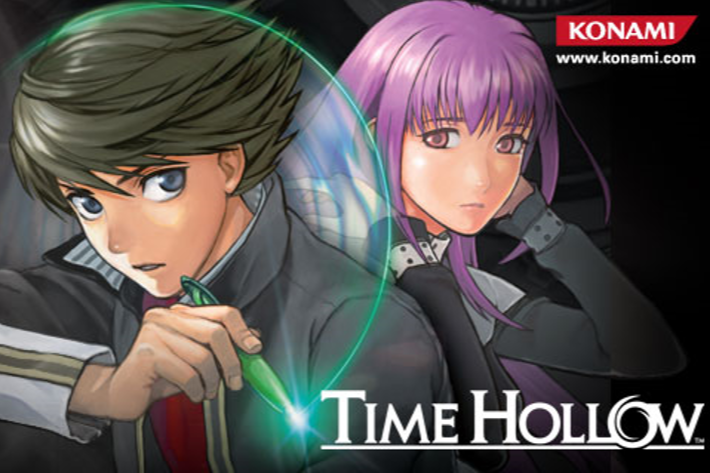
    You control Ethan Kairos, who ends up in a timeline where his parents disappeared some years ago. Given a magic pen that allows him to open portals to the past (quite honestly the weakest excuse to use the DS’s touch screen ever, and you only do it about eleven times) he sets out to solve the mystery.

    It sounds pretty… anime, and the start—where you’re introduced to his school chums and the specky lassie that fancies him—sets alarm bells ringing, but written by Junko Kawano of Shadow of Memories non-fame it’s far more interesting than that. Rather than being one of those time travel things where the hero does a bunch of stuff, time changes for better or worse and he goes about fixing it if it went wrong, here it’s delightfully mixed up by giving other characters the ability to change timelines, meaning that as soon as you “fix” something, someone else might pop in, break that and leave you in a new reality that you have to get your bearings in before you can even work out what to fix.

    It’s all scripted, of course, which does mean you’re not really doing any actual work to make any of this stuff happen, but it’s all pretty logically consistent for a time travel plot, even if it doesn’t wrap up quite as neatly as I’d hope (as usual, the characters are never as smart as the players.) It’s frankly far more entertaining than it has any right to be.

    Will I ever play it again? Nah. Although I’m adding it to my collection of DS games, not just getting rid of it, so there’s that.

    Final Thought: Entirely possible that I liked this just because a pet cat is a fairly important character in the whole thing. Well drawn, cute meows, A++ cat would cat again.

  • PES 2014: Pro Evolution Soccer (Konami, 2013)

    PES 2014: Pro Evolution Soccer (Konami, 2013)

    Developed/Published by: PES Productions / Konami
    Released: 20th September, 2013
    Completed: 9th July, 2014
    Completion: Won the World Cup as Scotland (on penalties versus Uruguay in a 0-0 nailbiter.) That’s all that matters, really (though I did also play Be A Legend as Messi, lazily, for a while.)
    Trophies / Achievements: 38%

    Football! Yes, we’ve gone football mad here at exp. Towers, what with the World Cup and everything (though that’s finished by the time you’re reading this, which means that we’re no longer football mad and are instead football sane.) 

    Whenever there’s a big international tournament (because the Old Firm has led met to basically distrust and fear club football) I tend to like to play a footy game, and it’s almost always Sensible Soccer (I usually go to the bother of finding the most recent update files and everything.) However I decided to actually try a “modern” football game for the first time in years and years, and it was this one!

    Note I put “modern” in quotes there, because the weird thing about PES 2014: Pro Evolution Soccer is that—and this is probably not news to people who buy football games every year, or whatever—it feels like a game that could have come out on PS2. I mean… it looks like one too, sorta. shonky animations, character faces that—unless they’re a star—are generic, crap crowds, awful, repetitive commentary…

    It’s sorta weird! And retro! But not in a good way, like Sensible Soccer. In a way that makes me think all the way back to this series when it was International Superstar Soccer on Nintendo 64, except faster? 

    In fact, after playing a few quick exhibitions I decided to scale back my ambitions from “I’m gonna download all the fan-made real team information and play this seriously!” to “let’s win the World Cup with Scotland and call it a day.”

    It’s important to note, however, that if you look past all the surface stuff, PES 2014 still plays a decent game of footy. Don’t play it on Beginner (at all) otherwise you’ll spank every team like they’re Brazil (a sentence that now makes sense after this World Cup) but on Regular, it’s fun! You know, football. Passes, through balls, that sort of thing. It’s not very exciting, you’d probably call it workmanlike, but scoring a goal still feels amazingly rewarding, so there’s that.

    Will I ever play it again? No. Next time (Euro 2016, probably) maybe I’ll pick up a FIFA. Those feel “new” right?

    Final Thought: I didn’t really discuss why I put PES 2014 down so fast, did I? Indeed, I’m sure there are many, many people out there who want to moan about my surface take on this, after all the website crows about the game’s “trueball tech” and the “M.A.S.S. (Motion Animated Stability System.)“ Even if that was all incredibly apparent, there’d still be the UI.

    This is a game where, in the flagship modes are “Be a Legend” and “Master League”, you spend a lot of time in menus. It’s also a game where literally every screen has a loading screen after it. Where information that could all be on one screen is spread across two or three. Where getting from one football match to the next—even if you don’t touch or change anything—can take two or three minutes.

    It’s gash; it takes all the imagined fun of “being a footballer” or “managing a football team” and replaces it with all the fun of “watching loading screens” and “turning off the music because there are only six songs” and “stopping playing this forever.”