
Developed/Published by: Kaizen Game Works
Released: 10/04/2025
Completed: 10/03/2026
Completion: Finished it doing pretty much everything outside of getting all the garbage and signs.
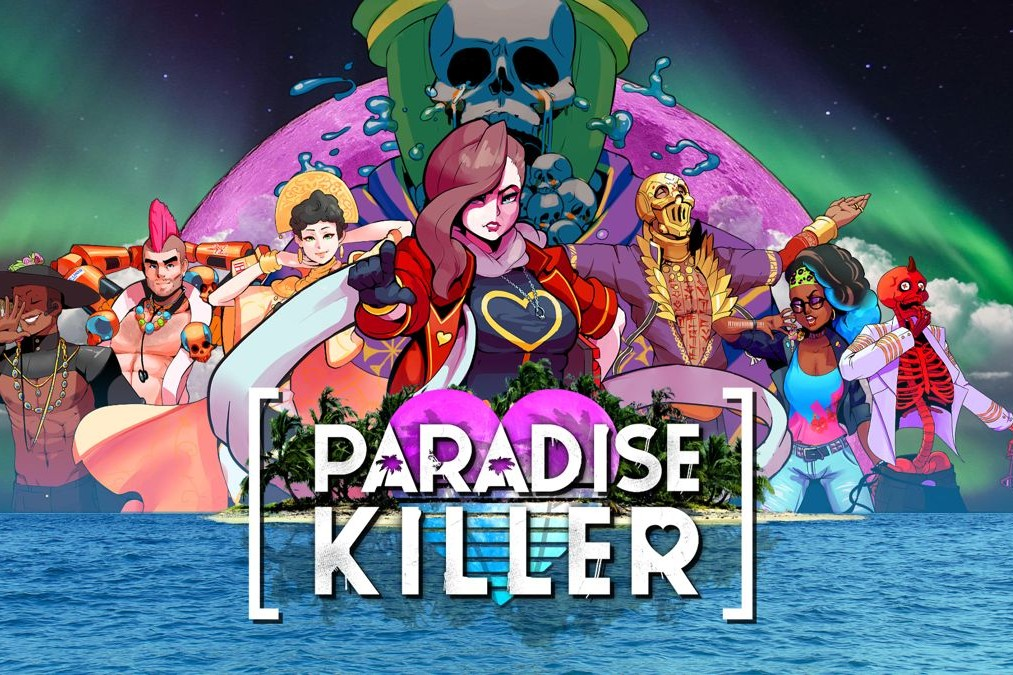
I was a big fan of Kaizen Game Works’ Paradise Killer, even though I came to it late, and I’ll admit to being a bit hesitant about Promise Mascot Agency, considering the risk–a UK company making a game about wacky Japanese mascots?–but I was concerned before playing Paradise Killer that it’s vaporwaveyness was going to be grating, and it more-or-less worked, so I decided to give them the benefit of the doubt.
Well, Promise Mascot Agency is a textbook example of that “difficult second album.” There’s a lot to like here, but there’s also a kind of messiness to it. If it was literally an album, there’d be some really discordant stuff on there, the kind of album where you want to skip every third or fourth track because it doesn’t work, and on which none of the other songs are quite fully-formed enough to quite get their hooks into you. Not an album, even, where you feel ambition got the better of them, just one where they noodled too much, for too long, and ended up with something that almost–but not quite–works, and to do anything else would require throwing away all the work they’d already done, and what’s there isn’t terrible, so it doesn’t deserve that.
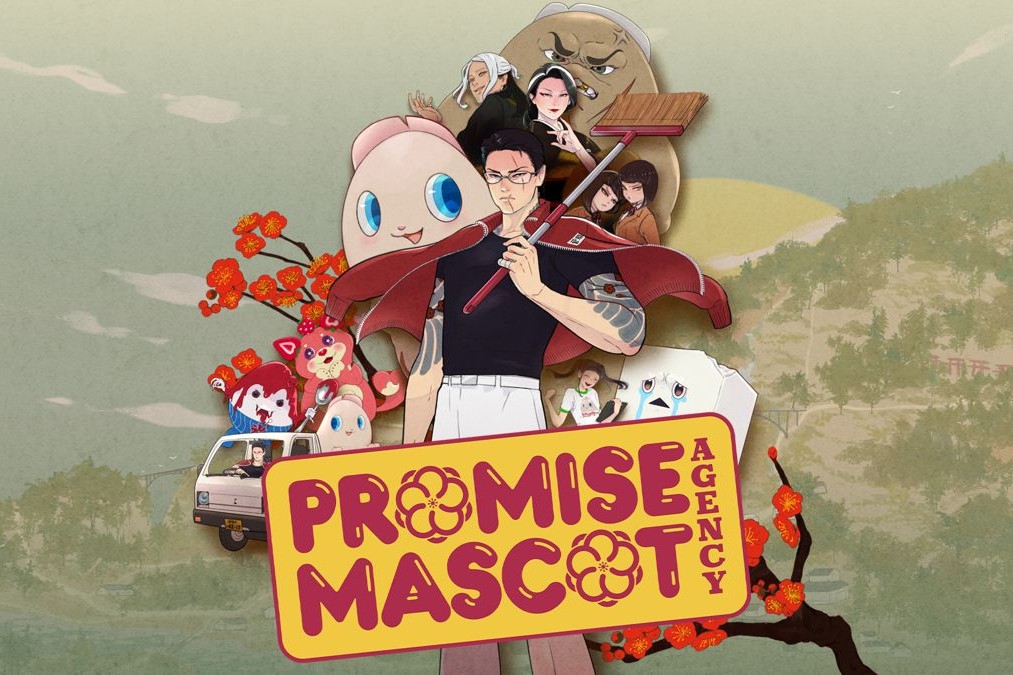
In Promise Mascot Agency, you play Michi, aka “The Janitor”, a classic, Yakuza-series style honour-above-all super amazing guy, which means it makes perfect sense that he’s voiced by the literal Kazuma Kiryu, Takaya Kuroda. Michi and his yakuza brother, Toki (who doesn’t seems sus immediately at all) are ambushed on a job, leading to his family owing a truly absurd amount of debt and his death a requirement. Lucky for Michi, however, the family happens to own a failing mascot agency in Kaso-Machi, a town where Yakuza never go because… it’s cursed! The kind of curse that kills any Yakuza who goes there. Considering he’s a dead man anyway, Michi heads to Kaso-Machi in his shitey old kei truck, aiming to raise as much money with the help of a sentient finger before he croaks from whatever it is the curse does.

Promise Mascot Agency is, in a lot of ways, a mechanical follow-up to Paradise Killer. Both games are open world genre mash-ups: if in Paradise Killer you were playing a sort of first-person Crackdown smooshed into a deduction game–leaping around to collect clues–in Promise Mascot Agency you’re (kind of) playing Burnout Paradise, but driving around to collect the mascots and other things you need for the management sim. You never control Michi outside of the truck, so if you’re not driving around, you’re either in cut-scenes or menus.
Like Paradise Killer, going around the world collecting stuff is great! It’s a complete pleasure to explore, smash signs, pick things up and so on—well, past a certain point. Again like Paradise Killer, there’s an upgrade system, and while it’s better here–there are more upgrades–it’s got a problem which upgrade systems sometimes face: the upgrades don’t make the kei truck more fun they make it less shitty.
I get it from a narrative standpoint–the truck isn’t really supposed to be some incredible off-road super car–but much like Paradise Killer, one of the very first things you’re going to want to do is just find most of the upgrades and be done with it. You don’t need them all immediately, but there are a couple that make exploration so much nicer (and more rewarding) and those ones do feel like they probably should have been handed out on the critical path close to immediately, leaving the others as nice to haves.1
But really Promise Mascot Agency’s true problem is–sadly–the whole “mascot agency” bit. Game director Oli Clarke Smith has said that the original idea came from the team’s art director, Rachel Noy, and the original idea was a 2D Kairosoft-like, but that Smith and tech director Phil Crabtree “wanted to create something bigger.”
They have certainly created something bigger, but it betrays the entire concept of the game. There’s no real management at all. You hire mascots–choosing their compensation–send said mascots on jobs, and that’s about it.
That really wouldn’t be the worst thing–I’m fine with simplicity–but for the fact that for some reason there’s also a card game jammed in. When mascots go on a job, there’s a percentage chance–higher when they’re new and low rank–that they’ll fuck up the job somehow (getting stuck in a door because their head is too huge being the classic example.) The way you solve this problem is that you have “hero cards”–collected in-world–with which you can play a simple card game to defeat the problem. The problem has HP; you play cards of the required type to damage it.

It’s not a difficult or in-depth game at all. It’s basically Top Trumps, though as you upgrade the cards by playing through the story or collecting more collectables, some cards will give you more actions or allow you to draw more cards, but generally you just play the cards with the highest damage. It feels like a really half-formed idea, and the problem is that you do it fucking endlessly.
Now, the game gives you the option of sending mascots off with consumables that will make this game show up less, but that bumps up against the game’s design otherwise, where you’re really trying to make as much money as possible. The kind of player who doesn’t use health potions on bosses “because they might need them” isn’t going to buy and burn thousands of yen worth of consumables just to give themselves a 50% less chance of a mini game that’s “quick.”
And as quick as it is, it’s unbelievably annoying to send a bunch of mascots off on jobs, think “ah, now I can do the thing I like: driving around collecting shit” and drive 30 seconds only to have a bunch of alerts meaning you have to play the card game three or four times.
It’s really disastrous for Promise Mascot Agency. Unlike Paradise Killer, where collecting stuff really ties deeply into the conversations, and getting to do another conversation with new stuff is a pleasure to aim for, in Promise Mascot Agency the actual mascot agency is just an annoyance. If you’ll allow me to return to that album metaphor, it really feels like if you got an album and there was a car alarm that set off randomly in every song. And not in a good way (I feel like I need to say this for everyone who’s a fan of experimental, car alarm-based music.)
It’s just really hard to get into an enjoyable flow with Promise Mascot Agency until you get to the point where you don’t need money any more, and when you don’t need money any more… you don’t need to send mascots off anyway!
To be honest, the whole game is just quite oddly paced. You can blame my min-max brain again, but they introduce the idea that you need to send money back to the family in a certain chapter fairly early into the game, but before that chapter you don’t have to, and you can do basically everything else in the game. So… as soon as I realised that I could play it without slowing my accumulation of money by having to send cash back (and I could instead spend it all on town upgrades or other things that increased passive income) I did that for as long as I could stand, and then basically speedran the actual plot.

And that plot is… ehhh. You obviously know why the job went wrong immediately, and the mystery of Kaso-Machi is… fine. Paradise Killer’s plot is pretty messy, but I found it came together well, but Promise Mascot Agency just doesn’t feel that rewarding. And it’s actually a problem of the mechanics.
In Paradise Killer, the reason the ending works is because it’s building on everything you’ve done: your entire time spent building a case (or cases) is all used at the end, and you really do shape what happens by your play. In Promise Mascot Agency, the climax is a big mascot competition where the odds are unfairly stacked against you. Going into it, I thought “oh man, this is actually where the card game is going to matter. It’s going to really require me to have upgraded all my cards and play them in the right order to do enough damage to win.”
But… it doesn’t. The entire end of the game is completely scripted. You can just not bother to try at all because you get deux ex machina cards in your deck after some forced losses.
This sucks! It sucks so much! It makes all the effort you expended feel wasted and it hammers home that the card game isn’t really anything at all other than something to gum up your time spent playing this.
I got to the end of Promise Mascot Agency completely and utterly deflated. It’s a game that just works against itself. I had a jolly time driving around and collecting stuff, and while the story isn’t any great shakes, I liked the character designs and enjoyed some of the mascot story beats. But what’s portrayed as the core not only isn’t really there, the game would probably be better if it was removed.
Ah well, third albums are usually good, aren’t they?
Will I ever play it again? Rinsed this. Well, I didn’t do the races, or some of the other extra content, but I didn’t have much urge to do any of it.
Final Thought:
Speaking of the character designs… Matriarch Shimazu. If I didn’t think everyone at Kaizen Game Works knows what they were doing with Matriarch Shimazu some of her later character poses makes it exceedingly clear they knew what they were doing. Let me simply say: 🥵.
- I suppose the argument could be made that the most necessary ones are pretty hard to miss, but they can still be missed… ↩︎