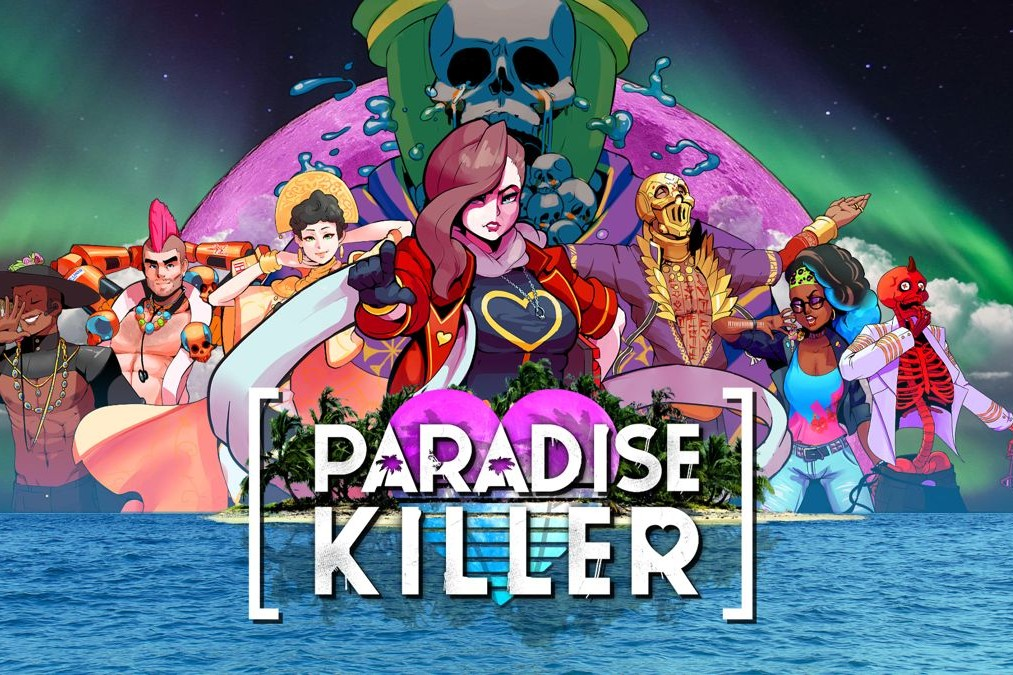

Developed/Published by: Kaizen Game Works
Released: 04/09/2020
Completed: 19/07/2025
Completion: Convicted everyone who deserved it. Or did I?
Paradise Killer is weird.
Weird in that way that saying it’s “weird” is reductive. Because it’s weird in the way something like Twin Peaks is–weird because the decisions it makes are trying to open you up to something deeper. Discombobulation is not the point, but a result of pushing the boundaries: trying to express themes, thoughts and ideas in the way that they need to be expressed. That feeling of strangeness? It’s your brain twiddling the dials, trying to find the game’s wavelength.
I went into Paradise Killer close to blind. I knew it was “vaporwave” and that Brandon Sheffield liked it, but that was–literally–about it. I legitimately had no idea until I played it that it wasn’t a straightforward visual novel, but that it had full 3D movement!
That design is actually a pretty damn important aspect of Paradise Killer that, somehow, it’s easy to miss–the promos concentrate, perhaps sensibly, on the character design and ~vibes~. But Paradise Killer is (I think) a great example of an unexpected genre-meld, taking a visual novel detective story and spreading it around in an open-world first person collect-a-thon platformer. The funny thing is that the game it most made me think of was Crackdown. You know how one of the purest joys of Crackdown was just… jumping around, collecting those orbs? Well, that’s pretty much what you spend your time doing in Paradise Killer, as you leap around paradise, picking up a huge variety of completely useless things, currency, and very occasionally clues. It’s consistently entertaining–hitting that lizard brain need to see if you can get somewhere, then getting there, and then collecting the thing that was there (that you don’t even need)–and very cleverly gives you something to do as you ferry between different suspects collecting testimony. If I have a criticism it’s that the game’s traversal upgrade system barely exists. There are three foot baths in the game that upgrade your abilities, but once you’ve got a double jump, a dash and a (slightly annoying, intentionally frictiony) radar, you’re done, and I did that within the first… hour (I played for something like eighteen!) I’d have loved to have played this getting faster, bigger jumps, more powerful, but maybe they just couldn’t be arsed with it. Maybe they just didn’t think it was that important. But it feels like a real missed opportunity, because once you’re about halfway through and you’re schlepping across the island and there aren’t as many shiny things to pick up, it starts to feel like a bit of a chore.
Intriguingly, they don’t want to make not-shlepping too easy. While the game does include a fast travel system, it’s extremely expensive in the game’s (limited) currency, blood crystals. Save points are fast travel points, but you have to spend a crystal to unlock it, and then every time you travel from it, it costs a crystal. You also have to spend this currency for other things that probably feel more important even if they’re not, so that does mean that if you’re extremely tight with consumables like me, you might fast travel rarely (if at all.) I certainly only started doing it once I had a huge buffer of blood crystals and was collecting the last two or three pieces of testimony I needed to finish up my case. It just felt wasteful otherwise.
But speaking of the case. Paradise Killer has one of the most unusual settings I think I’ve ever experienced. Before you begin playing, you probably think, as I did “ok, a beautiful vaporwave island with unusual characters. Got it.” But as soon as you start playing, the game makes it clear that it’s not so simple at all, and asks you to piece together what’s actually going on. And what’s going on is completely fucked up.
In Paradise Killer, you play Lady Love Dies, part of a group of ageless beings, the Syndicate, who (at least on paper) are attempting to resurrect the alien gods that they worship by creating paradise in a pocket dimension. They do this by kidnapping humans from the “real” world, enslaving them, and then when the attempt at creating paradise inevitably fails, ritualistically slaughtering them all before moving on to the next island and trying again.
The game begins at the failure point of another paradise, Island Sequence 24. Every citizen has been killed, the Syndicate was preparing to move to Island Sequence 25, only for the Syndicate’s leaders, the council, to be brutally murdered. The island is immediately locked down, no suspects can leave, and as Lady Love Dies, the Syndicate’s lead investigator, you are called back to investigate the murder after being exiled for the island for 3,000,000 days for being deceived by a god (in the game’s fiction, despite the Syndicate’s goal, the gods are not even to be trusted by them.)
When I say Paradise Killer is weird, this is what I mean. You are leaping about a beautiful island paradise, bumping those vaporwave beats, talking to beautiful, largely charming people who just happen to commit a genocide on the reg. It’s… weird. And uncomfortable.
The best comparison I can come up with is to imagine that the worshippers of the Great Old Ones of HP Lovecraft’s Cthulhu Mythos weren’t, like, weird fish men or indescribable shapeless forms but hot dudes and babes, but that they were absolutely as completely disinterested in the idea of humanity as anything but cattle in their attempt to resurrect not so much pure evil but pure cosmic indifference. And that you play one of them and you’re supposed to be invested in them solving a crime.
The important–and difficult–aspect to emphasise here is that it’s not like you’re playing a nazi. It’s like… did you ever have an ant farm? Sea Monkeys? You know they eventually just die, right? They can’t survive in the artificial space you’re holding them in. But the likely fact is that the idea of ants or tiny crustaceans as beings who deserved a life rather than, well, something curious to observe or forget about, didn’t even cross your mind. The gulf between you is so vast. That’s what’s going on here. That’s who you’re playing. Humans are the ants.
This is… complicated, and to be honest, I’m not entirely sure how I felt about it as the background of this game. The suspects that you deal with are–generally–tired and frustrated with the system they’re part of, a cycle they can’t seem to affect. The murders occur, in the way they occur, because people are trying to create change.
But it’s selfish change. There is no idea of restorative justice here. In fact there’s no sense that anything can change– when you make a certain class untouchable, the system will roll on.
So there’s a lot tangled up in Paradise Killer, and I think the thing that disconcerts me the most about it is how big and open to interpretation the themes are, but how easy it might be to not think about it all that deeply. To sort of just… enjoy the world, uncritically. I think the game does a lot of work to make that possible. The case you’re solving is genuinely interesting even with a narrow focus, and the open map allows you to solve it almost entirely in a non-linear fashion (although I found myself with several sticking points–it would have been nice if they highlighted case-specific collectibles once testimony implied what I needed to grab, some require far too much scouring.) You will, undoubtedly, invest in what’s going on, and then fixate on what the best course of action is; who really deserves judgement?
What’s interesting is that I played it very much down the line. I played it the way the game seemed to want me to: to follow the letter of the law. But at the end of the game I was most disappointed that while Lady Love Dies could execute everyone she deemed guilty, she wouldn’t turn the gun on herself. Because she was as culpable as any of them for it all. They all deserved judgement. But that’s life, I suppose. We sacrifice a few, call it justice, and the system endures.
Will I ever play it again? I don’t, ultimately, think this is a game that rewards more than one playthrough. I also don’t think I’d actually like to return to this world of cosmic horror.
Final Thought: Whether or not I’d return to it, I do think Paradise Killer was brilliant. Though it deals with heavy themes with a light touch, I do want to make clear I don’t think the game is problematic for doing so–I think it’s challenging. “Weird.” Paradise Killer gave me a lot to chew on, and I think if you’re up for it, it’s worth the effort really engaging with.