
Developed/Published by: A.G. Cartlidge / Gemini
Released: 1983
Completed: 02/12/2024
Completion: Delivered five presents to Santa.
Altogether now, in our best Noddy Holder impression: It’s CHRISTMAS! And here at exp. Towers that means we… play through ropey old Christmas games that we’ve dug up because maybe it’ll make us feel festive, although normally it just makes us shake our head in despair, thinking about a situation where anyone received these games and then had to play them because they didn’t have anything else to play.
So here’s Sleighbells1 for BBC Micro, which I think is the first time that arguably the UK’s most important home computer has shown up here on exp.. As part of the BBC’s Computer Literacy Project, it exposed entire generations to computers for the first time (and the BBC Micro was still being used in some schools until the mid/late 90s so it crossed from Boomers all the way to late Millennials). While I think that the most understandable point of comparison for non-Brits might be the Apple II, being a more expensive, sort of schooly “real” computer, I don’t think that really captures the utopian nature of the BBC Micro and the associated project (which you can read all about in NESTA’s excellent “The Legacy of the BBC Micro” white paper): an attempt to create a wide cultural change where the general British public would become truly educated in the tools that were going to change the entire world. To not just watch computers change everything: but take part in it.
When you think about that–and especially when you read the white paper–you can’t help but become a bit disappointed in the world we live in now. How computers work has become completely unknown to the average person, and our ability to control them has become ever sanded off as we get pushed into walled gardens and proprietary systems, and our governments seem to have absolutely no imagination in trying to actually transform society, at best hoping corporations might help regions “level up” rather than just suck money out, but mostly trying to keep enough blame on immigrants and minorities that struggling people don’t stop and consider a better world might be possible.
Sorry, this isn’t very Christmassy, is it?
Now. I’d love to follow this train of thought to explain something that I’ve often wondered about–that the BBC Micro seems to get discussed so much less in retro circles than contemporaries like the ZX Spectrum. Is it possible that utopian promises, long dashed, simply make us too ashamed to remember the venerable Micro? That it reminds us, always, that another United Kingdom was possible?
Not really. It’s just that the BBC Micro was really expensive, most people only played educational games or used LOGO on it, and commercial games outside of a venerable few were… a bit crap. Even compared to the likes of the Speccy.
But back to Sleighbells. While it does seem like Santa’s Sleigh Ride is the first Christmas game ever (look, I’m just not going to count Christmas Show and Tell) I keep finding new Christmas games that could easily be the second–it seems like 1983 was a big year for Christmas for some reason.
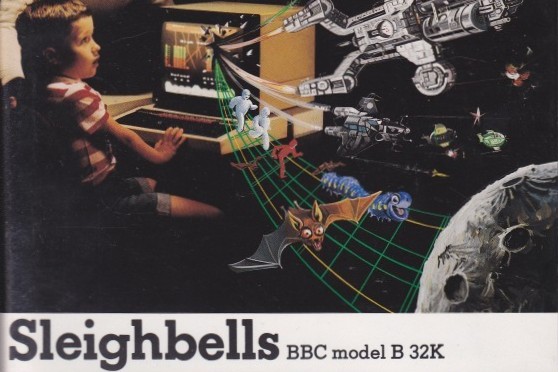
Packaged in generic box art and featuring absolutely no sleigh bells, Sleighbells is a multi-screen game that probably has some arcade inspiration but I’d be very hard pushed to work out what it is. Narratively, Jack Frost, who always seems to have a problem with Santa, has stolen all the presents, and so as Santa’s assistant you have to venture into his secret cave and steal them all back. You do this across four screens:

On the first screen, you have to get to the entrance while avoiding a gang of snowmen who make a beeline towards you.

On the second, you just have to run through the cave, avoiding the snowflakes that fall.

On the third, you… do the same thing again, but there are snowmen popping out of the ground and there’s a bat flying about that will kill you literally the instant the level begins unless you move forward immediately. Fun!

On the fourth, you’re supposed to catch the presents being pushed off ledges by… spiders(?) and move them to the left of the screen. The presents can squash you and that bloody bat is still there, but there’s absolutely no time pressure or anything so the first time I played this I just stood thinking I was “collecting” presents and wondering when the level was going to time out until I realised I had to move them one by one to the edge of the screen.
And that’s it, although it loops if you haven’t gone completely doolally with all the excitement.
This is, of course, rubbish, only remarkable because of how annoyingly difficult it seems at first (the snowmen mob you immediately, and that bat can fuck off) but once you get it it’s just a test of patience really. It does have a very festive title screen with a bleepy rendition of Jingle Bells, but that’s about as far as I’ll go.
Festive vibes ranking: LOW
Will I ever play it again? No!
Final Thought: Something I would be remiss to mention is that the spirit of the BBC Micro does live on in the form of the Raspberry Pi, which does see lots of ordinary people learning how to hack away at a very open computer format, even it is usually just to get a media server running, or a emulation box. It might have been nice, as Ian Livingston pitched, if the device had led to a second Computer Literacy Project as the BBC Nano though.
- It’s Sleigh Bells on the title screen, but “Sleighbells” on the box. I guess I’ve decided house style is to say the box is correct. But this probably doesn’t come up much outside of slapdash home computer games. ↩︎