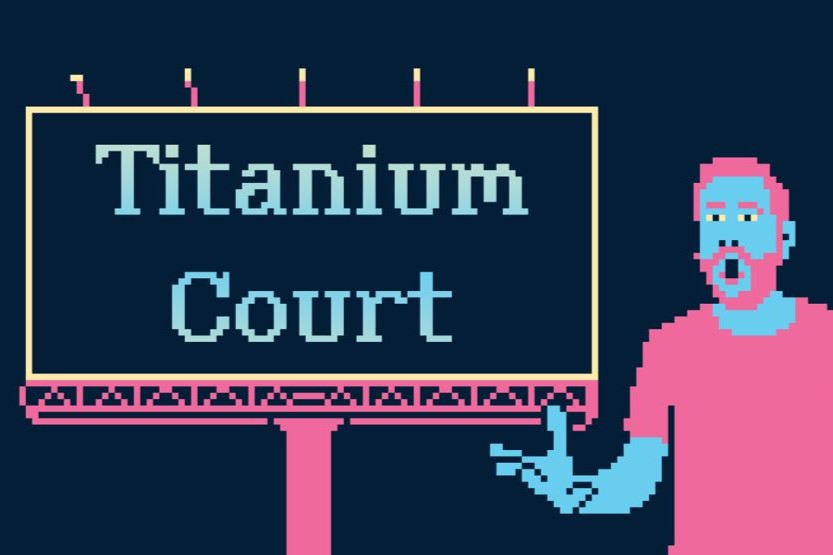

Developed/Published by: AP Thomson / Fellow Traveller
Released: 23/04/2026
Completed: 26/07/2026
Completion: I left.
In a weird sort of way, Titanium Court might be the most hyped game I’ve played in the last couple of years. Before AP Thomson even picked up his historic second Seumas McNally Grand Prize in a row I saw so many developers posting about an incredible game they couldn’t talk about, and then (once it was announced) posting that the incredible game that they previously couldn’t talk about was Titanium Court (and we should all be very jealous that they got to play it and/or be generally hype.) I was so intrigued that I decided to play Fortune-499, Thomson’s previous, visually similar game, and as a result of that was noticed and gifted a bunch of codes by Titanium Court publisher Fellow Traveller for the game’s demo to give away–which I’ll admit I thought might help exp. ride some of the wave of hype. Yep, I was pretty primed to play Titanium Court.
Whelp!
Do you know this feeling? You probably know this feeling. You’ve gone to see a movie, or maybe a play, that’s famously critically acclaimed. A piece of real art. Maybe it’s a satire, let’s say. You watch it, and, you know, it’s good! You’re following it, and you see what it’s doing. You appreciate it. But the audience is acting… weird. Everyone around you is laughing uproariously at jokes that you get, but aren’t, you know… funny. There’s something so performative about everyone around you. Like they’re all shouting “I get it! I get it! I’m at the level of the work I am viewing!”
When you leave, you wonder… wait, was that actually good? Or was it just something that made the audience feel good because it was “clever” and they understood it?
Titanium Court invites this comparison because I’m not sure I’ve ever played a game that’s more aggressively smug from the moment it opens, intentionally flowery in dialogue, and intentionally unclear on its game mechanics. It’s trying to confuse and bedazzle you so that once you get it, you feel sooo good for understanding it.
It’s a little patronising (at best) because Titanium Court is actually quite simple mechanically–the kind of idea that’s really “clever” if, I think, ultimately limited.
It’s a two-phase game. In one phase, you’re playing a classic match-3. In the second phase, you’re playing a set-and-go tower defence/real-time strategy. As I said above, it’s poorly explained, because “that’s the joke” and there’s a fair amount of meta dressing around this simple one-two: the idea is that you’re trapped in a faerie court that is currently engaged in a war, and every day you must try and win the day’s battles across a shifting landscape (yep, it’s a roguelike-like.) You can choose your “career” which affects your court’s abilities and/or win conditions, and then you play a number of rounds before a boss.

In each round, first you play the match-3. The aim of this segment is to make matches that gain you resources, remove enemy courts and, hopefully, place your court in an advantageous position, because the match-3 board is actually the map for the second phase. If you are surrounded by water or mountains, for example, no land enemies can reach you.
The intended tension in this section is that, generally, the most powerful strategy is to defend your court via the terrain, but, because you have to complete a set number of matches to get to the next stage–and match chains give you more moves–you can find yourself in a perfect position, but if you want or need more resources you might make a match and ruin your own position without enough moves to fix it.

In the second phase, you spend your resources to buy units that then spawn in a real-time battle. You can see the entire timeline, so your goal is to send out your harvester units (to get more resources) and then, if you need to engage in battle (and in almost all cases, you’re aiming to avoid it) send out enough units to defend your court or destroy the other courts. It’s not (especially) deep, being largely a numbers game as you can’t affect anything once things are in motion.
Around all of this are the machinations of the court, which you play via a simple top-down exploration game (it’s not unlike Fortune-499.) You wander around, choose who to talk to, and gradually unravel the mystery of the court and what you actually have to do to escape it properly (or not.)

Titanium Court is extremely, blatantly Shakespeare coded (A Midsummer Night’s Dream particularly) but even if there’s a character directly called Puck here it’s like if the play was populated by nothing but Pucks: annoying. If you go in blind, you wouldn’t grasp what I’ve explained about the game’s mechanics until you’ve been through several runs, and it’s not like the game is doing anything clever to “teach” you the mechanics as you go. It’s simply too in love with what it’s doing.
In Titanium Court’s favour, however, I do think the mechanical core, once you get it, has something compelling about it. The base mechanics are not especially interesting–honestly, it’s quite repetitive–but there’s enough variety layered on via careers and bosses and quirky things to find or do on certain runs (or across several runs) that there is–for a while–a reason to keep playing, even if every time you return to the court it’s like being at the world’s most irritating house party (wandering from room to room, getting involved in conversations with utter wanks.)
But the design simply does not hold up for as long as you’re expected to play it. It’s simply too easy to “solve” even with the roguelike-like design intending to provide enough moment-to-moment spice. Realistically, with almost all the careers you can steamroller runs by simply getting your court into the right position in the match-3 phase and just wobbling it back and forth till you run out of moves, and depending on the career you choose you can also massively abuse the game’s trading economy (or just select the correct units that match an optimum strategy and walk it.)
Titanium Court somewhat admits this (though I don’t think it’s as clever as the game thinks to do so) by allowing you to completely skip the actual “game” part of the game past a certain point, and from early on lets you skip the bosses to instead see AP Thomson perform his “We’ve got The Mountain Goats at home” shtick by playing entire songs, which is pleasant enough, but (honestly) it feels like you’re still at a horrible house party and someone’s pulled out a fucking acoustic guitar. Like, he’s good! But you still feel yourself cringing.
So Titanium Court–I suppose much like Fortune-499–hits the limits of the core design quickly, but unlike Fortune-499 it doesn’t choose to be short and authored around that. Instead Titanium Court takes being annoyingly smug to a level beyond what you could imagine (and it is genuinely hard to imagine it being more annoying and smug than it is at the beginning.) The middle bit of the game–when you’ve understood the game’s mechanics, and you’re having a jolly enough time doing runs, ticking off tasks, removing the “curses” that you’ve been told afflict the court and collecting the keys that you’ve been told will allow you to leave Titanium Court and complete the game… well that was all just to get you to realise…
Alright everyone, we’re going to spoiler town. If you think you might play Titanium Court and you don’t want to read on, my conclusion on the game is that it’s [rolls eyes, makes wanking motion with hand.] Do with that information what you will.

It’s all there to make you realise… to complete the game you just have to stop playing it.
This is, in my opinion, complete fucking drivel. I’m not the first person to say this (Willa Rowe’s piece, The Player’s The Thing talks about the mistaken nature of this twist in, frankly, a far more educated fashion than I’m going to) but the extent to which Titanium Court gets things backwards is, I think, remarkable.
I absolutely get the concept. Titanium Court’s core “idea” is based on the experience of playing old RPGs. You know when you visit a town, and characters have a few things they can say, and then when you exhaust what they have to say, they just repeat the last thing they said, forever?
Well, in Titanium Court, this is called “going stale” and it’s an affliction that affects the faeries of the court. As you (the player) exhaust them, they are trapped in this state, and to the other faeries, it’s a tragedy. Ultimately, their aim is to get rid of you as quickly as possible. Just Walk Out. You Can Leave!!!
Except, of course, you can’t. You have to collect keys to leave. And Titanium Court is an authored work. It’s not, like… a real place you’re visiting. Titanium Court is not like… like imagine you went to, uh… that Star Wars Disney hotel, right? When it was running. And everyone was given an exact script to say to you. And when you exhausted the script, they hauled off the actor and shot them in the head.
But you could leave at any point.
Now that’s a dilemma!
I mean, it’s not. You’d just leave, but the point is: these fairies aren’t real, and AP Thomson wrote them, and he’s created something where the tension, I guess, is supposed to be that we want to complete games and see the content he’s created versus not wanting a bunch of imaginary fairies to die, but he created the situation! He wrote all the beats!!!
The player isn’t causing any of this, they’re just playing their role. Now, I get that Thomson lampshades this by setting the game on a stage and actively telling the player they are playing a role, but then we face the idea that he’s expecting the player to engage with the story as told while also having an ironic detachment. This is a really advanced attempt to have his cake and eat it, and I guess I salute the chutzpah, but it’s ridiculous. It feels like he’s really trying to get you to just turn off the game, stop playing without resolution to make his point, because otherwise Titanium Court plays tricks to keep you playing: as soon as I collected my keys, I went to leave, but the script said something along the lines of “you feel there are things unresolved” so I thought “oh, I guess I’m not supposed to leave right away?” played a few more days, got increasingly bored, and then went to leave and… had all the keys stolen and had to re-earn them, practically doubling the amount of time I had to play [“You didn’t have to…”–AP Thomson] to actually leave and finish the game.
I haven’t been as fucked off with a game in years the way I was fucked off with this when all the keys got stolen, considering the plot is literally telling you “you are hurting these people with your presence.” I suspect there are more ways around to play this game–maybe you can just leave in the first place, maybe there are other ways to leave, maybe there’s something interesting that happens if you see the game to the very end and let everyone go stale–but Titanium Court also, intentionally, doesn’t let you play it again1 with the idea that you’re just supposed to share with others what happened to you and compare. I don’t hate that kind of thing–at least, I like games that try and offer a “this was your experience, others may have experienced something different” possibility space. But this aspect feels like another couched in an attempt to just be very, very clever.
I simply cannot see what people see in this game other than something that offers them just enough resistance that they feel big and clever for getting it. But “getting it” isn’t enough: what you’re getting has to offer you something meaningful. Titanium Court doesn’t. I don’t think its point even makes sense! I left and I didn’t look back; I only caused a few faeries to go stale. But the other ones? There’s no one there to hear what they have to say, no one there to prompt them. Isn’t that worse? To have something left to say and go unheard?
Will I ever play it again? I’m glad I can’t.
Final Thought: You know what? What they had to say was probably fucking annoying.
- Well, I assume you can easily on a full reinstall or whatever. ↩︎