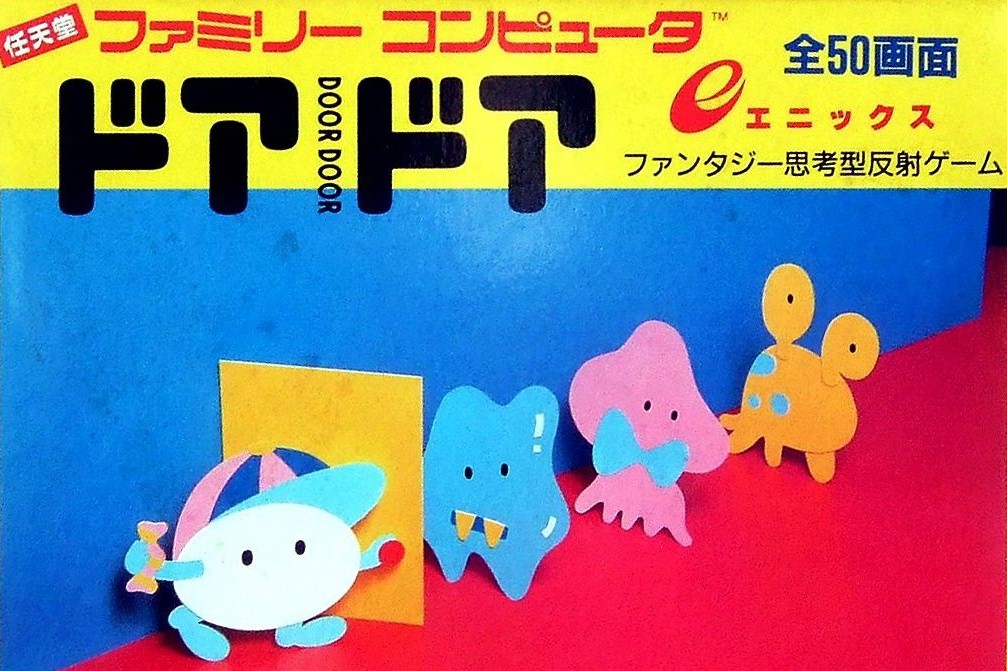

Developed/Published by: Chunsoft / Enix
Released: 18/07/1985
Completed: 31/08/2026
Completion: Made it to level 50, saving after ever level.
After playing the first (well, at least on Famicom) Square game for Pixels and Polygons Quarterly, King’s Knight, taking a look at the earliest output of the other eventual half of Square Enix, Enix, seemed to only make sense. However, much like Square, Enix’s early output was focused on the home computers of the era, so I’ll similarly skip to the first Famicom release, but Enix took a pretty interesting route into the video games industry that’s more than worth recounting.
Beginning as a publisher of real estate listings(!) in 1975, by 1982, after struggling to get a foothold as a trader/brokerage, owner Yasuhiro Fukushima had decided to make the (frankly, not obvious) transition into video game publishing. But how to get games, considering Fukushima knew nothing about making games, or even hiring the people to do so?
Well, according to Chris Kohler’s Power-Up: How Japanese Video Games Gave The World An Extra Life, inspired by the manga industry, which attracts new talent via contests, he thought he’d simply do the same thing, launching the “First Game Hobby Programming Contest” with three million yen in prize money (in return for claiming the copyright of the winning games…)
However, I think Fukushima was at least clued into the games industry enough that it wasn’t purely inspired by the manga industry. In this advert for the contest (via bowloflentils) Fukushima’s play is inspired by the “bedroom coder” boom of the US (and UK) promising to crown the first “new star” and promising they’ll become popular “like rock stars.”

This is pretty bold, but it attracted what would ultimately become legends of the industry such as Yuji Horii, so… fair enough? However, this contest does feel like a classic trick that’s still pulled today: run a contest for a small prize, then monetise the work of the winners, and laugh all the way to the bank.
But what’s that! In the small print: “we will pay royalties.”
Now, to be honest, I don’t have any idea how fair these royalty agreements were, but if we take Enix at their word, they’re extremely happy to crow about the success their previous winners had by the time of the third contest, explicitly showing Door Door creator Koichi Nakamura’s royalties:

So this obviously worked out for Enix, they’d upped the prize money, and become even more magnanimous, as by the third contest copyright is retained by the author–though they’ll get exclusive sales rights for the winning entries, so maybe it wasn’t functionally that different.
Indeed, this system gave Enix an incredible amount of games to release in a way that I’m sure many other publishers couldn’t compete with: in their first month of releases fresh off the contest, they put out an astonishing thirteen games (if records are to be believed) the majority of which hadn’t won anything so no initial outlay at all! But at this point, for these hobbyist coders, getting any royalties at all probably felt like hitting a jackpot.
But of course, as we see from the above advert, Door Door was the super mega jackpot. The kind where all the lights on the machine are going off and tokens are spilling onto the floor up to your knees.
And it didn’t even win that first contest! It came second to a turn-based strategy game!
Door Door is interesting because it doesn’t just have a place in history as Enix’s first big game, but also as Chunsoft’s first game. Chunsoft, weirdly, don’t seem to quite get their due in at least the western view of the Japanese game history, where I think their name is most often connected to the Mystery Dungeon/Shinren The Wanderer series.
Now, don’t get me wrong, that’s a great series, but Chunsoft developed the first five Dragon Quest games! Yuji Horii and Akira Toriyama didn’t just do it all by themselves!
And, frankly, they made Door Door. And Door Door is… great!
Inspired by Dig Dug–in fact Nakamura was originally making a clone, before switching to something simply inspired by the idea of herding enemies2–it’s almost surprising that I’d say it’s great, because Dig Dug is crap, and when you first play Door Door it’s going to feel slow and a tad unresponsive. The first time you climb a ladder, you’re going to be like… is this honestly how long it’s going to take to climb ladders in this game.
But frankly? Chill out. I approached Door Door a little differently than I have maybe other puzzely, actiony Famicom/NES titles, where I tend to binge them. Door Door’s slower pace and deterministic enemy design engendered a different tact: I loaded it onto my Trimui Brick and just played a couple of levels now and then in breaks and downtime. I treated it a bit more like… Picross… actually no, wait, I tend to binge that too. Perhaps more relatably something like Puzzmo: pop in, a little brainteaser, a palate cleanser, and then move on.
Now, to be fair: this obviously wasn’t the exact intention for Door Door. In fact, I dug around and I couldn’t find a way to continue in Door Door, which is disappointing, so it was intended for the player to get through it in one go. But it’s also 2026 and we’ve got quick saves and the author is dead, so it’s fine.

That said: if you did want to play it “for real” part of the reason Door Door is so good is that the game is an early masterpiece of teaching you how to play it while playing it. For everything that’s said about Super Mario Bros.’ famous first screen, Door Door does the exact same thing here, opening with a level with the hero, a door, and an enemy, where all you can do is open the door, getting the enemy into it, and then closing it, winning the level: teaching you that the entire game is about clearing the level of enemies by getting them to walk into doors–from the right direction (enemies can only walk into doors in the direction that they slide open.)
Did the Shigster see this before making Super Mario Bros? You might say “well, hang on. The original Door Door doesn’t have this design at all!” To which I’d respond: but the update Door Door mkII does–if anything it’s even more teacherly, the Famicom version more of a supercut–and that came out over six months before Super Mario Bros.!!!
Alright, it’s still a bit of an edge case, but Shiggy-Shig-Ah [“Stop this. It’s not the 90s any more”–Ed.] was kind of sniffy about Pac Land‘s influence, which makes me think he probably was inspired by Door Door mkII. I mean it was a huge hit!
Anyway, Door Door doesn’t just teach you once. What I love about Door Door is that it regularly gives you new “training” levels that teach you a technique that you can use from then on–and, in fact, from the beginning of the game. It’s almost Öoo like in its clever use of the hero Chun’s simple actions (just move, climb and jump!) when interacting with the enemies. You’ve always been able to do these things; you just don’t realise until the game forces to you do them.
The enemies are the other trick to the game: they’re deterministic, like Pac-Man’s foes, but in a slightly richer environment. So, for example, you’ll face enemies that beeline towards you, some that always climb ladders when they approach them, and the most threatening foe, the one that jumps whenever you do, meaning you can never dodge, them only run.
With all of these enemies on screen, there’s really a puzzle to every level, but it’s not really a “pressure/puzzle” platformer, one of my least favourite styles. The enemies are a threat, but because you can jump, and they’re pretty slow too, you can get a lot of time to lead them a merry dance as you try and work out the best way to dispatch them–and then, if you do die, when you restart any you’ve killed are still dead, allowing you to move forward, but ultimately the goal is to wipe them out all in one life (I’ll admit I died to move on a couple of times.)

Honestly, it’s really elegant, especially with the addition that if you can get a lot of enemies in one door at once and close it before they leave, you get a bonus, meaning there’s an incentive to use every skill you learn across the game to clump enemies together. So, for example, you’re taught early that you can jump to avoid opening doors. Then you can jump to get the jumping enemies to switch platforms–or stop them crossing the screen boundary. And soon this compounds, and you’re ripping through a few levels when you really meant to only do one while you waited for the tea to brew.
If there’s a problem with Door Door it’s that the design does allow the player to get into no-win situations (there are a lot of levels where there are less doors than enemies as part of the puzzle) which requires a bomb spawning for players to suicide, and that the last level is a bizarre test of timing your jumps that honestly I thought was just a corrupted screen. You can complete it, but considering it just loops the game, not even a congratulations, it’s not really worth doing.
But everything up to that point is! Not bad for a game that didn’t even win the contest it was made for!
Will I ever play it again? Honestly, after beating it I’ve had a few goes playing it for “real” with all my new Door Door skills and it’s not unpleasant.
Final Thought: What with the (possible) Miyamoto inspiration, I got a bit excited when I remembered that hated Phillips CD-i Mario game Hotel Mario was all about doors, thinking maybe there would have been a funny example of (not quite) simultaneous discovery there considering the game was made in America by people who would have never seen Door Door and Miyamoto never touched it. No such luck, Mario closes doors but he just jumps on enemies like usual. Oh well!
- According to a historical exchange rate I dug up, which may or may not be exactly on the money. But crikey, the yen was weak in the early 80s, huh? A similar amount of royalties would net $25,000 today, and the yen feels weak right now! ↩︎
- According to an interview translated by the ever reliable shmuplations.com. ↩︎