
Developed/Published by: Blendo Games
Released: 20/08/2012
Completed: 18/09/2025
Completion: Finished it.
Thirty Flights Of Loving has loomed large in my mind for, uh, thirteen years, because I added it to my Steam wishlist and then promptly just never picked it up. An absolutely insane situation considering the game, at fifteen minutes long, is actually shorter than Gravity Bone which preceded it. I mean I waited nearly a year per minute. Well, I’ve played it now.
Thirty Flights Of Loving, compared to Gravity Bone, is a bit more of a challenge. If Gravity Bone took what you expected about a first person game and then twisted it, Thirty Flights of Loving doesn’t even give you the grace of letting you settle in before twisting. I mean, it’s pre-twisted is what I’m saying. You open the bag that says “bagel” on it and there’s a goddamned pretzel in there.
(I suppose in this metaphor, with Gravity Bone you’d start eating a bagel and then it would suddenly twist in front of your eyes into a pretzel? Creepy. I don’t like this metaphor any more!!!)
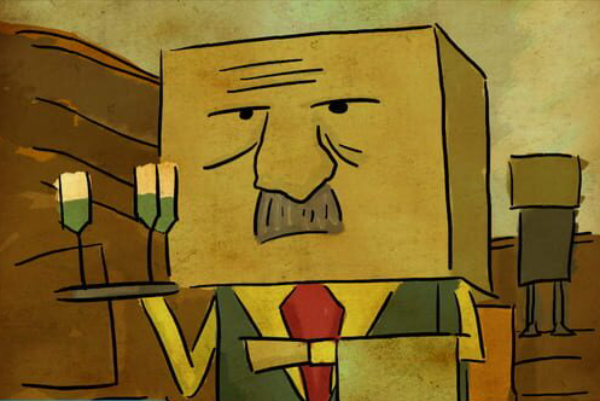
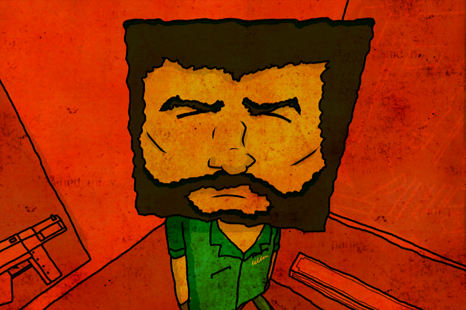
Thirty Flights Of Loving is ultimately an exploration of the idea: can you do cinematic cuts in a video game? Telling, vaguely and non-linearly, the story of doomed love and a heist gone bad, the game cuts intentionally and cleverly to remove the thing you just don’t remove from video games–the “dead space” between incident. It’s shocking, actually, to head down a corridor and suddenly find yourself, well, in a new room, because the trip down the corridor adds nothing narratively.
This is a decision that few games I know of have made outside of–of course–their cut-scenes, and I think it raises really interesting questions about the value of what we do in games. I’ve written at crushing length about the difficult path games try to walk–narrative, but play–and I suppose the disappointing thing about Thirty Flights Of Loving is that it has interaction but no “play”, where I feel like the theory–we could have cinematic cuts in games–can only be proven by giving me actual play and “cutting” when I’m not doing anything that’s actively in aid of that. After the firefight, cut to the exterior, don’t make the player navigate there–but never take the control away from the player. Just cut.
I think for many, the potential flaw here is obvious–it’s discombobulating. I mentioned above that the cuts are shocking, which in many ways is surprising, because cuts in cinema are, famously, not shocking (proven scientifically.) Is is simply that “flow”, that hugely important state to the interactive art is broken by a cut?
Or does Thirty Flights Of Loving’s use of only scene cuts–keeping action continuous elsewhere–create more discontinuity when paired with its mysterious narrative? Could a game with even heavier use of cuts–cuts within scenes and cuts between scenes–work better? What would that even look like?
I’m not sure, but it’ll probably take a game longer than fifteen minutes to work it out. Thirty Flights Of Loving does a lot with its time, managing some moments of beauty and ending with a recognisable longing. I might go so far as to say a saudade. Maybe Thirty Flights Of Loving doesn’t answer any questions, but the ones it leaves you with are worth thinking about.
Will I ever play it again? I’ll wait another thirteen years and see how I feel.
Final Thought: I’d be remiss not to point out something else cinematic about Thirty Flights Of Loving that really stands out–the superb score by Chris Remo. It’s a huge factor in the game’s feel.