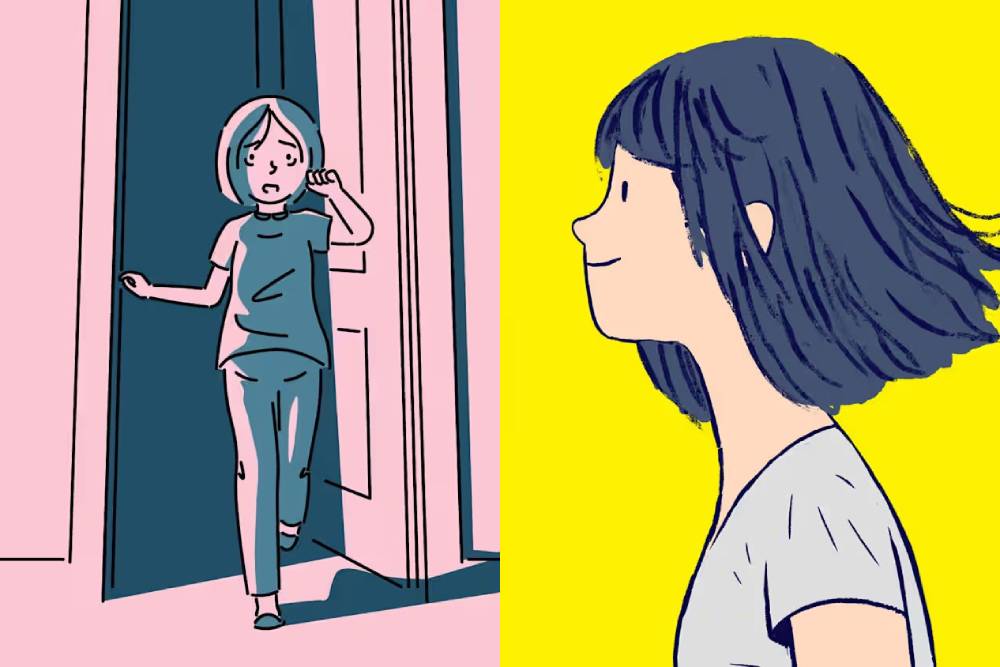


and Roger
Developed/Published by: Tearyhand Studio / Kodansha
Released: 23/07/2025
Completed: 06/11/2025
Completion: Finished it.
Florence
Developed/Published by: Mountains / Annapurna Interactive
Released: 14/02/2018
Completed: 06/11/2025
Completion: Finished it.
This year for me (and perhaps for many others) has very much been the year of the short game, and I’m not complaining. In fact, I really think it’s the direction the industry has to go towards. Sad to say but as excited as I am to play, say, the remasters of Dragon Quest I & II or Final Fantasy Tactics, they’re just getting thrown on the backlog to join the likes of Persona 3 Reload. Whereas if I hear about a game that I can play quickly and get a full experience from I jump at it. This has paid off tremendously sometimes, sometimes not, but it actually doesn’t matter as long I’ve experienced something with an idea and a point of view. My time hasn’t been wasted, when in some other games an play session the length of one of these games could be spent grinding, or cut-scenes, or on nothing very much in particular.
It does make these games a little hard to write about if I’m not actively warning you off of them, because the urge is to just say “well, play it” especially if the feeling is that going into too much detail might spoil the experience. This is a problem that feels a little more immediate than it often does with cinema, where–for whatever reason–it feels a little easier to talk around the work. You can be a bit less direct.
So before I go into too much detail on and Roger, I’d like to say that’s it’s a worthwhile experience–it’s one that I was surprised by and found deeply moving. If you consider yourself open minded and think you’re ok potentially having an ugly cry, I think you should give it a shot and you can come back here later.

So what’s interesting about and Roger is that it’s a Florence-like. I’m not sure if it’s the first one of these! What’s particularly interesting about and Roger is that it takes the basis of Florence and infuses its interactivity with real meaning in a way that makes the originator seem completely facile.
When discussing Florence, I think it’s important to begin by discussing the conditions that the game was made under, with Mountains’ lead developer Ken Wong accused of being verbally abusive to staff. Wong has apologised, but I don’t think I would have chosen to write about it if it wasn’t, I think, really important contextually. Especially considering and Roger’s lead developer, Yona directly praised it in conversation with Patrick Klepek at Remap:
“I think it’s the most wonderful game I’ve ever played … It taught me the value of storytelling through games.”
Florence tells the complete story of a young woman’s romance with a cellist in a confident and seamless combination of motion comic and mini-game. If we’re following the inspiration chain I have to wonder if the game was particularly inspired by Jenny Jiao Hsia’s and i made sure to hold your head sideways, a “flatgame” and another beautiful short experience that I’d urge you to take some time to play whenever you have a spare moment. I’ve got no particular proof Florence was inspired by flatgames–and you can trace more gentle, linear interactive storytelling to at the very least Brøderbund’s Living Books–but the continuous nature of the experience–outside of the deeply mistaken decision to include too-frequent chapter breaks–calls them to mind. However, I think for many the easier comparison would be a narrative, less-intense Warioware, as each scene features a game mechanic that you have to learn and then perform to progress.
For example: to brush your teeth, you move the joystick back and forth. To form a speech bubble, you click jigsaw pieces together. And so on.
Florence’s issue is that these mechanics are not, in themselves, fun! They are simply roadblocks to the next scene. Rather than Warioware, it’s more like a game almost entirely made up of the way interactions work in Heavy Rain. You know how you have to move the stick to, like, open a door and if you don’t do it right, you fail? And it’s just a waste of everyone’s time? Florence, despite its short running time, can often feel like that.
There’s one interaction that works and that I think is quite clever, it’s the aforementioned “jigsaw pieces as dialogue”. On your first date, each puzzle features a lot of pieces to fit together, but on later dates the pieces become simpler and quicker to fit together. It’s the one place in which function meets form, where, just as in a burgeoning relationship, you find the conversation flowing easier and easier.
(If I was going to go deep on symbolism, however, I’d like to note the fact that the final puzzle features two jigsaw pieces fitting together, the piece with the extrusion representing the male character, and the piece that has the hollow for it to fit representing the female character. It’s a little… I don’t know… ill-considered?)
Florence also suffers because it just doesn’t have that much to say. It’s proof that interactivity isn’t enough. You are better served by reading through No Girlfriend Comics again, which I don’t think pretends to have any gravitas and says something probably more relatable.

The thing that bothers me most about Florence, actually, is that it doesn’t even commit to its story. To get into spoilers, after her breakup, Florence returns to the painting that she always put off. No reason for this is given: she’s shown at the start as having succumbed to routine; and it is implied that the relationship falters for the very same reason. If I’m being completely fair, these moments–big, bad breakups–lead to a lot of change in people’s lives and reorientation on what’s important, but that beat is missing here, and while maybe it’s too neat, that the game misses the chance to offer closure by, for example, having her ex be invited to her art show for a “goodbye and thank you” beat… I know you could say it’s too obvious, but to end with what really amounts to nothing speaks, frankly, of immaturity.
Florence is a pleasant, but forgettable experience. Nice, maybe a little sad, but there’s so much more going on in real people’s lives and relationships than, well, things that can be summed up in little mini games.

Such feelings would make you think that and Roger isn’t going to work at all. After all, you still progress linearly through a series of scenes, you still perform mini-games to move forward.
But and Roger understands something about its position as a video game–that we have expectations of it. We don’t expect it to cheat or lie to us. and Roger begins to do that to us immediately. Buttons you expect to click move. Then new buttons appear. When you finally press one, it doesn’t do what you expect. It’s unsettling, it’s frustrating, and it is deeply intentional.
In and Roger, you play a young girl who wakes in her home and discovers things seem to be… different. Time doesn’t seem to be working right. Performing ordinary actions is complicated. And where she expects to find her father, she finds a stranger, who is acting like everything is normal while doing things that make no sense.
In some respects, the game is a mystery: the player has to work out why these things are happening, and what’s really going on. In other ways, it’s not really a mystery at all. You understand quickly that something is heartbreakingly wrong, and nothing you do or try to do is going to be able to change that.
Above I mentioned the terrible, pointless added interactivity of Heavy Rain. I think everyone who ever plays that thinks: “This is stupid. Who can’t open a door?” and I think in context that’s fair: you’re playing an able-bodied character. People don’t think about or actively perform opening a door. You just do it automatically. Pressing “A” at a door to watch an animation of it happening is more real than “performing” the action. But what if you’re not able-bodied? What if opening a door is hard because you aren’t quite sure where the handle is, moment to moment? What if the action your brainwaves transmits doesn’t line up with what you’re trying to do?
In and Roger, the player is forced to consider that. I think there’s a possibility that the way it does it could be viewed as a gross simplification, and I think it’s important to guard against the idea that by experiencing it you truly “understand” what it means to have a disordered mind or a disabled body. But I reacted to it. I would love to know what advocacy groups think of it, but I do hope that I’m not off-base in thinking they’d approve–even if only as a tool for empathy.
and Roger does have issues. The game is intentionally frustrating, and I do think for some players that could bleed into being actively angering–there’s a few mini-games where your actions are obscure or obscured, and unlike Florence, some players may actually get stuck (interestingly, for me these were not games where the game was “messing” with me, but in the middle section that cleverly plays more straightforward.)
I think the game also makes maybe one too many big narrative swings towards the end. I think, ironically, one revelation is made to increase our empathy, make us more aware of the cost these things have on more than just the central character, but it’s disturbing and unbalances things. Earlier moments of frustration work well enough.
But at the end, and Roger destroyed me. Surprisingly so–my reaction felt like it came out of nowhere. I’ve been touched by, well, I’d say a version of what this game is about, and the game’s ultimate message: that all we can do is love; that it’s not a weakness but a strength… it hits, because it’s real. The issues that and Roger deals with is not as simple as what Florence deals with, but it’s something that at some point in your life you realise you’re going to deal with–a lot. And really love is what’s going to keep you going, no matter how hard it is.
It’s easy to roll your eyes at that, and I think there are many people who are going to bounce off of this if they don’t connect with what it’s doing or what it’s about. And many might chafe at what I assume will be the most controversial thing about and Roger–that it comes from a clearly Christian lens.
I’m an avowed agnostic, and I will say that this aspect didn’t bother me at all, because it doesn’t feel like the game proselytises at any point. In fact, I think it probably says something more about my expectations that when a character mentions praying quite naturally, my eyebrows raise in surprise.
I’ll admit, in media now we’ve come to expect “overt” reference to Christianity to say something about the character, to feature in their arc, rather than being a background detail. And this game does end with a quote from 1 Corinthians. But the game isn’t about Christianity. It’s simply one a fact of the character’s lives–and a fact of the creator Yona’s life. and Roger is richer for it, in my opinion, though I do think your mileage may vary.
But all things considered? and Roger is very good. It is thoughtful in its use of mechanics and representation of themes, while also having a strong vision behind it. And I think it just existing makes the world a slightly nicer, more empathetic place. There’s not a lot of things you can say that about.
Will I ever play them again? Although I think Florence is important to understand and Roger from a design perspective, I don’t think it matters a jot if you’ve played it before playing and Roger. In fact, I’d say you really don’t need to bother with Florence in the first place. As for and Roger? I’m not sure I could go through it again, emotionally, but I’m glad I did it once.
Final Thought: The one thing that’s a huge clanger with and Roger, and I do have to make a point of this, is the inclusion of achievements. I think it just goes against everything the game should be making you feel, and your immersion in it. If you can turn even the notifications off, please do. You just don’t need them (and no game does, in my opinion, but that’s a different story entirely.)