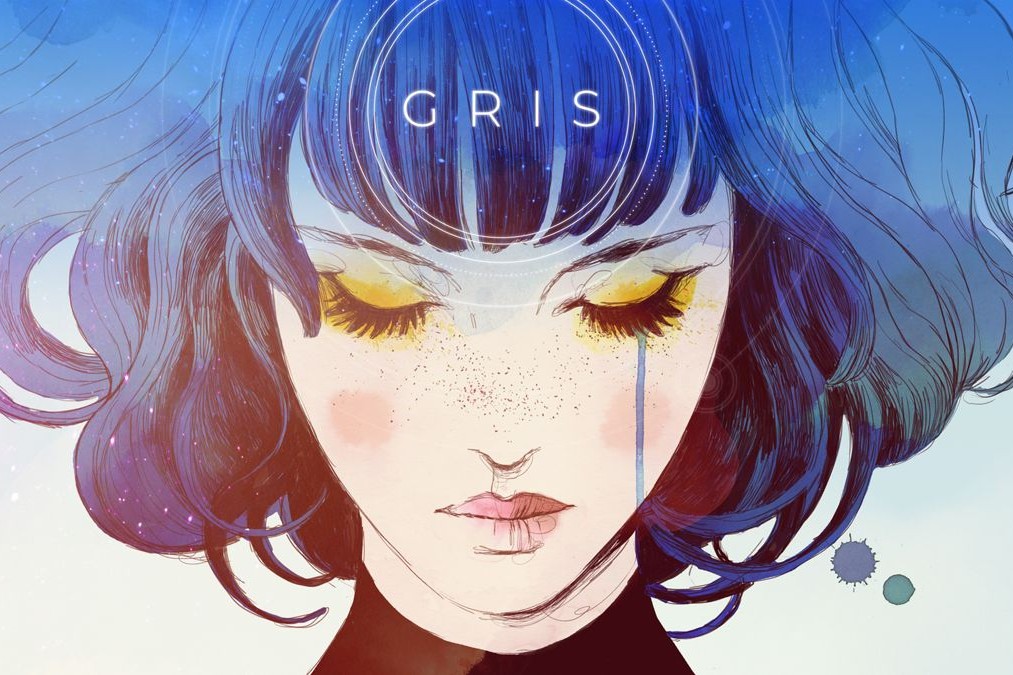
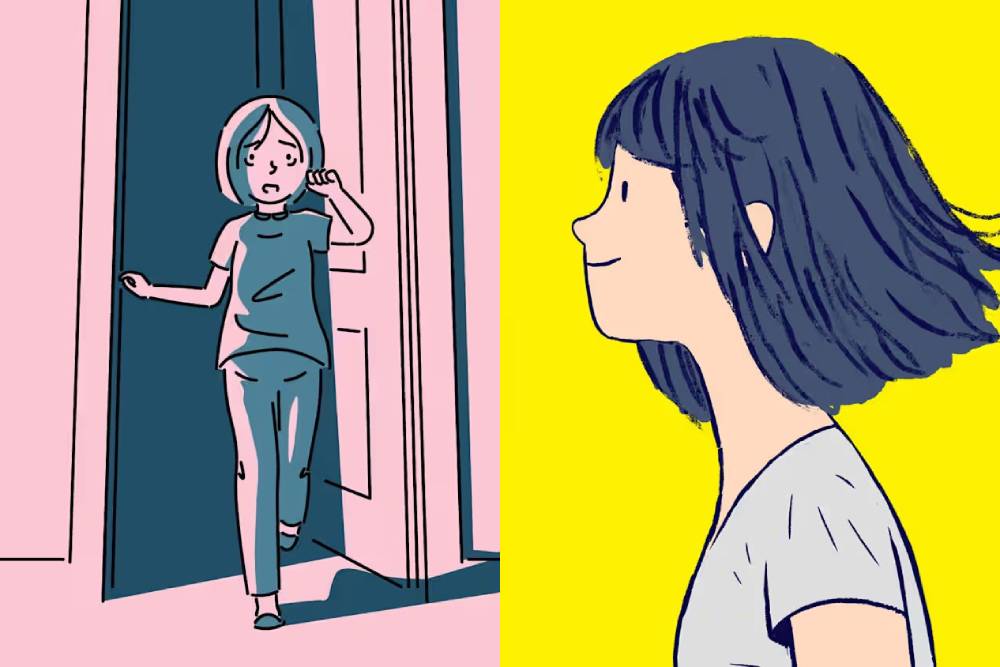
Developed/Published by: Nomada Studio / Devolver Digital Released: 13/12/2018 Completed: 05/04/2026 Completion: Finished it. Did most of the extra puzzles for the first couple of sections then lost the taste for it and only did extra ones by accident.
Gris has sold over three million copies and been out for eight years, so I think I can get away with saying: it’s bad!
I can be pretty hard on “artistic” games, by which I make a distinction from pure “art games” and the more commercialised form. The kind of game that may have ~themes~ but still feels like a product. Games that, often, don’t really feel like they’ve got anything to say–or at least, nothing that challenges the audience (not that all art has to be a slog.)
I’m aware that this may be uncharitable; after all, it can be personal preference. We come to anything with the knowledge we already have; a work that might seem obvious and derivative to me might be completely mind blowing to another person who has never seen anything like it. So I shouldn’t–really–beat up on Gris too much for being trite.
In Gris, you play the titular character who–after waking up in the palm of a crumbling statue–travels through a 2D platformer world gaining abilities, collecting stars and facing off against a black creature who seems to want to stop her bringing colour back to the world.
There’s no dialogue, but the game is–blatantly–about grief and the “black dog” of depression, and if you think that “binging colour back to the world” and being chased by a big inky black creature that’s trying to stop you is sort of an embarrassing way to explore those themes, well, snap. But I did intend to be charitable on this aspect, so let’s just let that slide.
What I can’t let slide is that Gris is simply not enjoyable to play, with a catalogue of design flaws that make it–despite what should be a breezy, sub-four hour playthrough–miserable. First: the game does an absolutely horrific job in making it clear what is something you collide with or not. What’s foreground, background and so on.
The game is very art-forward, which is understandable, but it feels like there’s no consistency. There are so many sections–especially in a later swimming section–where I repeatedly just hit myself against walls because it looked as much like background as anything else. I admit was on an Steam Deck, so you could argue the game’s reliance on zooming out a huge amount is at fault, but I don’t really think “you need a big monitor or telly” is much of an excuse, or even true.
What do you collide with here?
The level design is also full of the kind of decisions that should have been caught long before release. Pretty much every level begins with you being dropped somewhere so you can head either left or right… with no hint of a critical path. Indeed, sometimes the game takes you back to a hub and every time it happened I thought “oh, I’ve made a mistake here” but I hadn’t. You could argue that’s kind of a magic trick–I was always heading in the right direction–but if I’m still feeling uncertain and unclear, it’s not so much a magic trick as “something confusing that happened.”
A lot of the problem relates to the fact that the game doesn’t make movement especially fun. Gris makes the classic error of making your movement unpleasant at first so it can get better later (rather than starting good and getting excellent; I admit I just complained about this in Promise Mascot Agency.) If I enjoyed movement, I’d be more inclined to explore when hit with a variety of directions I could possibly go.
Gris feels like she’s moving very slowly in those massive zoom-outs (you’ll beg for a dash) and when they introduce swimming, it’s so frustratingly slow and gummy it’s just awful (and don’t think you can try and double-jump your way out of the problem–each time you get dunked, making it feel even slower.)
And yet ironically, one of the worst things about Gris is that in key narrative moments–big chase scenes–you lose control completely1 reducing you to a mere spectator of the beats that should be thrilling. It’s not a relief to not have to move Gris; it just makes you wonder why you’re bothering to play any of it at all.
For a game that wants to be about overcoming adversity, it’s a problem that the actual adversity that the game provides is simply a catalogue of tiny frictions that make every interaction with it low-level annoying. The puzzles–which use Gris’ growing range of abilities–are basically fine and paced acceptably. Indeed, one aspect of the level design I appreciated was how they tucked the “extra” puzzles for collectibles around the critical path puzzles so they kind of worked as a second challenge on the “same” puzzle. But after the first level, I just stopped doing them, because I wasn’t interested in struggling with the game feel any further than I really had to.
If I’m being completely fair to Gris, even if I found the narrative at best basic and obvious, you could go over this game, get rid of all of its frictions and you’d have a solid–if maybe uninspiring–puzzle platformer. It feels very much like a problem of not getting the feedback when it could have made a difference, not listening to it, or simply not having the time to act on it. But who am I to speak? As I said, this sold millions of copies. They’re fine!
Will I ever play it again? I’m good. The team went on to make Neva, and I suppose I have some interest if they were able to fix the problems of Gris with it, but not enough to find out.
Final Thought: There’s an extra cutscene for getting all the collectibles, and something I suppose I do find sort of interesting is it makes the exact theme of the game explicit. Now, you might think I’d be against that, considering everything I’ve said, but in a weird way the cutscene does “cap off” the narrative in a way the normal ending doesn’t, and I think it’s kind of a shame that they hide it from most players. I contain multitudes.
Pedants may wish to note that you can slightly move Gris left and right or up and down in some of these. But it’s meaningless. ↩︎
I was looking to stretch my legs during a deep dive on some other games for research recently, and when the IGF Award shortlist was announced there was an avalanche of people in my feed expressing excitement that they could finally say how good AP Thomson’s upcoming Titanium Court was. So I took a quick look, saw that Thomson had previously made the game Fortune-499 which at least looked visually similar, and thought “why not!”
Fortune-499 is styled as a JRPG, but it has a really beautiful mechanic, one that I think–because it sounds complex, but has to play out simple–would be very easy to fuck up completely. It’s a rock paper scissors prediction deckbuilder. In each JRPG-style battle, you hit your opponent if you win rock paper scissors; you get hit if you lose, and you both take damage if you throw the same. Now, as we know from Alex Kidd, rock paper scissors is an absolutely rubbish, frustrating mechanic in a video game, but Fortune-499 fixes it completely by giving you a fortune telling deck. Before each hand you can draw up to four cards which “reveal” (well, affect the probability of) which hand your opponent is most likely to throw. So if you draw paper +4, you can be pretty confident they’ll throw paper, so throw scissors. As you play the game, you can shred cards in your deck and power up cards, so you could, for example, have a deck that’s got nothing but strong rock cards in it, meaning that you can always throw paper, because it’s extremely unlikely your opponents will ever throw anything else.
I love this design. It’s so elegant. But it’s also, I think, a little limited, which Thomson has had to work around. The game is played across a series of in-game days (which basically work as a series of dungeon levels) and after each day your deck resets, because otherwise you’d quickly build an unstoppable deck. There are also a few more mechanics layered on, which muddy things up a bit: you have magic points, and can cast spells, and stick cards aside to replay them, allowing you to break the game a bit by spamming a mana card repeatedly.
I think these design decisions are included because Thomson–probably correctly–felt that the base design didn’t really have enough challenge or variety to sustain something like a roguelike deckbuilder1 and Fortune-499 does put me in mind of Dicey Dungeons, because it similarly is less interested in letting you play out a power growth fantasy than making you solve puzzles built around the game mechanics.
The issue I have with this in Fortune-499, unfortunately, is that the puzzles are usually… annoyingly fiddly. Fortune-499 doesn’t have manual saving and on certain levels punishes you for dying by charging you to retry (boo!) but it asks you often to move around the level to trigger certain things or change your deck and spells in pretty specific ways to defeat certain enemies, and you can… just get it wrong and not really understand why. I’ll admit, I spent far too long on an early-ish puzzle that required me defeat a group of enemies at once that should have been quite obvious and easy because I hadn’t noticed something important2 and a later puzzle, that required you shaping your deck to defeat an enemy in one turn… phew (at least that one let you restart the level for free.)
It’s just a little, you know… clunky, and never quite as rewarding as you’d hope (there’s some player-hostile moves too, like a section that lets you shape your deck in preparation for a battle that doesn’t come. I get the joke, but it’s annoying!)
Narratively, too, Fortune-499 is… fine? You play a depressed, cursed witch stuck in a dead-end office job who finds their workplace infested with demons, and it largely goes the way you kind of expect it to go. Like many people these days, I’d probably fucking kill myself for a dead-end office job with any sort of salary, so that aspect is a fucking lead banana in 2026, but there are parts that work: I loved an entire section where a wizard co-worker is summoned to “help” on clearing out the demons but ignores your pre-existing knowledge, eventually cutting you out completely (when he fights an enemy that he doesn’t have to fight, and it takes forever… now that’s a player-hostile joke that works.) That thread wraps up a little too neatly, I guess, but nothing else pops quite as much–though I like that the game works its way to a conclusion both narratively and mechanically. It’s not quite as breathtaking as the conclusion of, say, Crisis Core: Final Fantasy VII, but what is?
As is sometimes the case, Fortune-499 is the unfortunate recipient of… faint praise. I love the mechanic, I found it generally pleasant enough for the three and a half hours it took, but the moments of frustration just held it back enough to get a “well, if this sounds good to you, play it, but if it doesn’t, don’t.” Dang!
Will I ever play it again? Nope!
Final Thought: Having said all this, the good aspects of Fortune-499 make me genuinely excited to play Titanium Court. Hopefully soon!
Though don’t get me wrong–they just might not have been interested in creating a game like that anyway. ↩︎
When a summoner dies, their portals explode, not the enemies that were summoned. ↩︎
This year for me (and perhaps for many others) has very much been the year of the short game, and I’m not complaining. In fact, I really think it’s the direction the industry has to go towards. Sad to say but as excited as I am to play, say, the remasters of Dragon Quest I & II or Final Fantasy Tactics, they’re just getting thrown on the backlog to join the likes of Persona 3 Reload. Whereas if I hear about a game that I can play quickly and get a full experience from I jump at it. This has paid off tremendously sometimes, sometimes not, but it actually doesn’t matter as long I’ve experienced something with an idea and a point of view. My time hasn’t been wasted, when in some other games an play session the length of one of these games could be spent grinding, or cut-scenes, or on nothing very much in particular.
It does make these games a little hard to write about if I’m not actively warning you off of them, because the urge is to just say “well, play it” especially if the feeling is that going into too much detail might spoil the experience. This is a problem that feels a little more immediate than it often does with cinema, where–for whatever reason–it feels a little easier to talk around the work. You can be a bit less direct.
So before I go into too much detail on and Roger, I’d like to say that’s it’s a worthwhile experience–it’s one that I was surprised by and found deeply moving. If you consider yourself open minded and think you’re ok potentially having an ugly cry, I think you should give it a shot and you can come back here later.
So what’s interesting about and Roger is that it’s a Florence-like. I’m not sure if it’s the first one of these! What’s particularly interesting about and Roger is that it takes the basis of Florence and infuses its interactivity with real meaning in a way that makes the originator seem completely facile.
When discussing Florence, I think it’s important to begin by discussing the conditions that the game was made under, with Mountains’ lead developer Ken Wong accused of being verbally abusive to staff. Wong has apologised, but I don’t think I would have chosen to write about it if it wasn’t, I think, really important contextually. Especially considering and Roger’s lead developer, Yona directly praised it in conversation with Patrick Klepek at Remap:
“I think it’s the most wonderful game I’ve ever played … It taught me the value of storytelling through games.”
Florence tells the complete story of a young woman’s romance with a cellist in a confident and seamless combination of motion comic and mini-game. If we’re following the inspiration chain I have to wonder if the game was particularly inspired by Jenny Jiao Hsia’s and i made sure to hold your head sideways, a “flatgame” and another beautiful short experience that I’d urge you to take some time to play whenever you have a spare moment. I’ve got no particular proof Florence was inspired by flatgames–and you can trace more gentle, linear interactive storytelling to at the very least Brøderbund’s Living Books–but the continuous nature of the experience–outside of the deeply mistaken decision to include too-frequent chapter breaks–calls them to mind. However, I think for many the easier comparison would be a narrative, less-intense Warioware, as each scene features a game mechanic that you have to learn and then perform to progress.
For example: to brush your teeth, you move the joystick back and forth. To form a speech bubble, you click jigsaw pieces together. And so on.
Florence’s issue is that these mechanics are not, in themselves, fun! They are simply roadblocks to the next scene. Rather than Warioware, it’s more like a game almost entirely made up of the way interactions work in Heavy Rain. You know how you have to move the stick to, like, open a door and if you don’t do it right, you fail? And it’s just a waste of everyone’s time? Florence, despite its short running time, can often feel like that.
There’s one interaction that works and that I think is quite clever, it’s the aforementioned “jigsaw pieces as dialogue”. On your first date, each puzzle features a lot of pieces to fit together, but on later dates the pieces become simpler and quicker to fit together. It’s the one place in which function meets form, where, just as in a burgeoning relationship, you find the conversation flowing easier and easier.
(If I was going to go deep on symbolism, however, I’d like to note the fact that the final puzzle features two jigsaw pieces fitting together, the piece with the extrusion representing the male character, and the piece that has the hollow for it to fit representing the female character. It’s a little… I don’t know… ill-considered?)
Florence also suffers because it just doesn’t have that much to say. It’s proof that interactivity isn’t enough. You are better served by reading through No Girlfriend Comics again, which I don’t think pretends to have any gravitas and says something probably more relatable.
Seriously, there’s a part of Florence that’s just this. Actually, not exactly this, you need to click through to see the animation.
The thing that bothers me most about Florence, actually, is that it doesn’t even commit to its story. To get into spoilers, after her breakup, Florence returns to the painting that she always put off. No reason for this is given: she’s shown at the start as having succumbed to routine; and it is implied that the relationship falters for the very same reason. If I’m being completely fair, these moments–big, bad breakups–lead to a lot of change in people’s lives and reorientation on what’s important, but that beat is missing here, and while maybe it’s too neat, that the game misses the chance to offer closure by, for example, having her ex be invited to her art show for a “goodbye and thank you” beat… I know you could say it’s too obvious, but to end with what really amounts to nothing speaks, frankly, of immaturity.
Florence is a pleasant, but forgettable experience. Nice, maybe a little sad, but there’s so much more going on in real people’s lives and relationships than, well, things that can be summed up in little mini games.
Such feelings would make you think that and Roger isn’t going to work at all. After all, you still progress linearly through a series of scenes, you still perform mini-games to move forward.
But and Roger understands something about its position as a video game–that we have expectations of it. We don’t expect it to cheat or lie to us. and Roger begins to do that to us immediately. Buttons you expect to click move. Then new buttons appear. When you finally press one, it doesn’t do what you expect. It’s unsettling, it’s frustrating, and it is deeply intentional.
In and Roger, you play a young girl who wakes in her home and discovers things seem to be… different. Time doesn’t seem to be working right. Performing ordinary actions is complicated. And where she expects to find her father, she finds a stranger, who is acting like everything is normal while doing things that make no sense.
In some respects, the game is a mystery: the player has to work out why these things are happening, and what’s really going on. In other ways, it’s not really a mystery at all. You understand quickly that something is heartbreakingly wrong, and nothing you do or try to do is going to be able to change that.
Above I mentioned the terrible, pointless added interactivity of Heavy Rain. I think everyone who ever plays that thinks: “This is stupid. Who can’t open a door?” and I think in context that’s fair: you’re playing an able-bodied character. People don’t think about or actively perform opening a door. You just do it automatically. Pressing “A” at a door to watch an animation of it happening is more real than “performing” the action. But what if you’re not able-bodied? What if opening a door is hard because you aren’t quite sure where the handle is, moment to moment? What if the action your brainwaves transmits doesn’t line up with what you’re trying to do?
In and Roger, the player is forced to consider that. I think there’s a possibility that the way it does it could be viewed as a gross simplification, and I think it’s important to guard against the idea that by experiencing it you truly “understand” what it means to have a disordered mind or a disabled body. But I reacted to it. I would love to know what advocacy groups think of it, but I do hope that I’m not off-base in thinking they’d approve–even if only as a tool for empathy.
and Roger does have issues. The game is intentionally frustrating, and I do think for some players that could bleed into being actively angering–there’s a few mini-games where your actions are obscure or obscured, and unlike Florence, some players may actually get stuck (interestingly, for me these were not games where the game was “messing” with me, but in the middle section that cleverly plays more straightforward.)
I think the game also makes maybe one too many big narrative swings towards the end. I think, ironically, one revelation is made to increase our empathy, make us more aware of the cost these things have on more than just the central character, but it’s disturbing and unbalances things. Earlier moments of frustration work well enough.
But at the end, and Roger destroyed me. Surprisingly so–my reaction felt like it came out of nowhere. I’ve been touched by, well, I’d say a version of what this game is about, and the game’s ultimate message: that all we can do is love; that it’s not a weakness but a strength… it hits, because it’s real. The issues that and Roger deals with is not as simple as what Florence deals with, but it’s something that at some point in your life you realise you’re going to deal with–a lot. And really love is what’s going to keep you going, no matter how hard it is.
It’s easy to roll your eyes at that, and I think there are many people who are going to bounce off of this if they don’t connect with what it’s doing or what it’s about. And many might chafe at what I assume will be the most controversial thing about and Roger–that it comes from a clearly Christian lens.
I’m an avowed agnostic, and I will say that this aspect didn’t bother me at all, because it doesn’t feel like the game proselytises at any point. In fact, I think it probably says something more about my expectations that when a character mentions praying quite naturally, my eyebrows raise in surprise.
I’ll admit, in media now we’ve come to expect “overt” reference to Christianity to say something about the character, to feature in their arc, rather than being a background detail. And this game does end with a quote from 1 Corinthians. But the game isn’t about Christianity. It’s simply one a fact of the character’s lives–and a fact of the creator Yona’s life. and Roger is richer for it, in my opinion, though I do think your mileage may vary.
But all things considered? and Roger is very good. It is thoughtful in its use of mechanics and representation of themes, while also having a strong vision behind it. And I think it just existing makes the world a slightly nicer, more empathetic place. There’s not a lot of things you can say that about.
Will I ever play them again? Although I think Florence is important to understand and Roger from a design perspective, I don’t think it matters a jot if you’ve played it before playing and Roger. In fact, I’d say you really don’t need to bother with Florence in the first place. As for and Roger? I’m not sure I could go through it again, emotionally, but I’m glad I did it once.
Final Thought: The one thing that’s a huge clanger with and Roger, and I do have to make a point of this, is the inclusion of achievements. I think it just goes against everything the game should be making you feel, and your immersion in it. If you can turn even the notifications off, please do. You just don’t need them (and no game does, in my opinion, but that’s a different story entirely.)