Tag: 2010

  • Flotilla (Blendo Games, 2010)

    Flotilla (Blendo Games, 2010)

    Developed/Published by: Blendo Games
    Released: 03/25/2010
    Completed: 13/07/2025
    Completion: Survived an entire run with… caveats.

    Well, I didn’t get the Xbox out as I said I wouldn’t in my Gravity Bone essay, but I did decide to play some Flotilla on PC. This worked out in my favour because I almost immediately remembered why I gave up on Flotilla the first time–that I don’t have a fucking clue how to move ships in 3D space–and was then able to abuse a save mod to be able to literally not die in my first or second battle every time. I mean I literally died in the tutorial on my first run!

    Flotilla is an interesting one, because it’s a good example of a “nearly there”, a work that makes you think of a huge hit that came later that just nails what it was trying to do. In this case, it’s FTL, which takes the metagame (travelling between nodes in space, experiencing events or battles) but ties it to a much more understandable battle system more inspired by board games like Space Alert and a clear drive towards a conclusion.

    In some respects, it’s a shame that Flotilla wasn’t a success, because arguably FTL misses some of the spirit of Flotilla, but in others, it makes total sense. As I said above, the battle system is extremely taxing. Not only does it require the player have a really strong understanding on how to position things in 3D space on a 2D screen, you also have to be able to predict how multiple opponents will themselves move in 3D space, because turns happen simultaneously. And ships are only really vulnerable from above or below, so it’s not even a matter of just trying to make a beeline to enemies and wipe them out–you have to track how they’re oriented and consistently flank them to do any damage.

    In my case, once I had worked out how to move my ships (you do x/y movement first, then z, which while not intuitive, does make sense if you can stand to constantly reposition the camera to see what you’re actually doing) I quickly learned I have no knack for prediction whatsoever. Send a ship to flank? It’d just end up miles away from the ship I intended because that ship would move in a way I didn’t expect–or somehow it would end up exposing its belly while flying directly at it. Again: I died on the tutorial.

    The mistake Flotilla makes is that it’s designed to be a short, replayable experience–each run is supposed to be, like, a half an hour, as you’re cast as a starship captain with seven months to live–but thinks that makes it ok that you’ll die in the first couple of nodes tens of times because the game is hard. It doesn’t! You just feel like you’re not getting it. You never get to settle in, see the campaign play out a little.

    It would be unfair to call the game complicated–the rules are very simple once you understand them. It’s just that the combination of rules, interface and simultaneous movement makes the whole thing deeply frustrating, and it stops you enjoying the metagame, which hints to everything that FTL would do. You get to experience cute events which can pay off in future events or battles, ships “level up”, and you can get useful upgrades for them. You can even expand your fleet with new and bigger ships. 

    You’ll probably face those bigger ships before you get any yourself though–nothing quite as demoralising as getting further than you ever have and immediately having your ships carved into pieces by a “beam ship” that the tactics now require you keep your distance from (how!!!)

    One thing I do like–perhaps counter-intuitively–is that the game doesn’t have a final boss or conclusion that you’re working towards as in FTL. In FTL and other games of this sort–your Cobalt Cores, for example–you have to always be building towards that final battle. If luck doesn’t grant you the build you need or are working towards–your run is pointless. Here the end is: you die, either in battle or from your terminal illness. There is an “endless” mode (added after release) but I like that the idea of the game was just “have fun in space until you die!”

    The problem is that I don’t find the battle system fun at all, so I can’t! In the end I just used save backups to play a full run, which of course, was meaningless. But it was nice to have this deadly, upgraded fleet after rescuing some cats and ripping off some hitchhikers before I shuffled off this mortal coil. Felt like I’d done something with my life.

    Cats!

    It’s that stuff that makes Flotilla so charming, and kind of what kept me battering my head against it so pointlessly. It’s got style. Panache. And I think if you like this type of taxing, 3D space battler, well, this is a step out of the norm and all the better for it. But it’s not for me.

    Will I ever play it again? Absolutely never, no. There’s a sequel, Flotilla 2 for VR, and  feel like moving ships around literally in 3D space might make it more playable. However…

    Final Thought: Flotilla 2 cuts the campaign out completely! Even if I was to get fancy and pick up a Steam Frame or something being unable to rescue cats drops what feels like the unique selling point of the game (for me.) But at the same time, really the battle system is the distinguishing factor, and I don’t actually like it! So I suppose if I want to play a node-based event/battle roguelike-like with funny events, there’s like… six hundred I haven’t played. I can just play one of those.
  • Kirby’s Epic Yarn (Good-Feel, 2010)

    Kirby’s Epic Yarn (Good-Feel, 2010)

    Developed/Published by: Good-Feel / Nintendo
    Released: October 17th, 2010
    Completed: 28th November, 2014
    Completion: Finished all the levels. Didn’t 100% collect everything or anything, but close (cannae be arsed to boot it up to find out exactly how close.)
    Trophies / Achievements: n/a

    Do you like Starbucks? I really don’t. In fact, I go absolutely out of my way to not use Starbucks. I hate it when I’m at, say, an airport, and the only way I can get a hot tea is from a Starbucks. I mean, look at that, I’ve written “hot tea” there because I’ve gotten so used to being beaten down by Americanisations from places like Starbucks that I don’t just say tea. Thing is, it’s not like Starbucks is that bad. It’s bland, and competent. It’s really, when you get down to it, not offensive.

    You might want to guess here where I’m going with this, but Kirby’s Epic Yarn isn’t Starbucks. No. What Kirby’s Epic Yarn is like is… well, imagine a person who loves Starbucks, right? They love it. And so they decides to start their own coffee place, very much based on Starbucks. Their coffee shop attempts to have Starbucks-style coffee, Starbucks-style music, Starbucks-style decor. But, by virtue of being made from the sweat of an individual, it doesn’t come out quite that way. The coffee is a little more interesting. The music is some interesting jazz. And the decor has a really cute, handmade feel. This person hasn’t got anything wrong, they’ve just made something much more personal, more “real” despite basing their design on something bland, corporate and forgettable.

    It’s the kind of place that you’d go—hell, I’d go—and I wouldn’t hate it, you know? I’d appreciate the cute touches that they put in. The cushions, or the art. I’d find myself having a perfectly pleasant time there. None of that edge of irritation that Starbucks engenders—where it’s so bland, you feel annoyed that it’s been calculated to not annoy you.

    But I’d, without really thinking about it, not bother to go back.

    That’s Kirby’s Epic Yarn. It’s cute, full of lovely touches. Genuinely sweet, really. But the core… well it’s just another forgettable 2D platformer, isn’t it? If you’re going to put all this effort into making something lovely, please don’t base it on a Starbucks.

    Will I ever play it again? Nope. And this goes on the sad pile of “Nintendo games I won’t keep” which is rare indeed.

    Final Thought: I honestly thought Jeff and Casey Time had taken music from this game. I was pretty sure they’d lifted one of the tracks… maybe Lava Landing? (which is amazing, give it a listen!) but it turns out that it’s an original piece of music, The Infinite Tea Time. Also amazing but really nothing like Lava Landing. This is therefore proof I, and you, should watch Jeff and Casey Time again because it was really good and it’s clearly been too long.

  • ModNation Racers (San Diego Studio, 2010)

    ModNation Racers (San Diego Studio, 2010)

    Developed/Published by: San Diego Studio / Sony Computer Entertainment
    Released: 25th May, 2010
    Completed: 7th July, 2014
    Completion: Finished the campaign.
    Trophies / Achievements: n/a

    If you have a question, it’s probably “Don’t you mean ModNation Racers: Road Trip?” and it would be a fair (if surprisingly specific!) question; I’d expect nothing less. However, I’m actually talking about the PSP version, which I chose to play for two reasons: one, I was able to download it on my Vita thanks to apocalicense 2014 (where Sony accidentally let you download all PSP games on Vita, even the ones you aren’t supposed to be able to) and two, because this one has cut-scenes and I guess I was interested in the “world-building” of a game largely sold on its level creation/sharing?

    Anyway. I remember this being announced at E3 in 2009, and the general feeling being that, yeah, vinyl toys are a pretty cool thing to crib for when it comes to character creation, but that in comparison to “Play, Create, Share” stablemate LittleBigPlanet… well, no matter what you tried to make in ModNation Racers, you’d end up with a racetrack.

    It’s true, and kind of an interesting framing of how we think about games. A side-scrolling platform game level? That could be any number of things! But a kart racing game racetrack is always a racetrack.

    The thing about LittleBigPlanet, of course, is that a LittleBigPlanet game level… is always a LittleBigPlanet game level. If you want to start designing a platform game, you want to decide how your hero moves. In LittleBigPlanet, your hero moves like total garbage. With possibly the floatiest, worst jump in any game that’s ever been taken seriously, along with that “three Z planes” thing that literally everyone hates, there’s a good reason that every story I’ve ever heard about someone who makes LittleBigPlanet levels getting hired in the industry, it’s onto the LittleBigPlanet team.

    (Absurdly, of course, for LittleBigPlanet 3 they haven’t unlocked the levers of Sackboy’s movement, instead adding more characters with their own specific quirks; The “create” part of the “Play, Create, Share” slogan is something that has been paid lip service at best, let’s all be honest.)

    But my point is this: if ModNation Racers was a solid kart racer, being able to build a good race track should teach you more, much more than building a LittleBigPlanet level, in terms of pacing, challenge, excitement, all those other things you want to know when crafting an experience for a player.

    Nae luck, ModNation Racers is crap as well.

    Will I ever play it again? Nope.

    Final Thought: “But!” you cry, “You played the PSP version, you lunatic!“ I could install the Vita version! but I’m not going to, because Mario Kart is still good on the Nintendo DS, dig? I’ll give the series this, it’s way way easier to build a racetrack than it is to build an LittleBigPlanet level.

    Which probably makes it extra weird that the pre-made tracks in ModNation Racers are so boring.

  • Patchwork Heroes (Acquire/Japan Studio, 2010)

    Patchwork Heroes (Acquire/Japan Studio, 2010)

    Developed/Published by: Acquire, Japan Studio / Sony Computer Entertainment
    Released: March 18th, 2010
    Completed: 29th March, 2014
    Completion: Finished the main campaign without letting a single person die/go unsaved. Hurrah!
    Trophies / Achievements: n/a

    Oh, hello! Patchwork Heroes is a game I actually wrote about already—for exp. issue infinity—and so I don’t think I should write about it again. And, yeah, I wrote about it without having finished it. Deal with it. I kind of forgot about the game for a while but returned to it last weekend and polished it off. I’m not going to discuss it any more than that—look, if you wanted to hear what I had to say, you should have bought a copy of the zine three years ago, ok—well, other than to say you should buy it, you can download it for the PS Vita and it’s lovely. Just buy it.

    Will I ever play it again? A tougher question than usual. I can see myself playing it again, yeah, but I’d (as usual) rather see a sequel.

    Final Thought: It’s funny how if you really like a game, failing a lot and having to replay it just isn’t a problem, eh? Towards the end of Patchwork Heroes there’s actually a few unfair twists (hell, it’s a Japanese video game, that’s the way they make things harder) but I always had this sense I could deal with it, that I could do better. So I would spend hours not really getting further but still enjoying it. And yet in so many games when I hit a high challenge it’s such an unpleasant stumbling block. Was I ever really enjoying them at all?

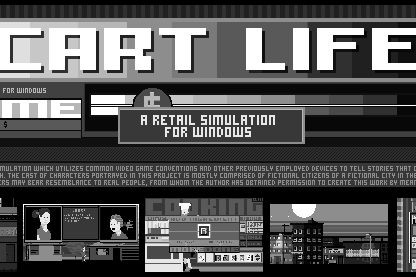
  • Cart Life (Hofmeier, 2010)

    Cart Life (Hofmeier, 2010)

    Developed/Published by: Richard Hofmeier
    Released: July 29, 2010
    Completed: 27th March, 2014
    Completion: I didn’t. This is the first time on this site I have a game I can officially state I gave up on.
    Trophies / Achievements: n/a

    I wasn’t going to write about Cart Life! As I played it for a while and gave up on it, I was prepared to let it slink off into the dark. However, I was asked by a few people (not least Incredibly Strange Games’ Chris Charla) why I didn’t like Cart Life, so I kind of feel honour bound to outline why I couldn’t bring myself to even finish one of the stories in Cart Life.

    Full disclosure: I played every one for at least two-three days of in-game time, and in every case multiple times.

    So, Cart Life then. After this year’s IGF and GDC Awards, where Papers Please cleaned up, I decided to go back and find out what it was that made the last two award-show defining titles the titles you—at a glance—can deduce are obviously depressing, intentionally boring, and glibly worthy. I’ll talk about Papers Please in future! But I wanted to trust that these games were being chosen for what they actually are, not what they represent vis-a-vis a “trend.” (I’m not convinced.)

    But what is Cart Life?

    Cart Life is a weird sort of mash-up of adventure game and Lemonade Tycoon-esque simulator. There’s sort of a dash of The Sims, too. Basically, you have a hero—one of three street vendors—and they have a goal, something simple like “get enough money together for a deposit on a flat within a week.” They’ve also got to eat, sleep, and feed their addiction (smoking, or coffee, for example.)

    So, what you do is you get them up in the morning, you get them over to their cart, and you spend their day doing monotonous tasks. Then you either do something vaguely social/story-related if there’s time, or go to sleep and have pointedly bad dreams. And there’s never, ever enough time in the day.

    That there’s never enough time in the day is an obvious point for a game to make, but it’s a point that Cart Life is making, and it’s what kind of leads to what I consider my main criticism of it:

    Without already being extremely video game literate, Cart Life is impossibly off-putting. Yet with an extreme level of game literacy, Cart Life presents a challenge that obscures anything it’s trying to say.

    This is possibly a little hard to explain, but to put it roughly: Cart Life uses its video gamey aspects: world navigation, maps, menus, “mini-games” to represent the challenge the characters face. But if you’re not already very familiar with this kind of thing, the idiosyncrasies of the system and general lack of useful tutorials are insurmountable. And this isn’t something I could call useful to the meaning to the game, as it’s definitely a struggle with the “top layer” of the content.

    Of course, if you can become familiar with how to play the game, as I did… it’s too easy to get drawn into a system where you are determined to absolutely murder the challenge; to “min-max” your play. Didn’t spend the day just right or make enough money? Reload the last save.

    This is probably controversial! In fact, I can imagine that many (most?) players of Cart Life doggedly played a “failing” hero right to the end (where it turns out it’s the taking part that counts, anyway.) However, having played many, many first days where I made mistakes because I didn’t understand how to play, once I did I was in the mindset that I could always do better. It was after beginning Melanie’s story for the fifth time or so where I managed to run a “perfect” first day (set up the cart, get the permit and a bus pass, even walk her daughter home from school) that I was like “gah, fuck this.” (Admittedly because I’d min-maxed so hard that I went to bed at 6pm, woke up at 3am the next day and broke the game completely.)

    In an earlier article I talked briefly about how when and why you stopped playing a game is also educational, just in a different way from doggedly getting to the end to suck the marrow from the bones of its design. With Cart Life, I stopped because I found the tension of “being a game” and “being meaningful” impossible to relate when presented the design of Cart Life.

    There  are several interviews with Richard Hofmeier where he talks about how the game is supposed to not so much be depressing, but to instil in the player that kind of pride a wage slave worker gets from doing a boring, repetitive task well. I’m going to set aside how arguably patronising that is—there’s a rougher, more polemic article I could write about how Cart Life’s success is related to a safe, private othering of the working poor by the kind of middle-classes who would write and talk about and vote for an “art” game—and say that having been a wage slave, Cart Life is weak at this. I know how it feels to cut the plastic ties on a bundle of newspapers or a cardboard box, and it doesn’t feel like switching my hands to the keyboard to type “cut the ties,” an experience which in every case I thought “urgh, how irritating.”

    You don’t think “how irritating” when doing a job like that. You think “just a few more then it’s break time” or “fuck, these bindings are cutting into my hand” or you escape into your own mind entirely because it’s all you’ve really got to do.

    I just don’t see the challenge of the game as accurately representing the challenge of these lives, something that I think Hofmeier admits (he’s stated in interviews that actual vendor cart owners respond least positively to his game, and I do understand his artistic urge to make dealing with newspapers involve text.)

    But If you want a key example: Andrus is an immigrant. As an immigrant myself, one who was pretty sure he was speaking English, I discovered that when I moved to Canada I spoke Scots and no one understood me. Just talking to people became a difficult navigation of the right words to use. A challenge.

    Andrus? He speaks awkwardly, yeah. But if I want to talk to anyone in the game, I just hit “up” and he does all the work for me.

    Will I ever play it again? Hofmeier has made the game open source and I’m definitely interested to see if anyone is interested in picking the game up and murdering the bugs which plague it. I actually doubt we’ll see a complete, non-glitchy version of the game, but if we did, I’d consider taking another run at it, tempering my urge to min-max or “be a gamer.”

    Final Thought: I wouldn’t let Andrus smoke. No matter how bad his cough got, how poorly treated by the cough drops from the store, I wouldn’t let him smoke. I never said the game didn’t succeed in some ways.

    This essay is featured in Every Game I’ve Finished 14>24.

  • Fable III (Lionhead Studios, 2010)

    Fable III (Lionhead Studios, 2010)

    Developed/Published by: Lionhead Studios / Microsoft
    Released: October 26th, 2010
    Completed: 6th February, 2014
    Completion: Completed the main story (saving everyone), did basically all the non-collectables side quest and then, inexcusably, went on and beat both DLC.
    Trophies / Achievements: 725/1250

    Fable II was, for me, one of those games that just worked. I remember when it came out, it was received with some reservations—it was buggy, particularly, but also the strange tone that meant you could walk into a village, fart forty times and leave beloved—but from beginning to end, bugs and all, it was an experience I met at its level and it worked perfectly. It promised so much for the future.

    So you might wonder why it’s taken me four years to play Fable III. Well, because I’d heard (and in fact, seen) that it was complete pish. But for some reason I had bought it? And (apparently?) all the DLC? So I thought I might as well get it over with.

    Let me say this: Fable III is a complete failure. It’s a failure of such magnitude that not only does it take what was good about Fable II and break it in several places in the name of improvement, you’re not sure Lionhead Studios were even trying.

    It’s not the bugs! Well, in some cases it is the bugs. I mean, the criticised-for-being-slightly-too-hand-holdy breadcrumb trail, which worked completely in II, now disappears, doesn’t point the right direction, clips into the ground… it’s a disaster. The dog, a key part of II, is now totally unable to pathfind, barking for treasure before getting stuck on a wall and rotating on his axes. And “hand-holding” the innovation that Molyneux so carefully snake-oiled works only if you don’t run or, you know, go up a very slight incline or something, because then the other character can’t keep up and you both “hold hands” with six foot of air. Fable III is absolutely the buggiest game I have ever seen a major publisher put out. It’s pathetic.

    But that’s all quibbly stuff, really. The kind of thing you can get over if the core is really solid. It isn’t. The core is a group of ideas that (potentially) sound like good ideas, but which after prototyping you’d definitely think “this doesn’t work” unless you’re (I guess?) on some kind of tight deadline where you say “fuck it, we’ve announced it, we’ll bodge it.”

    A good example: No menus! So when you press start, you go into a magic room where you can do all the stuff you’d normally do in menus. Unless you pause in a cut-scene, when you get a menu. And if you want to do anything, like select a new weapon, it’s actually a menu, just in 3D and you have to use the triggers to control it. And if you want to see details you have to… use a menu anyway. Incredible.

    The fact is that playing Fable III you have no idea why they’d make any decision they did unless they were some extreme pressure to finish something—anything!—because they’d already spent the money on John Cleese and Stephen Fry and Simon Pegg and… it’s most obvious when you finally get to the “real” game—acting as King of Albion.

    This part is amazing. It belies a totally idiotic surface understanding of… fuck it, I don’t know, everything? You’re the king. You’re told “6.5 million people are going to die unless you have 6.5 million coins in your treasury at the end of the year.” Let’s put aside the biggest question of all (“How would having that money in the treasury help?”) and consider that, if you are playing an evil character, surely the aim would be to let everyone die? And why can’t you explain to people that there will be a war in less than a year and everyone needs to tighten their belt for a bit while you sort it out?

    You end up in the absurd position where making tough decisions to get money in the treasury is simplistically treated as “evil” and good decisions—which cost more money—can only be paid for by owning all of Albion and collecting rent. So: to be a “good” king you have to buy houses from the people you will go on to rent to and profit from, therefore reducing the entire country to serfdom. So moral!

    I’m actually pretty sure that they hacked the idea together anyway, considering that your evil brother tells you all the bad things he did were for the people, but there’s a cut-scene earlier where he explains how he’d see Albion burn before give it up (which doesn’t come to anything so I have to question if they remembered that they left that bit in.)

    I think my favourite bit is the game tells you have a year, skips wildly between days so really there’s only something like five proper days (although in-game days pass, they don’t count, because who would find something like that totally immersion-breaking?) and when you reach “121 days to go” the game basically ends no matter what and without warning. Fuck’s sake.

    Will I ever play it again? Fuck no. Though I had to play the DLC though to make sure it will never cross my diseased mind. It’s more of the same but mercifully brief.

    Final Thought: Right at the beginning of the game you’re asked to let the girlfriend you’ve just met and have no feelings for because you’ve literally just met them die or some people you’ve definitely never met. If you let her live, your hero leaves the castle and you never see her again. You’ll wonder, at least briefly, why your hero doesn’t care and why she’s never even mentioned again, and you’ll later discover that there’s a quest where you can reconnect with her but it disappears for no reason half-way through the game because fuck you that’s why.

    This essay is featured in Every Game I’ve Finished 14>24.